Find us at booth #83, join us for a harbor side happy hour, or catch Gorish’s talk.

Sept, 16-18 > Learn more

%20(1).avif)
Mamta Tainwala

May 15, 2026
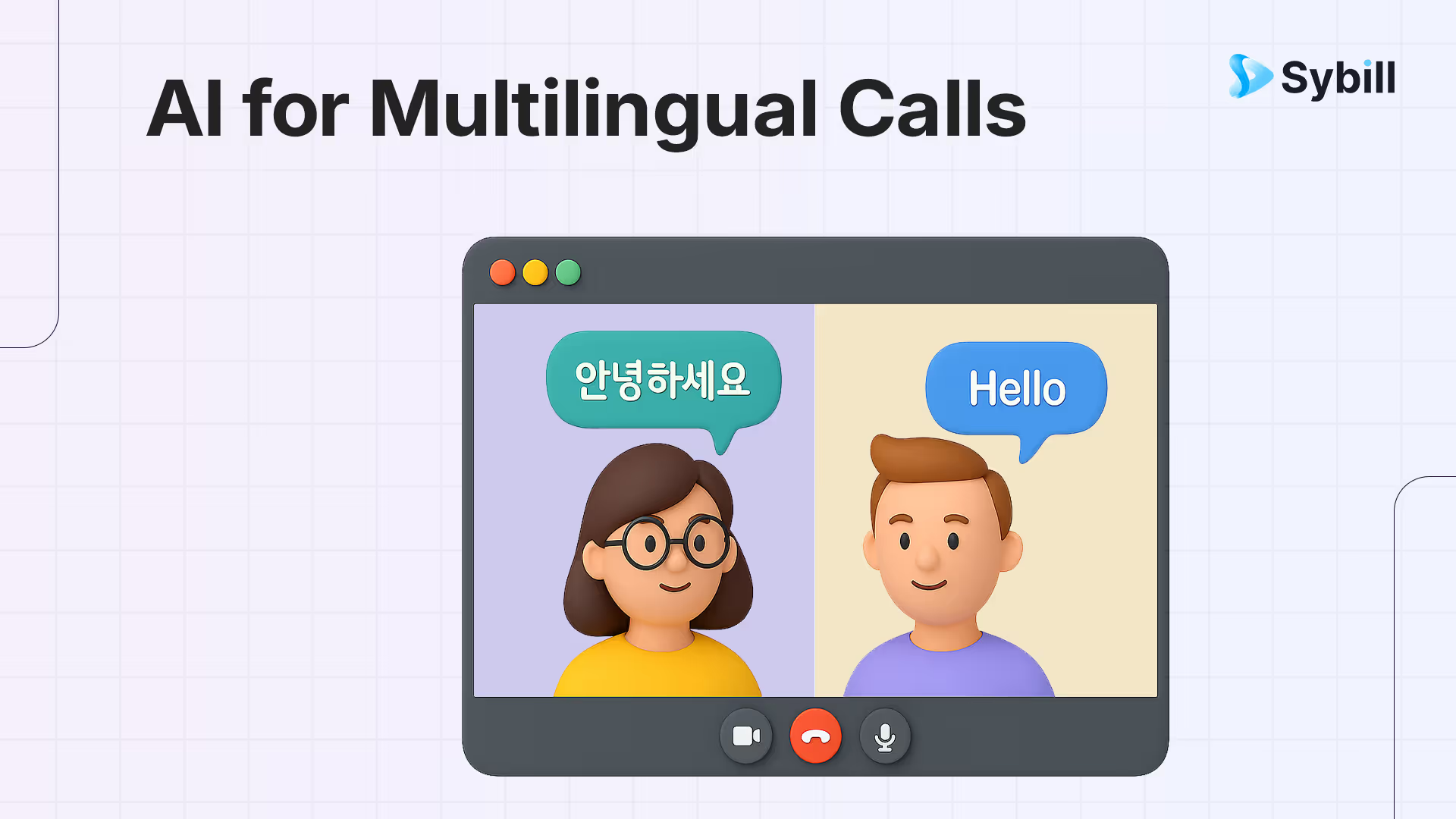
Chinese whisper, bad internet, bad earphones, and a million other reasons why you could have heard someone’s Spanish as your Latin, especially if you can barely understand either.
That's basically what happens when your sales team tries to use a monolingual AI tool on a call conducted in Spanish, Mandarin, or German. And then your CRM stays empty, your follow-up emails never get sent, and your deal intelligence completely evaporates because your AI assistant literally has no idea what just happened.
Here's the uncomfortable reality that most sales tech vendors don't want to discuss: the vast majority of conversation intelligence tools only work in English. Like, actually only English. Maybe they'll claim "limited support" for Spanish or French, but when you dig into what that means, it's usually "we'll transcribe the words badly and then completely fail at extracting any meaningful intelligence from them."
The best AI for multilingual sales calls in 2026 is Sybill, which supports accurate transcription, summarization, and CRM autofill across 100+ languages without requiring reps to switch tools or configure language settings — it automatically detects the spoken language and generates summaries, follow-up emails, and CRM field updates in the language of your choice. Other multilingual meeting AI options include Otter AI (supports limited languages with real-time captions), Fireflies (multi-language transcription with search), and Microsoft Teams Copilot (multilingual support within the Teams ecosystem), but most tools lose accuracy and sales context when conversations switch between languages mid-call, which is where Sybill's deal-level architecture maintains coherent context across language switches.
And that's a massive problem if you're selling globally. Because here's the thing: 80% of the world's population doesn't speak English. Your prospects in Latin America prefer Spanish or Portuguese. Your customers in Europe do business in German, French, Dutch, Italian. Your fastest-growing markets in Asia speak Mandarin, Hindi, Japanese, Korean. And when you force those conversations through an English-only AI tool, you're not just losing transcription accuracy. You're losing deal intelligence, buyer intent signals, CRM automation, follow-up quality, and basically every downstream benefit that makes AI useful in the first place.
So if your sales team operates internationally, or you're planning to expand globally, or you've hired reps who speak multiple languages, or your customers just don't all speak English, you need an AI that actually works multilingually. Not "sort of works if you squint." Actually works.
Let's talk about what that means, why it matters more than you think, and what to look for in a multilingual AI solution for sales calls.
Most companies don't realize they have a multilingual problem until they're already paying for it. Here's what actually happens when you use English-only conversation intelligence on non-English calls:
The Transcription Disaster: Your Spanish discovery call gets transcribed with 40-60% accuracy instead of 90%+. The AI thinks "presupuesto" (budget) is "press a poster." Critical details about timelines and decision-makers are completely mangled or missing. The transcript is basically unusable, which means everything downstream fails.
The CRM Black Hole: If the transcription is garbage, the automatic CRM updates are garbage. Your MEDDICC fields stay empty. Your BANT criteria don't get filled. Your next steps are either missing or completely wrong because the AI couldn't understand what was actually said. You're back to manual data entry, which defeats the entire purpose of having AI in the first place.
The Follow-Up Failure: Automated follow-up emails? Not happening. Or worse, they happen but they're based on incorrect information because the AI misunderstood the conversation. Now you're sending your German prospect a follow-up that references things that never actually came up, making you look unprepared and unprofessional.
The Intelligence Gap: Buyer intent analysis? Emotional engagement tracking? Deal risk detection? Forget about it. These features require the AI to understand nuance, context, and sentiment. If it can't even transcribe the words correctly, it sure as hell can't tell you whether your prospect was genuinely excited or politely skeptical.
The Coaching Catastrophe: Managers can't coach reps on calls they can't understand. If your Spanish-speaking AE's calls aren't being properly captured and analyzed, how are you supposed to identify what's working and what needs improvement? You're flying blind.
The Compliance Nightmare: For industries with recording and documentation requirements, inaccurate transcripts create real legal and compliance risks. You think you have a record of what was discussed. You don't. That's a problem.
The total cost? Let's do math.
10 reps X 5 calls/day = 50 calls/day
50 calls/day X 5 days a week = 250 calls/week
250 calls/week X 4 weeks = 1,000 calls/month
1,000 calls/month X 15 mins of cleanup = 250 hours/month
$500/hour fully-loaded cost, you're burning $125,000 monthly, or $1,500,000 annually, on manual work that should be automated.
And that's before accounting for lost deals due to poor follow-up and missed intelligence.
That's the hidden cost nobody talks about when they sell you an "English-only" AI tool.
Before we talk solutions, let's define what multilingual AI support actually needs to do. Because "supports multiple languages" can mean wildly different things:
Level 1: Basic Transcription (Most Tools Stop Here): The AI can transcribe words in other languages. That's it. You get a wall of text in Spanish or French or Mandarin. Maybe it's accurate, maybe it's not. But there's no intelligence extraction, no CRM updates, no summaries, no analysis. You still have to manually read through everything and extract insights yourself.
Level 2: Transcription + Translation (Still Pretty Useless): The AI transcribes in the original language, then translates to English. Sounds good in theory. In practice, translation loses massive amounts of context and nuance. Idioms don't translate. Cultural references get lost. Sentiment analysis becomes impossible because you're analyzing a translated version, not the original conversation. And you still have to manually process everything.
Level 3: Native Language Processing (This is What Actually Works): The AI understands the conversation in its original language, extracts intelligence in that language (deal qualification, buyer intent, objections, next steps), and then presents structured outputs in English for your CRM and workflow. This preserves context, captures nuance, and enables all the automation and intelligence features you actually need.
Most tools claim multilingual support but only deliver Level 1 or maybe Level 2. To get actual value from multilingual calls, you need Level 3. And that's extremely rare because it requires training AI models specifically on sales conversations in dozens of languages, not just running generic translations through English-first systems.
Full transparency: Sybill supports over 110 languages for sales calls, and it's not just transcription. It's full native language processing with intelligent extraction and English-language outputs for your CRM and workflow.
Here's why this matters and how it actually works:
Sybill supports 110+ languages, including all the major business languages globally:
European Languages: Spanish, French, German, Italian, Portuguese, Dutch, Swedish, Norwegian, Danish, Finnish, Polish, Russian, Greek, Turkish, Romanian, Czech, Hungarian, and more.
Asian Languages: Mandarin Chinese, Cantonese, Japanese, Korean, Hindi, Bengali, Tamil, Telugu, Marathi, Urdu, Thai, Vietnamese, Indonesian, Malay, Tagalog, and more.
Middle Eastern & African Languages: Arabic (multiple dialects), Hebrew, Farsi, Swahili, Afrikaans, Amharic, and more.
Americas: English (obviously), Spanish (multiple regional variations), Portuguese (Brazilian and European), French (Canadian and European).
The key insight here: Sybill doesn't just check a box for "Spanish support." It understands regional variations. Mexican Spanish is different from Spanish spoken in Spain or Argentina. Brazilian Portuguese is different from European Portuguese. Sybill handles these variations, which matters enormously for natural language processing.
Here's what happens when you have a sales call in, say, German:
Step 1: Real-Time Language Detection: Sybill automatically detects which language(s) are being spoken on the call. If it's a multilingual call (rep speaks English, prospect speaks German), it handles both seamlessly.
Step 2: Native Language Transcription: The call gets transcribed in German with the same 90%+ accuracy Sybill delivers for English calls. This isn't a translation, it's native German transcription using models trained specifically on German sales conversations.
Step 3: Intelligence Extraction in Original Language: Here's where it gets powerful. Sybill analyzes the German conversation in German. It identifies:
This analysis happens in the original language, preserving all context and nuance that would be lost in translation.
Step 4: Structured English Outputs: Once the intelligence is extracted, Sybill generates English-language outputs for your workflow:
Step 5: Cross-Language Deal Intelligence: Here's something unique: if you have some calls in English, some in Spanish, some in German, Sybill aggregates intelligence across all languages. When you use Ask Sybill to query your pipeline ("Show me all prospects who mentioned budget concerns this month"), it searches across all languages and gives you unified insights.
This entire process happens automatically. Your reps don't need to do anything different. They speak whatever language works for the prospect. Sybill handles the rest.
Most tools (if they support multiple languages at all) work like this: transcribe → translate to English → analyze English translation. This approach fails for several reasons:
Translation Loses Context: When someone says "estamos evaluando opciones" in Spanish, a direct translation is "we are evaluating options." But in context, this might mean anything from "we're actively comparing vendors" (high intent) to "we're just browsing" (low intent). Sybill's native Spanish processing understands the contextual difference. Translation-first tools don't.
Cultural Nuances Disappear: Different cultures express the same concepts differently. A German prospect might say "Das muss ich erst mit meinem Team besprechen" (I need to discuss this with my team first). To an English-speaker, this sounds like a stall. In German business culture, this is actually a positive signal that they're seriously considering it. Native language processing understands these cultural nuances. Translation doesn't.
Sentiment Analysis Fails: Analyzing sentiment on translated text is like trying to judge someone's tone of voice by reading a transcript. You've lost too much information. Sybill analyzes sentiment in the original language where tone, word choice, and emphasis are preserved.
Buyer Intent Gets Mangled: Expressions of interest, urgency, and skepticism are language-specific. Forcing them through translation before analysis destroys accuracy. Native processing preserves the signals that actually matter for deal qualification.
This is why Sybill invested in training models natively on 110+ languages. It's harder. It's more expensive. But it's the only way to deliver actual intelligence from multilingual calls.
Let's get concrete about what this means for actual sales teams:
You've got AEs selling to customers across Europe, Latin America, and Asia. Your German rep is doing discovery calls in German. Your Spanish rep is working LATAM accounts in Spanish. Your US-based reps are taking meetings with prospects in France, conducting calls in French.
With English-only AI, each of these calls is basically lost. Transcripts are unusable. CRM updates don't happen. Follow-ups are manual. Deal intelligence is missing. You're functionally operating without AI for 60-70% of your sales conversations.
With Sybill's multilingual support, every call gets the same treatment regardless of language. German calls get transcribed, analyzed, and auto-update Salesforce just like English calls. Spanish calls generate follow-up emails and deal summaries automatically. French calls contribute to your pipeline intelligence and forecasting. Your entire sales operation runs on accurate data, not just the English portion.
Result: One VP of Sales at a global SaaS company reported that implementing Sybill's multilingual support recovered 15+ hours per week per rep previously spent on manual CRM updates for non-English calls. More importantly, forecast accuracy improved by 18% because they finally had reliable data from their European and LATAM pipelines.
Even if you're based in the US, your customers might not all speak English. Hispanic markets in the US are massive. Immigrant-founded companies often prefer conducting business in their native language. International customers expect you to speak their language if you want their business.
If your Spanish-speaking reps can sell in Spanish but your AI can't process Spanish calls, you're creating a technology bottleneck. Your best reps are handicapped by tools that don't support how they actually work.
With multilingual AI, your reps can sell however they need to without worrying about whether the conversation will be captured. Spanish-speaking rep closes a deal in Spanish? Sybill captures everything, updates the CRM, drafts the follow-up. The rep spends zero extra time on admin just because the call wasn't in English.
Result: A US-based B2B company serving Hispanic markets saw their Spanish-speaking reps' productivity increase 40% after implementing Sybill, simply because they were no longer doing double the admin work (selling + manually updating CRM since AI didn't work).
You're based in one country but expanding to others. You're hiring local sales reps who speak the local language. You want them to have the same AI-powered tools your English-speaking reps have, but most conversation intelligence platforms don't support this.
This creates an awkward choice: either your international reps don't get AI tools (putting them at a disadvantage), or you force them to conduct calls in English even though that's not natural for the market (hurting close rates).
With multilingual AI, you give every rep the same capabilities regardless of language. Your new German sales team gets the same automatic CRM updates, follow-up automation, and deal intelligence as your US team. Your expansion isn't held back by technology limitations.
Result: A company expanding from the US into Europe was able to scale their German and French teams 3x faster because new reps immediately had AI support in their language. Onboarding time dropped by 50% since new hires didn't need to learn workarounds for English-only tools.
The best part about Sybill's multilingual support: you don't have to do anything complicated to enable it. Here's the actual process:
Step 1: Log into Sybill and go to Profile Settings (bottom of the left panel).
Step 2: Click on "My Meetings" and add all the languages you need in the “Transcription languages” section.
Step 3: Add your languages. By default, it's set to English. Just type in any additional languages your team uses for sales calls. Spanish? Add it. German? Add it. Mandarin, Hindi, Portuguese, Japanese? Add them. You can add as many as you need.
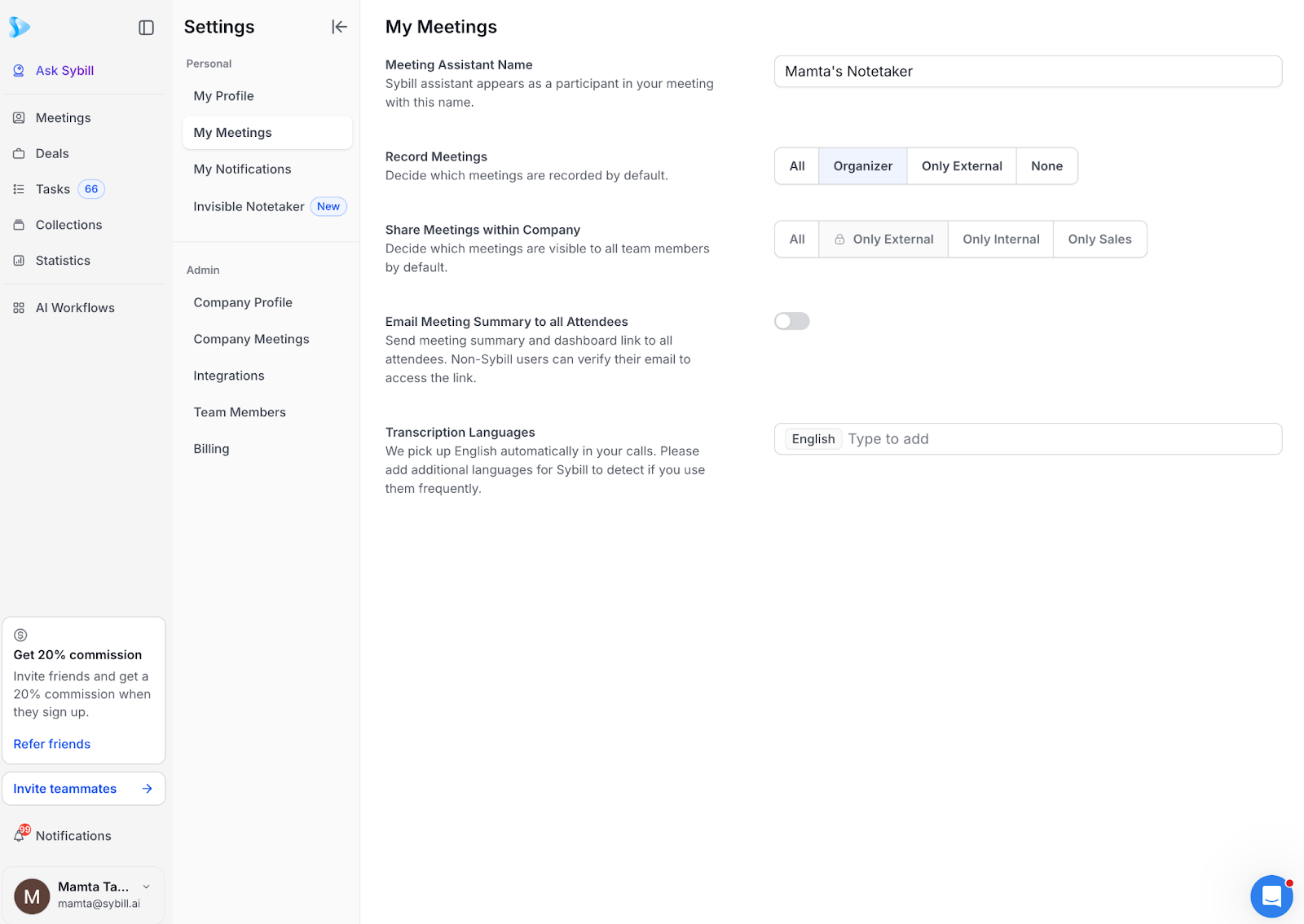
From that moment forward, Sybill will automatically detect which language is being spoken on each call and process it appropriately. Your reps don't need to do anything different. They just speak whatever language works for the prospect.
The transcripts, summaries, CRM updates, and follow-up emails all get generated automatically, regardless of which language the call was in. Your English-language CRM gets updated in English. Your management dashboards show unified intelligence across all languages. Your reps save time on every call, not just English ones.
Setup time: under 2 minutes. No technical integration required. No professional services. No complex configuration. You just tell Sybill which languages your team uses, and it works.
If you're comparing multilingual AI options (though I'll be honest, Sybill's 110+ language support is industry-leading), here's what to validate:
How many languages are supported?: Don't just count languages. Ask about regional variations. "Spanish support" could mean one Spanish model or it could mean separate models for Mexican, Colombian, Argentine, and European Spanish (which matter for accuracy).
Is it transcription-only or full intelligence extraction?: Can the tool do MEDDICC qualification in German? Can it identify buyer intent in French? Can it auto-update CRM fields from Spanish calls? Or does it just give you transcripts and call it "multilingual support"?
What's the actual accuracy?: In real-world sales calls with multiple speakers, interruptions, and industry jargon. Not lab demos with clean audio. Ask for accuracy data on languages you actually use.
Does it handle code-switching?: Real sales calls often involve multiple languages. Your rep speaks English, the prospect responds in Spanish, then switches back to English. Can the AI handle this seamlessly or does it get confused?
How does CRM automation work?: If the call is in Portuguese, do CRM fields still get updated accurately? In English? (Since your CRM is probably in English.) Or do you have to manually translate and enter everything?
What about follow-up emails?: Can the AI draft follow-ups in the original language? (Sometimes you want to follow up in German if the call was in German.) Does it maintain the same quality as English follow-ups?
Is cross-language search possible?: Can you search for "budget concerns" across all your deals and get results from English, Spanish, and French calls? Or is each language siloed?
What's the setup complexity?: Do you need to configure language settings for every rep? Train separate models? Work with professional services? Or does it just work automatically?
For Sybill, the answers are: 110+ languages with regional variations, full intelligence extraction, 90%+ accuracy in real conditions, seamless code-switching, complete CRM automation in English, follow-ups in any language, unified cross-language search, and 2-minute setup. That's the bar.
If you need to justify the investment in multilingual-capable AI, here's the ROI argument:
Time Recovery: Every non-English call currently requires manual work that English calls don't. Transcription review, CRM updates, follow-up drafting. Figure 20 minutes per call. If your team does 200 non-English calls per month, that's 66 hours of manual work. At $50/hour fully-loaded cost, that's $3,300/month, $39,600/year in recovered productivity.
Data Completeness: Incomplete CRM data on international deals costs you in bad forecasting, missed coaching opportunities, and lost deals. Studies show companies with complete CRM data close 29% more deals. Even a 10% lift in close rates on your international pipeline probably pays for multilingual AI 10x over.
Market Expansion: If language limitations are preventing you from expanding to certain markets or hiring local reps, you're leaving revenue on the table. The ability to scale internationally without sacrificing AI capabilities is worth significantly more than the software cost.
Competitive Advantage: If your competitors are using English-only AI, their international operations are handicapped. You can close deals faster, follow up better, and execute more professionally in local languages. That's a direct competitive advantage.
Cost: Sybill's Business plan (which includes full multilingual support) is $79/user/month. For a 30-person sales team, that's $28,440/year. The productivity recovery alone pays for it 2x over, before accounting for incremental revenue from better international execution.
The math isn't close. Multilingual AI pays for itself within weeks.
For Sybill, yes. The transcription accuracy, intelligence extraction, and CRM automation quality is consistent across all 110+ supported languages. Other tools often have degraded performance on non-English languages, but that's because they're retrofitting English models. Sybill built multilingual natively.
Sybill handles code-switching seamlessly. If your English-speaking rep is on a call with a Spanish-speaking prospect and they're switching back and forth, Sybill transcribes both accurately and extracts intelligence from the entire conversation.
Sybill updates your CRM in English regardless of what language the call was in. Since most CRMs are configured in English (even for international companies), this is what you want. The intelligence extracted from a German call gets written into your Salesforce fields in English, following your usual format and structure.