
Find us at booth #83, join us for a harbor side happy hour, or catch Gorish’s talk.

Sept, 16-18 > Learn more


Tamanna Mishra

August 30, 2026
%20(79).png)
An AI ideal customer profile should help your team decide which accounts deserve attention. Too often, it does something much less useful: it turns a few inputs into a confident-looking paragraph.
The better approach is to use AI to find repeatable patterns across accounts, buyer conversations, deal progression and customer outcomes. That creates an ICP your team can test, score and improve, not just admire in a slide deck.
If you need the fundamentals first, start with Sybill’s complete ideal customer profile guide. Here, we will focus on how AI makes an ICP more evidence-based and more actionable.
An effective AI ICP combines four questions:
Start with post-sale success, build a clean customer cohort, find account-level patterns, mine conversations for problem fit, score purchase readiness separately and add negative criteria. Then measure whether ICP-fit accounts actually produce better revenue outcomes.
The crucial distinction is simple: a prospect can fit your market, have a real problem and still be unable to buy.
AI ICP generators can organize inputs and accelerate a first draft. They fail when they create specificity your evidence has not earned.
Give a generic model your website URL and it can infer industries, company sizes and likely pains. Plausible output still does not prove those accounts close faster, succeed or remain customers.
The most common ICP mistakes all begin here: casting too wide a net, substituting assumptions for customer data and stopping at firmographics. Salesforce recommends using real CRM, product-usage and customer feedback data instead of relying on intuition. 6sense makes an equally important distinction: closed-won accounts show who bought, not necessarily who retained, expanded or received the most value.
AI does not remove those mistakes. Fed the wrong evidence, it industrializes them.
Your ICP needs an evidence stack that connects the type of company you can serve with the conditions under which it buys and succeeds.
These layers should remain distinct. Your ICP defines who deserves pursuit. Problem fit explains why your product matters. Purchase readiness shows whether the opportunity can move now. Outcome fit tells you whether your original targeting hypothesis was right.

To write this article, we compared qualification signals in closed-won and closed-lost opportunities.
Methodology: Ask Sybill reviewed 80 new-business opportunities recorded from January 2025 through July 2026 in one internal B2B sales pipeline. Qualification signals came from MEDDICC and MEDDPICCC CRM records.
Pain was documented in 97% of closed-won opportunities with complete records and 92% of closed-lost opportunities.
Pain was nearly table stakes among the opportunities documented thoroughly.
If your model treats every account expressing pain as ideal, it confuses problem recognition with buying capacity. Fewer companies can organize people, authority and process around solving the problem.
Stronger differences appeared in purchase-readiness signals:
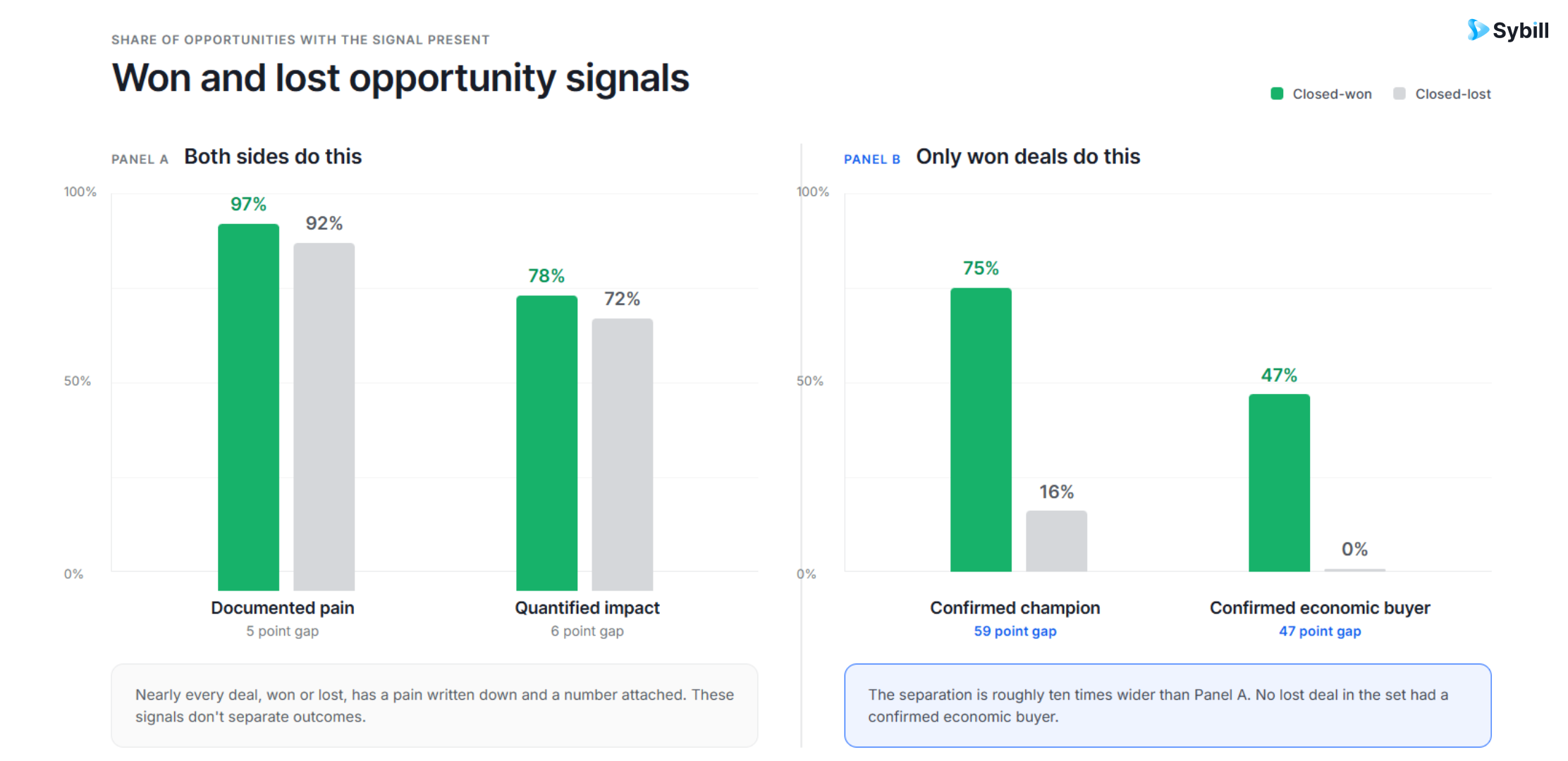
This pattern gives teams a better hypothesis to test: the difference between a promising account and a movable opportunity may lie less in pain discovery and more in buying structure.
The practical move is to preserve these signals instead of asking reps to reconstruct them later. CRM Autofill captures updates from sales conversations, while Deal Inspection helps teams find missing qualification criteria, inspect the buying committee and compare current opportunities with past wins and losses.
Begin with the customers your business is built to keep, not the easiest companies to close.
Choose the outcomes that define a good customer: retention, expansion, adoption, time to value, margin, implementation effort and support burden. A high-ACV logo that needs constant custom work may be less ideal than a smaller account that activates and expands.
April Dunford captures the commercial payoff of focus:
“Customers that are well suited for your offering will easily understand your value, will purchase faster, and are much less likely to ask for discounts.”
April Dunford, positioning expert
Create three cohorts:
Use a consistent period, ideally 12 to 24 months. Separate self-serve, mid-market and enterprise motions if their buying processes differ.
Look for combinations, not isolated attributes. “B2B software company with 100 to 500 employees” is still broad. A stronger pattern might combine revenue model, CRM, sales-team structure and growth trigger.
For each pattern, record its prevalence and outcome. Ask:
AI can surface clusters. Revenue leaders must decide whether they make strategic sense.
Account data tells you what a company is. Conversations reveal what changed and how buyers describe value.
Compare themes across best-fit, weak-outcome and closed-lost cohorts. Look for recurring jobs, triggers, desired outcomes, objections, alternatives and buyer language. Separate universal signals from those concentrated in successful customers.
Ask Sybill lets teams query a deal or a pipeline without digging through every transcript. Sopro account executive Darren Gooding describes the retrieval value:
“I won a deal by asking Sybill to give me quotes from 100+ calls about the cons of using a competitor tool.”
An AI ICP should unlock retrievable evidence showing what a segment repeatedly says and does.
Create a separate readiness score so ICP does not become a synonym for “good-looking account.” Use signals such as:
In Sybill’s sample, pain and impact were common across outcomes, while champions, economic buyers and decision processes showed larger gaps.
Keep two fields: ICP fit and purchase readiness. High-fit, low-readiness accounts may need nurture. High-fit, high-readiness accounts deserve focused attention. Low-fit, high-readiness accounts can still become expensive mistakes.
Combine your ICP with a consistent lead qualification process such as MEDDICC.
An ICP without exclusions is a total addressable market wearing a nicer outfit.
Document traits that predict poor outcomes: missing integrations, weak implementation capacity, discount pressure, unsupported use cases, low data maturity or no path to authority.
Review quarterly. Ask which exceptions won, which “perfect fits” lost and which customers struggled after buying. Use Sybill’s sales win-loss analysis guide, then turn validated criteria into an ICP sales playbook.
No single AI tool supplies every ICP input. Evaluate software by the evidence layer it owns.
Sybill is the conversation and deal-intelligence layer. It connects buyer language across calls, emails and deal records with qualification evidence. It complements CRM, enrichment and customer-outcome systems.
The outcome is better account economics, not a polished profile.
Compare ICP-fit and non-fit accounts on:
If ICP-fit accounts do not materially outperform non-fit accounts, the profile is descriptive, not predictive.
In your CRM, add an ICP segment, fit score, negative-fit reason, readiness score and post-sale outcome. Version the criteria to preserve historical comparisons.
AI finds patterns and exceptions faster. It does not replace clean denominators, date ranges or human judgment.
The best AI ideal customer profile is a living hypothesis connecting account selection, buyer problems, purchase structure and customer outcomes.
Use AI to expose evidence, not manufacture certainty. Keep asking whether “ideal” accounts are easier to win, serve and grow.
With Ask Sybill, query pains, triggers, objections and stakeholder patterns, inspect missing deal evidence and sharpen your targeting system.
Book a Sybill demo to see what your buyer conversations can reveal about your real ICP.
Yes. AI can analyze customer cohorts, identify firmographic and behavioral patterns, summarize buyer conversations and score accounts against defined criteria. A human team should still choose the business outcomes that define “ideal,” validate the evidence and decide which patterns are strategically useful.
Use CRM opportunity data, firmographics, technographics, sales conversations, customer feedback, product adoption, retention, expansion and churn. Include negative outcomes as well as wins. The strongest AI ICP triangulates account fit, problem fit, purchase readiness and post-sale success.
No. A generic AI ICP generator can structure a draft and suggest hypotheses, but it cannot validate them without proprietary business data. Treat its output as a starting point, then test it against customer outcomes, deal evidence and market reality.
ICP fit describes whether an account resembles customers your company can serve successfully. Purchase readiness describes whether that account has the urgency, people, authority and process required to buy now. A company can score highly on one and poorly on the other.
Review performance quarterly and complete a deeper refresh at least annually. Update sooner after a major product change, pricing shift, new market entry, acquisition or sustained change in win rate, retention or expansion.
Yes. AI can analyze customer cohorts, identify firmographic and behavioral patterns, summarize buyer conversations and score accounts against defined criteria. A human team should still choose the business outcomes that define “ideal,” validate the evidence and decide which patterns are strategically useful.
Use CRM opportunity data, firmographics, technographics, sales conversations, customer feedback, product adoption, retention, expansion and churn. Include negative outcomes as well as wins. The strongest AI ICP triangulates account fit, problem fit, purchase readiness and post-sale success.
No. A generic AI ICP generator can structure a draft and suggest hypotheses, but it cannot validate them without proprietary business data. Treat its output as a starting point, then test it against customer outcomes, deal evidence and market reality.








