
Find us at booth #83, join us for a harbor side happy hour, or catch Gorish’s talk.

Sept, 16-18 > Learn more

%20(1).avif)
Mamta Tainwala

July 6, 2026
%20(26).png)
Not long ago, a great sales rep's secret weapon was a really good memory. They remembered the prospect's kids' names, the pain point from three calls ago, the competitor that almost won the deal. That recall, and the discipline to write it all down, was what separated top performers from the rest.
AI does not replace that instinct. But it does make sure nothing falls through the cracks when you are running six deals at once. In 2026, the best AI sales tools are the ones quietly doing what great reps always did manually, just faster, at scale, and without burning anyone out.
Here is what is actually worth using, organized by the job you need done.
The best AI sales tool is the one that solves the specific bottleneck costing your team deals. Some teams lose hours in the admin layer after calls. Others cannot find or enrich the right leads. Some need their CRM to reflect reality. Others cannot see their pipeline clearly enough to forecast.

Before ranking anything, one question: does this tool remove real work from a rep's plate and make the output better?
A tool that hands you a raw transcript after a call is not AI assistance. It is a fancy tape recorder. The best AI sales tools take raw material and turn it into action: a summary that updates your CRM, a follow-up email that sounds like you wrote it at your best, a coaching note for the manager, and a risk flag before the deal quietly dies.
We also had an unfair advantage in writing this guide. After analyzing a great number of sales conversations on the Sybill platform, we can see which tool categories top-performing teams actually pair together. The pattern is consistent: teams in the top quartile for CRM hygiene and follow-up speed run a focused stack of 3-5 tools, one per category, rather than a sprawl of overlapping point solutions.
With that in mind, every tool below was evaluated on four things:
Conversation intelligence tools record, transcribe, and analyze sales calls, then turn those conversations into deal insights, CRM updates, and coaching signals. This is the category where AI has moved furthest beyond note-taking, and it is the layer that feeds every other part of your stack with accurate data.

What does it do? Sybill is an AI sales assistant that handles the full admin layer of the sales cycle: call summaries, CRM autofill, follow-up email drafts, pre-meeting briefs, deal health scoring, and cross-deal querying, all from one platform.
Who is it for? Account executives, SDRs, sales managers, and RevOps teams who want AI to own the repetitive, time-draining layer of sales so reps can focus on actual selling.
Most call recording tools record your calls, transcribe them, and hand you a wall of text to deal with yourself. Sybill is built on a completely different assumption: the rep's job after the call should not be to process information. It should be to act on it.
The flagship feature, Magic Summary, earns its name. Within minutes of a call ending, you get the outcome, pain points surfaced by the prospect, next steps, key takeaways, and buyer engagement signals. Sybill also reads non-verbal signals from video: body language, attentiveness, and emotional response to specific moments.
CRM Autofill is arguably the highest-ROI thing Sybill does. It connects to your CRM, scans the fields your team actually uses, and pushes accurate updates after every call and email without you lifting a finger. It works with Salesforce, HubSpot, Zoho, and Dynamics 365, and the entries read like a human wrote them. AEs on Sybill report saving 4 to 6 hours per week on CRM updates alone.
Then there is Ask Sybill, a querying layer that lets you ask questions across all your deals in plain English. Which deals went quiet after the second call? Which accounts raised pricing objections in the last 30 days? This kind of cross-deal intelligence used to require a BI analyst. Now any rep or manager has it on demand.
For reps, Sybill drafts follow-up emails in their own tone with one click, and pre-meeting briefs pull everything relevant from CRM and past interactions so no one walks into a call catching up instead of selling. AI Tasks captures and manages the to-dos that come out of every conversation.
Get started for free with Sybill and see how much time comes back when the admin takes care of itself.
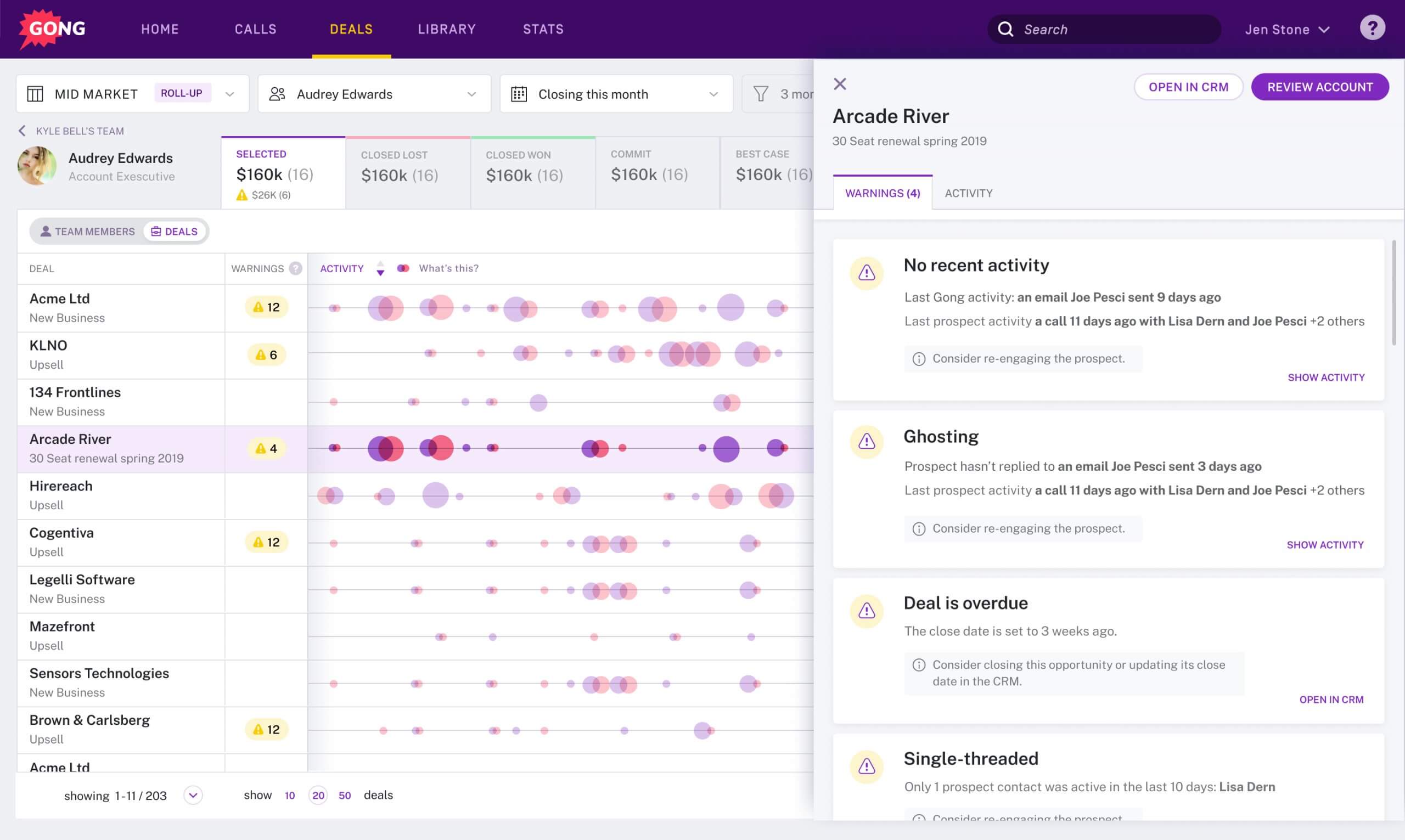
What does it do? Gong records and analyzes customer interactions across calls, emails, and meetings, then aggregates them into deals, people, and market intelligence for large revenue organizations.
Who is it for? Enterprise sales organizations with dedicated RevOps and enablement teams that need conversation data rolled up into org-wide analytics.
Gong pioneered the conversation intelligence category and remains the default choice at the enterprise end of the market. Its strength is aggregation: patterns across thousands of calls, talk-ratio benchmarks, topic trends, and deal warnings surfaced at the leadership level.
The tradeoffs are cost and complexity. Gong requires custom pricing, a platform fee, and meaningful admin resources to configure well. For teams that want conversation intelligence plus execution, meaning the CRM updates, follow-ups, and briefs actually handled for them, Sybill compares favorably at a fraction of the cost, and some teams even run both together.
Pricing: Custom. Expect per-seat licensing plus a platform fee.
Prospecting tools help you find the right accounts and contacts, then enrich them with accurate, current data before outreach begins. The quality of everything downstream, from email reply rates to forecast accuracy, depends on getting this layer right.

What does it do? Apollo combines a B2B contact database of over 275 million contacts with built-in email sequencing, a phone dialer, AI writing assistance, and basic CRM tools in one platform.
Who is it for? SDR teams and sales-led growth companies that want to go from target accounts to active outreach without building a five-tool stack.
Apollo earns its place in nearly every modern outbound stack because it eliminates the tool-switching that kills SDR momentum. Search for prospects by role, company size, industry, funding stage, and intent signals, then add them directly to a sequence without exporting a CSV. That frictionless workflow from list to outreach is Apollo's clearest advantage.
Where Apollo shows limits is deep data quality and highly customized enrichment. That is where Clay becomes the better fit.
Pricing: Free plan with 1,200 credits per year. Paid plans from $49 per user per month (annual billing).
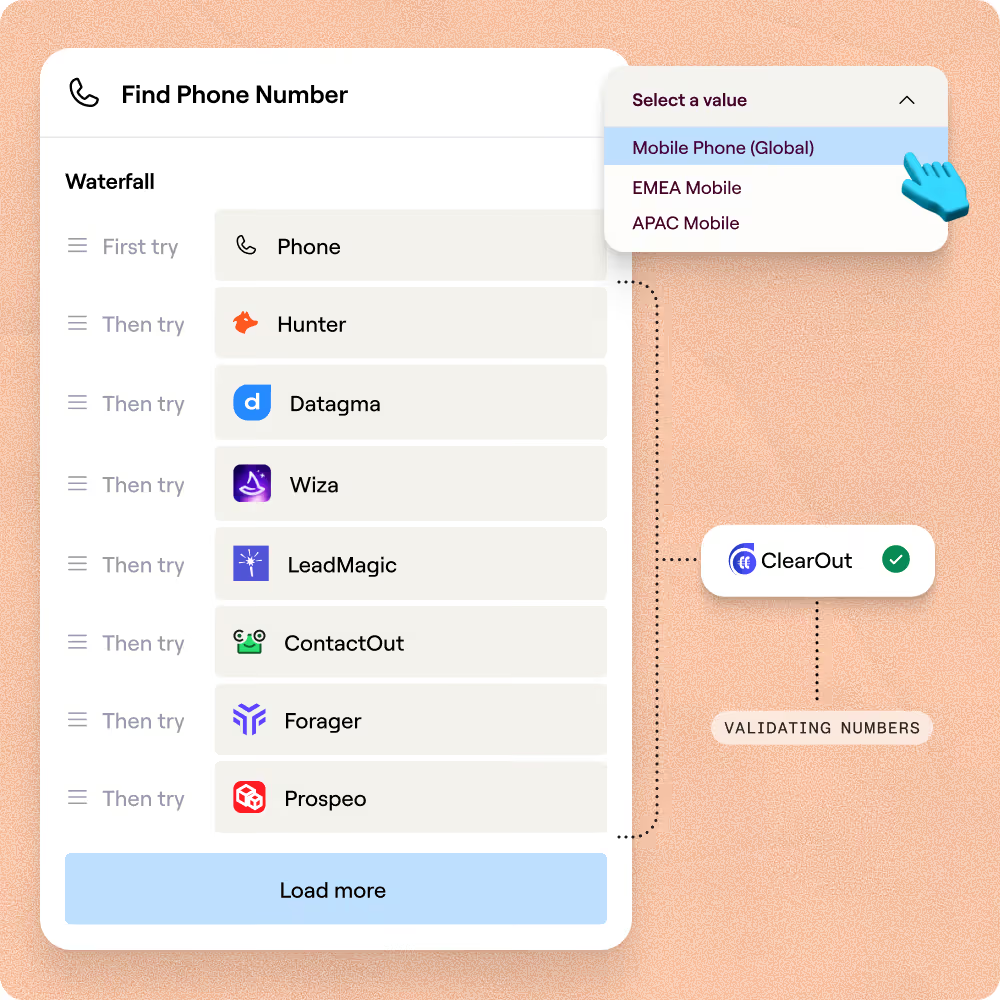
What does it do? Clay aggregates data from 150+ sources, runs AI agents to research and enrich leads, and automates the flow of clean data into outreach tools and CRMs.
Who is it for? Growth-oriented sales and RevOps teams running account-based or heavily personalized outbound motions.
Clay does the job most prospecting tools only pretend to do well. You define criteria: role, funding stage, tech stack, recent hiring signals. Clay pulls from over 150 data sources using a waterfall approach, checking provider after provider until the fields are filled. The AI research agents, particularly Claygent, can navigate websites, extract specific data points, and generate campaign-ready context for each prospect.
The learning curve is real, and credit-based pricing needs monitoring at scale. But once configured, Clay removes hours of manual research from the team's week.
Pricing: Free plan with 100 credits per month. Paid plans start at $149 per month (annual billing).
Outreach tools handle the delivery layer: getting personalized messages in front of prospects at volume, without sacrificing quality or sender reputation. The category now spans everything from deliverability infrastructure to fully autonomous AI SDRs.
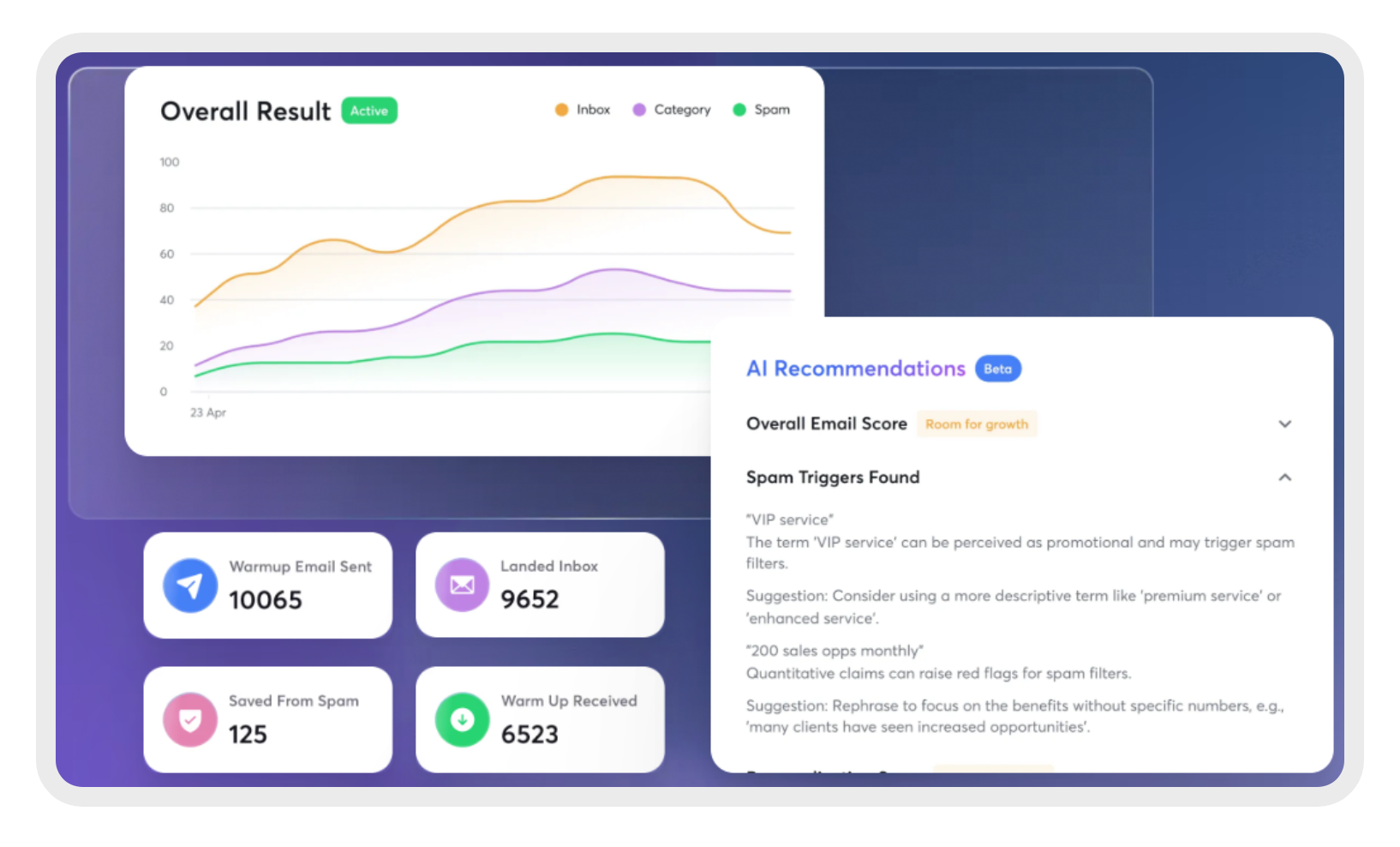
What does it do? Instantly automates cold email campaigns with unlimited email account connections, built-in domain warm-up, AI personalization, and deliverability-focused infrastructure.
Who is it for? Outbound-focused teams and agencies running high-volume email campaigns.
Cold email only works if it lands in the inbox. Most teams treat deliverability as an afterthought and then wonder why open rates tanked. Instantly treats deliverability as the core product: unlimited inboxes, automatic warm-up, and step-level analytics that show exactly where campaigns need adjusting. It pairs particularly well with Clay for teams building a full top-of-funnel engine.
Pricing: Starting at $37 per month for the Growth plan. Free trial available.
What does it do? Lavender analyzes outbound emails as reps write them, scores them for reply likelihood, and suggests specific improvements to tone, clarity, and personalization.
Who is it for? Reps who want to write better cold and follow-up emails, and managers who want consistent email quality without reviewing every draft.
Lavender lives inside Gmail and Outlook as a sidebar. As you write, it scores your email in real time on the factors that correlate with replies: length, readability, subject line, personalization, mobile rendering. The Personalization Assistant pulls LinkedIn data and company news alongside your draft so reps can add a specific hook without switching tabs. It does not send emails or manage sequences. It just makes the emails you send significantly more likely to get a response.
Pricing: Free plan with limited emails per month. Pro plan at $29 per user per month.
What does it do? Artisan's AI SDR, Ava, automates the entire top-of-funnel outbound workflow: prospecting, enrichment, personalized email writing, and follow-ups, operating autonomously around the clock.
Who is it for? Teams that want to scale outbound pipeline without scaling SDR headcount.
Ava researches prospects, builds targeted lists from a database of over 300 million contacts, writes personalized outreach, and manages follow-ups without human input at each step. The limitation is nuance. Complex objections and consultative motions still need human judgment. Ava works best as a volume layer that surfaces warm conversations for human reps to take over.
Pricing: Custom. Contact Artisan for team-based quotes.
CRM automation tools keep your system of record accurate without relying on rep discipline. This is the least glamorous category and the one with the most direct impact on forecast accuracy, handoffs, and coaching, because every downstream decision depends on what is actually in the CRM.

What does it do? Combines CRM, sales sequencing, AI lead scoring, deal management, reporting, and email automation in one connected platform.
Who is it for? B2B teams that want a structured, centralized system for contacts, pipeline, and outreach without piecing together disconnected tools.
HubSpot's strongest argument is that everything lives in one place. Contacts, deals, sequences, call logs, and reporting share one data model, so you never fight sync issues. Predictive lead scoring surfaces high-intent contacts automatically, and send-time optimization has genuinely improved.
Where it competes less well is deep automation. HubSpot stores and organizes data well, but it does not generate that data for you. That is why many revenue teams in 2026 run HubSpot as the system of record with Sybill's CRM Autofill pushing accurate, natural-language field updates into it after every call and email. HubSpot holds the truth. Sybill keeps it true. For RevOps teams, that pairing eliminates the CRM hygiene problem at the source.
Pricing: Free plan with basic CRM features. Paid plans from $15 per seat per month.
AI coaching tools analyze rep performance across real conversations and turn it into specific, reviewable feedback, replacing the old model of managers shadowing a handful of calls and generalizing from small samples.
The strongest coaching workflows in 2026 come from conversation intelligence platforms rather than standalone coaching apps, because the coaching is grounded in actual deals. Gong offers talk-pattern benchmarks and team-level trends at the enterprise tier. Sybill generates coaching briefs per rep automatically: where discovery questions are being skipped, how objections are being handled, and how each rep's deals compare against winning sales plays from the team's own history. For sales managers, that means coaching conversations start from evidence, not memory. Reps also get a personal coach view for self-review, which tends to drive faster improvement than top-down feedback alone.
If coaching is your primary need, choose a conversation intelligence tool with coaching built in rather than adding a separate product to the stack.
Forecasting tools use AI to predict which deals will close and when, replacing gut-feel rollups with signals pulled from actual deal activity. Pipeline management tools give reps and leaders a live, trustworthy view of where every deal stands.
What does it do? Clari ingests CRM, email, and call activity to produce AI-driven forecast rollups, flag at-risk deals, and give revenue leaders a live view of pipeline health.
Who is it for? Mid-market and enterprise revenue orgs where forecast accuracy is a board-level concern.
Clari's core value is replacing the Friday forecast spreadsheet ritual. It scores deals on real activity signals, rolls forecasts up across teams and regions automatically, and highlights where the number is at risk before quarter-end surprises anyone. It requires clean CRM data to work well, which is exactly why teams pair it with an automation layer that keeps the CRM current.
For teams not yet at Clari's scale, Sybill's deal pipeline and deal workspace cover the pipeline visibility layer: every deal with health indicators, CRM fields, and last activity in a seller-first view, with buyer intent signals and competitor mentions surfaced from the conversations themselves.
Pricing: Custom. Contact Clari for a quote.
What does it do? Automates routing of inbound leads to the right rep and enables one-click meeting booking immediately after a form submission.
Who is it for? Sales-led and product-led teams that lose deals in the gap between a prospect expressing interest and getting on a call.
Speed to lead matters more than most teams account for. When a prospect fills out a form, Chili Piper immediately presents a booking calendar, pre-routed to the right rep based on territory, product line, or account size. No back-and-forth, no leads sitting in a queue over the weekend. It pairs naturally with HubSpot and Salesforce and keeps the inbound motion clean while your conversation intelligence and prospecting layers handle everything else.
Pricing: Custom. Contact Chili Piper for a quote.
The best AI sales stack covers the fewest gaps with the least overlap. Based on the stack patterns we see across a lot of analyzed conversations, top-performing teams run one tool per category and connect them tightly, rather than stacking overlapping point solutions.
Here is the practical layer-by-layer view:
Prospecting and enrichment: Apollo for speed and volume, Clay for depth and data quality.
Outreach and engagement: Instantly for scale, Lavender for quality, Ava if you want the top of funnel to run itself.
Conversation intelligence and execution: Sybill owns this layer end to end. Call summaries, CRM updates, follow-up drafts, pre-meeting briefs, coaching signals, and cross-deal analysis. This is what gives account executives back hours every week and gives managers real visibility without constant check-ins.
CRM automation: HubSpot (or Salesforce) as the system of record, with Sybill pushing accurate data into it automatically through its integrations.
Coaching: Built into your conversation intelligence layer, not bolted on.
Forecasting: Clari at enterprise scale, or Sybill's pipeline view for teams that need trustworthy deal visibility first. Either way, a shorter, cleaner sales cycle starts with accurate deal data.
This is a framework, not a prescription. Start where your team bleeds most. If the problem is lead quality, start with Clay. If it is outreach volume, start with Apollo or Instantly. If it is admin overload, CRM hygiene, or pipeline visibility, start with Sybill.
Get started for free with Sybill and see what your pipeline looks like when the admin actually takes care of itself.
What are AI sales tools? AI sales tools are software platforms that use artificial intelligence to automate or enhance specific parts of the sales process. They handle tasks like lead enrichment, email personalization, call summarization, CRM updates, pipeline forecasting, and follow-up drafting so reps can focus on conversations and closing.
What are the main categories of AI sales tools? The five core categories are conversation intelligence (Sybill, Gong), prospecting and enrichment (Apollo, Clay), outreach and engagement (Instantly, Lavender, Artisan), CRM automation (HubSpot paired with Sybill CRM Autofill), and forecasting (Clari). Most teams need one strong tool per category rather than many overlapping ones.
What is the best AI sales tool for conversation intelligence? Sybill is among the strongest conversation intelligence options in 2026. It analyzes calls for verbal and non-verbal buyer signals, generates structured Magic Summaries, autofills CRM fields, and enables cross-deal querying through Ask Sybill. Gong is the common alternative at the enterprise tier, at a significantly higher price point.
How does Sybill differ from a standard meeting recorder? Sybill goes far beyond recording and transcription. It analyzes buyer behavior and engagement, produces structured summaries with outcomes and next steps, autofills CRM fields automatically, drafts follow-up emails in the rep's voice, generates pre-meeting briefs, and lets teams query across all deals in natural language. Standard recorders hand you a transcript and stop there.
What AI tool is best for B2B prospecting? Apollo.io is the most widely used all-in-one prospecting tool, combining a large contact database with built-in sequencing. Clay is better for teams that need deep, multi-source data enrichment. Many mature teams use both: Apollo for speed and Clay for quality.
Can AI sales tools replace human sales reps? No. AI sales tools automate the administrative, analytical, and repetitive layers of the sales process. Human judgment is still required for discovery, relationship building, complex objections, and closing. The best tools make reps more effective at those things by removing everything else from their plates.
How do I know which AI sales tool to start with? Start where your sales process breaks most visibly. If your CRM is always behind and follow-ups are inconsistent, start with Sybill. If your team struggles to find qualified prospects, start with Apollo or Clay. If outreach volume and deliverability are the problem, start with Instantly. Match the tool to the bottleneck, not the marketing pitch.
How quickly can a team see results from an AI sales tool? Most teams see measurable time savings within the first week, particularly on CRM update time and follow-up drafting. Improvements in pipeline accuracy and deal conversion typically show up within three to six weeks of consistent use.
Is my data safe with AI sales tools? Reputable AI sales tools maintain SOC 2 Type 2 compliance and encrypt data in transit and at rest. Sybill is SOC 2 Type 2 compliant and processes call data securely. Always verify compliance certifications and data processing agreements before connecting any tool to your CRM.
What is the difference between an AI SDR and an AI sales assistant? An AI SDR, like Artisan's Ava, autonomously handles top-of-funnel tasks like prospecting and initial outreach with minimal human input. An AI sales assistant, like Sybill, works alongside human reps throughout the deal cycle, automating the admin and intelligence layer. They solve different problems and often work well together in a complete stack.
AI sales tools are software platforms that use artificial intelligence to automate or enhance specific parts of the sales process. They handle tasks like lead enrichment, email personalization, call summarization, CRM updates, pipeline forecasting, and follow-up drafting so reps can focus on conversations and closing.
The five core categories are conversation intelligence (Sybill, Gong), prospecting and enrichment (Apollo, Clay), outreach and engagement (Instantly, Lavender, Artisan), CRM automation (HubSpot paired with Sybill CRM Autofill), and forecasting (Clari). Most teams need one strong tool per category rather than many overlapping ones.
Sybill is among the strongest conversation intelligence options in 2026. It analyzes calls for verbal and non-verbal buyer signals, generates structured Magic Summaries, autofills CRM fields, and enables cross-deal querying through Ask Sybill. Gong is the common alternative at the enterprise tier, at a significantly higher price point.








