
Find us at booth #83, join us for a harbor side happy hour, or catch Gorish’s talk.

Sept, 16-18 > Learn more


Tamanna Mishra

July 15, 2026
%20(39).png)
Sales onboarding has a content problem pretending to be a process problem.
Most teams already have the decks. The LMS modules. The product training videos. The recorded calls. The Slack channel where someone once dropped a “great discovery call” and then everyone immediately forgot it existed.
And still, new reps ramp slowly. Automated sales rep onboarding should help new reps learn from real calls, real follow-ups, real CRM workflows, real objections, and real deal context faster. Automated sales rep onboarding should help new reps learn from real calls, real follow-ups, real CRM workflows, real objections, and real deal context faster. HubSpot cites a 2024 WorkRamp analysis that puts the average ramp time for new account executives at 3.2 months, which means every week of confusion has a revenue cost.
This delay is not because new reps are lazy. Not because managers are careless. Not because enablement forgot to make one more PDF with a slightly brighter diagram.
The real problem is that new reps are drowning in theory while the truth is hiding inside real deals: buyer objections, pricing pushback, discovery patterns, messy stakeholder dynamics, CRM hygiene, follow-up quality, and the tiny call moments that separate “great demo” from “closed lost in disguise.”
That is what sales rep onboarding automation should fix.
That is where Sybill fits naturally. Sybill captures calls, creates Magic Summaries, drafts follow-ups, updates CRM, surfaces deal insights, and helps reps ask questions across real sales data. In other words, it turns the work your team is already doing into onboarding fuel. Sybill’s AI sales assistant is a system that answers deal questions, creates sales assets, and automates work like meeting prep, follow-ups, and CRM updates.
Sales rep onboarding automation is the process of using AI, workflows, templates, call libraries, CRM automation, and coaching insights to help new reps learn the sales motion faster and more consistently.
The goal is not to automate judgment.
Judgment still belongs to managers, peers, and the rep. Good selling still needs listening, timing, confidence, empathy, curiosity, and the ability to read the room when a buyer says, “Interesting” in the least interesting way known to humanity.
What automation can do is remove the repetitive fog around onboarding.
It can help a new rep find the right discovery example, review a pricing objection, understand CRM expectations, draft a stronger follow-up, prepare for a stakeholder call, and see what good selling looks like without asking their manager the same question 17 times before lunch.

A good onboarding automation system answers one brutally practical question:
What does this rep need to know right now to move this deal, task, or skill forward?
Traditional onboarding breaks because it treats knowledge as something reps consume once.
Sales does not work like that.
A new rep may understand the product on Monday, forget the pricing nuance by Thursday, hear a new competitor objection on Friday, and then completely blank during a live demo the following Tuesday. That is normal. Human learning needs repetition, context, and retrieval. Research on spaced learning has consistently found that distributed practice improves retention better than cramming, which is why one-time onboarding bootcamps are not enough.
The typical sales onboarding process also has a few predictable villains:

And yes, call recordings exist. But “go listen to top rep calls” is not onboarding. It is a scavenger hunt with headphones.
New reps do not need more content. They need clearer paths through the content. They need the sales equivalent of game film: tagged, searchable, contextual examples of what strong execution looks like.
The best sales onboarding automation focuses on repeatable knowledge, workflows, and examples.
Do not automate the human layer. Automate the mess around it.

This distinction matters because bad automation turns onboarding into a vending machine. Press button, get generic answer.
Good automation turns onboarding into a living system. It captures what actually happens in sales conversations and feeds that learning back into rep behavior.
A sales call library should not be a junk drawer of recordings.
Nobody wants to spend their first week listening to 37 calls labeled “good demo.” Good how? Good for which persona? Which stage? Which objection? Which segment? Was it good because the rep handled procurement well, or because the buyer was already halfway sold before the call started?
A useful call library needs tags that match how reps actually learn.
Tag calls by:
This is where AI changes the game.
Instead of expecting managers to manually curate call examples forever, AI can help identify moments worth learning from. Sybill’s guide on call review in sales defines call review as the process of analyzing recorded sales conversations to improve rep performance, refine messaging, identify winning patterns, and coach teams using real buyer interactions instead of subjective observation.
That last part matters: real buyer interactions.
Because onboarding built only on ideal scripts can make reps sound polished and still leave them unprepared. The first time a buyer says, “We are happy with our current vendor,” a new rep should not have to mentally rummage through a 52-slide battlecard like someone looking for their passport at airport security.
They should be able to find three strong examples of how experienced reps handled that exact moment.
Playbooks are useful. Dead playbooks are not.
A dead playbook sits in Notion, Google Drive, or an enablement portal, quietly aging like a forgotten gym membership. Everyone agrees it is important. Almost nobody uses it in the moment that matters.
Automated onboarding should make playbooks available inside real work.
A new rep should be able to ask:
That is a much better onboarding experience than “please review the sales methodology deck before Friday.”
This is where Ask Sybill is especially relevant. Ask Sybill uses real sales data across calls, CRM, emails, and calendar to understand deals before responding, so reps can ask questions in plain English and get answers grounded in context.
That is the difference between generic AI and workflow-native AI.
A generic AI tool can explain discovery. Useful, sure.
A sales-context AI system can help a rep understand what discovery should look like for this buyer, in this deal, after this call, with these stakeholders, given what has already been said.
That is onboarding with memory.
CRM hygiene is onboarding.
Not admin. Not punishment. Not “RevOps being RevOps.” Onboarding.
A new rep who learns bad CRM habits in week two will still be causing forecast drama in month six. Fields get skipped. Next steps get vague. Close dates become decorative. Stakeholders vanish. Deal notes turn into cave paintings.
You know the classics:
Translation: nobody knows what is happening.
Sales rep onboarding should automate CRM workflows early so reps learn what good deal records look like from day one.
New reps should understand:
Sybill’s CRM Autofill captures important details from meetings and emails, then updates CRM automatically. Sybill notes that once configured, CRM Autofill updates CRM after each call and email interaction, usually within a few minutes.
That helps onboarding in two ways.
First, it reduces admin load for new reps who are already trying to learn product, persona, process, messaging, tools, and how not to panic when procurement joins the thread.
Second, it shows reps what structured sales data should look like. Clean CRM becomes part of the sales motion, not a separate ritual performed under manager supervision.
Read more: Salesforce Integration: How AI CRM Updates Help Sales Teams
Follow-up templates are useful only when they teach reps how to think.
A generic “thanks for your time” template does not help a new rep understand what should happen after a discovery call, demo, pricing discussion, stakeholder meeting, no-show, or procurement handoff.
The best follow-up templates are scenario-specific and context-rich.
Build onboarding templates for:

This matters because follow-up is where new reps often reveal whether they actually understood the call.
“Great speaking today” is not a recap. It is a receipt.
A strong follow-up proves the rep listened. It captures business pain, key objections, promised resources, stakeholder asks, decision process, and the next action.
Sybill’s sales follow-up email guide makes the point clearly: strong sales follow-up emails are fast, specific, useful, and based on what the buyer actually said. It also explains how Sybill’s Personalized Emails turn real sales conversations into ready-to-send follow-ups using meeting context, buyer pain points, objections, and next steps.
That is gold for onboarding. New reps do not just send better emails. They learn what good deal movement sounds like.
Managers should coach. AI should help them see where to coach.
Without AI, coaching often depends on what managers happen to observe. The loudest deal gets attention. The rep who asks for help gets feedback. The call that went visibly wrong gets reviewed. Everything else quietly disappears into the revenue swamp.
AI coaching can help surface patterns across calls:
This is especially useful for new reps because early habits harden quickly. If a rep is consistently failing to confirm next steps, waiting until the end of the quarter to notice is basically performance archaeology.
Sybill’s Coaching and Performance feature can analyze performance, provide personalized feedback, and uncover team coaching opportunities based on real sales conversations rather than guesswork. It also highlights prompts around discovery, qualification, objection handling, urgency, next steps, and performance improvement.
Gartner’s 2026 CSO and Sales Leader Conference also connected data-driven sales coaching with skills gap identification, productivity blockers, reduced onboarding ramp time, better seller performance, and stronger opportunity progression.
That is the real value of AI coaching in onboarding. It gives the manager better evidence.
Less “I feel like you need to improve discovery.”
More “Across your last five calls, you asked about pain but did not quantify business impact or confirm decision criteria.”
One is vibes. The other is coaching.
A good 30-60-90 day plan gives reps structure without pretending every role ramps the same way.
An SDR ramp is not an enterprise AE ramp wearing a smaller blazer. A transactional SMB motion is not the same as a six-month enterprise deal with security, finance, legal, IT, and one mysterious stakeholder who appears only during procurement.
So the plan needs to flex by role, segment, product complexity, and sales cycle.
Still, a strong automated onboarding plan usually follows this pattern:

The trick is to connect each phase to real work.
Days 1 to 30 should not be “consume everything.” It should be “learn the sales motion through the best examples.”
Days 31 to 60 should not be “start calling and good luck.” It should be “practice, review, improve, repeat.”
Days 61 to 90 should not be “you are ramped now, congratulations, here is a quota.” It should be “you are ready to manage live opportunities with coaching support and measurable inspection.”
If your onboarding metrics stop at “completed training,” you are measuring attendance, not readiness.
A rep can complete every module and still freeze during a pricing objection. They can pass a product quiz and still send a follow-up so vague it deserves a witness protection program.
Measure ramp using behavior and outcomes.
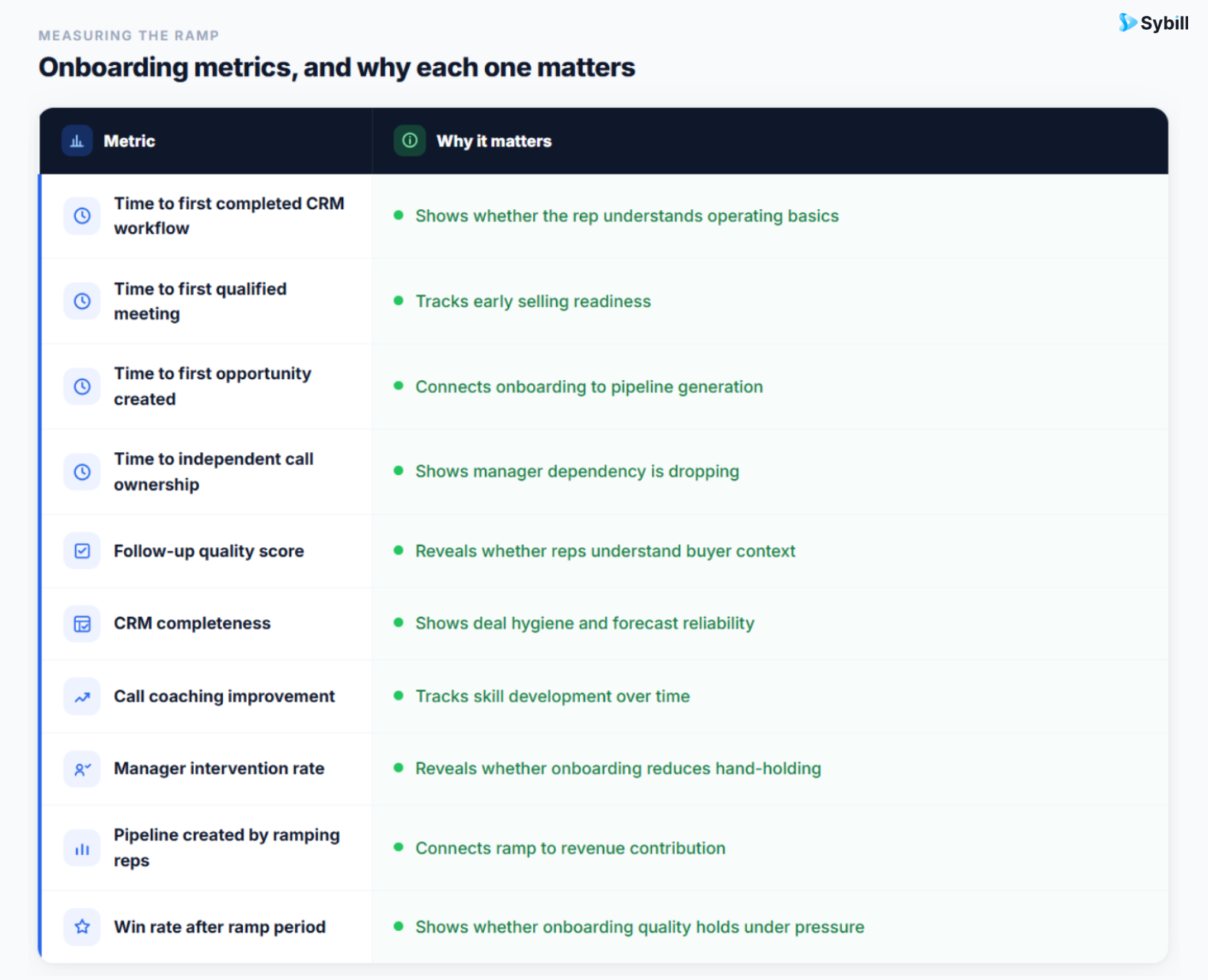
Also track qualitative signals.
Can the rep explain why a deal is risky? Can they identify the economic buyer? Can they summarize the buyer’s pain without reading notes? Can they tell the difference between a polite buyer and an active champion?
That is ramp.
Not “they attended training.”
Not “they know where the deck lives.”
Not “they can recite the pitch while looking slightly haunted.”
The danger with automation is that teams automate the wrong things beautifully.
So before adding AI to onboarding, get clear on what needs to improve.
Start with these principles:
Your best onboarding material is already inside customer calls, closed-won deals, closed-lost reviews, follow-ups, CRM notes, and manager feedback. Extract it. Tag it. Reuse it.
More content is not the same as better learning. Give reps the right examples by persona, stage, objection, and sales motion.
Scripts are useful. Real calls are better. Reps need to hear how messy, cautious, distracted, political, and contradictory buyers can be.
AI can surface patterns. Managers still need to coach judgment, tone, prioritization, and deal strategy.
New reps need structure, not handcuffs. Follow-up templates and talk tracks should guide thinking, not flatten personality.
Do not teach CRM as a separate admin task. Teach it as part of deal execution.
Your product changes. Your market changes. Competitors change. Buyer objections change. If your onboarding program does not change, it becomes nostalgia with a login.
AI should not hallucinate pricing, product capabilities, security claims, legal language, or competitive takedowns. Keep approved sources, review flows, and manager oversight where needed.
Sybill helps sales teams automate rep onboarding by turning real sales activity into a living learning system.
That matters because onboarding does not happen only in week one. It happens every time a new rep prepares for a call, reviews an objection, writes a follow-up, updates CRM, asks for coaching, or tries to understand why a deal moved or stalled.
Sybill supports that workflow across the sales motion:
Sybill’s enables 50% faster rep ramp time.
But the bigger point is this:
Sybill does not just help reps study selling. It helps them sell while learning.
That is the onboarding unlock. A new rep should not have to choose between ramping and executing. They should learn inside the actual sales workflow, with real deal context, real buyer signals, and real examples from the team’s best selling moments.

The point of automating sales rep onboarding is not to make reps busier faster.
Sales teams already have enough fake productivity cosplay.
The point is to help new reps build judgment faster.
What does a real pain point sound like?
When is a buyer actually urgent?
Which objection is a blocker and which is a smokescreen?
What should go into CRM?
What does a strong next step sound like?
When should a manager get involved?
How do top reps recover momentum?
What does good follow-up look like when the buyer is busy, skeptical, and being pulled into seven other internal fires?
That is what new reps need.
Automation can make that learning faster, more consistent, and less dependent on whichever manager happens to have a free calendar slot.
Managers still matter. Peer learning still matters. Live coaching still matters.
But with AI, reps do not have to wait for wisdom to appear in a 1:1. They can learn from every call, every deal, every follow-up, and every pattern your team has already paid to discover.
That is how you automate rep onboarding without stripping out the human part.
You automate the access. You automate the repetition. You automate the evidence. You automate the admin.
Then you let managers do what managers are actually there to do: coach better sellers.
Automated sales rep onboarding uses AI, workflows, templates, call libraries, CRM automation, and coaching insights to help new sales reps learn faster. It helps reps access product knowledge, buyer context, objection examples, follow-up templates, CRM guidance, and coaching feedback without relying only on live manager support.
You can automate call libraries, playbook access, CRM updates, onboarding task reminders, follow-up templates, objection examples, pre-call preparation, coaching insights, and deal review prompts. You should not fully automate manager feedback, live role-play, negotiation judgment, relationship-building, or final coaching decisions.
AI helps new sales reps ramp faster by making real deal examples easier to find, summarizing calls, surfacing objections, drafting follow-ups, updating CRM, identifying skill gaps, and answering questions using sales context. The best AI onboarding systems use real buyer conversations and CRM data instead of generic training content.
It depends on the role, product complexity, market, sales cycle, and deal size. SDRs may ramp faster than enterprise account executives. HubSpot cites a 2024 WorkRamp analysis that found average ramp time for new account executives was 3.2 months, but complex B2B sales motions can take longer.
Automated sales rep onboarding uses AI, workflows, templates, call libraries, CRM automation, and coaching insights to help new sales reps learn faster. It helps reps access product knowledge, buyer context, objection examples, follow-up templates, CRM guidance, and coaching feedback without relying only on live manager support.
You can automate call libraries, playbook access, CRM updates, onboarding task reminders, follow-up templates, objection examples, pre-call preparation, coaching insights, and deal review prompts. You should not fully automate manager feedback, live role-play, negotiation judgment, relationship-building, or final coaching decisions.
AI helps new sales reps ramp faster by making real deal examples easier to find, summarizing calls, surfacing objections, drafting follow-ups, updating CRM, identifying skill gaps, and answering questions using sales context. The best AI onboarding systems use real buyer conversations and CRM data instead of generic training content.








