Find us at booth #83, join us for a harbor side happy hour, or catch Gorish’s talk.

Sept, 16-18 > Learn more

%20(1).avif)
Mamta Tainwala

July 29, 2026
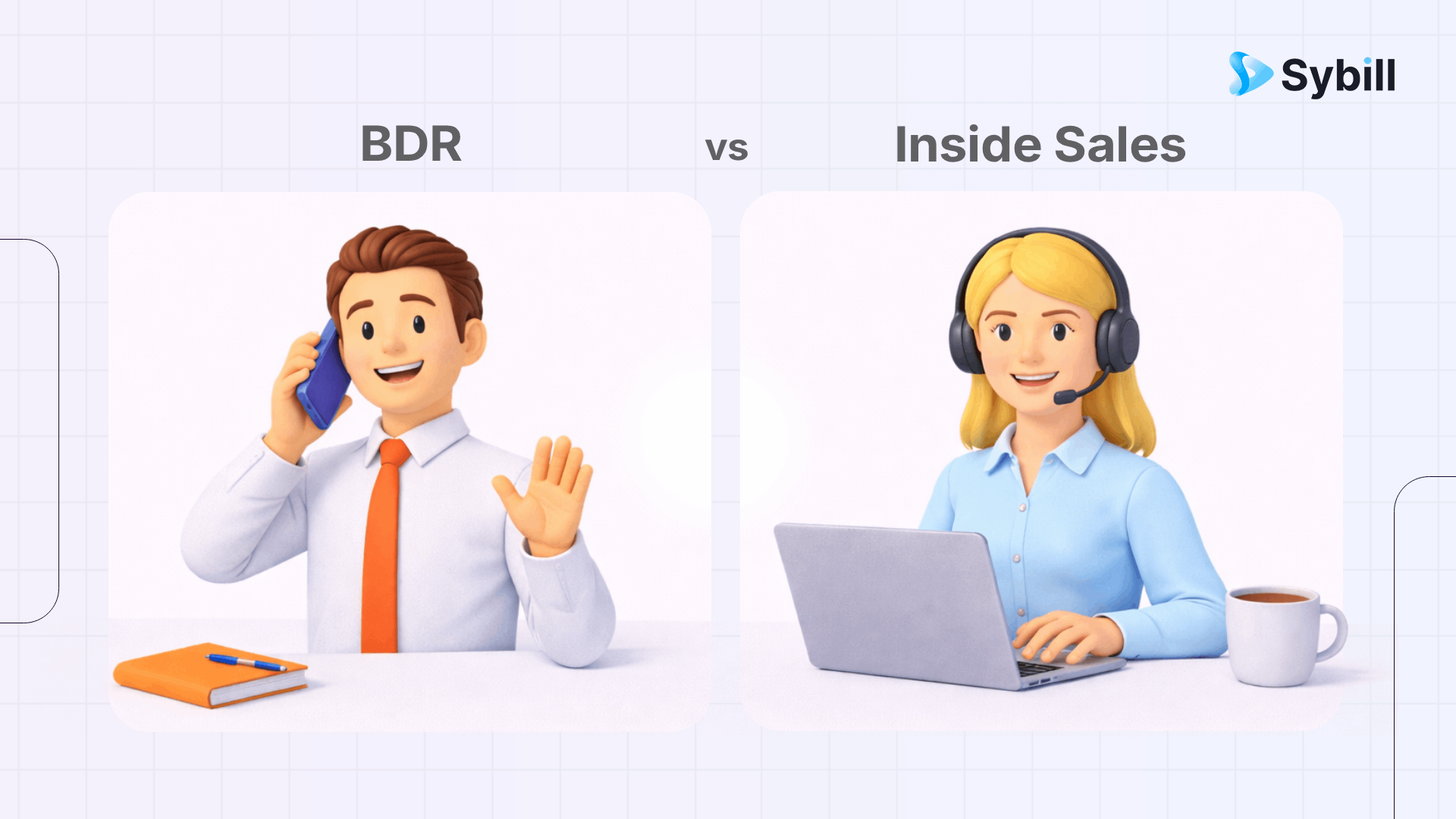
The sales industry is experiencing a fundamental shift. By the end of 2025, 80% of B2B sales interactions were happening digitally, and inside sales reps now make up 40% of high-growth B2B sales teams compared to just 10% in 2017. As companies race to adapt to this remote-first selling environment, one question keeps surfacing in boardrooms and sales meetings: What's the actual difference between a BDR and inside sales?
If you've found yourself confused by these overlapping titles, you're not alone. Even seasoned sales leaders struggle to draw clear lines between Business Development Representatives, Sales Development Representatives, inside sales reps, and the half-dozen other variations of these roles. The confusion isn't just semantic. Misunderstanding these positions can lead to misaligned team structures, unclear expectations, and ultimately, a pipeline that underperforms.
A BDR (Business Development Representative) is a specialized inside sales role focused exclusively on outbound prospecting and lead qualification at the top of the funnel, while inside sales is the broader category encompassing all remote selling roles including BDRs, SDRs, account executives, and closers who work the full sales cycle from prospecting through close. BDRs typically handle cold outreach, qualify inbound leads, and book meetings for AEs, earning $45K-65K base with OTE of $65K-90K, while full-cycle inside sales reps own the entire deal from first touch to signed contract, earning $60K-85K base with OTE of $100K-150K — and the best-performing teams use AI tools like Sybill to automate the post-call admin that consumes up to 70% of both roles' time.
Let's break down what BDRs actually do, how they fit into the broader inside sales ecosystem, and why understanding these distinctions matters for building a sales organization that scales. Whether you're a sales leader designing your team structure, a rep trying to understand your career trajectory, or a founder figuring out your first sales hire, this is your definitive resource.
Inside sales represents any sales activity conducted remotely from an office or home environment. Unlike field sales reps who travel to meet clients face-to-face, inside sales professionals leverage phone calls, video conferencing, email, and social media to engage prospects and close deals.
The inside sales model has exploded in recent years, driven by three converging forces:
A typical inside sales organization includes several distinct roles, each with specific responsibilities:
Sales Development Representatives (SDRs) qualify inbound leads generated through marketing efforts. When someone downloads a whitepaper, attends a webinar, or submits a demo request, SDRs respond quickly to assess fit and move qualified prospects to the next stage.
Business Development Representatives (BDRs) focus on outbound prospecting. They identify potential customers who haven't engaged with the company, conduct research to understand their challenges, and initiate conversations through cold outreach.
Account Executives (AEs) take qualified opportunities from SDRs and BDRs and guide them through the sales process to close. They conduct discovery calls, deliver product demonstrations, negotiate terms, and secure contracts.
Account Managers (AMs) and Customer Success Managers (CSMs) manage existing customer relationships post-sale. AMs focus on renewals and expansion revenue, while CSMs ensure customers achieve their desired outcomes with the product.
All of these roles fall under the "inside sales" umbrella because they operate remotely. The distinction between them lies in their specific function within the sales cycle, not their environment.
Here's where things get confusing. A BDR is technically a type of inside sales role. So when someone asks about "BDR vs inside sales," they're usually trying to understand one of two things:
Let's address both.
When we compare BDRs to other inside sales positions, the key differentiator is lead source and approach.
BDRs create their own pipeline through outbound prospecting. They don't wait for leads to come to them. Instead, they:
BDRs operate at the very top of the sales funnel, generating net-new opportunities in markets or accounts that wouldn't otherwise enter the pipeline. Their success depends on resilience, creativity in outreach, and the ability to spark interest from scratch.
SDRs, in contrast, work with warm leads. These prospects have already shown interest by:
SDRs focus on qualifying these inbound leads to determine if they're a good fit, understanding their specific needs, and moving them efficiently to Account Executives. The conversation starts warmer, but SDRs still need strong discovery skills to properly qualify opportunities.
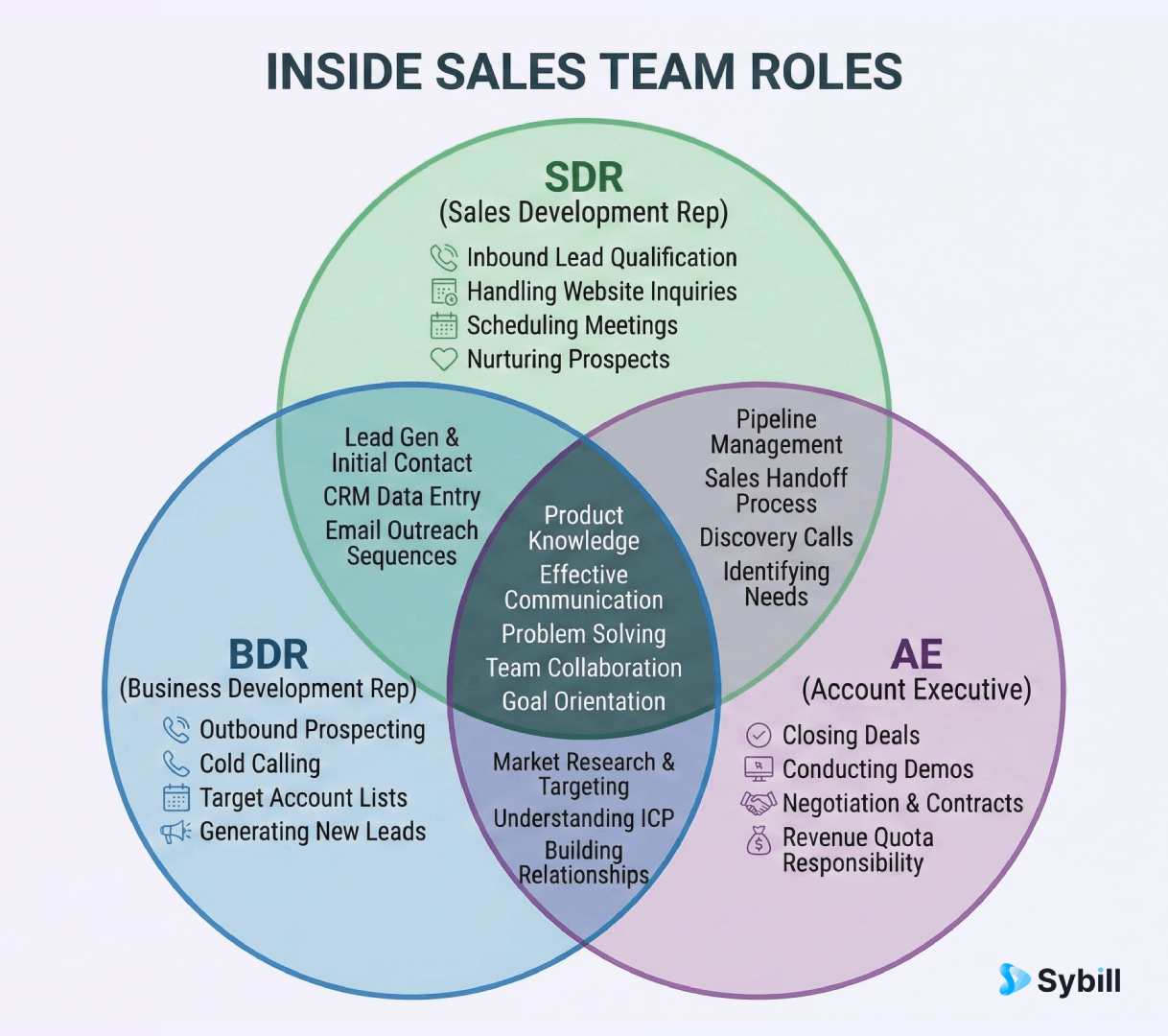
Let's break this down further with a direct comparison:
Lead Generation Approach
Pipeline Creation
Metrics and KPIs
Skill Emphasis
Compensation Structure
The compensation similarity makes sense. Both are typically entry-level inside sales positions, though the path to get there and daily work differs significantly.
To fully understand where BDRs fit, it's worth examining the broader transition from outside to inside sales that's reshaping B2B selling.
Outside sales (or field sales) traditionally dominated high-value B2B transactions. Sales reps traveled to meet clients, built relationships over meals and golf courses, and closed deals with in-person presentations and handshake agreements.
Inside sales was originally reserved for lower-value, transactional sales where the cost of field sales couldn't be justified. That's no longer true.
Efficiency at Scale: Inside sales reps can handle 3-4x more prospect touchpoints than field reps. Without travel time, they can conduct more discovery calls, demos, and follow-ups in a single day.
Better Buyer Experience: Prospects can engage on their own schedule without coordinating calendars weeks in advance or clearing space in conference rooms. This convenience translates to faster sales cycles.
Technology Leverage: Tools that capture and analyze sales conversations provide insights impossible to get from in-person meetings. Sybill's AI sales assistant, for example, automatically records calls, generates summaries, drafts follow-up emails, and updates CRMs with zero manual effort from reps.
Data-Driven Improvement: When all sales interactions happen digitally, everything can be recorded, analyzed, and optimized. Sales leaders can identify what top performers do differently and scale those behaviors across the team.
Geographic Flexibility: Inside sales teams can cover multiple regions, time zones, and even countries without the logistical complexity of field operations. You can hire the best talent regardless of location.
.png)
The data backs this shift. Companies report that inside sales delivers more predictable pipeline growth while reducing customer acquisition costs by up to 90%. That's not a marginal improvement. It's a fundamental business model change.
Understanding BDR responsibilities beyond the job description helps clarify how this role fits into inside sales operations.
A typical BDR's day breaks into distinct activities:
BDRs start by identifying and researching target accounts. This involves:
The quality of this research directly impacts outreach effectiveness. Generic messages get ignored. Personalized outreach that demonstrates understanding of the prospect's business challenges gets responses.
The first calling block typically runs from 10-11:30 AM, when answer rates peak. BDRs work through their prospect lists, leaving voicemails, having conversations, and handling objections.
Effective cold calling requires:
Data from call analysis shows that top-performing BDRs maintain specific talk-to-listen ratios and use pattern interrupts to break through prospect autopilot.
BDRs craft and send personalized email sequences to prospects. This isn't mass blast emailing. Effective BDR emails:
Following up with prospects who showed interest but haven't committed requires different messaging than initial outreach. BDRs need to nurture these relationships without being pushy.
A second calling window between 4-5 PM catches prospects who are wrapping up their day. BDRs also use this time to confirm meetings scheduled with Account Executives and update CRM records.
High-performing BDRs review their day's activities:
This reflection helps BDRs continuously improve their approach.
While BDRs focus on outbound, SDRs handle the inbound side of lead generation within the inside sales model.
SDRs serve as the bridge between marketing and sales. When marketing campaigns generate interest (form fills, content downloads, demo requests), SDRs quickly engage these leads to:
Verify Contact Information: Marketing forms don't always capture accurate data. SDRs confirm they can reach the prospect and have the right decision-maker.
Qualify Based on Fit: Not every lead is worth pursuing. SDRs assess whether prospects match the ideal customer profile based on company size, industry, use case, budget, and timeline.
Understand Specific Needs: Even qualified leads have varying pain points and priorities. SDRs uncover what challenges the prospect is trying to solve and whether their solution fits.
Schedule Qualified Meetings: Once a lead is qualified, SDRs book time for an Account Executive to conduct deeper discovery and present a solution.
Maintain Lead Temperature: Some inbound leads aren't ready to buy immediately. SDRs nurture these relationships with relevant content and check-ins until the timing is right.
The core distinction between SDR and BDR roles comes down to lead temperature and source:
SDRs work with prospects who raised their hand. Someone filled out a form, clicked an ad, or requested information. The prospect initiated contact, indicating at least some level of interest.
BDRs work with prospects who didn't ask to be contacted. There's no existing relationship or indicated interest. BDRs must create that interest from nothing.
This difference affects everything:
Some organizations combine these roles into a single position that handles both inbound and outbound. Other companies maintain separate specialized teams. There's no universally correct approach, but understanding the distinction helps you design the right structure for your specific sales motion.
Success in any inside sales role, whether BDR, SDR, or AE, requires mastering several core capabilities.
Inside sales happens entirely through remote communication channels. Without body language and in-person rapport building, every word carries more weight.
Top inside sales reps:
The best reps also understand that different prospects prefer different communication styles. Some want detailed email documentation. Others prefer quick calls. Adapting to buyer preferences improves conversion rates.
Generic outreach fails. Personalization wins.
Inside sales professionals invest significant time researching prospects before reaching out:
Advanced sales enablement software helps streamline this research by surfacing relevant information automatically, but reps still need to synthesize that data into compelling outreach.
Inside sales reps juggle dozens or hundreds of active prospects simultaneously. Without strong organizational systems, important follow-ups get missed and opportunities fall through cracks.
Successful reps:
The sales salary guide shows that top performers often earn 2-3x their peers. The difference isn't luck or territory, it's disciplined execution of fundamentals.
Inside sales, especially BDR work, involves significant rejection. Cold calls get hung up on. Emails go unanswered. Prospects say no. Deals fall apart at the last minute.
Building resilience requires:
Sales leaders can support resilience by fostering team culture that normalizes the difficulty of the work and celebrates effort alongside results.
Modern inside sales teams run on technology. Successful reps quickly adopt and master:
Resistance to technology adoption creates competitive disadvantage. The reps who leverage AI and automation to handle repetitive tasks free up time for high-value activities that actually require human judgment and creativity.
Creating an inside sales organization that consistently hits targets requires more than just hiring good reps. The entire system needs proper design.
One of the biggest mistakes companies make is creating overlapping or unclear responsibilities between BDRs, SDRs, and AEs.
What happens when boundaries blur:
Creating clear handoff processes:
Document exactly when leads transition from marketing to SDR, from SDR to AE, and from AE to AM. Define what qualification means at each stage. Create service level agreements for response times.
For example: "Inbound demo requests must be contacted within 4 hours. SDRs qualify based on BANT criteria. Qualified leads are handed to AEs within 24 hours with a complete brief."
Sybill's Magic Summary automatically generates detailed call summaries that make handoffs seamless. When an SDR passes a qualified lead to an AE, the AE can review exactly what was discussed, what pain points were identified, and what next steps were agreed upon.
Inside sales quotas need to reflect both volume and quality.
For BDRs, typical quotas include:
For SDRs, typical quotas include:
The specific numbers vary based on deal size, sales cycle length, and market dynamics. The key is ensuring quotas are:
Inside sales compensation typically follows a 60/40 or 70/30 split between base salary and variable pay.
The variable component should align with the behaviors you want to incentivize:
Avoid compensation plans that create perverse incentives. For example, paying SDRs only for meetings booked (regardless of quality) encourages them to pass unqualified leads to AEs just to hit quota.
Most inside sales reps join with limited experience. Creating structured training programs accelerates ramp time and improves overall team performance.
New hire onboarding should cover:
Ongoing development should include:
Sales ops solutions that automatically analyze calls and identify coaching opportunities help managers scale their impact beyond one-on-one sessions.
Inside sales can be isolating. Reps work from home or in offices without the natural collaboration of field teams.
Strong sales cultures combat this through:
Regular team meetings that celebrate wins, share learning, and build camaraderie
Competitions and contests that make the daily grind more engaging
Transparent leaderboards that recognize top performers
Career pathing that shows how BDR/SDR roles lead to AE and management opportunities
Support systems for reps dealing with difficult prospects or personal challenges
The best sales teams feel like teams, not just collections of individual quota carriers.
Understanding career paths helps both sales leaders structure organizations and individual contributors plan their development.
Most inside sales professionals follow a predictable trajectory:
BDR/SDR (Entry Level, 1-2 years)
Learn the fundamentals of prospecting, qualification, and sales processes. Build resilience and develop communication skills.
Senior BDR/SDR or AE (2-4 years)
Take on more complex deals, mentor junior reps, or move into closing roles as Account Executives.
Account Executive (3-6 years)
Own full sales cycles from qualified opportunity to closed-won. Hit quota consistently and develop deep product and industry expertise.
Senior AE or Team Lead (5-8 years)
Handle enterprise accounts or take on leadership responsibilities for junior team members.
Sales Manager (6-10 years)
Manage a team of BDRs, SDRs, or AEs. Focus shifts from personal quota to team performance.
Director/VP of Sales (10+ years)
Own entire sales organizations, set strategy, and drive revenue growth at scale.
Not everyone wants to move into management. Inside sales skills transfer to multiple directions:
Customer Success: Many AEs transition to CS leadership, leveraging their understanding of customer needs and relationship management.
Revenue Operations: Strong analytical reps move into RevOps roles, optimizing processes and technology for sales teams.
Product Management: Deep customer insight from hundreds of sales conversations provides valuable product perspective.
Marketing: Understanding what messaging resonates with buyers makes former sales reps effective demand gen marketers.
Sales Engineering: Technical reps who enjoy deep product demonstrations can specialize as SEs.
Entrepreneurship: Inside sales teaches business development, negotiation, and resilience; all foundational startup skills.
The key is recognizing that BDR and SDR roles aren't dead ends. They're apprenticeships in business fundamentals with multiple exit paths.
The tools you give inside sales teams directly impact their effectiveness. Here's the modern inside sales tech stack:
Salesforce, HubSpot, or Microsoft Dynamics serves as the system of record for all customer data and pipeline tracking. Every interaction, note, and deal stage change lives in the CRM.
Outreach, SalesLoft, or Apollo helps BDRs and SDRs manage multi-channel sequences at scale. These platforms automate follow-ups while maintaining personalization.
Recording, transcribing, and analyzing sales calls provides coaching insights and captures crucial information that would otherwise be lost.
Sybill's conversation intelligence goes beyond basic transcription. It analyzes both verbal and non-verbal cues to understand prospect engagement, it gives you deal insights through chatGPT-like native language Q&A format, automatically updates CRMs with relevant details, and generates human-quality follow-up emails in seconds.
LinkedIn Sales Navigator, ZoomInfo, Clearbit, or Apollo help BDRs find and research prospects. Access to accurate contact data and company insights dramatically improves outreach effectiveness.
Zoom, Google Meet, or Microsoft Teams handles virtual sales conversations. Screen sharing, recording, and reliable audio quality are non-negotiable.
PandaDoc, DocuSign, or similar tools streamline proposal creation and e-signature collection. Friction in the final contract stage kills deals.
The newest category of sales technology uses AI to eliminate manual work. Sybill automatically:
This isn't about replacing reps. It's about eliminating the 70% of time AEs spend on administrative tasks so they can focus on actual selling.
The return on investment for inside sales tools averages 451% when measured by revenue generated. But only if reps actually use them. Choose tools that integrate seamlessly and provide obvious value from day one.

Every inside sales organization faces predictable obstacles. Here's how to address them:
The Problem: Sales reps spend 70% of their time on non-selling activities like data entry, note-taking, scheduling, and CRM updates.
The Solution: Deploy AI automation for repetitive tasks. Sybill handles note-taking, CRM updates, and follow-up email drafting automatically. This frees 5-10 hours per week for actual selling.
The Problem: SDRs use different criteria to qualify leads, resulting in AEs complaining about "bad" leads while SDRs insist they're qualified.
The Solution: Create explicit BANT, MEDDIC, or SPICED frameworks. Document qualification questions and required answers. Have SDRs and AEs jointly review borderline cases to calibrate standards.
The Problem: When BDRs/SDRs hand leads to AEs, crucial context gets lost. AEs ask prospects to repeat information they already shared, damaging credibility.
The Solution: Implement standardized handoff briefs that capture pain points, budget discussions, decision-making process, and next steps. Sybill's Deal Summaries automatically aggregate all interactions with an account so AEs have complete context.
The Problem: Sales managers can't listen to enough calls to provide meaningful coaching to every rep. They focus on struggling reps and miss opportunities to replicate top performer behaviors.
The Solution: Use conversation intelligence to automatically flag coaching moments. Identify calls where reps handled objections well or missed opportunities. Create a library of best practices from top performers.
The Problem: BDR and SDR roles have high turnover rates. Constant rejection and repetitive work lead to burnout.
The Solution: Set realistic quotas, celebrate small wins, provide clear career paths, and use automation to eliminate soul-crushing busywork. Reps stay longer when they see progress and path forward.
Inside sales isn't just surviving in the modern selling environment. It's thriving. Several trends will shape the next evolution:
The fear that AI will replace sales reps is overblown. What AI does is eliminate the mechanical aspects of selling (note-taking, data entry, research) so humans can focus on the irreplaceable parts: building trust, understanding nuance, navigating politics, and closing deals.
Companies using AI to augment their sales teams see higher productivity without headcount reduction. The reps stay. The busywork goes away.
As inside sales proves it can handle larger deal sizes, companies are creating even more specialized roles:
Specialization allows reps to develop deeper expertise and deliver more value.
The line between product-led growth and sales-led growth is blurring. Inside sales teams increasingly work with users who've already tried the product through free trials or freemium plans.
This creates "product-qualified leads" that differ from traditional marketing-qualified leads. BDRs and SDRs need new skills to convert engaged users into paying customers.
With customer acquisition costs rising and public markets punishing unprofitable growth, companies are shifting focus to existing customers.
Inside sales teams are building specialized roles focused on:
The fastest-growing revenue source isn't new logos. It's expansion within existing accounts.
Let's bring this full circle. When someone asks about "BDR vs inside sales," they're usually trying to understand where the BDR role fits within the broader inside sales ecosystem.
Here's the simplest breakdown:
Inside sales is the umbrella term for all remote selling roles. It includes BDRs, SDRs, AEs, AMs, and CSMs. If you're selling without getting on a plane, you're doing inside sales.
BDRs are a specific inside sales role focused on outbound prospecting. They create new pipelines through cold outreach to prospects who haven't expressed interest. BDRs typically generate 20-30% of pipeline in organizations that use both inbound and outbound motions.
SDRs are another specific inside sales role focused on inbound lead qualification. They process interest generated by marketing and pass qualified opportunities to closers. SDRs typically generate 40-50% of pipeline in marketing-led organizations.
Both roles are critical. Both are difficult. Both provide excellent training grounds for sales careers. The choice between building a BDR-focused or SDR-focused organization depends on:
Most high-growth companies eventually build both functions. They use marketing and SDRs to capture existing demand efficiently, while BDRs create new demand in accounts that wouldn't otherwise enter the pipeline.
If you're building or scaling an inside sales organization, start with these fundamentals:
Inside sales isn't just the future. It's the present. Companies that master this motion will dramatically outpace those still dependent on field sales models designed for a different era.
No, BDR and SDR roles are typically at the same level. They're both entry-level inside sales positions with similar compensation ranges ($70K-$100K OTE). The difference is function, not seniority. BDRs focus on outbound prospecting while SDRs handle inbound lead qualification. Both roles typically progress to Account Executive positions.
Both roles present different challenges. BDR work is often considered more difficult because it requires creating interest from scratch through cold outreach. You're dealing with more rejection, lower response rates, and prospects who haven't expressed any interest. SDR work, while dealing with warmer leads, requires speed and excellent qualification skills to process high volumes of inbound interest. The best way to think about it: BDR is harder to start conversations, but SDR is harder to manage conversation volume. Your personality type determines which feels more difficult.
Inside sales absolutely works for enterprise deals. The pandemic proved that even million-dollar contracts can close remotely. Enterprise inside sales requires longer sales cycles, more stakeholder meetings, and often hybrid approaches that combine virtual engagement with occasional in-person executive interactions. Many companies now have dedicated "Enterprise BDR" or "Strategic SDR" roles that focus exclusively on large accounts. The key success factor is using technology like conversation intelligence and AI assistants like Sybill, to maintain context across dozens of interactions with multiple stakeholders over months-long cycles.