Find us at booth #83, join us for a harbor side happy hour, or catch Gorish’s talk.

Sept, 16-18 > Learn more

%20(1).avif)
Mamta Tainwala

February 12, 2026
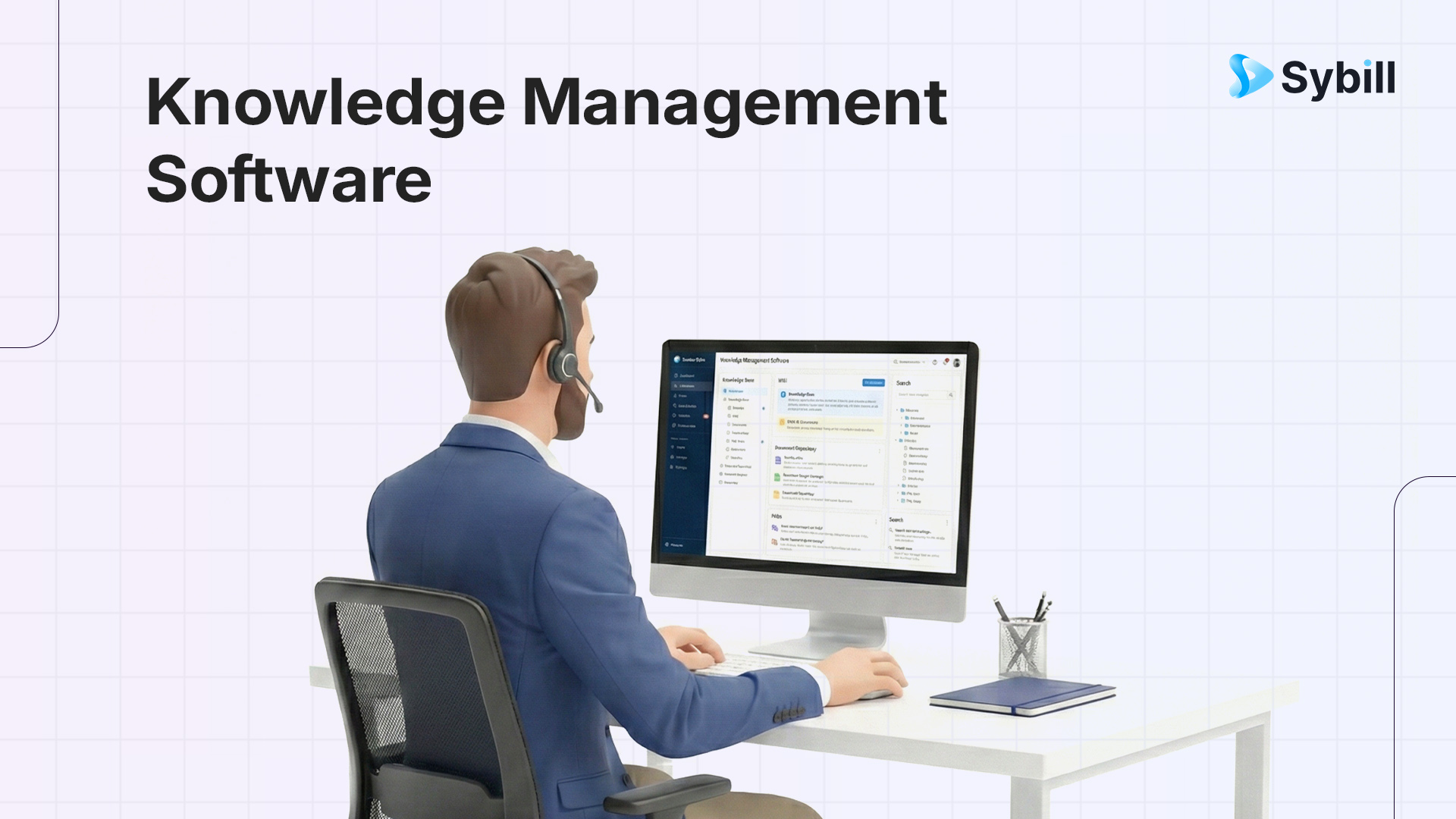
TL;DR: Traditional knowledge management tools are great at organizing docs and wikis. But for sales teams, the most valuable knowledge isn't sitting in a document. It lives inside calls, emails, and deal conversations. This guide breaks down the best KMS tools for static knowledge (playbooks, SOPs, help centers) and makes the case for why revenue teams also need dynamic knowledge management through tools like Sybill that capture, organize, and make searchable the intelligence flowing through every sales interaction.
"I wrote them down in my diary so that I wouldn't have to remember." That's knowledge management in its purest form. Capture what matters. Store it somewhere accessible. Move on.
Now imagine you had to manage a 20-person sales team. Your diary wouldn't cut it. You’d need those notes searchable, shareable, updated in real time, and ideally smart enough to answer questions on their own. That's the promise of knowledge management software in 2026, and the reality is that most tools only deliver on half of it.
For sales and revenue teams, the most critical knowledge isn't static. It's not the battlecard sitting in your wiki or the onboarding deck collecting dust in Google Drive. It's the dynamic intelligence generated every single day through discovery calls, demo conversations, negotiation emails, and buyer interactions. And it vanishes the moment a call ends unless something captures it.
That gap is exactly what this guide addresses. We'll cover the best traditional Knowledge Management tools for organizing static knowledge, and then we'll show you why tools like Sybill are becoming the knowledge management layer that revenue teams didn't know they were missing.
Knowledge management software helps organizations capture, organize, store, and distribute information so teams can find what they need without digging through Slack threads, email chains, or the brain of "that one person who's been here since 2019."
At its core, a KMS serves as a central repository. Think internal wikis, product documentation, customer FAQs, SOPs, training materials, and process guides. The good ones make all of that searchable, collaborative, and connected to the tools your team already uses.
Here's what separates a solid KMS from a glorified Google Drive folder:
These features work beautifully for what we'll call "static knowledge," the documented, structured information every company needs. But as we'll explore, there's an entire category of knowledge that traditional KMS tools were never designed to handle.
Most KMS guides lump everything into one bucket. But if you're running a revenue team, you need to think about knowledge in two distinct categories.
This is the stuff you write down once and update periodically. Playbooks, battlecards, pricing guides, product documentation, HR policies, onboarding curricula, and customer-facing help articles. It changes slowly, it's structured, and it lives in documents.
Traditional KMS tools handle this well. You need a place to write it, organize it, version it, and make it findable. Tools like Notion, Confluence, and Guru were built for exactly this.
This is the knowledge that's generated in real time through your team's daily work. What did the prospect say on the last call? What objections keep coming up this quarter? Which features get buyers excited and which ones fall flat? Who's the real decision-maker in the Acme deal, and what do they care about?
This knowledge is exponentially more valuable for closing deals than any static document. And yet, in most organizations, it disappears the moment a conversation ends. It lives in a rep's head, in scribbled notes, or in a CRM field that says "Good call, moving forward."
This is where tools like Sybill come in. Sybill functions as a knowledge management system for the dynamic intelligence that flows through every sales interaction, capturing it, structuring it, and making it searchable and actionable across your entire team. More on that soon.
Let's start with the tools that handle the documentation side of things. These are ranked by how well they serve teams that need organized, searchable, well-maintained knowledge bases.
Notion has become the default for startups and mid-sized companies that want docs, databases, wikis, and project boards in one place. The flexibility is its superpower. You can build an internal wiki, a product knowledge base, and a meeting notes archive all within the same workspace.
Notion AI adds natural language search and content generation, and the template ecosystem means you can spin up a structured knowledge base in minutes. The tradeoff is that without governance, things get messy fast. And at enterprise scale, search can struggle.
Best for: Startups and growing teams wanting one tool for docs, wikis, and light project management. Pricing: Free plan available. Plus at $10/user/month. Business at $18/user/month.
Confluence is the established choice for large organizations, especially those already using Jira, Trello, or Bitbucket. It offers structured spaces, page hierarchies, granular permissions, and tight project management integration.
The maturity is its strength. Version history, templates, and Jira linking make it a workhorse for engineering, product, and operations teams. The interface feels dated compared to newer tools, but the depth of features compensates for teams that need robust documentation infrastructure.
Best for: Large organizations already embedded in the Atlassian stack. Pricing: Free for up to 10 users. Standard at $6.05/user/month.
Guru's core idea is that knowledge should come to you, not the other way around. It delivers verified knowledge cards directly inside Slack, Chrome, Salesforce, or your email client. The verification workflow, where cards have assigned experts and expiration dates, ensures content stays current.
For sales teams juggling constantly changing pricing, positioning, and competitive intel, Guru's freshness guarantees are a real differentiator. Pair it with a dynamic knowledge tool like Sybill's Magic Summaries and you get both the playbook and the game tape in one workflow.
Best for: Sales, support, and ops teams needing fast, verified answers inside their existing tools. Pricing: Free plan available. Builder at $10/user/month.
Document360 is purpose-built for creating polished, searchable knowledge bases. It handles both internal wikis and customer-facing help centers with a clean editor, category-based navigation, and solid analytics that reveal which articles are performing and which are going stale.
The AI features include auto-tagging, natural language search, and content suggestions. If your primary need is structured documentation with a professional look, Document360 delivers more depth than general-purpose tools.
Best for: Teams that need a dedicated, polished KB for internal docs or customer self-service. Pricing: Starts at $199/month for the Professional plan.
Slite is what you pick when you want a clean, no-fuss internal wiki with surprisingly good AI built in. The "Ask" feature lets anyone query the knowledge base in natural language and get sourced answers. It nudges you when docs are outdated and flags duplicates, which solves the biggest problem with most wikis: content rot.
Best for: Small to mid-sized remote teams that want simplicity over power features. Pricing: Free plan available. Standard at $10/user/month.
Here's the uncomfortable truth: you can have the most beautifully organized Confluence instance in the world, and your sales team will still lose deals because of knowledge gaps.
Why? Because the knowledge that closes deals doesn't live in a wiki. It lives in conversations.
Think about what a rep actually needs to know mid-deal. Not "what's our pricing structure?" (that's in the playbook). They need to know: What did the CFO say about budget on the last call? Which competitor did the procurement team mention? What specific integration got the technical lead excited? What promises were made in the email thread last week?
That's dynamic knowledge. And it's the kind of intelligence that separates top-performing sales teams from everyone else. Sales reps already spend only 28% of their week actually selling, with the rest eaten up by admin and information hunting. The problem is that until recently, there was no good way to capture conversational knowledge systematically. Reps took notes (maybe), updated the CRM (poorly), and the rest just evaporated.
This is where Sybill enters the picture, not as a replacement for your wiki, but as the knowledge management layer for everything your wiki was never designed to capture.
Sybill is an AI sales assistant that records, analyzes, and organizes the intelligence flowing through every call, email, and deal interaction. But when you look at what it actually does through the lens of knowledge management, the parallels are striking.
Traditional KM tools need someone to write the content. Sybill captures knowledge automatically. Every sales call generates a Magic Summary that extracts key takeaways, buyer pain points, objections, next steps, and areas of interest. Every deal gets a continuously updated Deal Summary that synthesizes information across all calls and emails into a structured, evolving view of what's happening.
Nobody has to write anything. Nobody has to remember to update the CRM. The knowledge just gets captured. And because Sybill analyzes both verbal and non-verbal cues from prospects, you're capturing intelligence that even the rep on the call might have missed.
The Ask Sybill feature is essentially a natural language search engine for your team's entire body of sales conversations. Reps can ask questions like "What objections came up in the Acme deal?" or "What did the CTO say about our API integration?" and get instant, sourced answers pulled from actual conversations.
Sales managers can go even broader: "Why are we losing deals to [competitor] this quarter?" or "What features are getting buyers most excited lately?" Ask Sybill aggregates insights across all deals, all reps, and all conversations to surface patterns that no individual rep could see on their own. That's cross-deal intelligence, and it's the kind of knowledge that transforms how a sales org operates.
Knowledge is only valuable if the right people can access it. Sybill pushes summaries to Slack, email, and your CRM automatically. New reps can ramp faster by learning from real conversations across the team. Managers can coach using actual call data instead of self-reported vibes. Customer success teams get clean handoff context without playing telephone with the sales rep who closed the deal.
When a rep leaves, their deal knowledge typically walks out the door with them. With Sybill, every conversation they had, every insight they surfaced, and every deal signal they captured stays behind, structured and searchable. That's institutional memory that most organizations lose and never recover.
Here's where Sybill goes beyond what any traditional KMS does. It doesn't just store and retrieve knowledge; it acts on it. AI follow-up emails are drafted from actual call context in your own tone of voice. CRM fields get autofilled with accurate deal data mapped to frameworks like MEDDPICC or BANT. Pre-meeting briefs pull relevant context from past interactions so reps show up prepared. The knowledge doesn't sit in a database waiting to be found. It actively moves deals forward.
Get started for free with Sybill and turn every sales conversation into searchable, actionable knowledge your whole team can use.
The best-performing revenue teams don't choose between static and dynamic knowledge management. They layer both.
For static knowledge, pick a tool that matches your team size and ecosystem. Notion or Slite for lean teams. Confluence for enterprises. Guru if your priority is getting verified answers to reps in context. Load it up with your playbooks, battlecards, objection-handling guides, competitive positioning docs, and onboarding materials.
For dynamic knowledge, connect Sybill to your sales stack. It integrates with Salesforce, HubSpot, Slack, Zoom, and your email to capture the living intelligence from every interaction. Your CRM becomes a real source of truth. Your call data becomes a searchable knowledge base. Your team's collective wisdom becomes accessible to everyone, not locked in individual heads.
The result is a system where a new rep can check the wiki for the competitive positioning framework, then ask Sybill, "How have our top reps been positioning against [competitor] on recent calls?" and get answers drawn from real conversations. That's knowledge management that actually works for sales teams.
Picking the right tools comes down to honest answers to a few questions.
What kind of knowledge are you managing? If it's primarily long-form documentation, SOPs, and process guides, a document-centric tool like Confluence or Document360 is your best bet. If it's fast-changing competitive intel and verified answers, Guru or Slite shine. If it's the conversational intelligence flowing through your sales pipeline, that's Sybill's territory.
Who's the audience? Internal teams have different needs than customer-facing support. For public help centers, Document360 is purpose-built. For sales teams specifically, the combination of a lightweight wiki plus Sybill's deal intelligence covers both bases without tool sprawl.
What's already in your stack? Integration matters more than features in most cases. A tool that plugs into your CRM, Slack, and email will see 10x more adoption than a feature-rich platform that lives on its own island. Sybill's native integrations with Salesforce, HubSpot, Slack, and major conferencing tools mean it fits into existing workflows without friction.
What's your budget? Static KM tools range from free (Notion) to several hundred per month (Document360). Sybill offers a free tier for individual reps, with team plans scaling based on features and usage. You can check Sybill's pricing for the full breakdown.
What is knowledge management software?
Knowledge management software helps organizations capture, organize, and share information so teams can find answers quickly. It replaces scattered docs, Slack messages, and tribal knowledge with a structured, searchable system. For sales teams, it should cover both static documentation and the dynamic intelligence from customer conversations.
What's the best knowledge management tool for sales teams?
Sales teams benefit from layering two types: a static KMS like Notion or Guru for playbooks and battlecards, and a dynamic knowledge tool like Sybill for capturing and making searchable the insights from calls, emails, and deal interactions. Together, they cover what your team has documented and what your team has learned through selling.
How is knowledge management different from a CRM?
A CRM tracks deals, contacts, and pipeline stages. A KMS organizes and makes retrievable the knowledge your team needs to do their work. They're complementary. Tools like Sybill bridge the gap by automatically populating your CRM with structured intelligence from every sales interaction, effectively turning your CRM into a living knowledge base.
Can AI replace a knowledge management system?
AI is transforming KMS rather than replacing it. AI-enhanced tools can answer questions in natural language, auto-tag content, and surface insights proactively. For sales teams, AI assistants like Sybill go further by capturing knowledge that was never documented in the first place: the insights from live conversations that traditional tools simply miss.
How do I get my team to actually use a KMS?
Solve an immediate pain point first. For sales teams, that's often "where's the latest pricing doc?" or "what happened on that call last week?" Keep the structure simple, assign content owners for your static KB, and automate the dynamic side with tools that capture knowledge without requiring extra effort from reps. If a tool demands more work than it saves, adoption dies within weeks.
What's the difference between static and dynamic knowledge management?
Static knowledge management covers documented, structured content: playbooks, SOPs, FAQs, and product docs. Dynamic knowledge management captures the real-time intelligence from conversations, interactions, and workflows. Sales teams need both. Your wiki holds the playbook; a tool like Sybill captures the game tape from every sales call and turns it into searchable team knowledge.
Knowledge management software helps organizations capture, organize, and share information so teams can find answers quickly. It replaces scattered docs, Slack messages, and tribal knowledge with a structured, searchable system. For sales teams, it should cover both static documentation and the dynamic intelligence from customer conversations.
Sales teams benefit from layering two types: a static KMS like Notion or Guru for playbooks and battlecards, and a dynamic knowledge tool like Sybill for capturing and making searchable the insights from calls, emails, and deal interactions. Together, they cover what your team has documented and what your team has learned through selling.
A CRM tracks deals, contacts, and pipeline stages. A KMS organizes and makes retrievable the knowledge your team needs to do their work. They're complementary. Tools like Sybill bridge the gap by automatically populating your CRM with structured intelligence from every sales interaction, effectively turning your CRM into a living knowledge base.