Find us at booth #83, join us for a harbor side happy hour, or catch Gorish’s talk.

Sept, 16-18 > Learn more


Tamanna Mishra

March 31, 2026
Your sales enablement stack has trust issues. You’ve got Seismic for content. Gong for calls. Salesforce for CRM. HubSpot somewhere in the corner trying to hold it all together.
And yet, your reps still Google “how to handle pricing objections” five minutes before a call.
Welcome to 2025 - the year enablement stacks got too smart to be useful.
Sales teams aren’t short on tools. They’re short on clarity. Everyone’s tracking something, but no one’s connecting the dots. You’ve got metrics, but not meaning. Data, but no direction.
Meanwhile, sales enablement software use jumped 48% last year. And somehow, win rates didn’t.
So the question isn’t which tool you’re using. It’s whether your tools are actually working together to enable sales or just enable more logins.
The best sales enablement software today organizes this chaos. Then, it translates it.
It senses buyer intent. Reads tone. Automates context.
So we tried and tested some tools that promise to be the best sales enablement software, and brought you the real truth behind all the advertising fluff.
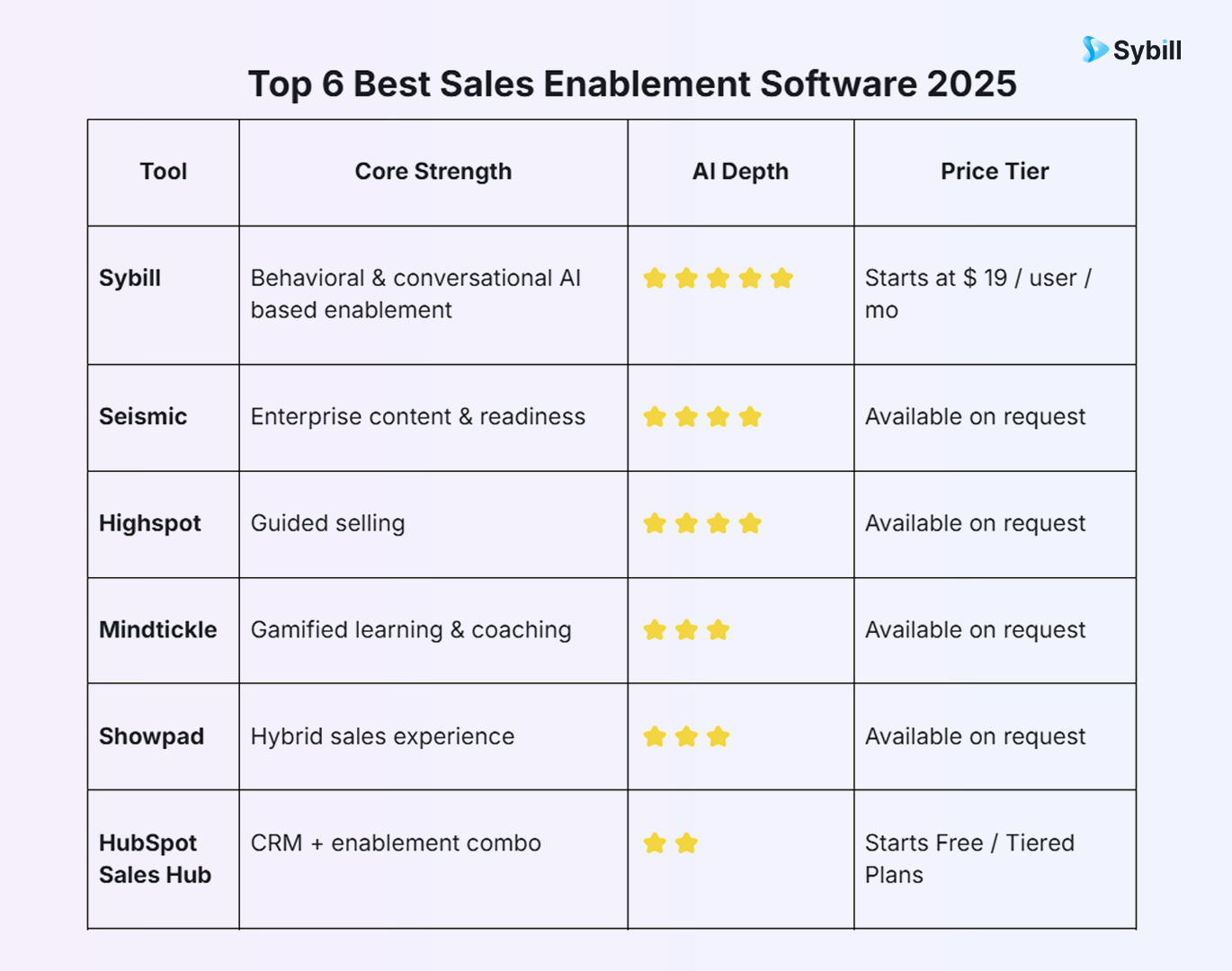
The best sales enablement software in 2025 includes Sybill as the top AI-first platform with buyer intelligence, Magic Summaries, CRM autofill, AI-powered follow-ups, and a Deal Workspace with Ask Sybill for instant pipeline answers; Seismic for enterprise content management and automated version control; Highspot for unified content, training, and coaching with AI Copilot; Mindtickle for science-based sales training with gamification and skill certifications; Showpad for immersive content and AI-assisted coaching; and HubSpot Sales Hub for SMBs wanting CRM and enablement in one place. The best choice depends on whether you need content management, training and coaching, or AI-first conversation intelligence and deal execution that orchestrates the entire selling workflow from prep through close.
Sales enablement software is the system that helps your reps do their best work - consistently, intelligently, and without chasing 47 open tabs to find a case study. At its core, a sales enablement tool is a unified platform that brings together everything reps need to move deals: content management, learning and training tools, and customer data.
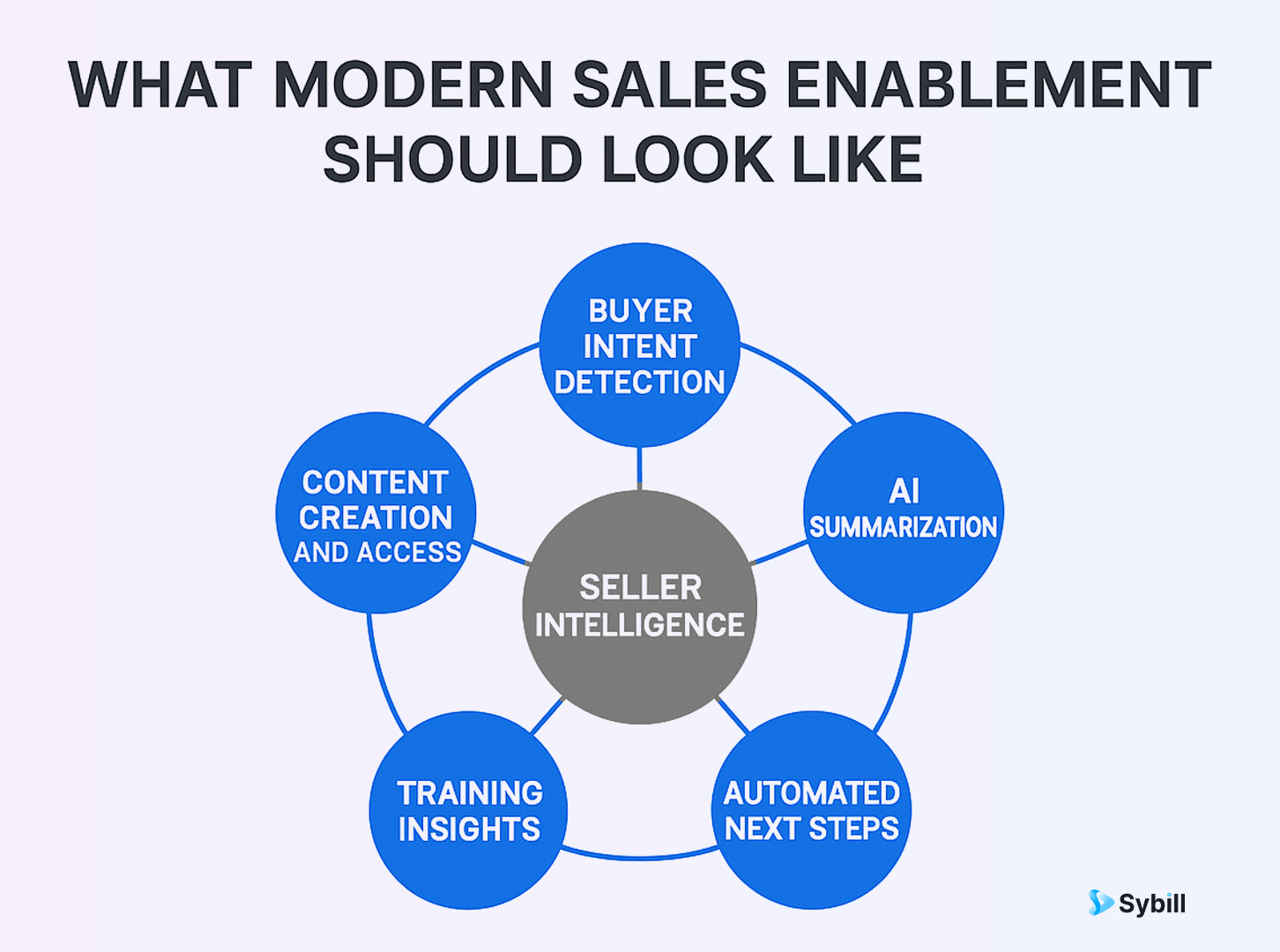
Well, at least that’s the promise of sales enablement software. But what it has become is a stack of three-letter acronyms promising to make sellers sound smart and close faster.
The truth is that the best sales enablement software in 2025 goes beyond content storage and training videos. The best sales enablement software in 2025 orchestrates the AE’s workflows towards deal closure.
It knows when a buyer leans in or tunes out.
It summarizes calls, detects objections, and suggests the next move.
It connects insights across tools, nudges reps before deals stall, and even drafts follow-ups that sound human.
So yes, sales enablement used to be about content. Now, it’s about conversation readiness. About showing up to every call already knowing the buyer’s objections, tone, and intent.
Because when your rep walks into a meeting armed with that kind of intelligence, the odds shift. Hard.
Teams with structured sales enablement record a 49% win rate on forecasted deals. Those without hover around 42%. That’s the difference between hitting quota and explaining why you didn’t.
But here’s what’s changed in 2025. Sales enablement is no longer about giving reps “more content” anymore. It’s about giving them more context.
Modern enablement extends way beyond pitch decks and onboarding modules. It’s conversation readiness. Reps walk into every call knowing the buyer’s last objection, tone, and intent. It’s personalization at scale - AI surfacing the right message, the right proof point, the right time. And it’s deal orchestration - connecting all those dots automatically so your reps don’t have to.
Picture this:
An AE opens a Sybill’s Pre Meeting Brief that lays out buyer objections, last meeting tone, and next steps. During prep, they ask AI Tasks to draft a quick business case for the CFO or spin up a contextual follow-up deck without waiting on marketing or ops. That’s enablement working in the moment, not in the next quarter.
Because sales doesn’t happen in PowerPoint anymore. It happens in motion. In calls, chats, and micro-moments where speed, relevance, and timing decide who wins.
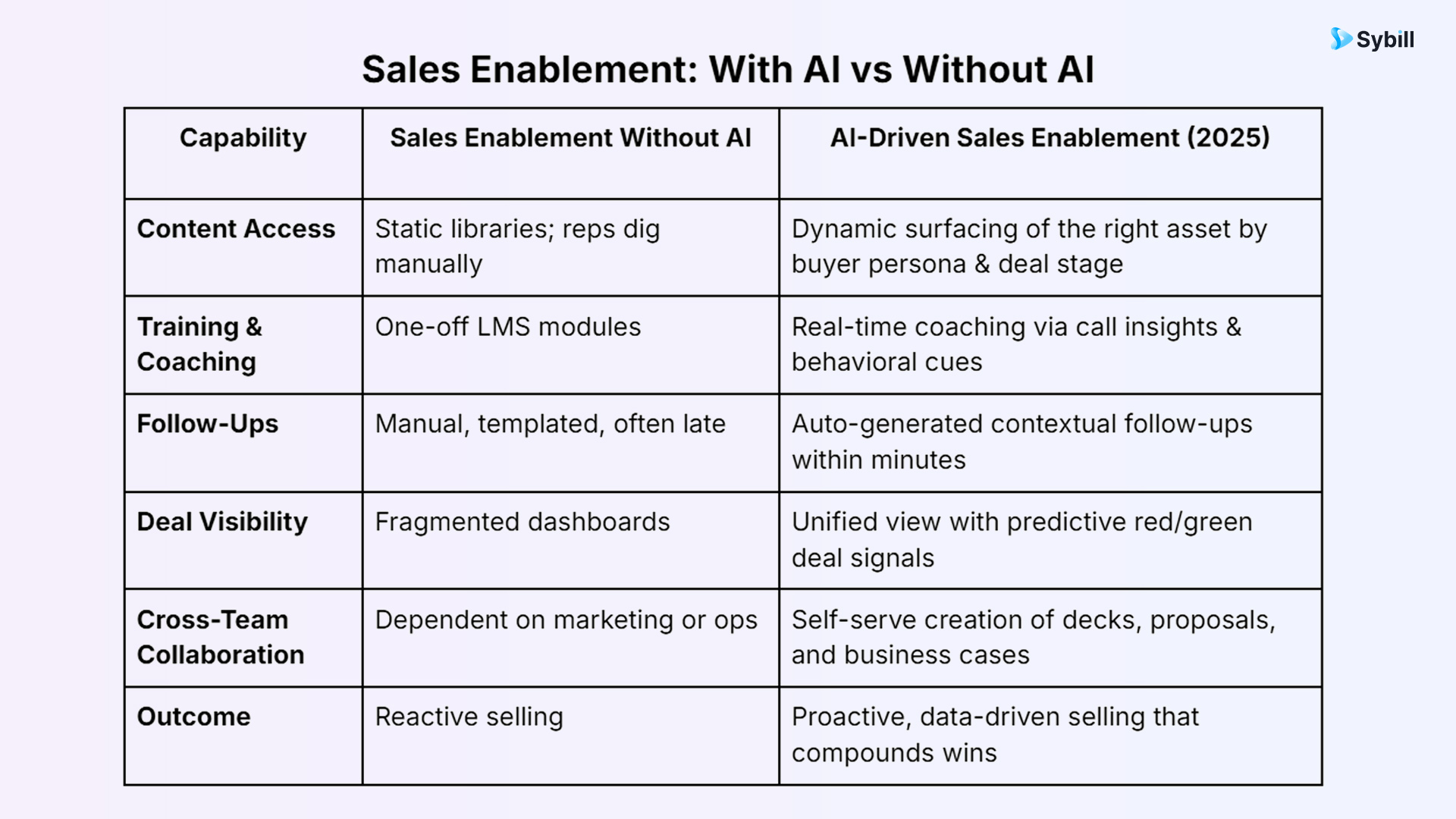
In 2025, AI isn’t just powering sales enablement. It is sales enablement.
And the teams still treating it as a side project? They’re already losing the deals they haven’t even chased yet.
Ask ten revenue leaders what the best sales enablement software in 2025 is, and you’ll get ten answers, most of them right, all of them incomplete. That’s because “best” depends on whether you’re building for startup speed or enterprise sprawl, for guided selling or guided sanity.
Still, there’s a short list of tools actually moving the category forward. These are the six best sales enablement tools defining how reps learn, prep, and close right now.
Sybill is built for the modern sales floor, the one where buyers talk less, multitask more, and leave micro-signals your reps can’t afford to miss. It’s the only platform natively built for behavioral and conversational enablement, where every interaction becomes data and every insight becomes action.
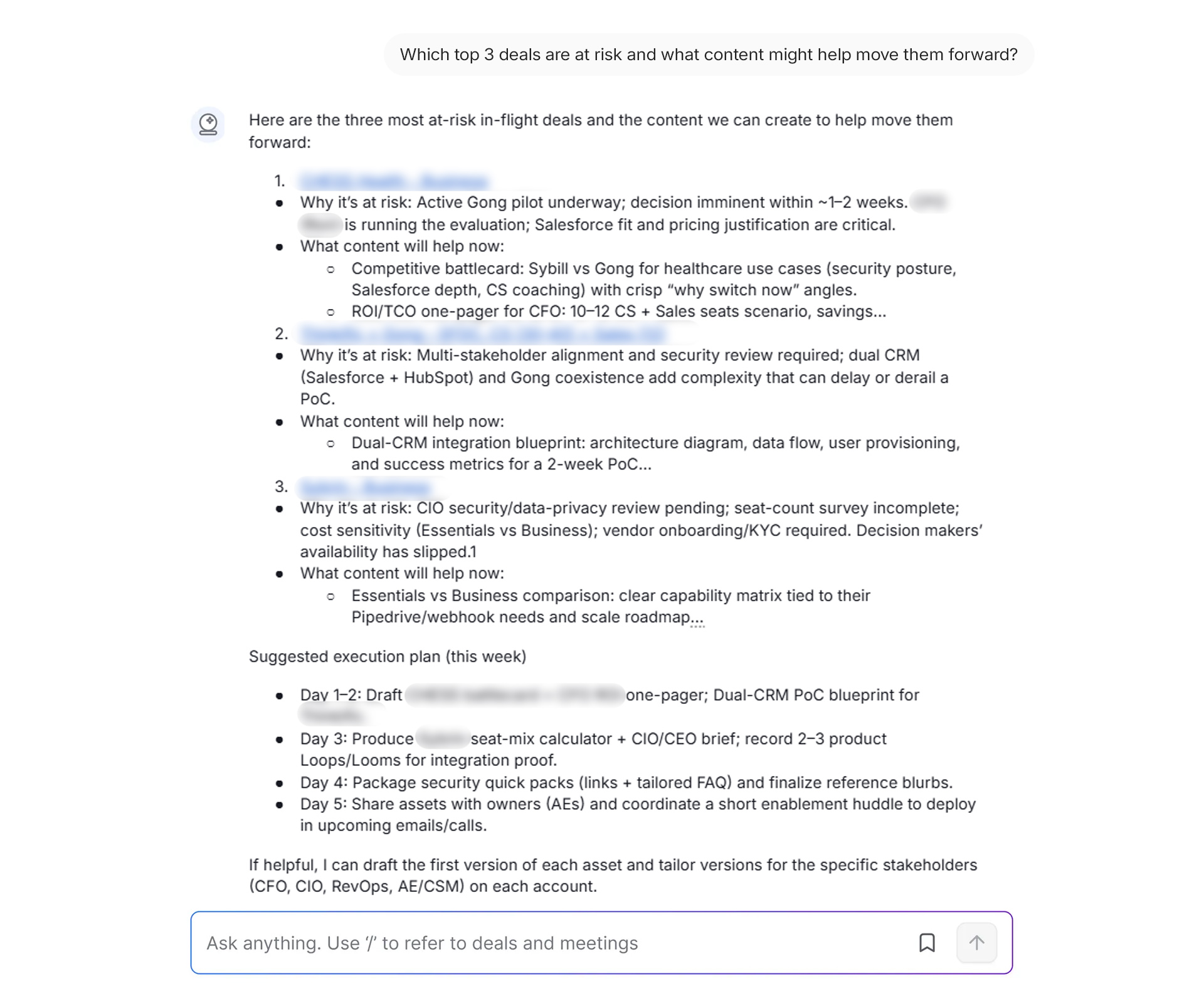
Sybill doesn’t bolt AI onto enablement. It builds enablement from AI. One workspace, zero tab-hopping. More importantly, it looks at enablement as a tool to drive specific deals forward, not just a feel good content enablement feature.
Managers, too, can simply Ask (Sybill) what’s going on with deals and which reps and deals need help. Contextual, AI powered deal coaching, for the win.
Best For: SaaS, tech, and fast-scaling startups that want enterprise-level intelligence without enterprise bloat.
Pricing: Free trial available; paid plans start at $19 per user per month.
Click here to try Sybill for free.
When your sales deck has 42 versions in circulation, Seismic is the grown-up in the room.
Strength: Centralized content, automated version control, and robust learning modules inside the Seismic Enablement Cloud. AI-driven personalization lets teams tailor collateral by persona, region, or product line at scale.
Why it works: Seismic thrives where there are multiple business units, compliance rules, and execs asking for “one more tweak.”
Limitation: Setup takes time, and the price tag is squarely enterprise.
Highspot turns enablement into muscle memory.
Strength: A unified system blending content, training, and coaching through AI Copilot. It links performance data to revenue outcomes.
Why it works: It’s clean, visual, and makes even complex playbooks feel like Spotify for sales content.
Limitation: Requires a thoughtful rollout. Expect a steeper setup curve for custom flows.
If sales training feels like detention, Mindtickle fixes that.
Strength: Combines science-based learning paths with gamified leaderboards, live challenges, and skill certifications. AI feedback loops show managers exactly which skills drive quota attainment.
Why it works: Keeps reps engaged and managers data-rich.
Limitation: Designed for large teams; smaller orgs may find it over-engineered.
Half your team’s in the office, the other half’s on planes. Showpad keeps them aligned.
Strength: Merges immersive content (3D models, interactive showrooms) with AI-assisted coaching tools. Reps can personalize assets on the fly and track engagement after sending.
Why It Works: Makes virtual selling feel less like Zoom fatigue and more like a demo room.
Limitation: Limited conversation analytics. You’ll still need a call AI layer for that.
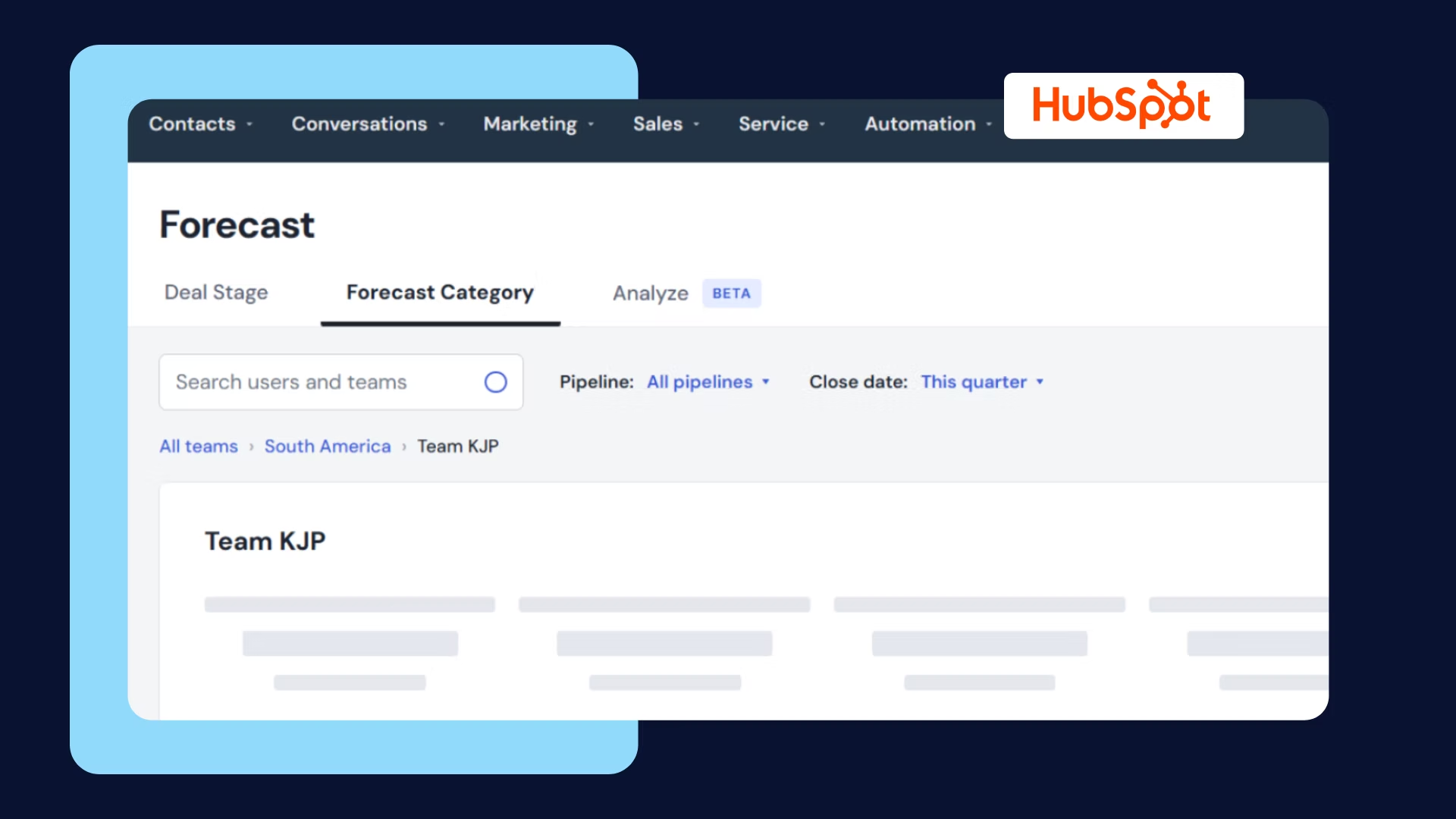
For startups and SMBs that want CRM and enablement in one place, HubSpot is the friendly all-rounder.
Strength: Built-in playbooks and email automation within its CRM interface. Simple dashboards show pipeline health.
Why It Works: User-friendly, budget-friendly, and integrates with most marketing stacks.
Limitation: Lighter AI layer compared to specialized tools like Sybill.
If your sales enablement software still stops at “content repository,” it’s already behind.
In 2025, the best sales enablement software isn’t defined by how many features it lists. It’s defined by how intelligently those features work together. Here’s what to look for when you’re evaluating your next (or first) enablement platform.
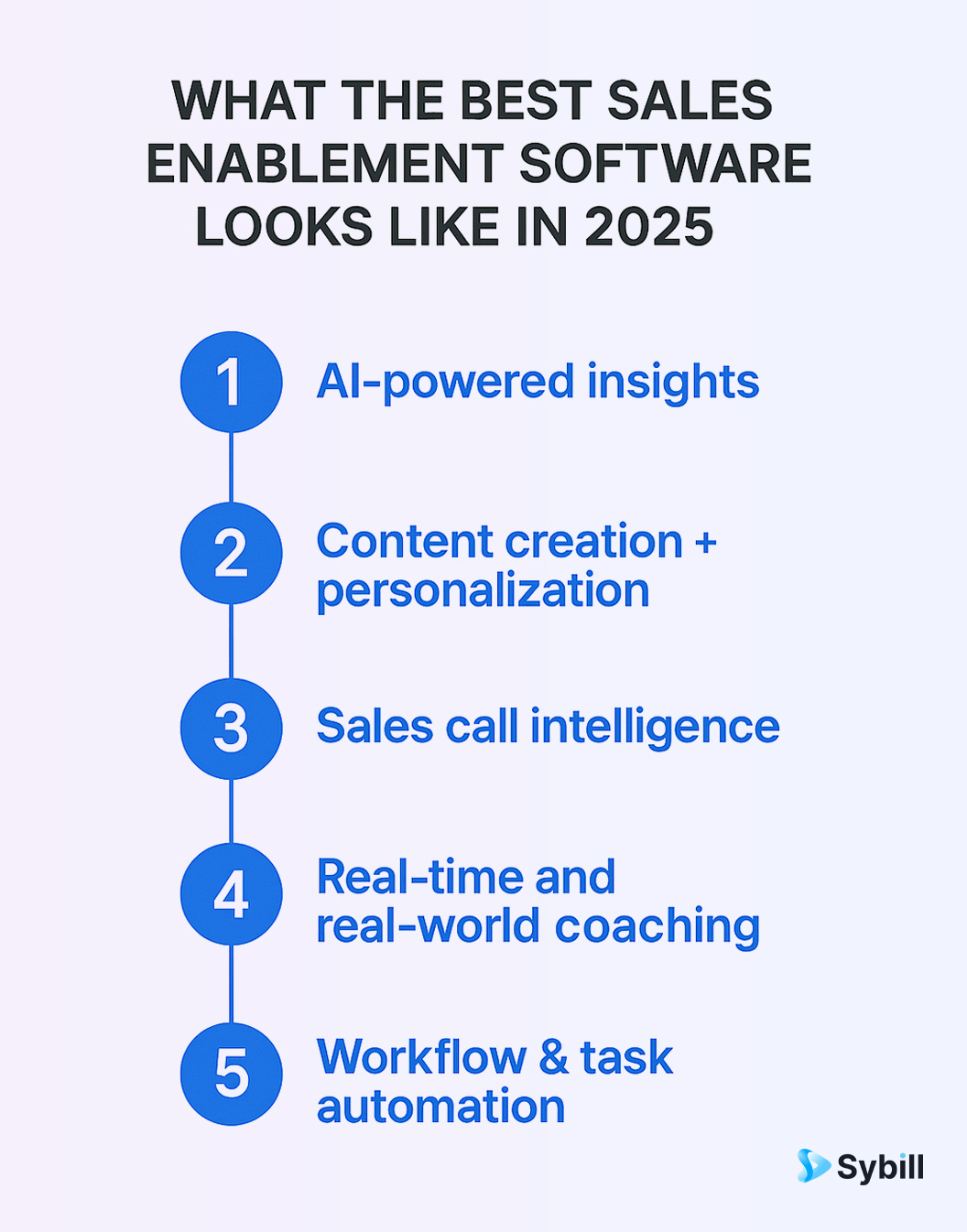
Dashboards are nice. But in 2025, insights win deals.
The best platforms don’t just show you data. They tell you what it means. They predict deal health, identify buying signals, and surface the exact action a rep should take next. Think of it as your pipeline’s early warning system, flagging red signals before your manager does.
This is where enablement turns predictive. It doesn’t wait for problems; it spots patterns before they become lost revenue.
Every company says “we have great content.” But if your reps can’t find it or use it for specific deals, it might as well not exist.
Modern enablement tools act as both librarian and stylist. They not only organize assets, they tailor them. The best systems deliver the right deck, one-pager, or case study based on buyer persona, industry, and stage of the deal.
And personalization isn’t just about swapping a logo on slide one. It’s about aligning every piece of collateral to the conversation that’s actually happening. If your sales content doesn’t talk like your buyer, it’s noise.
Enablement without conversation intelligence is like coaching with your eyes closed.
Today’s sales cycles live in calls, not spreadsheets. The best enablement software captures those moments, analyzes tone, detects objections, and distills hours of conversation into key takeaways.
AI-driven summarization gives you context at speed: what the buyer said, what they meant, what you missed, and what to do next. It’s real-time enablement, not next-day admin work.
Because nobody should ever have to rewatch a one-hour call to find one line that mattered to push the deal forward or create the right sales coaching or collateral.
The best enablement coaches.
Think instant feedback that evolves with every deal. Instead of static training decks gathering dust, reps get in-the-moment insights that align directly with active conversations.
AI-powered skill and deal coaching creates a learning loop: calls become lessons, lessons become plays, and plays become wins.
This is how top teams scale consistency without scaling headcount.
Ask any rep where their time goes, and they’ll tell you: somewhere between “writing follow-ups” and “waiting for marketing.”
AI-led workflow automation fixes that. It takes every output of enablement - notes, next steps, objections - and turns them into action. Follow-ups draft themselves, proposals generate with one short conversation, reminders queue up in seconds.
The best systems make enablement operational. They don’t just help you plan the next step. They execute it.
That’s the difference between busy teams and productive ones.
If your enablement tool can’t connect data, context, and execution in one flow, it’s not “enablement.” It’s just one more tool, one more tab, one more context switch in the day of your rep.
The best sales enablement software in 2025 doesn’t just tell reps what to do. It does half of it for them.
Sales enablement isn’t “support” anymore. It’s the revenue engine behind every consistent close. The best teams are winning with systems that think, adapt, and act faster than human reflex.
Because the best sales enablement software goes beyond just helping you sell. AI-backed sales enablement in 2025 helps you understand why people buy and then double down on those reasons.
Every hesitation, every question, every micro-signal in a call is an opportunity, if your platform knows how to catch it. That’s what an AI-first enablement approach delivers.
Don’t just enable your reps. Empower them to close.
Start your free trial of Sybill, the AI platform that turns every call into closing intelligence.
The best sales enablement tool in 2025 is the one that makes your reps faster, sharper, and more buyer-aware, not just busier. The modern rep doesn’t need another content library; they need context. The right platform reads buyer intent, summarizes conversations, and nudges next steps automatically. In short: the best tool is the one that helps your reps sell with confidence and precision. Sybill’s one of them.
In tech, the leading sales enablement platforms are the ones that blend AI intelligence with execution. These tools that don’t just analyze deals but help you act on them. The industry is shifting from static content systems to AI-first enablement platforms that coach reps, automate tasks, and sync with CRMs in real time. For high-velocity SaaS and startup teams, the leading choice is a tool like Sybill, that turns every call and CRM entry into insight, not busywork.
The #1 CRM in the world remains Salesforce, leading the market for enterprise-level relationship management and data visibility. But CRMs are only as powerful as the context that fuels them. That’s why companies now pair their CRM with AI-powered sales enablement tools, to transform static contact data into living, learning intelligence. The CRM stores the what; enablement reveals the why.