Find us at booth #83, join us for a harbor side happy hour, or catch Gorish’s talk.

Sept, 16-18 > Learn more


Tamanna Mishra

March 26, 2026

Coaching your reps isn’t about fixing their mistakes. What you want is to build a team of supersellers that’s always thinking like sellers and problem solvers.
Deal coaching is the practice of a sales leader reviewing active opportunities with reps at each deal stage — not to take over, but to sharpen strategy, surface blind spots, and increase win rates through guided decision-making. Unlike general sales coaching, deal coaching is deal-specific: it focuses on the particular stakeholders, objections, timelines, and competitive dynamics of a live opportunity. The best sales leaders coach differently at discovery, demo, negotiation, and close — adapting their guidance to what the deal needs at that moment, not applying the same playbook to every conversation.
Here’s more about what great sales coaching isn’t. It’s not micromanagement in disguise. It’s not about swooping in to correct rep mistakes or turning 1:1s into performance reviews. Real deal coaching is about building reps who think like strategists, not script readers.
That means shifting from telling to asking. Nudging reps to analyze, self-correct, and grow. It’s moving from generic pep talks to context-rich conversations rooted in each deal’s reality. And it’s about coaching the behavior behind the outcome, not just chasing the number.
Yet here’s the gap. While 74% of reps say they’d perform better with better coaching, only 26% feel they actually receive it. That disconnect is costing you deals - and future sales leaders.
Modern sales coaching is about shaping reps who can diagnose and adapt mid-deal. Not ones who wait for a manager to tell them what to do.
And that’s what this blog is about.
But before that, we have the ultimate cheat sheet for you, with 30+ smart coaching prompts per deal stage, from early qualification to close.
[Download the Coaching Playbook with 30+ Coaching Prompts]
Before we get into stage-by-stage strategy, let’s talk about what makes deal coaching actually work. Whether you're coaching a rep with a $5K SaaS trial or a $500K multi-threaded opportunity, the fundamentals stay the same.
Truly effective sales coaching is built on three core pillars: timeliness, specificity, and collaboration. Most sales managers get these wrong - not because they don’t care, but because they’re overwhelmed, reactive, or stuck in legacy coaching modes.
Let’s unpack what the best deal coaching techniques look like in practice.
If you’re only coaching at the end of the month, congrats! You’re doing postmortems, not coaching. Great deal coaching happens when the context is alive, not when it’s buried under 10 other calls and lost Slack threads.
Coaching pro tip: The best reps learn in flow. Time your feedback to match the rep’s rhythm.
“Be more confident.”
“Take control of the call.”
“Don’t just show the deck. Have a conversation.”
These all sound like coaching… but they’re just buzzwords in disguise.
Specificity is the oxygen of great coaching. Instead of general praise or broad advice, give reps actionable insights they can apply on their very next call.
Coaching pro tip: Specific, behavior-based coaching drives real behavioral change. Generic feedback creates anxiety.
If your coaching sessions feel like lectures, you're doing it wrong.
Reps don’t grow when you give them a list of things they did wrong. They grow when they’re thinking with you. Reflecting on what worked, what didn’t, and why.
The best deal coaching techniques use the Socratic method: ask, don’t tell.
Coaching pro tip: Don't just review deals with your reps. Train their decision-making muscles.
Ask Sybill gives managers a front-row seat to deal signals, buyer behavior, and rep performance. So you know when to coach, what to say, and where to dig deeper.
Click here to try Ask Sybill for free.
Let’s ditch pipeline labels. Each stage is a coaching opportunity.
Deals don’t fall apart all at once. They unravel in small moments.
A rushed qualification. A missed stakeholder. A lukewarm close.
The job of a great coach isn’t to hover. It's to shape how reps think, prepare, and adapt at each stage of the cycle.
Here’s what effective deal coaching looks like, stage by stage.
This is where bad deals creep in and waste cycles. Too many reps fall into the trap of chasing anything with a pulse, especially under pressure. Your job as a coach isn’t just to ask “is this qualified?” It’s to sharpen your rep’s decision-making lens.
Focus on the thinking pattern behind the early conversation:
Live coaching prompt: “What would make this deal worth not pursuing?”
Coaching tip: Don’t glorify pipeline volume. Teach reps to disqualify with integrity. It’s the foundation of great qualification coaching.
This is where reps get stuck in the “happy ears” zone. The buyer loves the product... but nothing moves. Coaching here is about narrative control and political awareness.
Coach reps to craft a problem–impact–value story. It’s not just about features or integrations. It's about how your solution solves a painful, measurable problem better than the status quo.
Next: Stakeholders. If your rep is too cozy with a single champion, the deal is fragile.
Coaching example: “How do you know they’ll fight for you when you’re not in the room?” This takes your reps beyond their ‘happy ears.’
Coaching tip: Listen to recorded calls and challenge what’s not being said. Great solution selling coaching often comes from spotting missing signals.
This is not the time for “just check in” emails or end-of-quarter discount fire drills. At this stage, you’re not coaching hustle. You’re coaching control under pressure.
Here’s what to focus on:
Coaching prompt: “What’s stopping them from signing this week?”
Coaching tip: Avoid end-of-quarter panic coaching. Instead, create a deal-closing game plan early. That’s how a real deal closing coach helps reps win under pressure.
There’s a reason your CRM is lying to you.
The activity says the deal is in “Commit.” The notes say “All looks good.” But the buyer’s tone? The hesitation? The vague next steps? They’re screaming stall.
This is where sales coaching best practices have evolved. It’s no longer about checking boxes or tallying up emails and meetings. It’s about coaching reps to read the room and the buyer.
Most coaching frameworks still center around what the rep did. Number of calls made, stage advanced, meeting held.
But deals don’t close because reps move opportunities forward in the CRM. Deals close because buyers are emotionally and logically ready to buy.
And that shows up in behaviors:
If you’re only coaching based on activity, you’re missing the emotional heartbeat of the deal.
Behavior-based coaching means helping reps interpret what buyers are signaling and not just what they’re saying.
Here’s how to do it:
Train reps to get curious, not just compliant.
Behavior tells the truth activity hides.
Want to coach based on actual buyer behavior without shadowing every call?
Tools like Ask Sybill surface tone shifts, objections, hesitations, and emotional cues - so you can coach based on the real story, not the sanitized call notes.
This is sales coaching best practice for modern teams. Contextual, fast, and grounded in buyer truth.
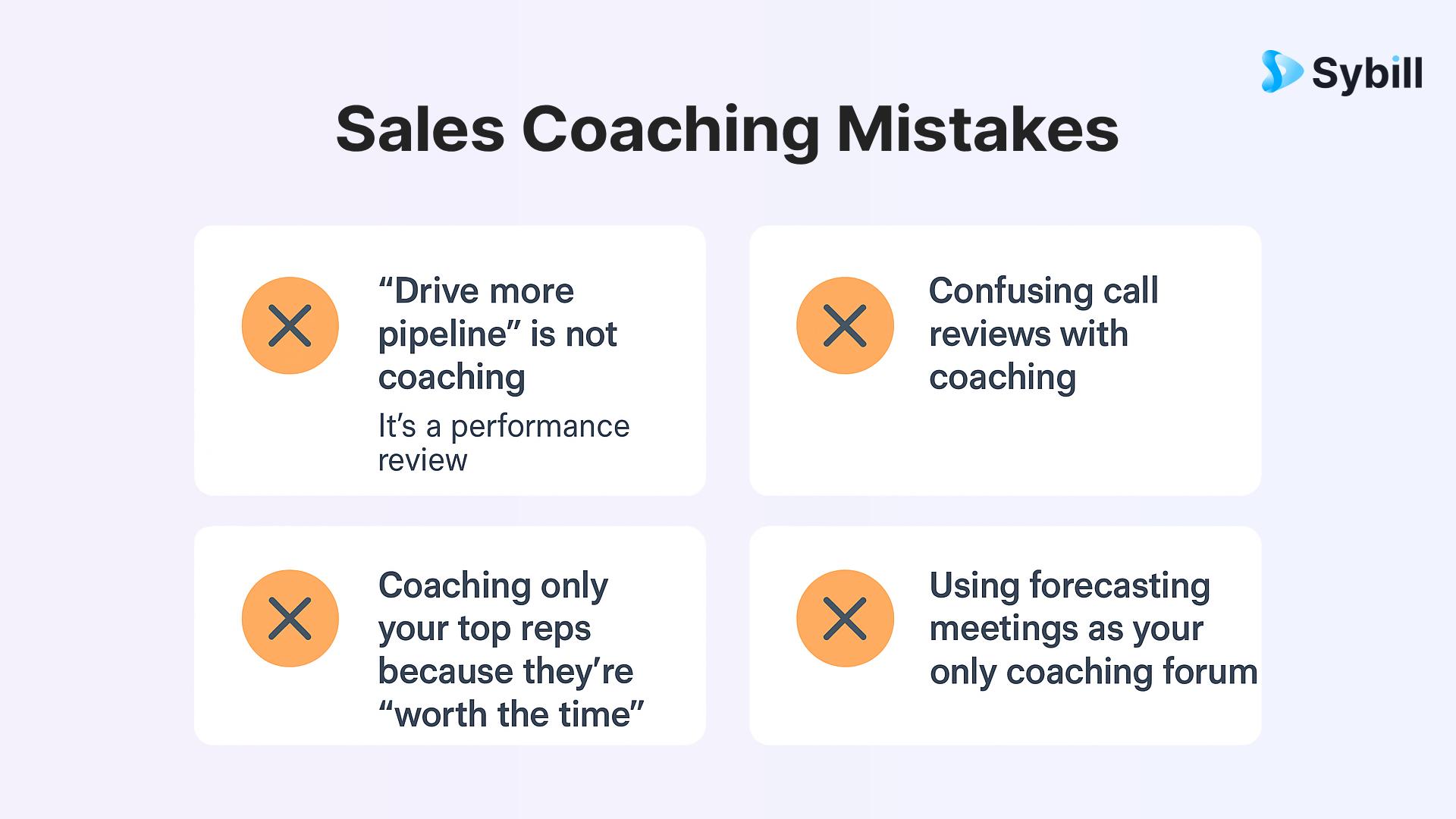
Most sales coaching fails not because managers don’t try but because they’re stuck in the wrong habits.
Old-school playbooks.
Busywork disguised as feedback.
Forecast meetings pretending to be coaching sessions.
If you recognize any of these, don’t panic. You’re not alone. But it’s time for a reset.
Telling your reps to book more meetings or log more opps isn’t coaching. It’s scorekeeping. Coaching is helping them understand why their pipeline is thin, where deals are stalling, or how they’re qualifying poorly. Volume without insight just creates burnout.
Classic bad sales management habit. You’re pouring strategy into your A-players and leaving your B-players to fend for themselves. But here’s the thing: it’s your middle that moves the number. Great coaches lift the middle and unlock hidden potential.
If your coaching sounds like “Let’s go through your last call,” you’re reviewing, not coaching. Coaching means stepping above the transcript. Asking why they chose a certain strategy. Helping them self-reflect. Don’t just analyze the call. Analyze the thinking behind it.
Forecast calls are for deal status, not rep development. If that’s the only time your reps hear feedback, it’s no wonder they treat coaching as an interrogation. Separate the numbers from the growth.
The real mistake is thinking sales coaching is optional.
In a market where every deal is fought for, coaching is your competitive edge. So cut the fluff. And get intentional about sales coaching.
You can’t coach every rep on every deal, every week. And honestly? You shouldn’t have to.
Scalable sales coaching is about prioritization - knowing which conversations actually move the needle. It's not about being available 24/7. It’s about being available when it counts.
Top managers don’t micromanage. They pattern-match. They identify red flags early, coach proactively, and invest their time where deals or reps are most likely to shift with the right intervention.
Want to know where those leverage points are hiding? Hint: it’s not in the forecast call. It’s in buyer behavior, rep confidence, and friction between meetings.
Whether you use GROW, SPICED, MEDDIC, or some Frankenstein hybrid, frameworks give your coaching structure. They’re great scaffolding - but terrible crutches.
Adapt your approach based on rep maturity:
Coaching frameworks for sales should support independent thinking, not replace it.
Yes, templates are helpful. But scalable coaching isn’t a Notion doc. It’s a mindset.
When you coach this way, you don't just get better reps. You get smarter sellers who coach themselves mid-deal.
Ask Sybill surface deal risks, buyer objections, red/green flags, and next-step clarity. All without needing to dig through call recordings or CRM notes.
%2520(2).png)
That means you can spend less time gathering context and more time coaching where it counts.
This is how you scale coaching without scaling your calendar.
Click here to try Sybill for free.
Get the ultimate cheat sheet with 30+ smart coaching prompts per deal stage, from early qualification to close. Perfect for live coaching, async feedback, or manager 1:1s.