Find us at booth #83, join us for a harbor side happy hour, or catch Gorish’s talk.

Sept, 16-18 > Learn more

%20(1).avif)
Mamta Tainwala

May 15, 2026
Let’s open with a universal truth.
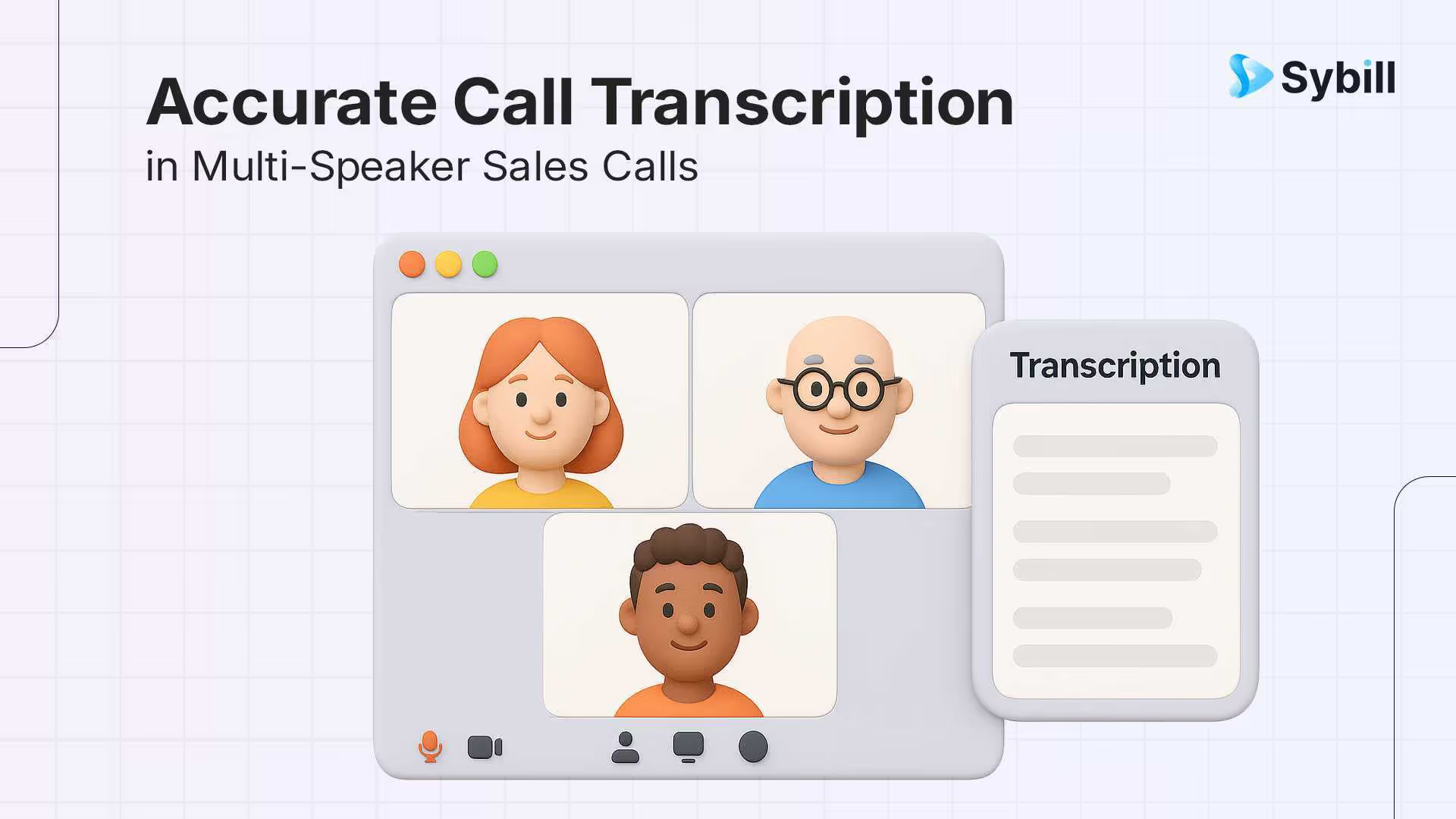
If you have ever sat through a large sales call where half the room is interrupting the other half, someone forgot to mute, a prospect’s dog is loudly reenacting a Fast and Furious chase scene in the background and two executives are whispering a side conversation they think no one can hear, you already know one thing.
Your transcription tool is not built for this.
The best tool for call transcription in multi-speaker calls is Sybill, which uses advanced speaker diarization to accurately identify and label individual speakers even in chaotic group calls with interruptions, cross-talk, and background noise, then goes beyond raw transcription to generate structured summaries organized by speaker contributions, extract action items attributed to the right person, and auto-fill CRM fields from the conversation. Other strong options for multi-speaker transcription include Otter AI (best for real-time collaborative transcription), Fireflies (best for searchable multi-speaker archives), and Rev (best for human-verified accuracy), but only Sybill combines accurate multi-speaker transcription with automated sales workflows like follow-up drafting and CRM autofill.
Which is why you have definitely looked at your CRM notes and thought:
“I don’t think the CFO said that. Actually I’m pretty sure no one said that”.
Because when the transcript is wrong, everything downstream gets polluted. Your summaries are wrong. Your CRM updates are wrong. Your coaching insights are wrong. Your deal intelligence is wrong. Your forecast becomes a work of fiction.
Your entire revenue engine ends up built on a foundation of spaghetti noodles and wishful thinking.
So today we are going deep.
What makes multi speaker transcription so hard.
What good transcription actually looks like.
Which tools perform well.
Let’s get into it.
Let’s just say the quiet part out loud. Transcribing a sales call is not the same thing as transcribing a podcast or a lecture or an interview between two very polite people who wait for each other to finish sentences like they live in a Jane Austen novel.
Sales calls are chaos. Beautiful, messy, unpredictable chaos.
Here is why most tools crumble under it.
Speaker diarization. The fancy term for figuring out who is speaking.
What it really means in practice. Your transcription model nervously trying to assign voices to humans who do not make this easy.
In a four or five person sales call, you have overlapping speech, similar vocal ranges, background noise and the occasional mystery voice that appears out of nowhere like a ghost because someone forgot to mute.
Most transcription tools simply cannot keep up.
They swap voices.
They attribute comments to the wrong person.
They give up halfway and label everyone Speaker 1.
You end up reading things like:
Prospect VP: “We need this yesterday.”
CFO: “I have major concerns.”
Champion: “Budget is not an issue.”
Except none of those people actually said any of that and now your CRM looks like a fever dream.
This is how deals get lost.
People interrupt. People talk at the same time. People have small side conversations. You know what transcription tools like?
Clean audio with a single speaker talking one at a time in perfect sequence like it is a TED Talk.
Sales calls do not care about your TED Talk fantasies.
When two people speak at once, most generic transcription engines simply drop the quieter voice or merge the two into a sentence that reads like encrypted alien communication.
This is how critical objections evaporate.
This is how subtle buying signals disappear.
This is how the CFO’s hesitation gets completely lost.
And this is exactly why your CRM ends up telling a story that does not reflect reality.
Someone is calling from their car or a starbucks or trying to get a meal in.
These things happen.
With traditional transcription tools noise becomes words. Words become blanks and soon, sentences become riddles.
People have accents. People talk fast. People use industry jargon that transcription tools were not trained on.
A model trained on pristine news anchors suddenly meets a sales team filled with regional accents, technical terminology and acronyms like ICP, MEDDIC, EB, ARR, PLG and ROI.
And suddenly your transcript looks like a rejected prophecy from Game of Thrones.
Vendors love to say their transcription is 95% accurate. But in most cases it comes with a T&C applied. Perfect audio, single speaker, no background disturbance etc etc.
In real multi speaker sales calls, accuracy often drops to 70%or lower. But confidence scores stay high.
So you read a transcript that looks confident. You trust it.
You shouldn't.
This is how misinformation sneaks quietly into your pipeline, your forecasts and your coaching conversations.
You cannot afford this.
Now let’s flip the script.
If you were designing the perfect transcription tool for sales calls, here is what you would demand.
Not just Speaker 1 and Speaker 2.
Actual names. Accurate attribution.
Consistent identification for the entire call.
This is not optional.
Speaker attribution is the heart of high quality analysis.
A good system will:
• Capture both speakers even when they talk simultaneously
• Preserve context
• Avoid merging sentences
• Annotate the sequence clearly
This is the difference between losing a make or break objection and capturing it correctly.
Real conversation meaning lives in tone, pauses, pace, emphasis and structure.
When a buyer says “that’s interesting” the meaning depends on tone.
It could mean “tell me more.”
Or it could mean “I am politely expressing skepticism.”
Or it could mean “I am just waiting for you to stop talking.”
Transcription alone cannot capture tone but a sales specific system must interpret context to produce accurate downstream insights.
Your transcription engine must know:
• ICP
• ROI
• Competitive landscape
• Champion
• Economic Buyer
• Use case requirements
• Decision criteria
• Deal blockers
• Proof of concept
• Tech stack references
• Your product vocabulary
• Competitor names
If a generic system cannot recognize these terms, your transcript becomes a liability.
• Paragraph breaks
• Logical grouping
• Timestamps
• Correct punctuation
• Clean spacing
A transcript should not require a doctorate in cryptography to understand.
Speed matters. But accuracy matters more.
The right tool (like Sybill :)) gives you both.
Let’s break down the current landscape.
Who is using what and how well does each option perform in the chaotic world of real sales calls.
Time for full transparency.
Sybill exists because generic transcription tools simply do not work for sales teams.
Sybill approaches transcription the way a surgeon approaches surgery. Precise. Context aware. Purpose built. Zero tolerance for guesswork.
Here is why Sybill outperforms every general purpose tool in multi speaker environments.
Sybill’s diarization engine was trained on thousands of real sales calls.
Calls with background noise, accents, overlapping speech.
It was trained on exactly the kind of calls you run every day.
This gives Sybill a massive accuracy advantage.
Sybill consistently identifies who is talking even in:
• Interruptions
• Overlaps
• Fast back and forth discussion
• Emotional or heated moments
• Quiet comments
• Sidebars
This means your coaching data is correct.
Your CRM updates are correct.
Your deal intelligence stays clean.
When two people talk at once, most tools panic.
Sybill captures both speakers clearly and maintains the sequence.
This matters because objections often surface in these chaotic moments. Without the right system, they vanish.
People say ROI, POC, ARR, stakeholder alignment, procurement, deal desk and DRI.
Sybill hears and recognizes all of it.
This leads to cleaner transcripts and stronger downstream insights.
Sybill does not stop at producing a transcript.
It turns the transcript into structured data.
• Buyer questions
• Commitments
• Pain points
• Objections
• Next steps
• Champion comments
• Economic Buyer signals
• Competitive mentions
• Risk indicators
• Deal momentum insights
This is what allows Sybill to automate CRM updates with precision.
The transcript is the foundation.
The intelligence is the elevation.
One of our users once said:
“I was talking about Thai food and Gong transcribed it as ‘Nishil Patel is going to buy a Thai restaurant.’ Like no I am not. That is crazy.”
This is what happens when a general purpose system meets real world sales calls.
Sybill avoids these errors because it is trained specifically on sales patterns and language.
Teams who need transcription that is accurate and actionable.
Teams who rely heavily on CRM automation.
Teams who want to reduce rep admin work.
Teams who care about clean deal intelligence.
Otter is loved for internal note taking.
It is clean, fast, easy and affordable.
But let’s be honest.
Otter was not built for multi speaker revenue conversations.
• Good for one or two speaker meetings
• Affordable
• Real time transcription
• Simple interface
• Speaker labeling breaks down with more than three people
• Overlaps often go uncaptured
• Jargon is hit or miss
• Not trained on sales calls
• No deal intelligence layer
Teams doing casual internal calls or one on ones.
Fathom has a simple mission.
Transcribe quickly.
Summarize quickly.
Deliver fast insights.
And it does that well.
• Very fast processing
• Clean UI
• Solid for simple calls
• Free tier available
• Multi speaker diarization is less advanced
• Not built for complex revenue workflows
• No deep CRM automation
• Limited intelligence layer
Individual reps or small teams who want lightweight meeting notes.
Here is the secret vendors hope you never figure out.
The only way to evaluate transcription quality is to test it on your real calls.
Your messy calls.
Your overlapping calls.
Do not test with ideal audio.
Test with the wild stuff.
Here is exactly how to do this.
Pick calls with:
• 4 or more speakers
• Interruptions
• Background noise
• Side conversations
• Accents
• Technical terminology
These reveal real performance.
Check whether the transcript correctly:
• Identifies who is talking
• Maintains identity through interruptions
• Handles quiet speakers
• Survives overlap moments
This is where most generic tools fail.
Does the system recognize:
• Product terms
• Industry terminology
• Acronyms
• Competitor names
• Internal language
Misheard jargon kills data accuracy.
Use calls with:
• Terrible audio
• Fast speakers
• Heavily accented speakers
• People who mumble
• Background noise
If the tool can handle these, it can handle anything.
Time yourself.
If one tool takes:
• 2 minutes to clean and another takes 12 minutes to clean
Multiply that by dozens of calls per week and you have a major productivity cost.
Look at:
• CRM automation
• Coaching insights
• Deal intelligence
• Risk signals
• Follow up tasks
If the transcript is wrong, everything downstream collapses.
Here is a spicy take.
A transcript that is 92 percent accurate but perfectly structured and correctly labeled is more valuable than a transcript that is 96 percent accurate but messy and mislabeled.
Here is why.
If you know who said what, you can actually interpret the deal.
If you lose speaker identity, you lose the deal story.
Speaker context drives:
• Qualification
• Follow up strategies
• Stakeholder mapping
• Forecast accuracy
• Coaching
You are scanning for:
• Pain points
• Objections
• Budget discussions
• Timeline constraints
• Buying signals
• Champion advocacy
A clean transcript makes this easier.
If the transcript cannot produce accurate CRM updates, it is failing, even if the word accuracy is technically high.
Let’s get painfully specific.
If your reps spend 10 minutes fixing transcripts and they run 30 calls per week, that is 5 hours of lost selling time weekly.
Over a month.
20 hours.
That is half a work week gone.
Imagine getting that time back.
If your coaching insights are wrong, reps stop trusting them.
If your CRM updates are wrong, leadership stops trusting the data.
If your deal intelligence is wrong, forecasts fall apart.
Bad transcription poisons trust slowly and silently.
If you misunderstand who expressed which concern, you could spend a whole week solving the wrong problem.
Deals are lost this way.
Here is the simple decision framework.
• You want the highest accuracy in multi speaker sales calls
• You want structured deal intelligence
• You want correct speaker attribution
• You want CRM automation
• You want coaching insights backed by real data
• You want reduced admin work for reps
This is Sybill’s sweet spot.
This is what it was built for.
• You need an extensive enterprise conversation intelligence platform
• You have a large budget
• You need a broad mediocre feature suite
But Gong’s transcription is not sales specific and can misinterpret everyday conversation.
• You mostly do one on one or small meetings
• You want lightweight note taking
• You prioritize speed and simplicity
Not ideal for real multi speaker sales calls.
The future is not transcription.
The future is everything transcription unlocks.
Here is where the industry is moving.
When your system knows who said what, it can automatically detect:
• Risk signals
• Buying signals
• Competitive threats
• Stakeholder alignment
• Commitments
• Pain points
This is where Sybill leads.
Managers cannot listen to every call.
Accurate transcripts make scalable coaching possible.
With enough correctly transcribed calls, AI begins recognizing patterns that predict outcomes.
You begin to understand not just what happened but what will happen.
Accurate transcription fuels high trust automation.
Reps get hours back.
Leadership gets cleaner data.
Deals move faster.
Transcription accuracy is table stakes now. The real innovation is happening in what you do with accurate transcripts:
Automatic Deal Intelligence: Transcripts are becoming input for automatic qualification, risk detection, and next-step recommendations. If the system knows who said what, it can identify when the Economic Buyer expressed concerns, flag competitive mentions, and spot buyer signals.
Coaching at Scale: With accurate multi-speaker transcription, managers can analyze rep performance across dozens of calls, identify patterns, and deliver targeted coaching without manually reviewing every call.
Predictive Analytics: As systems ingest thousands of accurately transcribed calls, they start recognizing patterns that predict deal outcomes. Certain conversation dynamics, topic sequences, and speaker interactions correlate with win rates.
The transcription is just the foundation. The magic happens when you combine accurate transcripts with AI that understands sales conversations and automatically turns spoken words into structured intelligence, CRM updates, and actionable insights.
Because they are trained on ideal audio with single speakers. Sales calls are the opposite. They include interruptions, background noise, fast turns and varied accents that generic models cannot interpret accurately.
Sybill’s diarization engine is trained specifically on multi speaker sales environments. It separates overlapping voices, attributes them correctly and preserves context, which general purpose tools often lose.
Because knowing who said what affects qualification, coaching, CRM updates and deal strategy. If the wrong stakeholder is credited with the wrong statement, your entire understanding of the deal becomes distorted.