Find us at booth #83, join us for a harbor side happy hour, or catch Gorish’s talk.

Sept, 16-18 > Learn more

%20(1).avif)
Mamta Tainwala

February 9, 2026
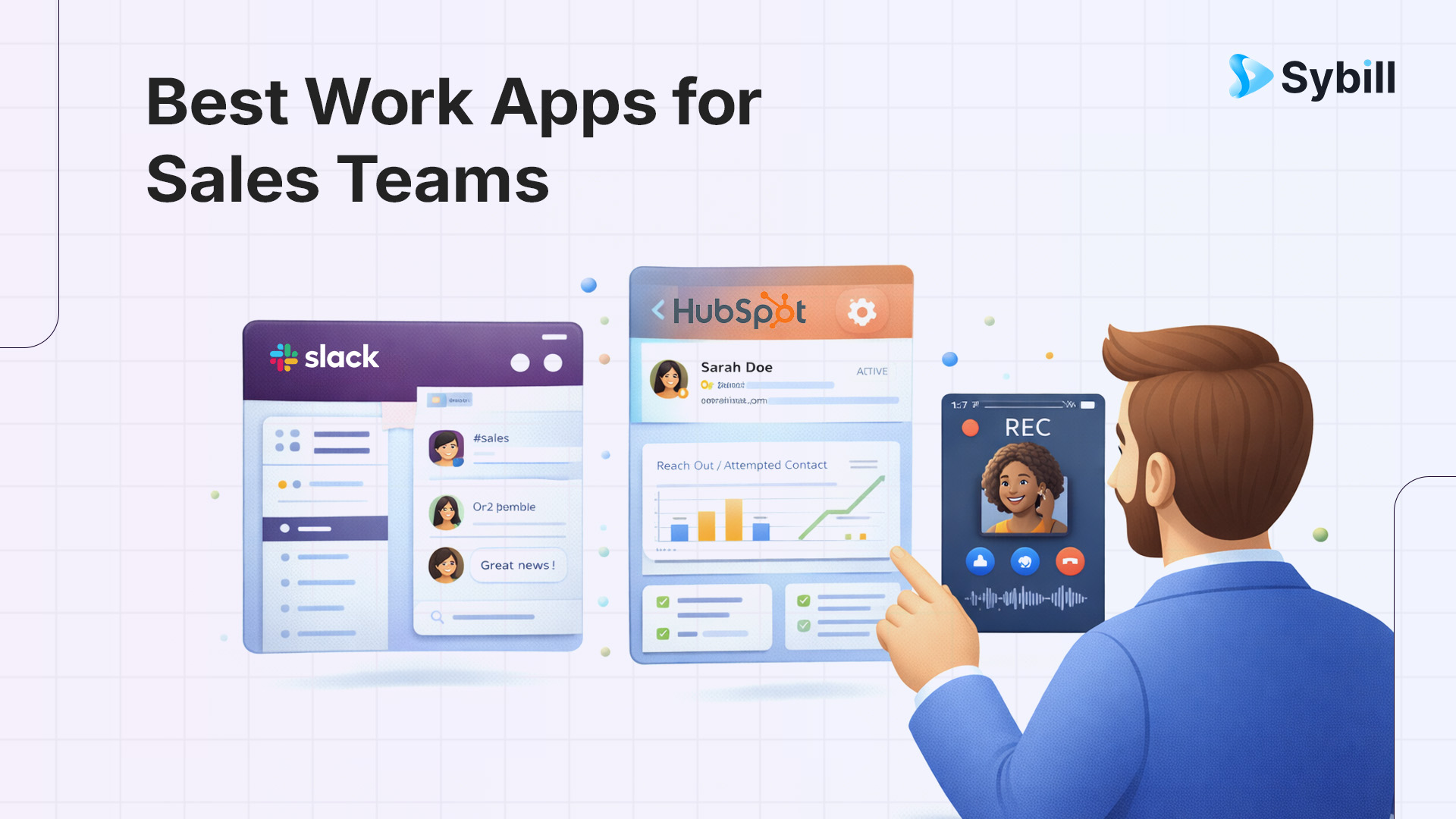
I spent weeks testing the most popular planning, communication, CRM, and automation apps to see how they hold up when your day revolves around sales calls, pipeline management, and closing deals. Here are the 12 best work apps that consistently help sales teams work faster and sell more in 2026.
Every app on this list tackles a different part of the sales workflow. I compared them by their core use case for sellers, starting prices, and where they fit in a typical sales rep's day. Here's how they stack up:
Let's now move to the detailed reviews.
What does it do? Sybill is an AI sales assistant that goes beyond note-taking. It records and summarizes sales calls, auto-fills your CRM with deal-specific data, drafts personalized follow-up emails in your writing style, and lets you ask natural-language questions across your entire pipeline.
Who is it for? Account executives, sales managers, and revenue teams that want to eliminate post-call admin work and keep deals moving without manual effort.
Most sales reps lose 5 to 6 hours every week updating their CRM, writing follow-up emails, and preparing for the next call. Sybill is designed to handle all of that automatically, so sellers can focus on conversations and closing instead of data entry.
After every call, Sybill generates Magic Summaries that capture intent, objections, stakeholder roles, and next steps in a format that's ready to act on immediately. These summaries are pushed to Slack and your CRM without lifting a finger.
What sets Sybill apart from basic AI note-takers is how deep the CRM automation goes. Instead of just logging a transcript, Sybill populates specific fields like Budget, Authority, Need, Timeline, competitor mentions, and custom MEDDPICC or BANT criteria directly into Salesforce or HubSpot. This means your pipeline data stays clean and current without manual upkeep, and managers can finally trust their forecasts.
The follow-up emails are another standout. Sybill drafts them within minutes of a call ending, using your natural writing style and referencing the buyer's actual language from the conversation. Reps send more follow-ups and edit less, which keeps deal momentum going even on days packed with back-to-back calls.
For managers and leaders, Ask Sybill is where the platform becomes a strategic tool. You can ask plain-language questions like "Which deals are missing an economic buyer?" or "What objections came up most this quarter?" and get answers sourced from across all your calls, emails, and CRM data. This transforms pipeline reviews from gut-feel status updates into evidence-backed coaching sessions.
The Deal Workspace centralizes risks, blockers, and multithreading status for individual deals, while Pre-Call Briefs compile buyer signals, previous objections, and context from earlier conversations so reps show up prepared without scrambling through old notes.
If you want to see how real sales teams use these features, Sybill's customer stories offer a good look at the impact.
Sybill saves the average rep 10 to 14 hours per week by automating post-call admin. It is not just a note-taker - it is an AI sales assistant that moves deals forward by handling CRM updates, follow-ups, and deal intelligence while you focus on selling.
What does it do? Salesforce is the most widely used CRM platform, offering pipeline management, sales forecasting, analytics, and deep customization for enterprise sales organizations.
Who is it for? Mid-market and enterprise sales teams that need a fully customizable CRM with advanced reporting, workflow automation, and a massive integration ecosystem.
Salesforce remains the CRM that most B2B sales teams build around. It tracks every deal from lead to close, lets you customize pipeline stages, and connects to virtually every other tool in your sales tech stack.
The platform's strength is its depth. You can build custom objects, automate approval workflows, create territory plans, and generate forecasts with configurable roll-ups. Salesforce Einstein adds AI-driven lead scoring, opportunity insights, and predictive analytics that help managers prioritize deals most likely to close.
For sales managers, the reporting engine is powerful. You can build dashboards that track quota attainment, deal velocity, conversion rates, and rep activity in real time. Combined with pipeline inspection tools, this gives leaders visibility into what is happening across the organization.
However, that power comes with complexity. Salesforce requires dedicated admin support for setup, customization, and ongoing maintenance. Reps often resist using it because manual data entry eats into selling time, which is exactly why many teams pair Salesforce with tools like Sybill's CRM Autofill to keep fields accurate without burdening sellers.
Salesforce is the industry-standard CRM for a reason. It handles complex B2B sales processes at scale. But keeping it accurate and adopted requires either dedicated admin time or CRM automation tools that populate it automatically.
What does it do? HubSpot Sales Hub combines CRM, email tracking, meeting scheduling, pipeline management, and sales automation in a single platform that also connects natively to HubSpot's marketing and service tools.
Who is it for? Growing sales teams, particularly in SMB and mid-market, that want an intuitive CRM with strong marketing alignment and a generous free tier.
HubSpot's biggest advantage for sales teams is how quickly you can get started. The free CRM includes contact management, deal tracking, email templates, and meeting scheduling. It is genuinely useful without paying anything, which makes it a practical choice for early-stage teams or individual reps who need to track deals immediately.
Once you upgrade, the Sales Hub adds sequences for automated outreach, playbooks for guided selling, and conversation intelligence for call recording and analysis. These tools work well for teams that want their reps following a consistent process without building everything from scratch.
The marketing connection is what makes HubSpot particularly powerful. Because marketing and sales live in the same platform, lead handoff is seamless. Reps can see every touchpoint a prospect has had, from the first blog visit to the latest webinar attendance, which helps tailor conversations and improves pipeline generation.
The trade-off is flexibility. HubSpot is opinionated about how sales processes should work, and heavy customization can be limited compared to Salesforce. Reporting is strong but can feel constraining for complex enterprise use cases.
HubSpot Sales Hub is an excellent choice for growing teams that want CRM, outreach, and marketing data in one place. It is easy to adopt and genuinely useful on the free plan, though complex enterprise sales processes may need more flexibility.
What does it do? Slack organizes team conversations into channels, supports direct messaging and huddles, and integrates with CRM, sales, and productivity tools for centralized communication.
Who is it for? Sales teams that need fast, organized communication for deal strategy, cross-functional coordination, and internal alignment.
Slack has become the connective tissue for modern sales organizations. Most teams use it to create deal-specific channels where AEs, SEs, managers, and leadership can collaborate on strategy without long email chains.
For sales specifically, Slack is where the action happens between calls. Reps share competitive intel, flag deal risks, request SE support, and celebrate wins. When integrated with your CRM and AI tools, it becomes even more valuable. For instance, Sybill pushes meeting summaries and AI-generated follow-ups directly to Slack channels, which means deal context is shared with the team instantly after a call ends.
Slack's Workflow Builder, now powered by AI, lets you create automations for deal stage notifications, approval requests, and handoff processes without writing code. Huddles are useful for quick stand-ups or impromptu deal reviews when you need five minutes to align before a prospect meeting.
The challenge is noise. As channels multiply, important signals can get buried. Clear naming conventions and disciplined channel management make the difference between Slack being a productivity boost and a distraction.
Slack is essential for sales teams that rely on speed and cross-functional collaboration. It keeps deal conversations organized and works best when integrated with the CRM and meeting tools your team already uses.
What does it do? Outreach is a sales engagement platform that automates and manages multi-channel sequences across email, phone, LinkedIn, and other touchpoints.
Who is it for? SDR and BDR teams running high-volume outbound prospecting, and AEs managing structured outreach cadences to progress deals.
Outreach solves the problem of keeping prospecting consistent at scale. You build sequences that combine automated emails with manual tasks like phone calls and LinkedIn messages, then track which steps drive replies and meetings.
The platform's strength is in its sequencing engine. You can A/B test subject lines, optimize send times, and analyze reply rates to refine your messaging. For SDR teams that make dozens or hundreds of touches daily, this structured approach keeps activity levels high without relying on memory or sticky notes.
Outreach also supports deal management features, though most teams use it primarily for top-of-funnel activity. The analytics layer shows managers which sequences convert best, which reps are hitting activity targets, and where prospects are dropping off.
The learning curve is real. Outreach has a lot of settings, and getting sequences right requires testing and iteration. Pricing is also enterprise-grade, which puts it out of reach for smaller teams.
Outreach is the go-to for teams that need structured, high-volume prospecting. It keeps outbound consistent and measurable, though it is best suited for organizations with the budget and headcount to justify the investment.
What does it do? LinkedIn Sales Navigator gives sales reps advanced search, lead recommendations, and InMail access to find and engage prospects on the world's largest professional network.
Who is it for? SDRs, BDRs, and AEs who prospect into B2B accounts and need to identify, research, and connect with decision-makers.
LinkedIn Sales Navigator remains the most direct way to find the right people in target accounts. Its advanced search lets you filter by seniority, function, company size, industry, and geography, then save leads and accounts to get alerts when prospects change jobs, post updates, or engage with content.
For account-based selling, the account mapping features are particularly useful. You can see the organizational chart, identify potential champions, and find warm paths through shared connections or mutual interactions.
The integration with CRM platforms lets you sync leads and log InMail activity, which helps keep prospecting connected to your broader pipeline management.
Sales Navigator works best when combined with a strong outreach strategy. The tool helps you find and research prospects, but converting them into conversations still depends on your messaging, timing, and follow-up discipline.
Sales Navigator is essential for B2B prospecting. It gives you the best access to professional buyer data, but turning that data into pipeline depends on your outreach strategy and execution.
What does it do? Calendly lets prospects and teammates book meetings directly on your calendar based on your real-time availability, eliminating scheduling emails.
Who is it for? Any seller who books discovery calls, demos, or follow-up meetings and wants to remove friction from the scheduling process.
Scheduling sounds simple until you calculate how much time it actually takes. The average meeting takes three to five emails to book. Multiply that by every prospect conversation, and you're losing hours every week to logistical ping-pong.
Calendly solves this by sharing a booking link that shows your real-time availability. Prospects pick a time, and it automatically creates calendar events, sends confirmations, and adds reminders. For sales teams, this speed matters. The faster a prospect books, the less likely they are to go cold.
The platform supports round-robin routing, so inbound leads get distributed evenly across reps. You can embed booking pages on your website, include them in outreach sequences, and set buffer times between meetings to avoid back-to-back burnout.
Calendly integrates with Google Calendar, Outlook, Salesforce, HubSpot, and Zoom, which keeps everything connected to your existing workflow.
Calendly is a small tool that saves disproportionate time. For sellers booking multiple meetings daily, removing the scheduling friction compounds into hours saved every week.
What does it do? Notion gives you a customizable workspace to organize notes, documents, wikis, and databases in whatever structure works for your team.
Who is it for? Sales teams that need a flexible system for playbooks, competitive battle cards, onboarding documentation, and shared deal rooms.
Notion is not a sales tool in the traditional sense, but many sales teams rely on it for knowledge management. It is where they store sales playbooks, competitive intelligence, objection-handling guides, and onboarding materials.
The flexibility is the appeal. You can build a competitive intel database where reps log what they hear on calls and everyone can search for the latest positioning. You can create deal room templates with standard sections for timeline, stakeholders, risks, and next steps. You can maintain an FAQ wiki that gets updated as the product evolves.
Notion's real-time collaboration means multiple team members can edit simultaneously, leave comments, and tag each other on updates. It is particularly useful for cross-functional deal teams that need a single place to organize complex enterprise deals.
The limitation for sales is that Notion does not connect to your CRM or pull data from sales conversations automatically. It is a manual system, which means it stays useful only if the team maintains it. For deal-specific intelligence that updates itself, tools like Sybill's Deal Workspace fill that gap.
Notion is the best workspace for organizing sales knowledge and team documentation. It shines when the team actively maintains it, but for deal-specific intelligence that updates automatically, you will need it alongside a dedicated AI sales assistant.
What does it do? Clari consolidates CRM, activity, and engagement data to create a unified revenue view with AI-powered forecasting and pipeline inspection.
Who is it for? Sales leaders, RevOps teams, and CROs who need accurate forecasts, pipeline visibility, and early warning on revenue risks.
Forecasting is one of the hardest parts of sales leadership. Reps are optimistic. CRM data is incomplete. And the end-of-quarter scramble happens because nobody spotted the risk early enough. Clari addresses this by pulling data from your CRM, email, calendar, and engagement tools to create a single view of revenue.
The platform's AI models analyze historical patterns and current deal signals to predict which deals will close, which will slip, and where the pipeline is thin. This gives leaders confidence in their forecast and helps them intervene before it is too late.
Clari also surfaces account engagement trends, showing which deals have gone quiet and which have active buyer involvement. For organizations that run weekly or biweekly pipeline reviews, this kind of visibility transforms the quality of those conversations.
The trade-off is that Clari's value scales with data quality. If your CRM is incomplete or reps are not logging activity consistently, the predictions suffer. This is why many teams focus on CRM automation first and then layer forecasting tools on top.
Clari is the forecasting platform sales leaders trust when the board asks about pipeline confidence. Its accuracy depends on the CRM data going in, so pairing it with tools that automate CRM updates maximizes its value.
What does it do? Zapier connects your apps and automates repetitive tasks by building workflows called Zaps, triggered by events across your tools.
Who is it for? Sales teams and RevOps professionals who want to automate handoffs, notifications, and data syncing between the tools in their stack.
Most sales teams use at least five to eight different tools daily. CRM, email, calendar, prospecting, communication, proposal software, and more. Zapier is the glue that connects them.
You can set up automations like: when a deal moves to "Closed Won" in Salesforce, send a Slack notification to the CS team and create an onboarding task in Asana. Or when a prospect fills out a demo request form, automatically create a CRM contact and add them to an Outreach sequence.
Zapier's strength is breadth. It connects to 8,000+ apps, which means almost any combination of tools in your sales tech stack can be linked. The no-code builder makes it accessible for RevOps teams that need to build integrations without engineering support.
The limitation is that Zapier works best for straightforward trigger-action workflows. Complex logic, conditional branching, and high-volume automations can get expensive and difficult to debug. For automating the actual sales work like CRM updates from call data or AI-drafted emails, you need tools purpose-built for that.
Zapier is indispensable for connecting your sales tools and automating the handoffs between them. It is best used for inter-app workflows, while purpose-built sales AI handles the deal-specific automation.
What does it do? Loom lets you record and share short video messages combining your screen, camera, and voice - perfect for personalized outreach and asynchronous communication.
Who is it for? SDRs and AEs who want to stand out in crowded inboxes with personalized video prospecting, demos, and follow-up messages.
Text-based outreach gets ignored. A personalized video where you walk through a prospect's website, reference their recent funding round, or demonstrate a feature specific to their use case gets watched. That is Loom's value for sales teams.
Reps use Loom to create quick prospecting videos that show genuine effort and personalization. Instead of writing a paragraph explaining how your solution helps, you can show it on screen in 90 seconds. The engagement analytics tell you who watched, how much they watched, and when they replayed certain sections.
Loom also works well for internal communication. Instead of writing a long Slack message about deal context or sending a meeting invite for a five-minute update, you record a quick video and share the link. This saves time for everyone while preserving the nuance that gets lost in text.
The main limitation is that video prospecting requires effort per message, which limits scale. It works best for high-value prospects or mid-funnel follow-ups where personalization matters most.
Loom adds a human element to outreach that text cannot match. It is most effective for targeted prospecting and mid-funnel engagement, where the effort of a personalized video pays off in higher response rates.
I tested each tool within active sales workflows - real pipeline management, prospecting, call follow-ups, and deal coordination, to see how they performed in the context of an actual selling day. A tool can look great in a demo, but the real test is whether it saves time and moves deals when used under pressure.
Here's what I evaluated:
I integrated each app into a full week of sales activity that included discovery calls, demos, pipeline reviews, and prospecting sessions. I tracked how much time each tool saved and whether it reduced context-switching between apps.
For CRM and automation tools, I tested whether the data flowing into Salesforce and HubSpot was accurate, complete, and actionable. Incomplete CRM data is the root cause of bad forecasting and wasted coaching time, so this was a critical factor.
I measured whether tools helped move deals faster. This included follow-up speed after calls, quality of meeting preparation, and how quickly cross-functional teams could align on deal strategy.
For tools used by managers and leaders, I assessed whether they made pipeline reviews more productive and coaching more evidence-based. The best tools replace opinion with data.
I tested how well each tool connected to the others. Sales teams do not work in isolated tools. They work across CRM, email, calendar, video, and communication platforms simultaneously.
The right work app depends on where you are losing time and where deals are stalling. Most sales teams need a combination of tools, but each one should earn its place in your stack.
After testing these tools across real selling workflows, the pattern is clear: the apps that make the biggest difference are the ones that eliminate the work sellers should not be doing in the first place.
Sybill made the largest impact on daily productivity because it automated the tasks that consume the most time: CRM updates, follow-up emails, meeting prep, while giving managers clean pipeline data they could actually trust. It is the closest thing to adding headcount without hiring.
But no single tool does everything. If your pipeline relies on high-volume outbound, Outreach keeps prospecting disciplined. If your leadership needs forecast confidence, Clari provides the analytics. If your team communicates at speed, Slack holds the deal context together.
Start with the problem that costs you the most time or revenue, pick the tool that directly addresses it, and make sure it integrates well with what you already use.
If your team is losing hours every week to CRM updates, writing follow-ups, and scrambling to prepare for meetings, Sybill handles all of that so you can focus on selling.
Here's why sales teams choose Sybill over basic note-takers:
The best work apps for sales teams cover five core areas: CRM for pipeline management (Salesforce, HubSpot), AI sales assistants for automating admin work (Sybill), communication tools for deal coordination (Slack), prospecting platforms for finding buyers (LinkedIn Sales Navigator, Outreach), and scheduling tools for booking meetings faster (Calendly). The right combination depends on your team's size, deal complexity, and where reps are losing the most time.
AI note-takers record meetings and generate transcripts. AI sales assistants go further by automating post-call execution. Sybill, for example, auto-fills CRM fields with deal-specific data, drafts follow-up emails in your writing style, generates pre-call briefs, and lets you query your entire pipeline with natural language. The difference is between documenting work and actually doing it.
Yes. Every tool on this list integrates with Salesforce, HubSpot, or both. Sybill connects natively to Salesforce and HubSpot for CRM autofill and pushes summaries to Slack. Outreach, Gong, Calendly, and Clari also offer direct CRM integrations. Zapier can bridge connections for tools without native integrations.