
Find us at booth #83, join us for a harbor side happy hour, or catch Gorish’s talk.

Sept, 16-18 > Learn more


Tamanna Mishra

May 15, 2026
Every sales rep has a system.
Their own notes. Their own follow-ups. Their own way of running discovery. Their own version of what “good” looks like.
Now zoom out.
Ask five reps how they qualify a deal, run a first call, or decide next steps. You will get five different answers. All confident. All inconsistent.
A sales playbook is a documented system that codifies your team’s winning sales behaviors — including messaging frameworks, objection responses, competitive positioning, discovery questions, and stage-specific actions — into a repeatable, coachable operating manual that reduces ramp time by 30-50%, improves win rates, and eliminates deal inconsistency across reps. The most effective sales playbooks in 2026 are built from actual closed-won deal patterns rather than leadership assumptions, organized by sales plays (situational actions for specific scenarios like competitive displacement, expansion, or inbound qualification), and operationalized by AI tools like Sybill that capture real conversation data to validate which plays actually work, auto-generate follow-ups aligned to the playbook, and flag when reps deviate from proven frameworks.
When results wobble, the instinct is to hire sharper reps, run more training, or swap one more enablement tool. That is lazy leadership. The problem is rarely talent. It is the absence of a real sales playbook.
Think about elite sports teams. Stacked rosters still lose when players improvise without a shared playbook. Raw skill does not replace coordination. B2B sales is no different. When every rep runs their own motion, outcomes become unpredictable by default.
Most sales playbooks fail quietly because they are treated as documentation projects. A static PDF. A forgotten wiki page. A well-intentioned onboarding artifact that never shows up in live deals. Reps do not ignore these playbooks out of rebellion. They ignore them because they are disconnected from how selling actually happens.
The real sales playbook meaning has nothing to do with documentation. Modern sales playbooks are execution systems. They align how teams run sales plays, interpret buyer signals, and move deals forward at scale. A strong B2B sales playbook does not constrain great reps. It makes excellence repeatable.
This guide is a practical breakdown of how modern teams design, operationalize, and evolve sales playbooks that actually drive revenue.
A sales play is a repeatable, goal-driven action designed for a specific moment in the sales cycle. Not a vibe. Not a suggestion. A deliberate move with a clear trigger and a measurable outcome.
That distinction matters more than most teams realize. When sales plays are poorly defined, sales playbooks turn into cluttered libraries of tactics with no accountability. Sales reps do things, but nothing compounds.
Here are three common sales plays most B2B teams run, often without realizing it.
Objective: Confirm value, align next steps, and progress the deal.
Success: Not "email sent" but next meeting booked with decision-makers.
Objective: Expand stakeholder coverage.
Success: Engagement from at least one additional buying role.
Objective: Restart momentum or disqualify fast.
Success: Response or a clear no.
Notice the pattern. Sales plays are situational. Each play should answer three questions clearly: when to run it, who runs it, and what success looks like.
Most teams stop at documenting tactics. Send this email. Ask this question. Run this sequence. They rarely document outcomes. That is why sales playbooks feel busy but ineffective.
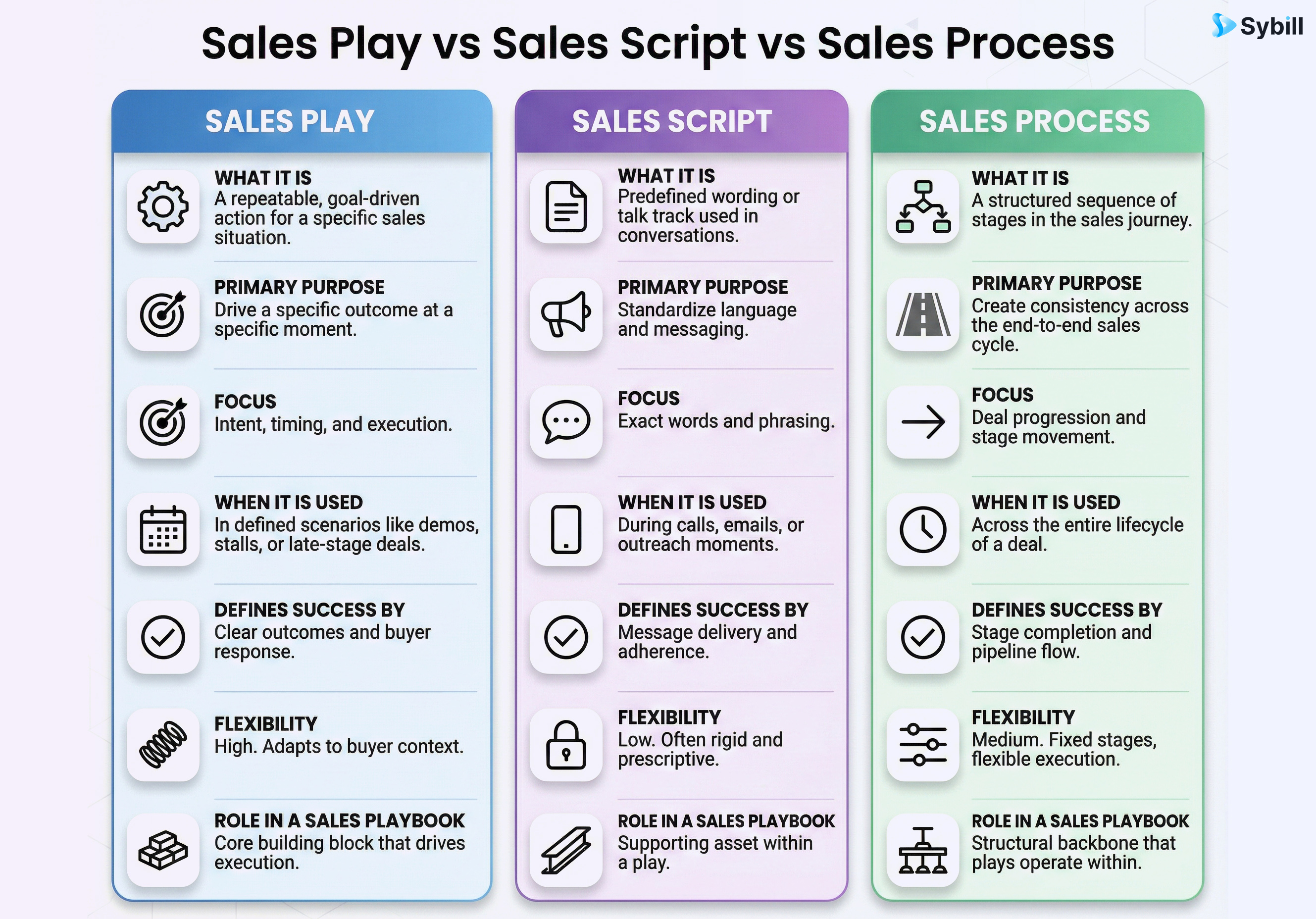
To be clear, a sales play is not a sales script. Scripts dictate words. Plays dictate intent and direction. A sales play is also not a sales process. Processes define stages. Plays define what winning behavior looks like inside those stages.
Get this wrong, and your entire sales playbook meaning collapses.
Most sales plays fail not because reps do not know what to do, but because they do not know what to do next, right now, for this deal.
Sybill removes that guesswork by turning live deal context into executable sales plays.
Instead of relying on memory, gut feel, or static playbook pages, reps can ask Sybill in plain English and execute the right sales play at the right time.
That is what modern sales plays look like when they are actually operationalized.
Click here to try Sybill free.
Ask ten sales leaders what a sales playbook is and most will point to a document. A slide deck. A wiki. Something reps are supposed to read, bookmark, and magically apply.
That assumption is exactly why most sales playbooks fail.
A sales playbook is the system that organizes, deploys, and evolves sales plays across the entire revenue motion. Not a reference file. Not onboarding homework. Not a Google doc. A system that works.
A modern B2B sales playbook is often misunderstood because teams confuse it with supporting assets.
A sales playbook is not:
Documents explain. Training educates. Enablement assists.
A sales playbook drives execution.
Top teams treat sales playbooks like internal operating systems. Everything flows through them.
This is how playbooks align people, process, and timing without turning reps into robots.
A sales playbook that works has three non-negotiable traits.
Get the sales playbook meaning right, and scale becomes predictable. Get it wrong, and no amount of hiring will fix the chaos.
Most B2B teams think they have a sales playbook. What they usually have is a sales process and a pile of enablement content. That gap is where execution breaks.
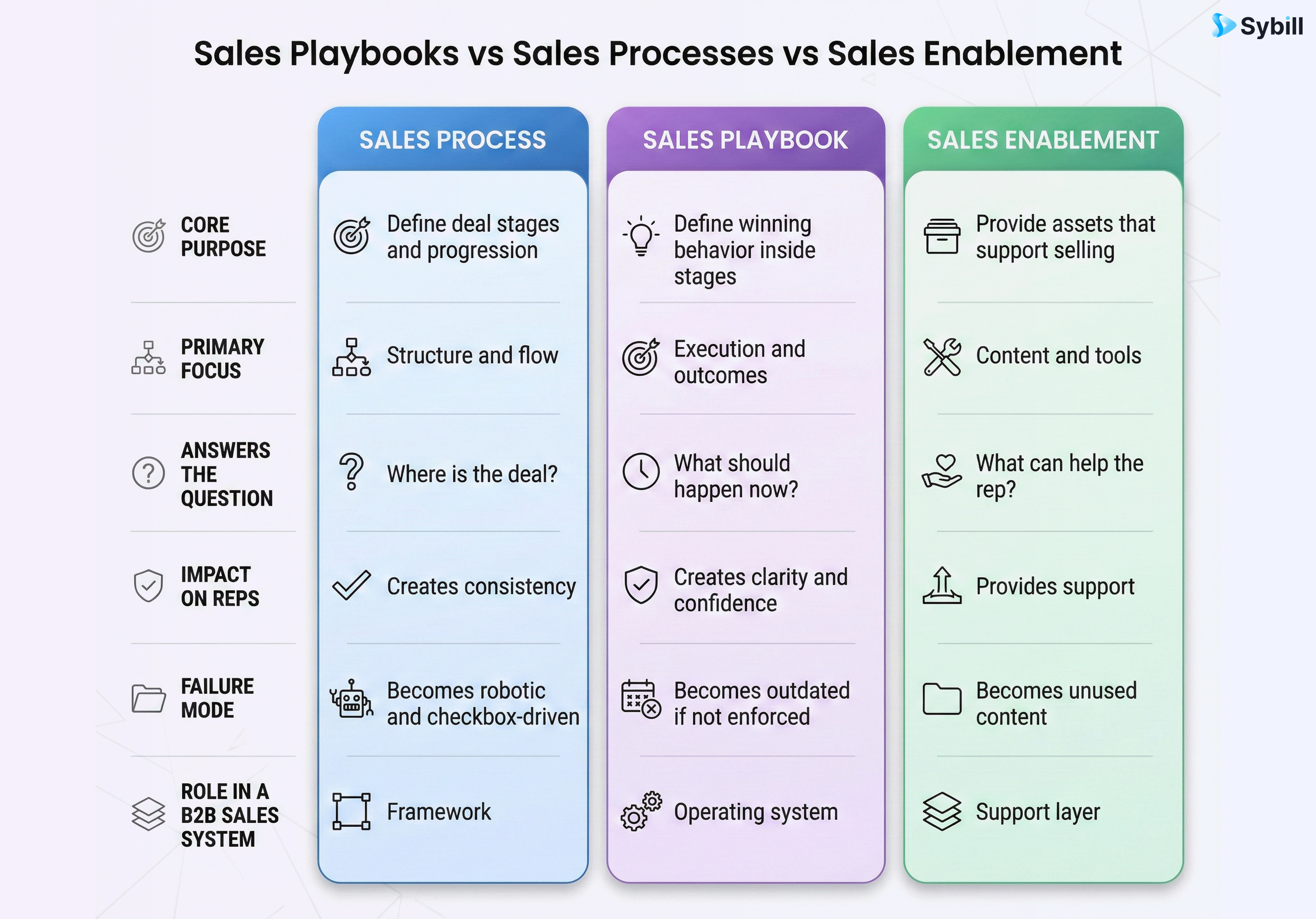
Sales processes, sales playbooks, and sales enablement solve different problems. When teams blur those lines, selling becomes either robotic or chaotic.
A sales process without a sales playbook turns reps into stage managers. They focus on moving deals forward on paper instead of winning in conversations. The result is checkbox selling. Stages advance, but buyer conviction does not.
Processes create structure. Playbooks create judgment.
Enablement teams produce content at scale. Decks, scripts, battlecards, templates. Without a B2B sales playbook to anchor execution, reps pick what they like and ignore the rest. Usage drops. Consistency disappears.
Enablement works best when it supports clearly defined sales plays instead of acting as a content warehouse.
Most RevOps teams over-invest in process optimization and content production while under-investing in execution clarity. They measure stage velocity and asset usage, but not whether the right behaviors happened at the right time.
A strong sales playbook bridges that gap. It connects process to behavior and enablement to outcomes.
B2B sales has changed faster than most teams want to admit. Buyers show up informed. Deals are multi-threaded by default. Sales cycles zigzag instead of moving neatly from stage to stage. In that environment, relying on instinct or experience alone is a liability.
This is exactly why a B2B sales playbook has shifted from “nice to have” to non-negotiable.
Three structural changes define today’s buying reality.
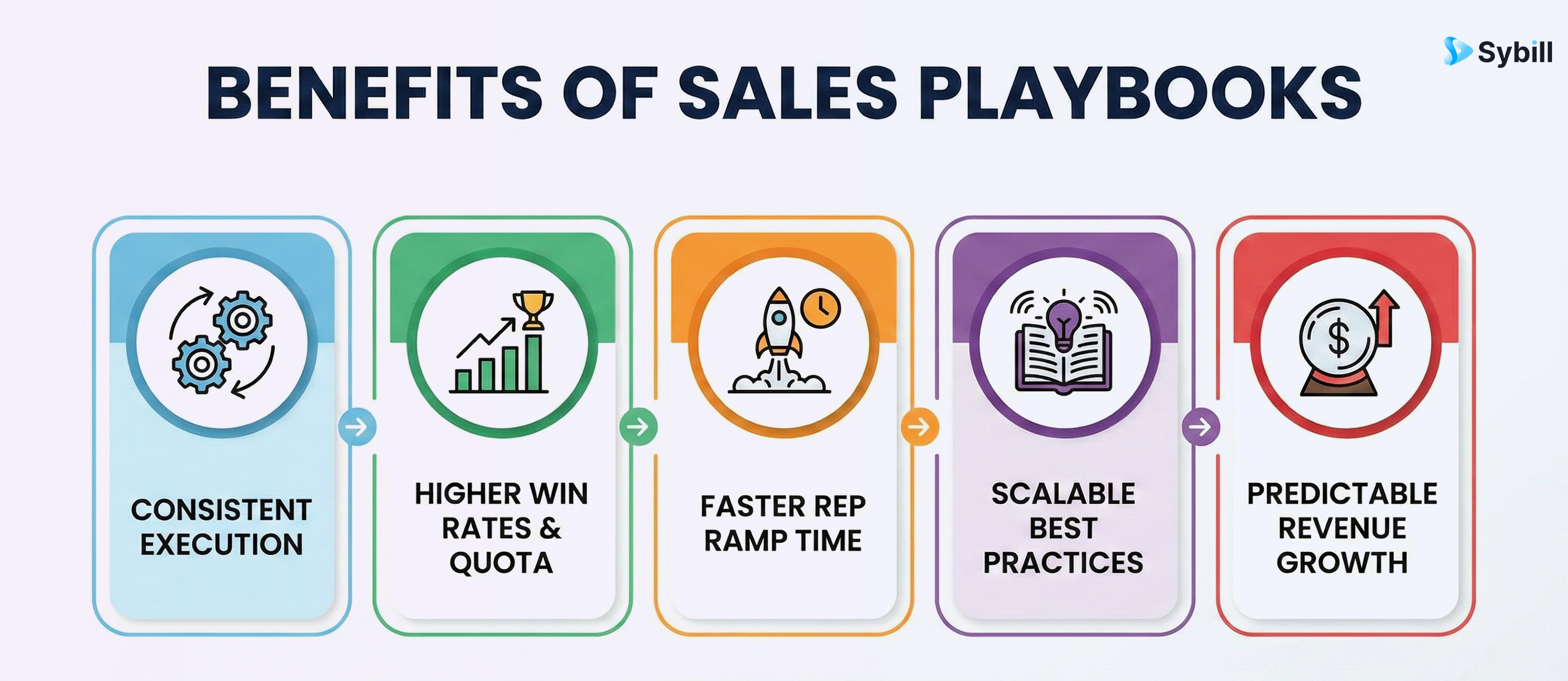
The impact of structured playbooks shows up consistently in performance data.
The takeaway is simple. Structure does not slow sales teams down. It removes friction.
Sales intuition works for individuals. It does not scale across teams.
A sales playbook is how B2B teams move from hero-driven selling to system-driven growth. It replaces guesswork with clarity and makes success repeatable, not accidental.
Next, we can break down what should actually go inside a modern sales playbook and how to structure it for real-world execution.
If you are wondering what is in a sales playbook, this is the structure to bookmark. Not theoretical. Not bloated. Built for real B2B execution.
A modern sales playbook template should answer one question relentlessly: what should happen next, and how do we know it worked?
Below is a clean, revenue-ready framework used by high-performing teams.
Every sales playbook starts with clarity on who you are selling to and how buying decisions actually happen.
This prevents reps from running the right plays on the wrong deals.
Click here to learn how to operationalize ICP through a sales playbook.
Stages matter only if movement is earned.
This keeps the pipeline honest and forecasting grounded.
This is the heart of the sales playbook.
Each play should specify when to run it, who owns it, and what success looks like.
Click here to learn how Sybill can help with this.
Messaging without context creates noise.
The goal is confident conversations, not scripted monologues.
Winning deals are decided after the call ends.
This is where momentum is protected or lost.
A sales playbook only works if it can be inspected.
This turns coaching from opinion into evidence.
This is what a modern sales playbook looks like when it is designed for execution, not documentation.
Most sales playbook examples online focus on scripts. That is the wrong place to look. Strong sales playbooks are defined by structure, timing, and outcomes, not just clever wording.
Below are three practical sales playbook examples that show how high-performing teams organize execution.
Designed for speed, learning, and fast disqualification.
Why it works: early teams optimize for signal, not scale.
Built to turn interest into momentum without bloating the cycle.
Why it works: momentum is engineered, not left to rep judgment.
Designed for complexity, politics, and long buying cycles.
Why it works: progress is measured by buyer commitment, not meetings held.
Across these sales playbooks, consistent patterns show up.
Strong sales playbooks do not tell reps what to say. They tell teams what winning looks like and how to get there, consistently.
Most startups delay building a sales playbook because they are afraid it will slow them down. In reality, what slows teams down is ambiguity. A lightweight sales playbook template creates speed by removing guesswork, not adding process.
The mistake early teams make is trying to build a “complete” playbook. That is how momentum dies.
Startups that build effective sales playbook templates follow a simple, disciplined loop.
Thin playbooks force clarity. They make patterns visible. They prevent reps from hiding behind activity.
Founders often over-engineer playbooks by adding scripts, edge cases, and “nice-to-haves” far too early. That creates cognitive overload and zero adoption.
Formalize when:
Stay flexible when:
The goal is repeatability without rigidity. A startup sales playbook should evolve as fast as the business does.
Most sales playbooks break not at design but at execution.
A sales playbook template can look perfect on paper and still fail if it relies on memory, manual updates, or manager enforcement. Scaling sales playbooks requires technology that sits inside real workflows.
This is where AI tools like Sybill become the differentiator.
Sales playbooks fail when they are built on incomplete data.
How Sybill helps
Instead of relying on what reps remember, your sales playbooks are grounded in what buyers actually said.
Raw conversations are useless unless they are structured and accessible.
How Sybill helps
This turns sales plays from theory into informed action.
Most teams confuse enforcement with oversight. That kills adoption.
How Sybill helps
Sales playbooks become self-reinforcing, not manager-dependent.
Momentum is lost after calls, not during them.
How Sybill helps
Execution stays consistent without slowing reps down.
Static sales playbooks die quietly.
How Sybill helps
Your sales playbooks evolve based on reality, not retrospectives.
Technology makes sales playbooks executable at scale. That is the difference between documenting best practices and actually running them.
Free sales playbook templates are useful when teams need structure fast. They help define stages, outline sales plays, and create a shared starting language. For early teams, that clarity matters.
They start hurting when teams treat templates as finished answers. Copying someone else’s scripts, messaging, or plays ignores buyer context, deal complexity, and product reality. That is how playbooks become shelfware.
The right approach is simple.
Sales playbooks fail when they live outside real selling. When they sit in folders, wikis, or onboarding decks, they become reference material instead of execution systems. That is why so many teams have sales playbooks and still struggle with inconsistency.
The missing link is buyer conversation data. Deals move or stall based on what buyers say, hesitate on, or avoid altogether. A sales playbook that is not connected to those signals will always lag reality.
Sybill closes that gap by operationalizing sales playbooks using real sales data from calls, emails, calendars, and CRM. Instead of guessing which sales plays to run, teams act on evidence, scale what works, and course-correct faster.
That is the difference between documenting best practices and building a revenue system that actually compounds.
The most common sales playbook mistakes have nothing to do with effort and everything to do with execution. Teams treat playbooks as onboarding artifacts instead of daily operating systems. They overload them with scripts and templates that look helpful but never get used. There is no inspection loop, so no one knows whether plays are actually being run. Ownership is unclear, accountability is missing, and the playbook slowly goes stale. In a fast-moving market, static documentation guarantees irrelevance.
A playbook in sales is a system that defines how sales teams execute at each moment of the buying journey. Unlike a sales process, which outlines stages, or sales enablement, which provides assets, a sales playbook specifies the behaviors, decisions, and actions that move deals forward. It connects strategy to execution by turning winning patterns into repeatable sales plays.
What a sales playbook should look like is simple, navigable, and built for use, not storage. It should follow a stage-based structure, clearly mapping sales plays to buyer moments. Visual clutter should be minimal so reps can find answers fast. Most importantly, it must be embedded into sales workflows through tools reps already use, not buried in folders or standalone documents.








