Find us at booth #83, join us for a harbor side happy hour, or catch Gorish’s talk.

Sept, 16-18 > Learn more

%20(1).avif)
Mamta Tainwala

February 26, 2026
Picking a sales meeting tool in 2026 feels a little like choosing a restaurant in a city you've never visited. There are too many options, everyone has a strong opinion, and the menus all look suspiciously similar until you actually sit down.
Gong, Otter.ai, and Sybill are three names that come up constantly in sales tech conversations. They all record meetings. They all produce summaries. And yet, they are built for fundamentally different jobs, different team sizes, different budgets, and different definitions of "done."
Here's what this guide covers:
Let's start with the snapshot.
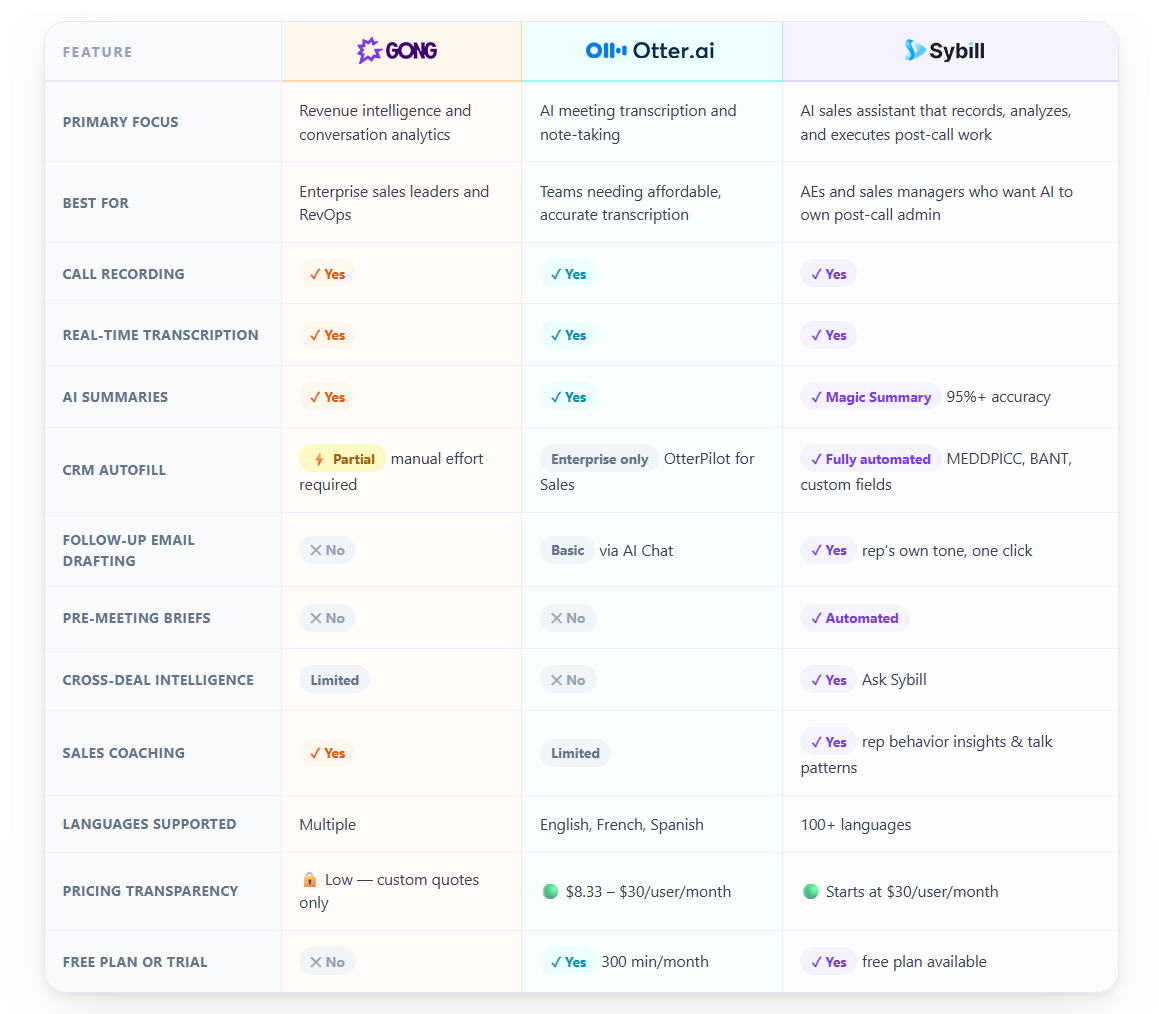
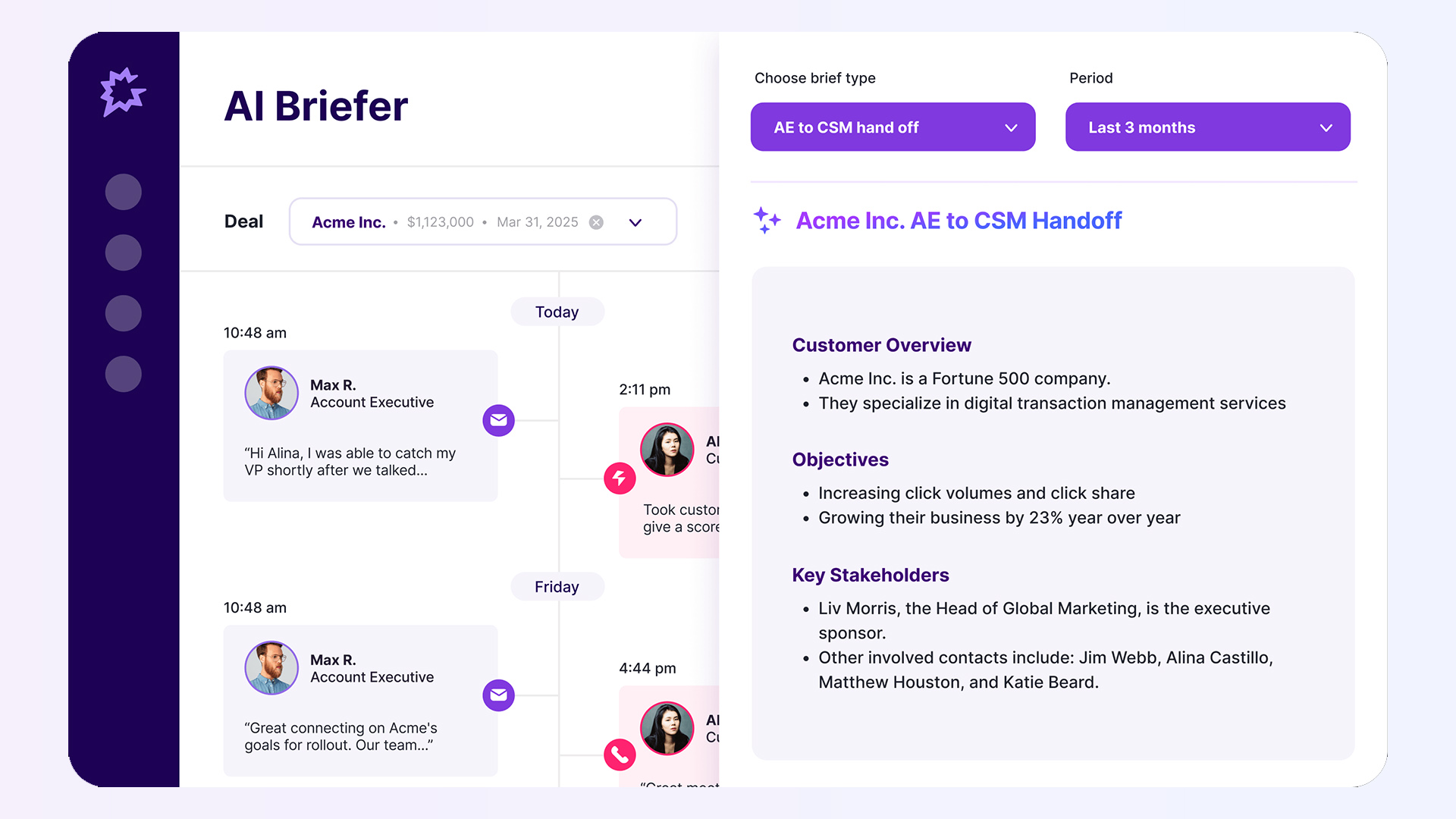
Gong is the heavyweight of the group. Founded in 2015 and rebranded as a Revenue Intelligence platform, it has spent years becoming the tool that sales leadership uses to understand what's happening across every deal, every rep, and every stage of the pipeline.
The platform captures calls, emails, and meeting data, analyzes it with AI, and surfaces patterns: which reps are handling objections well, which deals are going cold, which messaging themes correlate with wins. For a VP of Sales who wants to coach at scale and forecast with confidence, Gong offers a depth of insight that few tools can match.
Conversation intelligence is genuinely excellent. Gong records and transcribes calls, identifies key moments like competitor mentions, pricing discussions, and objection patterns, and builds a searchable library your entire org can learn from.
Deal intelligence gives leaders a cross-deal view of what's at risk and what's trending in the right direction, without relying on what reps self-report. That alone is worth something when your pipeline review is three days away and your CRM is a work of fiction.
Coaching workflows allow managers to clip call moments, leave timestamped feedback, and build shared coaching libraries from real conversations. New reps ramp faster when they can learn from recordings of top performers instead of role-play scenarios someone invented in a conference room.
For a deeper look at how conversation intelligence platforms should be evaluated before you sign anything, the best conversation intelligence tools guide on Sybill's blog is a useful framework to run through.
Gong is expensive by design. Per-user costs run between $1,300 and $1,600 annually, plus a mandatory platform fee of $5,000 or more. A 20-person team is looking at $30,000 to $40,000 before a single add-on is touched.
Beyond pricing, Gong is built for the leader looking down, not the rep looking forward. Reps often describe it as a surveillance tool rather than a helpful one. Post-call admin, CRM updates, follow-up emails, and meeting prep remain manual. Gong tells you what happened on the call. What happens next is entirely on the human.
Pricing is not published. You need to request a quote, which is itself a minor commitment.
Gong fits well if you are:
Otter.ai was not built for sales teams. That's important to say clearly, because it often ends up in sales tech stacks anyway, especially at early-stage companies looking for an affordable transcription tool to cover their calls.
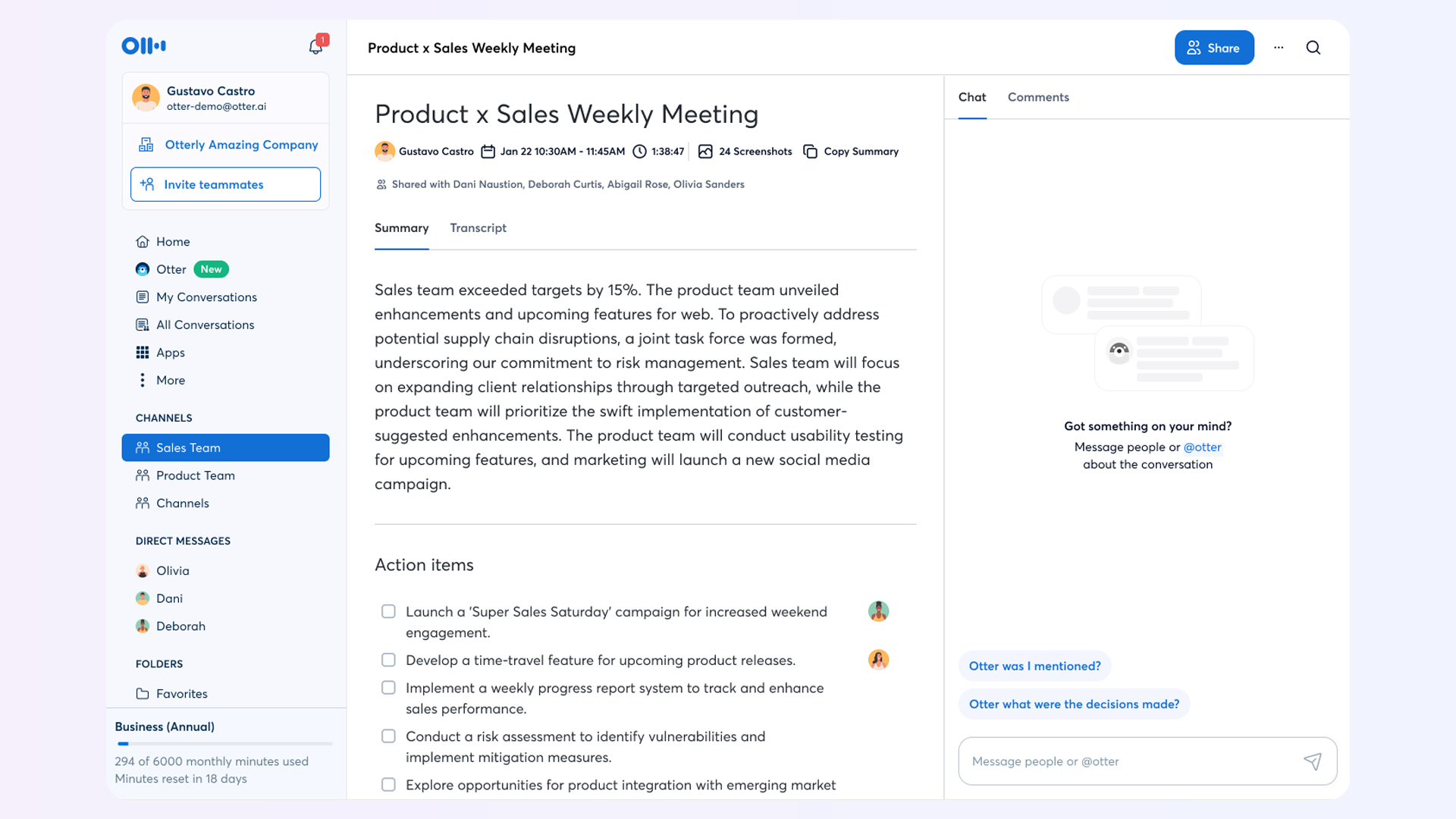
Otter is fundamentally an AI meeting transcription platform. It records meetings, identifies speakers, generates summaries, and produces action items. It integrates cleanly with Zoom, Google Meet, and Microsoft Teams. For what it costs, it does its core job reliably well.
The OtterPilot bot joins meetings automatically, generates real-time notes, captures shared slides, and can answer questions about the meeting after it ends via Otter AI Chat. For many teams that just need an affordable, accurate transcript, Otter delivers.
Transcription accuracy is one of Otter's genuine strengths, particularly for standard American English. Users consistently rate it highly in Reddit threads and G2 reviews for clarity and speaker identification.
Ease of setup is another real advantage. There's no long onboarding cycle, no implementation fee, and no sales call required to get started. You sign up, connect your calendar, and Otter starts showing up to meetings.
Affordability is the reason most people try it. At $8.33/month for the Pro plan when billed annually, it's one of the cheapest ways to get clean transcripts and AI summaries of your sales calls.
Otter AI Chat lets users ask questions across their meeting library, which is genuinely useful for surfacing what was discussed weeks ago without listening to full recordings.
Here's where Otter becomes a mismatch for serious sales teams.
The sales-specific features, branded as OtterPilot for Sales, are locked behind the Enterprise plan. That means CRM sync to Salesforce or HubSpot, sales-specific call analysis, deal insight extraction, and coaching tools are unavailable unless you're on a custom enterprise contract, which runs $15,000 to $35,000 annually. You can't just upgrade a tier to get them.
Otter supports only three languages: English, French, and Spanish. For global sales teams, that's a hard wall.
The free and mid-tier plans have hard minute caps per month. Hit them early and you wait, or you upgrade. There's no overflow pricing. When your limit runs out on the 20th of the month, Otter stops transcribing until the cycle resets.
At its core, Otter takes notes. It documents what happened. What that means for a sales team is that your reps still update the CRM themselves, still draft the follow-up email, still prep for the next call from scratch. The transcription is helpful, but the work is still there.
Note: Sales features are only available on the Enterprise plan. The lower tiers, while affordable, are essentially general-purpose meeting transcription.
Otter is a solid choice if you are:
For teams that have outgrown Otter's free or Pro limits, the jump to Enterprise just to access CRM integration is a steep one. That gap is where other tools step in.
Sybill is the newest of the three tools in terms of sales AI maturity, and it's the only one in this comparison that was built specifically for the rep's workflow, not the leader's dashboard.
Where Gong answers "what's happening in my deals?" and Otter answers "what was said in my meetings?", Sybill answers something more immediately useful: "what needs to happen next, and can you just do it for me?"
It's an AI sales assistant, not a note-taker. The distinction matters more than it sounds.
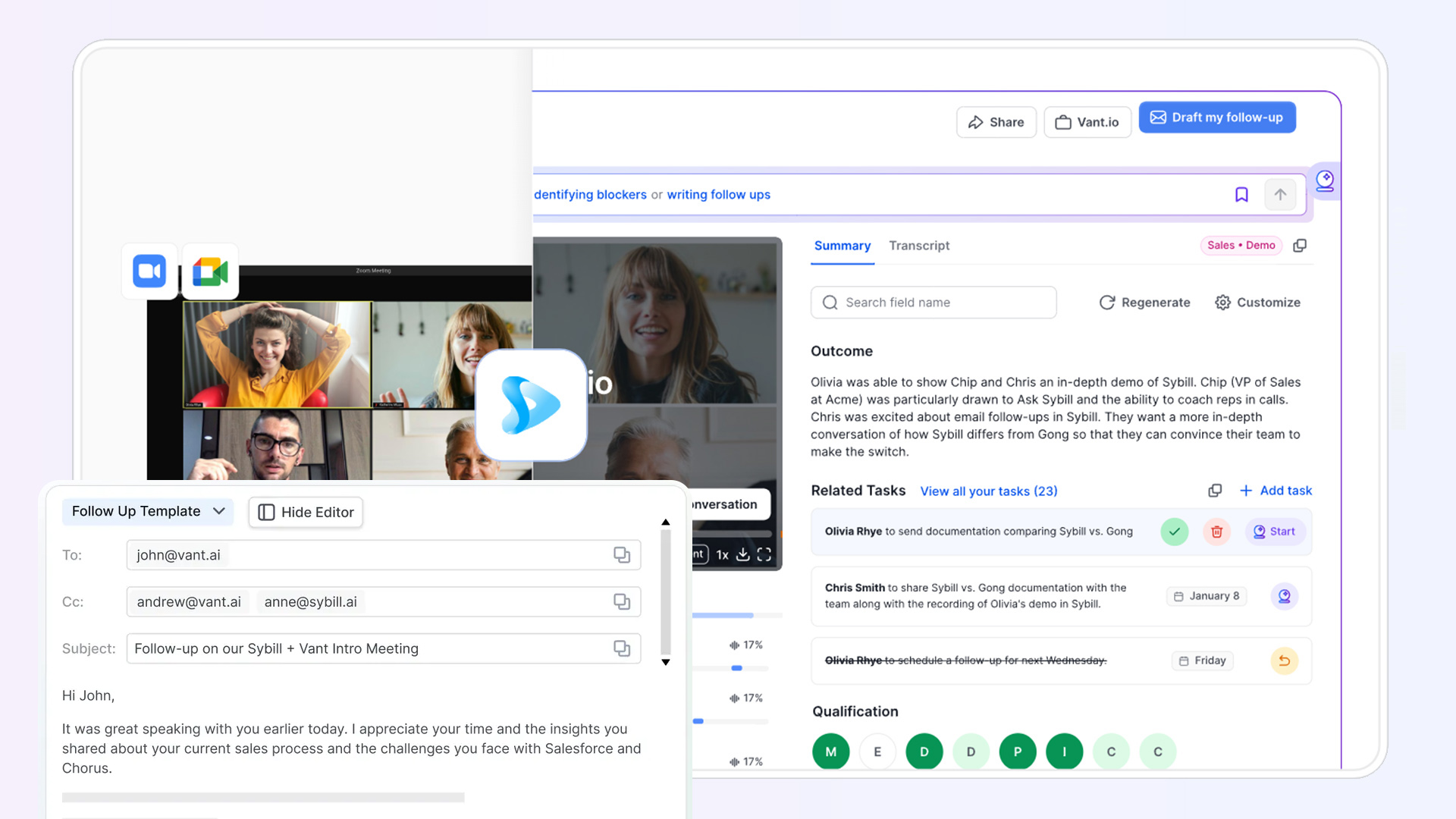
Magic Summary is Sybill's take on call summaries, and it consistently earns high marks from users for accuracy and relevance. Unlike generic summaries that paraphrase everything equally, Magic Summary is structured around what matters in a sales context: buyer pain points, key objections raised, next steps agreed on, and deal signals. Sybill claims 95%+ accuracy on these summaries, and independent user reviews tend to validate that.
Automated CRM autofill is where Sybill earns its keep for revenue teams. It doesn't just push free-text notes to your CRM. It populates structured fields, including frameworks like MEDDPICC, BANT, and your team's custom qualification fields, by reading across calls and emails at the deal level. The result is a CRM that actually reflects reality without someone spending 20 minutes filling it in after every call.
If CRM hygiene is a recurring headache, Sybill's CRM Autofill feature page is worth a look before your next RevOps meeting.
Follow-up email drafting happens automatically after every call, written in the rep's voice and tone. Not a generic template. Not something that needs to be rewritten before sending. Reps report sending follow-ups 80% faster.
Pre-meeting briefs pull together deal history, past conversation highlights, prospect company news, and pending action items, so reps walk in prepared without spending 30 minutes digging through notes and Slack threads the morning of.
Ask Sybill is a cross-deal query tool that lets reps and managers ask natural language questions across their entire call and email history. "Which deals mentioned budget constraints in the last month?" or "What objections came up most in deals we lost last quarter?" are questions that used to require a RevOps analyst. Now they take seconds.
For a broader look at how Sybill fits into the AI sales tools landscape in 2026, the comparison covers a useful range of use cases beyond just meeting intelligence.
Sybill is not a forecasting platform. If your primary need is pipeline roll-ups, territory analytics, or leadership-level visibility across teams, you'll want to supplement it with a dedicated analytics layer or pair it with your CRM's native reporting.
It's also not a sequencing tool. If outbound cadences and email automation are core to your workflow, Sybill handles the intelligence side but doesn't replace a platform like Outreach or Salesloft for pure outbound execution.
No platform fee. No mandatory implementation engagement. Self-serve setup.
Sybill is the right fit if you are:
As one Sybill user put it simply: "I no longer spend 90% of 1:1s chasing CRM updates. Now I coach."
All three tools record calls. All three transcribe them. The meaningful differences show up in what they do with the transcript afterward.
Gong's transcription feeds its analytics engine, which is excellent for coaching and pattern analysis but doesn't take action post-call. Otter's transcription is accurate and cleanly formatted, ideal if you genuinely just want a readable record. Sybill's transcription feeds Magic Summary, CRM Autofill, and follow-up drafts, so the transcript becomes the input to completed work, not just documentation.
For teams evaluating sales call recording platforms more broadly, that downstream question, what happens after the transcript is produced, is worth examining carefully.
This is where the three tools diverge most sharply.
Gong connects to CRM but still depends on reps to keep fields updated. It surfaces insights that managers can use to spot missing data, but the entry remains manual.
Otter's CRM sync (via OtterPilot for Sales) is real, but requires an Enterprise contract. The lower tiers have no CRM connectivity at all.
Sybill autofills CRM fields after every call and email interaction with no manual input. It handles custom fields, qualification frameworks, and free-text notes. This works on the Business plan, not just enterprise.
Gong leads here for teams that want manager-led coaching at scale. Its call library, scoring tools, and cross-team benchmarking are built specifically for systematic improvement programs.
Sybill approaches coaching differently, surfacing behavioral insights like talk-to-listen ratio, filler word patterns, and buyer engagement signals at the rep level. For AI sales coaching that's embedded in day-to-day workflow rather than a separate review process, Sybill's approach is more immediate.
Otter has minimal sales coaching capabilities. It's not what the tool is designed for.
Otter is the most affordable entry point, though its sales-specific value is gated behind enterprise pricing that erases the cost advantage. Sybill offers transparent, tiered pricing with meaningful functionality even at the Essentials level. Gong is the most expensive by a significant margin, with pricing that assumes organizational commitment rather than individual or team adoption.
Get started for free with Sybill and see how much post-call admin your team can hand off this week.
Gong is a revenue intelligence platform designed for sales leaders. It focuses on analyzing sales conversations, surfacing deal risks, and enabling manager-led coaching at scale. Otter.ai is a general-purpose AI meeting transcription tool. It records, transcribes, and summarizes meetings accurately and affordably but lacks the sales-specific automation features that revenue teams typically need, unless they're on an Enterprise contract.
Otter.ai is a capable transcription tool, but its sales-specific features, including CRM sync and OtterPilot for Sales, are only available on the Enterprise plan with custom pricing. For individual reps or small teams that just need clean transcripts, it works well. For teams that need automated CRM updates, follow-up drafting, or structured deal insights, it requires an enterprise commitment that erases its affordability advantage.
Gong and Sybill address different layers of the sales workflow. Gong is built for leadership: it gives managers and RevOps teams visibility into rep performance, deal health, and pipeline trends. Sybill is built for the rep: it automates post-call admin, drafts follow-up emails, fills in CRM fields, and prepares reps for their next meeting. Many teams use both, with Gong for leadership analytics and Sybill for rep-level execution. For a detailed breakdown, the Sybill vs Gong comparison page covers the difference point by point.
Sybill does this most completely, populating custom CRM fields across frameworks like MEDDPICC and BANT after every call and email, with no manual input required. Gong surfaces insights that can inform CRM updates but doesn't complete them automatically. Otter.ai can sync notes to Salesforce or HubSpot only on the Enterprise plan, and the integration is less structured than Sybill's field-level autofill.
For small teams, Gong's mandatory platform fee and per-user pricing make it difficult to justify. The tool is designed for organizational-scale deployment, not individual or small team use cases. Most small teams get better ROI from tools like Sybill, which provide conversation intelligence and post-call automation at a fraction of the cost and without a required implementation engagement.
Gong supports multiple languages, though exact coverage depends on the feature. Otter.ai supports English, French, and Spanish, which can be a limiting factor for global teams. Sybill supports transcription in 100+ languages, with Magic Summaries generated in English.
Yes. Sybill integrates with Gong and can sit alongside it in the same stack. Some teams use Gong for leadership-level dashboards and forecasting while deploying Sybill to reps for day-to-day task execution, CRM hygiene, and follow-up automation. The tools serve different users within the same organization without significant overlap in their core workflows.
Gong leads for structured, manager-led coaching programs at scale, with call scoring, benchmarking, and cross-team comparisons. Sybill provides coaching insights embedded in the rep's daily workflow through behavioral signals, talk time analysis, and call pattern summaries. Otter.ai is not designed for sales coaching and offers minimal capabilities in that area.
Three tools. Three different answers to the same question: what should happen when a sales call ends?
Gong says the leader should get better data. Otter says the rep should get a clean transcript. Sybill says the work should get done.
That's not a knock on any of them. Each tool reflects a real and legitimate need. The question is which need is most urgent for your team right now.
If your reps are still updating CRMs by hand, writing follow-ups at 7pm, and walking into calls with no briefing because there wasn't time to prep, the answer is probably not another dashboard. It's an assistant that gets the unglamorous stuff done so your reps can focus on the part of sales that actually requires a human.
Try Sybill for free and let your next call be the last one where the follow-up writes itself three hours later.
Gong is a revenue intelligence platform designed for sales leaders. It focuses on analyzing sales conversations, surfacing deal risks, and enabling manager-led coaching at scale. Otter.ai is a general-purpose AI meeting transcription tool. It records, transcribes, and summarizes meetings accurately and affordably but lacks the sales-specific automation features that revenue teams typically need, unless they're on an Enterprise contract.
Otter.ai is a capable transcription tool, but its sales-specific features, including CRM sync and OtterPilot for Sales, are only available on the Enterprise plan with custom pricing. For individual reps or small teams that just need clean transcripts, it works well. For teams that need automated CRM updates, follow-up drafting, or structured deal insights, it requires an enterprise commitment that erases its affordability advantage.
Gong and Sybill address different layers of the sales workflow. Gong is built for leadership: it gives managers and RevOps teams visibility into rep performance, deal health, and pipeline trends. Sybill is built for the rep: it automates post-call admin, drafts follow-up emails, fills in CRM fields, and prepares reps for their next meeting. Many teams use both, with Gong for leadership analytics and Sybill for rep-level execution. For a detailed breakdown, the Sybill vs Gong comparison page covers the difference point by point.