Find us at booth #83, join us for a harbor side happy hour, or catch Gorish’s talk.

Sept, 16-18 > Learn more


Tamanna Mishra

August 16, 2026
%20(71).png)
Use BANT when you need a relatively fast way to establish buying readiness through Budget, Authority, Need, and Timeline. Use GPCT when discovery needs to go deeper into Goals, Plans, Challenges, and Timeline so reps understand the business context behind the opportunity. Some sales teams use both: BANT for early qualification and GPCT for deeper discovery.
Unfortunately, it hasn’t.
BANT gets dismissed as an artifact from another era. GPCT gets positioned as the enlightened, buyer-centric replacement. Then somebody adds MEDDIC, MEDDPICC, SPICED, CHAMP, and six more acronyms until your sales methodology meeting starts to resemble alphabet soup with a quota.
The problem is the premise.
GPCT and BANT are useful for different qualification jobs.
BANT helps establish whether an opportunity has the basic ingredients required to move forward. GPCT goes deeper into why the buyer needs change, what they are already doing, what is stopping them, and how urgently the problem needs to be solved.
So the right question is not, “Which framework is better?” It is: What does your sales team need qualification to tell you?
The easiest way to choose badly is to ask which framework is more sophisticated. More sophisticated is not always more useful.
If an SDR needs to decide whether 40 inbound leads deserve AE time, a deeply consultative qualification process can become expensive.
If an AE is selling a six-figure platform to a buying committee, “Do they have budget, authority, need, and timeline?” may not tell the team enough to navigate the opportunity.
The better framework gives you enough information to make the next good sales decision without creating qualification work nobody uses.
BANT stands for Budget, Authority, Need, and Timeline. Salesforce continues to describe BANT as a lead qualification framework used to determine whether a potential customer is a good fit and sufficiently qualified to pursue.
GPCT stands for Goals, Plans, Challenges, and Timeline. HubSpot's GPCT framework starts with the buyer's desired outcomes and business situation, then extends into Budget, Authority, Consequences, and Implications through GPCTBA/C&I when deeper qualification is required.
The practical difference looks like this:
BANT helps you decide whether an opportunity can move. GPCT helps you understand why it should. Neither is the entire sales process.
No.
Rigid BANT is outdated. BANT itself is not.
Budget still matters. Authority still matters. Need definitely matters.
And an opportunity without any meaningful Timeline can live happily in your CRM until the sun burns out.
Even HubSpot, which developed GPCT partly in response to limitations in traditional BANT qualification, still publishes a current guide to using BANT effectively. Its modern recommendations go beyond asking for a fixed budget number and a single decision-maker.
The problem is treating BANT as four pass/fail gates.
A buyer may not have a neat budget line waiting for your product.
If the business problem is important enough and the economic case is strong enough, funding can move.
The more useful question is often not:
“What is your budget?”
but:
“How would an initiative like this typically get funded?”
Complex B2B deals rarely depend on one heroic decision-maker saying yes.
Finance may control budget. IT may approve architecture. Security may hold a veto. Procurement may negotiate terms. The business leader may own the outcome.
“Are you the decision-maker?” is therefore substantially less useful than understanding how the decision gets made.
A buyer acknowledging a problem does not make it important.
How painful is it? What does it cost? Why fix it now? Who cares internally?
This is exactly where deeper discovery frameworks such as GPCT become useful.
“Q3” is not a Timeline.
Why Q3?
What happens if the project slips to Q4?
A deadline without a consequence may simply be a date someone invented because the CRM demanded one.
So no, BANT has not expired.
Using BANT without curiosity has.
A good BANT qualification process gives your team four useful signals:
Not merely whether a budget exists today, but whether there is a plausible economic route to a purchase.
This may mean identifying several stakeholders rather than locating one person with a mythical “decision-maker” badge.
Need distinguishes genuine opportunities from people who enjoyed your webinar and agreed to a demo.
The stronger the business event behind the timeline, the more useful the signal.
For a full breakdown, see Sybill's guide to modern BANT qualification.
The GPCT sales framework moves the conversation upstream.
Instead of beginning with whether the prospect can purchase, it asks what is happening in the business that could make a purchase necessary.
What is the buyer trying to achieve?
A good Goal is specific enough that you can eventually determine whether your solution helped.
How are they attempting to achieve the Goal today?
Plans matter because your product is not competing with “nothing.” It may be competing with an existing process, another initiative, an internal build, extra headcount, or simply continuing as-is.
Why might the current Plan fail?
This is often where the real deal emerges.
If the buyer has a good Goal and their existing Plan will achieve it perfectly, your sales opportunity may be imaginary.
When must the Goal be achieved, and what creates that urgency?
This is the one explicit category both GPCT and BANT share, although good GPCT discovery tends to connect the date more tightly to the business outcome.
For a deeper implementation guide and GPCT sales questions, see our GPCT guide.
The biggest difference is simple: BANT qualifies the buying conditions. GPCT diagnoses the business situation.
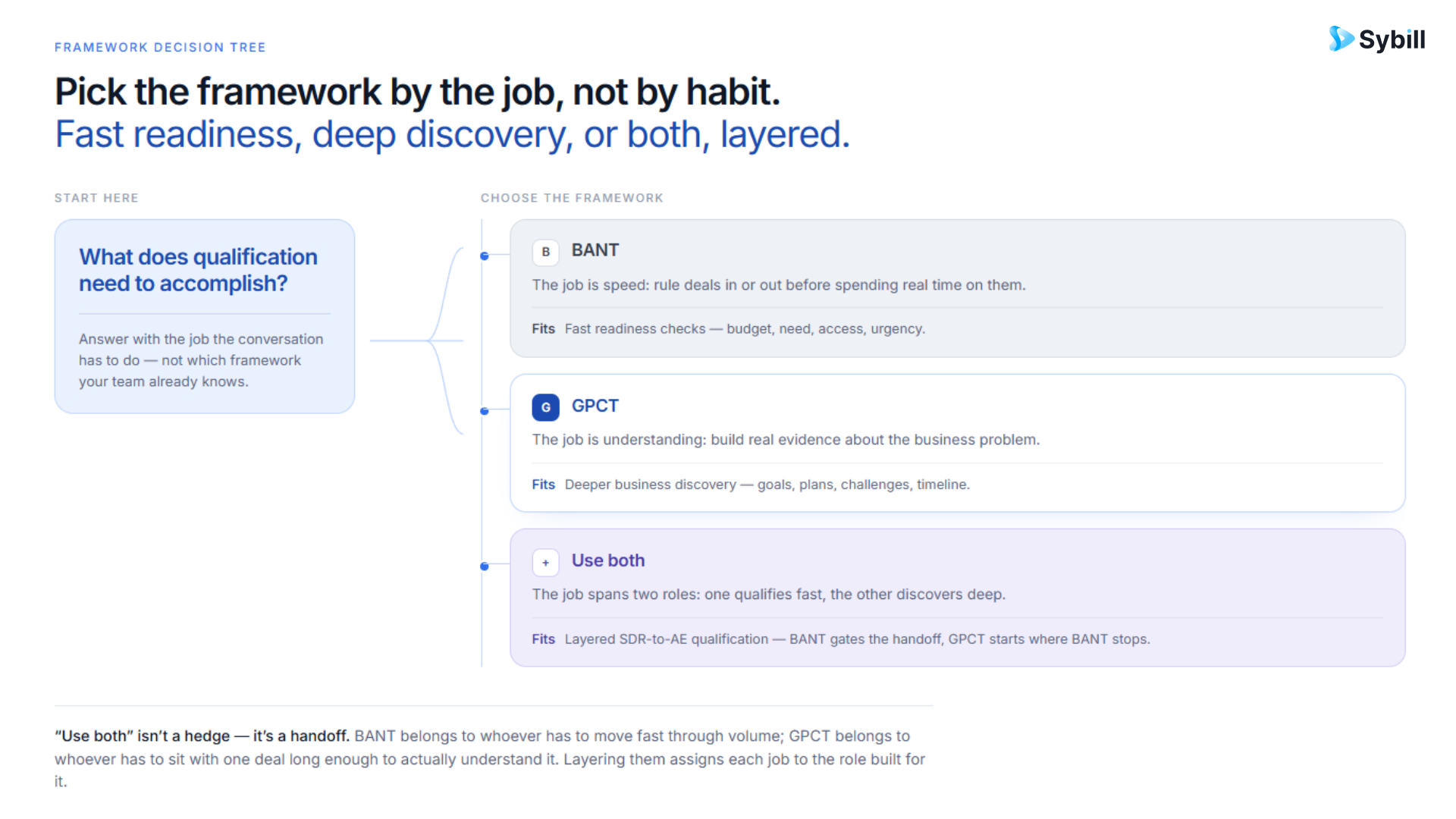
There is no magic ACV at which BANT abruptly stops working and GPCT switches on.
Use the nature of the sale instead.
BANT can make sense when:
Think of BANT as useful compression. You are trying to establish whether this opportunity deserves more time.
GPCT becomes more useful when:
GPCT asks more of the rep, but the additional context can make later conversations substantially better.
This is often the most practical answer.
An SDR could establish basic buying readiness through BANT before handing an opportunity to an AE.
The AE could then use GPCT to understand the business case in greater depth. Or a seller could lead discovery with GPCT, then establish Budget and Authority later once sufficient value has been uncovered.
Frameworks are tools. You are allowed to use more than one.
If your sales team is debating GPCT vs BANT, use these five questions.
If the job is primarily deciding whether to advance or deprioritize a lead, BANT may give you enough information.
If the rep needs to understand the business situation before deciding whether there is a real opportunity, GPCT goes deeper.
Straightforward buying process?
BANT may be enough.
Multiple stakeholders, conflicting priorities, and a solution that changes an important workflow?
GPCT gives the seller more context to work with.
If the Need is obvious and accepted, BANT can validate it quickly.
If the buyer knows something is wrong but cannot yet explain the business impact or why the existing Plan is insufficient, GPCT creates room for diagnosis.
Routing decision: BANT.
Discovery process: GPCT.
That distinction alone resolves a surprising number of methodology debates.
This is the question most framework comparisons ignore.
Imagine Framework A gives you four pieces of useful qualification data and reps update them consistently.
Framework B gives you twelve pieces of exquisite deal intelligence and 70% of the fields are blank.
Framework A is currently the better system.
The sophistication of a qualification framework means very little if the evidence disappears after the call.
Consider a VP of Sales evaluating technology to improve forecast accuracy.
The initial problem sounds simple: “Our forecast isn't reliable enough.”
Now qualify the same deal through both lenses.
That is a viable opportunity.
Now look through GPCT:
Same opportunity. Much richer story.
BANT tells the rep whether the opportunity has buying conditions. GPCT tells the rep what is broken and why fixing it matters.
That extra context influences the demo, business case, follow-up, stakeholder strategy, and potentially the entire deal.
Yes.
And for many teams, arguing that one framework must annihilate the other is unnecessary.
One practical model is:
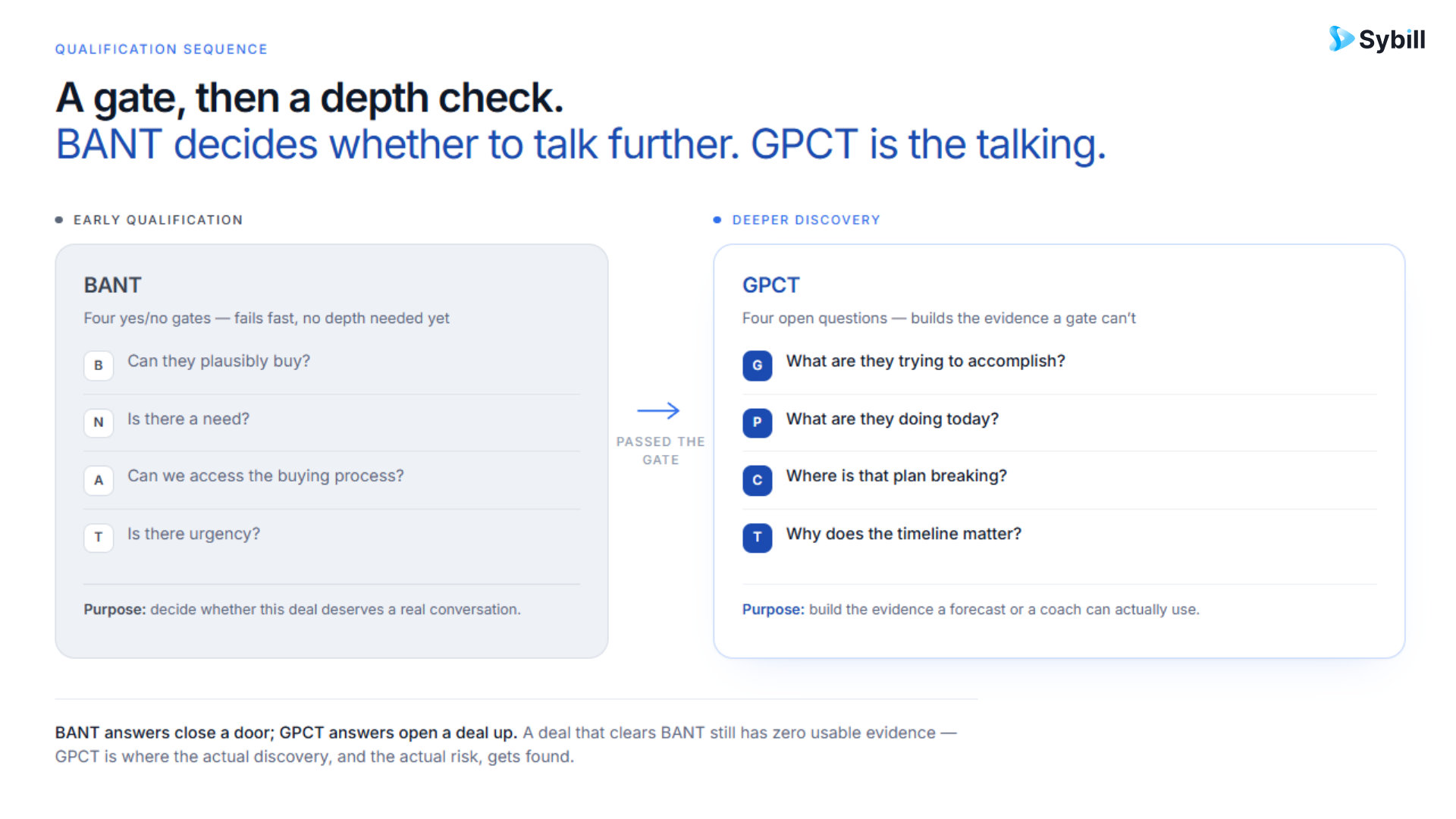
Another option is to use GPCT as the core discovery framework and layer Budget and Authority into the conversation later.
The framework should support how your team sells. Your sales process should not contort itself to protect the purity of an acronym.
Choosing a framework is the easy part. Getting 40 sellers to use it consistently six months later is the hard part.
Qualification usually breaks down in the gap between the buyer conversation and the CRM.
The rep learns that the economic buyer is worried about implementation risk. They hear that the Timeline depends on a board meeting. They discover that the buyer's current Plan involves hiring three more people.
Then the meeting ends.
The rep has another call in seven minutes.
By Friday afternoon, half of that context has become: “Strong opportunity. Good call. Follow up Tuesday.”
This is where AI changes qualification more materially than another enablement workshop.
Sybill's CRM Autofill analyzes calls and emails and can update methodology-specific CRM fields after interactions. Sybill currently supports qualification data including BANT and MEDDPICC, along with custom CRM fields. Click here to try.
Sybill also has dedicated workflows for automatically populating BANT and MEDDPICC fields from conversations rather than relying entirely on manual rep entry. (See the Salesforce qualification-field workflow)
For a team using GPCT or BANT, the workflow becomes:
Buyer conversation → qualification evidence captured → CRM updated → missing evidence visible → rep knows what to investigate next → manager reviews actual buyer context
That changes qualification from a data-entry requirement into something the team can use.
The manager's question stops being: “Why didn't you fill the field?” and becomes: “What buyer evidence do we have that this Timeline is real?”
That is a much better conversation.
There is a reason sales teams keep inventing qualification frameworks.
Selling is messy. Frameworks give the chaos some structure.
But they stop being useful the moment the team starts optimizing for framework completion instead of buyer understanding.
BANT is not dead. GPCT is not inherently superior. BANT gives teams a concise test of buying readiness. GPCT gives sellers richer context around the business problem and the buyer's path to change.
Use BANT when speed and prioritization matter most.
Use GPCT when discovery and business context matter more.
Use both if your sales process needs both.
And if your beautifully designed qualification system only works when reps remember to update 14 CRM fields after every meeting, the problem may not be the framework at all.
Qualification works better when the buyer evidence survives the call. See how Sybill turns conversations into structured CRM updates, so BANT, MEDDPICC, and custom qualification fields do not depend on rep memory.
BANT qualification is a sales framework used to evaluate an opportunity across four areas: Budget, Authority, Need, and Timeline. It helps sellers establish whether a prospect has the financial path, buying involvement, problem, and urgency required to justify moving an opportunity forward.
BANT stands for Budget, Authority, Need, and Timeline. The framework is commonly used to qualify leads and opportunities by checking whether the basic conditions for a potential purchase exist.
MEDDIC is not automatically better than BANT. It is more detailed. MEDDIC examines Metrics, the Economic Buyer, Decision Criteria, Decision Process, Identified Pain, and a Champion, making it useful for complex sales involving multiple stakeholders and a more involved buying process. BANT is simpler and may be more efficient when that additional qualification depth is unnecessary. See the full BANT vs MEDDIC comparison.
Yes. Sales teams can use BANT for early qualification and GPCT for deeper discovery, or use GPCT as the primary discovery framework while adding Budget and Authority later. The frameworks address different dimensions of qualification and do not need to be mutually exclusive.
BANT qualification is a sales framework used to evaluate an opportunity across four areas: Budget, Authority, Need, and Timeline. It helps sellers establish whether a prospect has the financial path, buying involvement, problem, and urgency required to justify moving an opportunity forward.
BANT stands for Budget, Authority, Need, and Timeline. The framework is commonly used to qualify leads and opportunities by checking whether the basic conditions for a potential purchase exist.
MEDDIC is not automatically better than BANT. It is more detailed. MEDDIC examines Metrics, the Economic Buyer, Decision Criteria, Decision Process, Identified Pain, and a Champion, making it useful for complex sales involving multiple stakeholders and a more involved buying process. BANT is simpler and may be more efficient when that additional qualification depth is unnecessary. See the full BANT vs MEDDIC comparison.