Find us at booth #83, join us for a harbor side happy hour, or catch Gorish’s talk.

Sept, 16-18 > Learn more


Mamta Tainwala

June 12, 2026
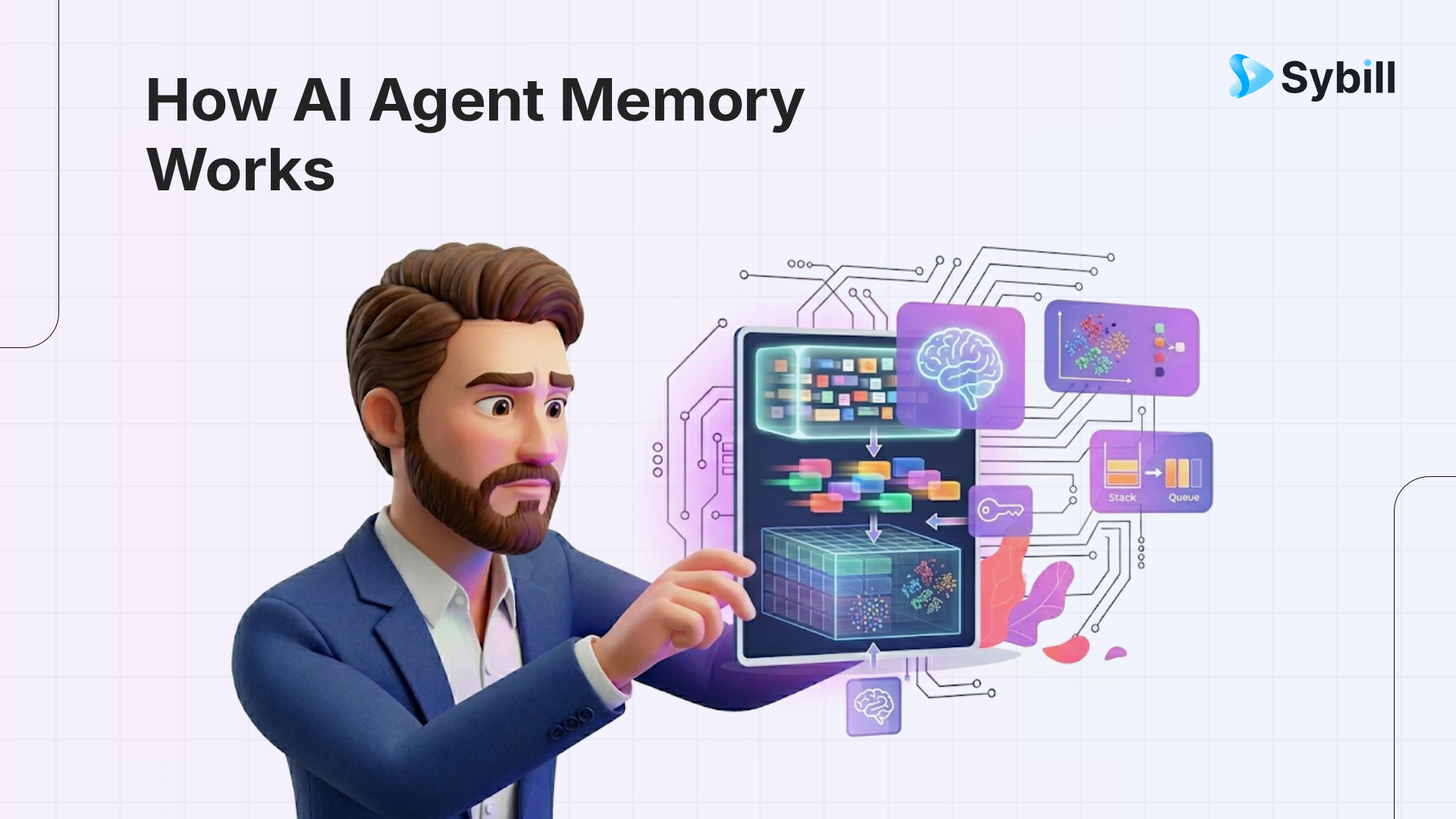
AI agent memory is the persistent store of information an agent accumulates and draws from to act on your behalf. It is what allows an agent to improve with every interaction rather than resetting to zero each time.
Without memory, every task an agent handles starts from scratch. It has no knowledge of past conversations, established preferences, or prior context. It produces output that is generic, inconsistent, and frequently requires correction. With memory, the agent builds a continuously richer picture of the world it operates in - the people, the deals, the preferences, the history - and uses that context to produce output that gets sharper over time.
Memory is the most underbuilt component in most agent setups today, and the most important one for long-term value. Most teams invest heavily in choosing the right model and connecting the right tools, then treat memory as an afterthought. That is exactly backwards. The model is the most commoditized part of any agent stack. Memory is where the differentiation compounds.
Gorish Aggarwal, CEO of Sybill AI, who built a six-agent personal setup from scratch, is direct about this: "The memory file keeps on adding up. So the AI or the agent has more and more context to do certain things in real life." His agents today know his meeting preferences, his team members' communication styles, the full history of his key relationships, and the context behind every active deal - because all of it has been accumulating in structured memory files for months.
That is not a feature of the model. It is a feature of deliberate memory architecture.
When someone uses a chatbot or a basic AI assistant and feels like the output is generic or misses the point, memory is almost always the root cause. The model is capable. The output is poor because the model has no context to work with.
Consider the difference between asking a new assistant to draft a follow-up email versus asking someone who has been with you for six months. The new assistant writes something correct but generic - accurate in form, missing in substance. The experienced assistant knows the account, knows your communication style, knows what was left unresolved in the last conversation, and writes something that actually moves the situation forward.
That accumulated context is memory. And for AI agents, it doesn't appear automatically. It has to be built, structured, and maintained deliberately.
The same dynamic applies at the organizational level. A sales rep who has been working an account for three months has built mental models of the buyer's priorities, objections, internal politics, and decision process. That context is valuable. It is also fragile - it lives in one person's head, doesn't transfer when the rep leaves, and is impossible to scale across a team. Organizational memory systems, done right, solve all three of those problems.
Not all agent memory works the same way. There are three distinct types, each with a different purpose and appropriate use case.
In-context memory is what the agent knows within a single session or task. It is the information currently loaded into the agent's context window - the conversation history, the task instructions, the documents it has been given to work with.
This type of memory is temporary. It does not persist after the session ends. An agent relying only on in-context memory is the equivalent of someone with severe short-term memory loss - fully capable within a conversation, but starting completely fresh the next time.
In-context memory is important and necessary, but it is not what makes agents compound in value. It is the baseline, not the differentiator.
External memory is information stored outside the model and retrieved when needed. This is the type of memory that makes agents genuinely smarter over time. It takes two formats:
Text files (markdown) are the right choice for qualitative, contextual information that doesn't need to be queried or filtered. A contact's background and communication preferences. The history of a specific relationship. Meeting and scheduling preferences. Project context. These files are fast to read, easy to update, and sufficient for most personal and small-scale agent setups.
Gorish maintains individual memory files for everyone he interacts with: "I have memory files for almost everyone that I interact with in my life. It has memory files for my team members. It has memory files for my investors, for my advisers, even from customers as well as potential prospects as well as my friends too."
Structured databases are better for high-volume, relational data that the agent needs to filter, query, or look up. A prospect list with deal stages and last contact dates. A log of competitor objections with how they were handled. A directory of team members with roles and communication styles. When the data exceeds ten records or requires lookups by attribute, a database gives the agent faster and more reliable access.
Gorish's rule: "If there are more than 10 things that an agent or an AI needs to choose from then you go to a database, a more deterministic route. Whereas if it is less than 10 then you can keep it in text files."
Semantic memory refers to knowledge baked into the model through training - general facts about the world, language patterns, domain knowledge. This is what allows a model to know that MEDDPICC is a sales qualification framework without being told, or that a follow-up email should have a subject line.
Semantic memory is the baseline competence every model brings. It is not specific to you, your deals, your customers, or your preferences. The gap between semantic memory and the output you actually need is exactly what external memory is built to fill.

Memory doesn't build itself. It has to be written. The most important mechanism in any well-designed agent setup is the write-back loop: after every action the agent takes, it writes what it learned to the relevant memory file or database.
This is how a contact memory file grows from "Sarah Chen, VP Sales at Acme, intro'd via LinkedIn" to a rich record that includes: how Sarah prefers to communicate (brief emails, direct to the point), what her key priorities are this quarter (pipeline coverage and rep ramp time), what objections she raised in prior conversations, what was agreed in the last meeting, and what is still open.
Without the write-back loop, memory has to be maintained manually - which means it either doesn't happen or happens inconsistently. With the write-back loop, the agent is effectively building its own context as it works.
Gorish's scout agent - the routing agent that monitors all his incoming channels - is responsible for directing information to the right memory files after every interaction. A call with a prospect gets summarized and appended to that prospect's memory file. A LinkedIn message that turns into a scheduled meeting gets logged against the contact's record. A follow-up email sent to an investor gets noted in the investor memory file.
The write-back loop is what makes memory compound. Each interaction makes the next one better.
The structure of a memory file depends on its purpose, but well-built memory files for sales and GTM contexts tend to cover the same categories regardless of the specific format.
For a contact or relationship:
For a deal:
For a process or preference:
For sales teams using Sybill, this deal-level memory is built automatically. Every call is captured and structured via Magic Summary. Every key field is pushed to the CRM via CRM Autofill. Every follow-up and action item is logged via AI Tasks. The deal memory that a custom agent would have to build manually is assembled by Sybill without any rep effort - and it is available to any connected agent or workflow through the Sybill MCP connector.

The core insight about agent memory is not that it stores information. It is that stored information makes every future action better, which means the value of the agent increases non-linearly over time.
In week one, the agent has minimal context. It knows the basics you gave it at setup - your role, your preferences, the accounts you're working. It produces decent output that needs moderate correction.
By week four, the agent has processed dozens of interactions. It knows how you write emails. It knows which accounts are sensitive and require a careful tone. It knows which contacts prefer bullet points over prose. The output requires less correction. The tasks it completes without your input have grown.
By month three, the compounding becomes visible. The agent handles an entire post-call workflow - summary, CRM update, follow-up email, task creation - with output quality that matches what you would have written yourself. It surfaces a risk signal on a deal you hadn't thought to check. It catches that a committed next step from two calls ago has gone unaddressed. None of this requires you to ask. It happens because the agent has enough context to know what matters.
This is fundamentally different from every tool that preceded agents. A better note-taking app saves the same amount of time on day one as it does on day three hundred. An agent with well-built memory is meaningfully more capable on day three hundred than it was on day one.
For sales teams, Sybill is designed to accelerate this curve. The intelligence layer it builds across calls, deals, and reps gives any AI system operating on top of it a head start - it is not starting from scratch, it is starting from months of accumulated deal and relationship context.
For a practical look at how this plays out in deal reviews, see how to do a deal inspection as a sales manager. For how it applies to rep development, see how to ramp new sales reps faster with AI.
Individual agent memory - files and databases maintained by one person for their own agents - solves the personal context problem. It does not solve the organizational context problem.
At the organizational level, the memory challenge is different in scale and complexity. It involves hundreds of deals, dozens of reps, thousands of calls, and multiple systems all generating information simultaneously. The question is not just "what does this agent remember?" but "what does the organization know, and how does any AI system acting on behalf of any team member get access to it?"
This is the problem Sybill is built to solve. Gorish describes the organizational version of his personal memory setup directly: "The reason civil is what it is is it builds that team memory across the organization for a sales use case. And that's essentially what what you see over here in a personal level is what civil does at an organizational scale."
Every call captured through Sybill feeds into a shared intelligence layer. Deal inspection draws from the full call and CRM history for every account - not just the last call, but the pattern across every interaction. Buyer intelligence surfaces what buyers across all your accounts care about, what objections they're raising, and what's changing in their priorities. Competitor intelligence tracks how competitors show up across deals over time - not just in individual calls, but as an organizational pattern.
Sales plays takes this furthest: it learns from past wins and losses across the team and surfaces guidance for active deals based on what actually worked in similar situations. That is organizational memory applied to real-time deal execution.
This is the memory layer that makes agents genuinely useful at scale - not because the model is better, but because the context it operates with is richer, more accurate, and continuously updated.
Not writing back after every action. Memory that isn't updated becomes stale and misleading. Build the write-back into the agent's workflow from day one, not as an afterthought.
Storing everything in one giant file. A single massive context file is slow to read, hard to update, and difficult for the agent to navigate. Structure memory into specific files by topic, relationship, or deal - and move to a database when any single category exceeds ten records.
Never pruning outdated memory. A contact file for someone you haven't spoken to in two years, with preferences noted from that relationship, is noise the agent has to sort through. Set a cadence for reviewing and archiving memory that is no longer relevant.
Treating memory as a dump, not a reference. Memory files should be structured for the agent to use, not transcripts of everything that happened. The right format is: key facts, current status, what matters now, and what is unresolved. Raw transcript dumps are large, slow, and not what the agent needs.
Building skills and forgetting memory. Skills tell the agent how to do something. Memory tells it what to know before it does it. Teams often invest heavily in skill files for repeatable tasks and skip building the context layer that makes those skills output correctly. Both are required.
What is AI agent memory?
AI agent memory is the persistent store of information an agent accumulates and draws from to act on your behalf. It includes contextual information about people, deals, preferences, and history that the agent retrieves when completing tasks. Without memory, every agent interaction starts from scratch.
How does AI agent memory work technically?
Agent memory is typically stored in external files or databases that the agent reads at the start of a task and writes to after completing it. Text files (markdown) work well for qualitative context under ten items. Structured databases are better for high-volume relational data. The agent retrieves the relevant memory when it needs context and updates it after acting - creating a compounding loop.
What is the difference between in-context memory and persistent memory?
In-context memory is temporary - it exists only within a single session and resets when the task ends. Persistent memory is stored externally and retrieved across sessions. Persistent memory is what allows agents to improve over time, because it accumulates context from every past interaction.
How do I build memory for my first AI agent?
Start with two files: a user context file (your role, priorities, communication preferences, key relationships) and a contacts file for the people your agent will interact with on your behalf. As the agent handles tasks, extend the memory to cover deals, projects, and any process-specific preferences. Use text files until any single category exceeds ten records, then move to a database.
Does Sybill function as an AI agent memory layer?
Yes. Sybill captures, structures, and stores intelligence from every sales call - deal context, buyer signals, qualification status, follow-up history - and makes it available to any connected AI system. For sales teams, it provides the organizational memory layer that makes agent outputs accurate and context-aware from the first interaction.
Why does agent memory compound over time?
Because every stored interaction makes the agent's next action better. An agent that has handled twenty calls for an account knows the stakeholders, the objections, the open questions, and the decision history. Its follow-up draft for call twenty-one draws on all of that context automatically. The more it knows, the less correction is needed, and the more it can handle autonomously.
The agent that wins is not the one running the best model. Models are converging. The agent that wins is the one with the richest, most accurate, most current context - because that context is what makes every action it takes genuinely useful rather than generically correct.
Building that context deliberately, maintaining it consistently, and expanding it with every interaction is how agent value compounds. It is also the hardest part to copy. A competitor can switch to the same model. They cannot replicate the accumulated deal, relationship, and preference context you have built over months.
For sales teams ready to build that memory layer without starting from scratch, Sybill handles the organizational context automatically. For teams building custom agents on top, the Sybill MCP connector makes that intelligence available wherever you need it. Get started for free with Sybill or book a demo.
AI agent memory is the persistent store of information an agent accumulates and draws from to act on your behalf. It includes contextual information about people, deals, preferences, and history that the agent retrieves when completing tasks. Without memory, every agent interaction starts from scratch.
Agent memory is typically stored in external files or databases that the agent reads at the start of a task and writes to after completing it. Text files (markdown) work well for qualitative context under ten items. Structured databases are better for high-volume relational data. The agent retrieves the relevant memory when it needs context and updates it after acting - creating a compounding loop.
In-context memory is temporary - it exists only within a single session and resets when the task ends. Persistent memory is stored externally and retrieved across sessions. Persistent memory is what allows agents to improve over time, because it accumulates context from every past interaction.