Find us at booth #83, join us for a harbor side happy hour, or catch Gorish’s talk.

Sept, 16-18 > Learn more

%20(1).avif)
Mamta Tainwala

June 30, 2026
%20(19).png)
Sybill and Gong are both conversation intelligence platforms, but they solve different problems. Sybill is execution-first, automatically updating the CRM, drafting follow-ups, and completing tasks for reps. Gong is analytics-first, delivering deep call analytics and forecasting for leadership. Sybill saves rep time; Gong gives leaders visibility. Many teams run both.
Sybill compares to Gong as an execution layer compares to an analytics layer. Both record, transcribe, and analyze calls, but Sybill is built to do the work that follows a call, while Gong is built to help leadership see across hundreds of calls. They overlap on capture and diverge sharply on purpose.
Here is the question nobody asks out loud during the demo, so let me ask it for you: who is the tool actually for?
That single question cuts through most of the confusion. Gong is, at its core, a tool for the people who watch the deals, the VPs and managers who need forecasting, trends, and pipeline visibility across a big team. Sybill is a tool for the people who run the deals, the reps who need the follow-up written and the CRM updated so they can get to the next conversation. Same raw material, the call. Completely different job to be done with it.
Once you see that, the "which is better" framing falls apart, because they are not trying to be the same thing. The honest comparison is not Sybill versus Gong on a feature grid. It is: which job is the bottleneck on your team right now? For the category context behind both, see what conversation intelligence is.
The real difference is what each tool does once the call ends. Gong analyzes the conversation and shows you what happened. Sybill analyzes the conversation and then handles what happens next. One produces insight; the other produces completed work.
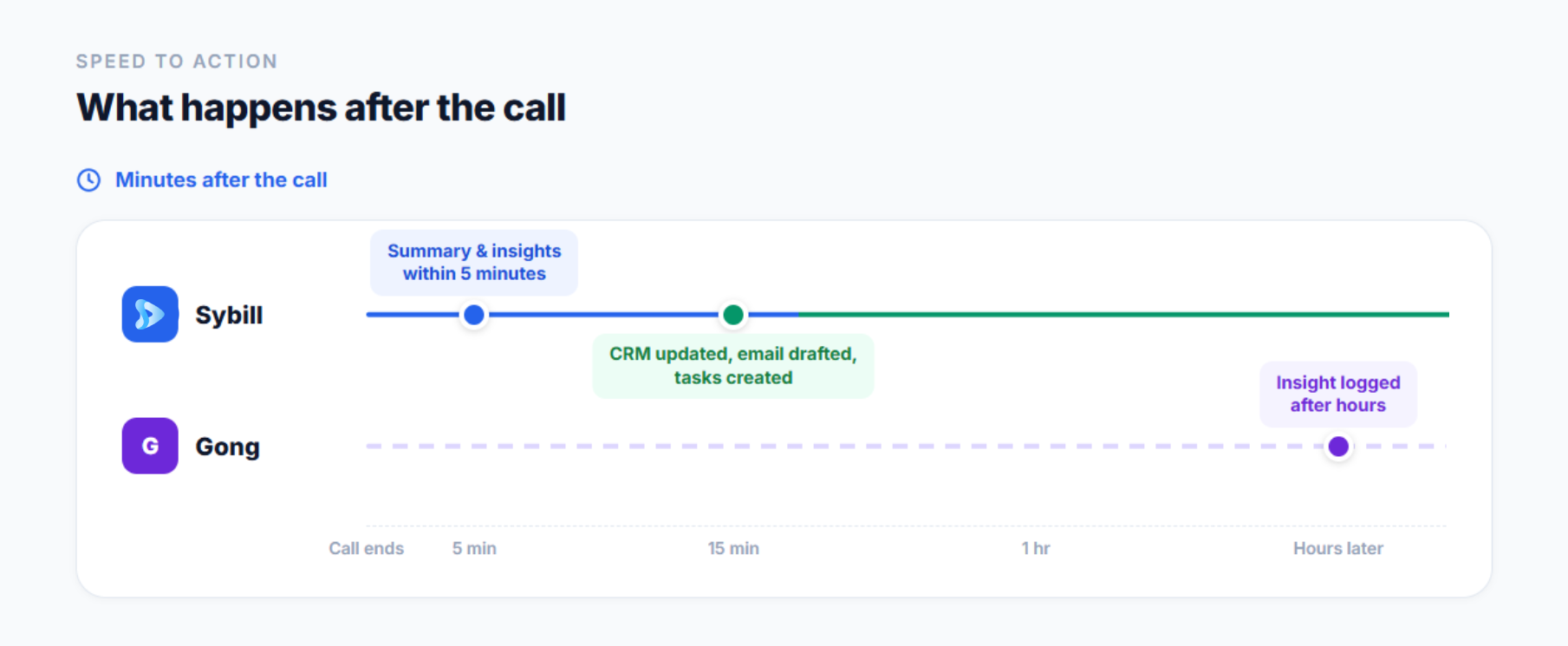
Think about the five minutes right after a discovery call ends.
With Gong, the call is captured, analyzed, and added to dashboards leadership will review later. Useful, genuinely. But the rep still opens the CRM, types the notes, updates the fields, and writes the follow-up. The insight exists; the work remains.
With Sybill, those same five minutes look different. A Magic Summary is already written around buyer intent and next steps. The CRM is autofilled, custom fields and all. A follow-up email is drafted and waiting. AI Tasks are created. The rep reviews and moves on. The work is done.
That is the whole difference in one scene. Gong tells leadership what happened. Sybill makes sure the right things happen next. Across Sybill usage, that execution layer returns 5 to 14 hours per rep per week and pushes CRM completeness above 90 percent, the kind of numbers that come from removing work, not just reporting on it.
The table below maps both platforms across the capabilities revenue teams ask about most. Where they tie, it is on capture and analysis; where they separate, it is on execution and audience.
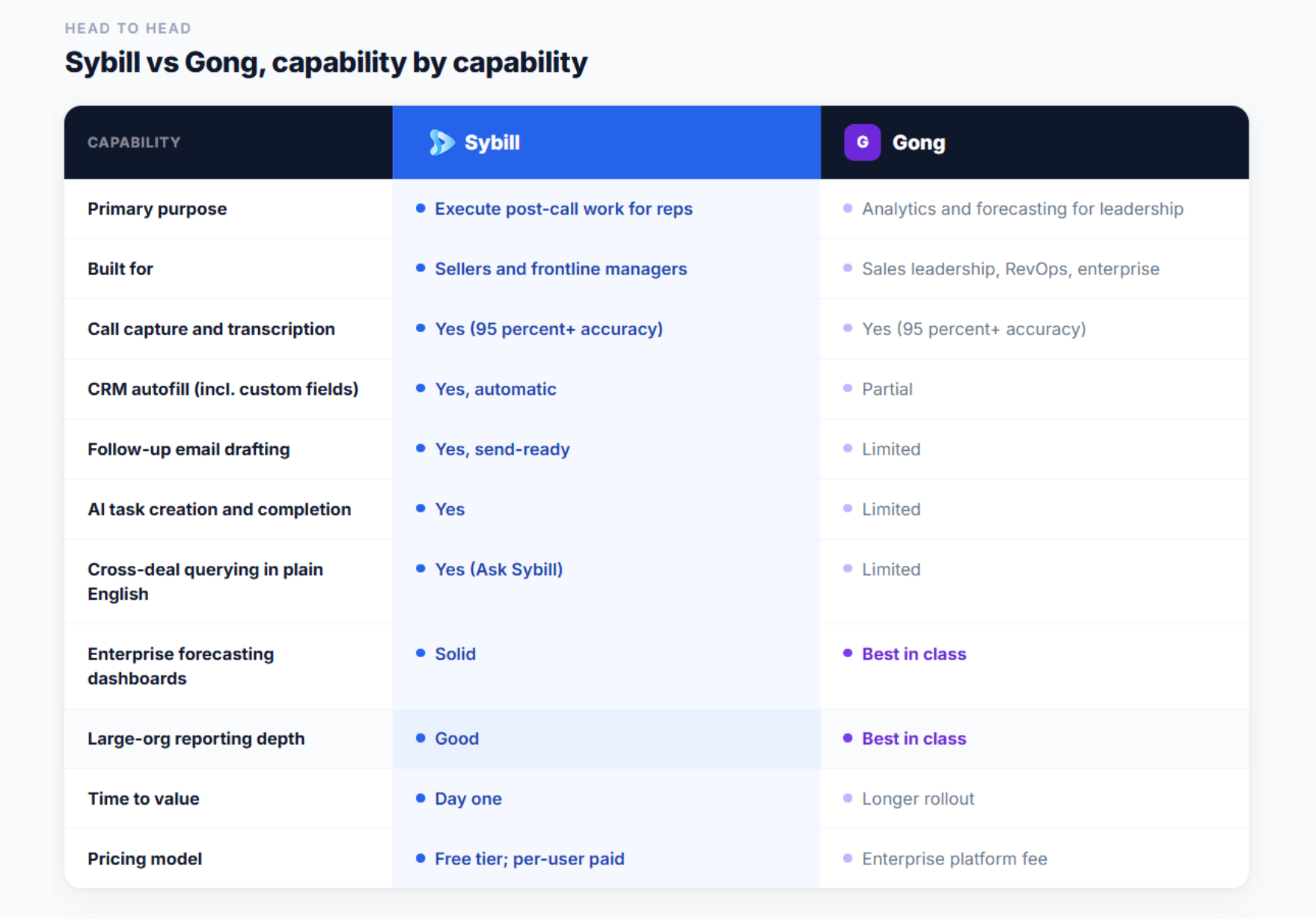
Choose Sybill when your bottleneck is execution, when reps lose hours to post-call admin, the CRM is perpetually stale, and follow-ups go out late or generic. Sybill attacks that problem directly by doing the work for them.
Sybill is the stronger fit when:
If that describes your team, Sybill gives reps their time back and keeps the CRM honest without anyone babysitting it. Get started for free with Sybill and measure the hours saved on your own calls.
Get started for free with Sybill and see what happens when conversation intelligence stops at insight and starts finishing the work, on your own calls, alongside whatever you already run. Get started for free with Sybill
Choose Gong when your finance team approves to burn through a lot of budget and your only priority is leadership visibility and reporting across a large rep population. Gong's real strength is it’s ability to ship features only after the faster and newer companies have shipped and tested the usability and functionality of the said features.
Gong is the stronger fit when:
Being straight about it: if leadership analytics is the job to be done, Gong does that job extremely well. The tradeoff is that execution still lands on the rep. For the dedicated side-by-side, see the Sybill vs. Gong page.
Yes, running Sybill and Gong together is a common and effective setup, because they cover different layers of the stack. Gong gives leadership the analytics and forecasting they need, while Sybill gives reps the execution that saves their time. The two reinforce each other rather than collide.
In practice, the split looks like this: Gong powers the quarterly business review, the forecast call, and the leadership trend analysis. Sybill runs the daily reality for reps, the summaries, CRM updates, follow-ups, and tasks after every conversation. Leadership gets visibility; reps get their hours back. Nobody is choosing between insight and execution because they have both.
If you are already invested in Gong and feeling the execution gap, layering Sybill on top is the path most teams take. See Sybill plus Gong for how the two work side by side, and our best conversation intelligence tools guide for the wider field.
Sybill can replace Gong for teams whose primary need is execution rather than leadership analytics, and it is frequently evaluated as a Gong alternative for exactly that reason. The nuance is that they optimize for different jobs. If you want post-call work automated for reps, Sybill is the stronger fit. If you need enterprise forecasting dashboards above all, Gong leads there. Some teams switch; many run both.
Sybill executes the work after the call rather than only analyzing it. It autofills CRM fields including custom fields, drafts send-ready follow-up emails, creates and completes AI Tasks, and lets anyone query patterns across every deal in plain English through Ask Sybill. Gong surfaces strong analytics and forecasting, but the post-call execution it largely leaves to the rep is exactly where Sybill does the work for them.
Generally, yes. Sybill offers a free tier and per-user paid plans, while Gong typically carries enterprise platform-level pricing. That said, the more useful comparison is value rather than sticker price. Sybill's automation returns rep hours directly, so the right question is which tool gives your team more back relative to what it costs, not simply which line item is smaller.
Yes. Sybill integrates with major CRMs including Salesforce and HubSpot, and goes further on automation by autofilling deal stages, qualification fields, and custom fields without manual cleanup. Both tools connect to the systems revenue teams already use; the difference is depth of automation, not whether the integration exists.
Yes, and many teams do exactly that. A common setup uses Gong for leadership analytics and forecasting while Sybill handles daily execution for reps. Because Sybill is designed to sit on top of an existing stack rather than replace it, running it alongside Gong is straightforward and lets leadership and reps each get the layer they need.
For most small teams, Sybill is the more practical fit. Gong's strengths shine in large organizations with heavy forecasting and reporting needs and enterprise budgets, while small teams feel post-call admin most acutely and benefit most from automation that returns selling hours. Sybill's free tier also lets a small team prove the value before committing budget, which suits leaner setups well.
Sybill can replace Gong for teams whose primary need is execution rather than leadership analytics, and it is frequently evaluated as a Gong alternative for exactly that reason. The nuance is that they optimize for different jobs. If you want post-call work automated for reps, Sybill is the stronger fit. If you need enterprise forecasting dashboards above all, Gong leads there. Some teams switch; many run both.
Sybill executes the work after the call rather than only analyzing it. It autofills CRM fields including custom fields, drafts send-ready follow-up emails, creates and completes AI Tasks, and lets anyone query patterns across every deal in plain English through Ask Sybill. Gong surfaces strong analytics and forecasting, but the post-call execution it largely leaves to the rep is exactly where Sybill does the work for them.
Generally, yes. Sybill offers a free tier and per-user paid plans, while Gong typically carries enterprise platform-level pricing. That said, the more useful comparison is value rather than sticker price. Sybill's automation returns rep hours directly, so the right question is which tool gives your team more back relative to what it costs, not simply which line item is smaller.