Find us at booth #83, join us for a harbor side happy hour, or catch Gorish’s talk.

Sept, 16-18 > Learn more

%20(1).avif)
Mamta Tainwala

June 30, 2026
%20(15).png)
After working in the space for 2 years, if I had to simply explain to someone, Conversation intelligence is an AI software that records, transcribes, and analyzes conversations to extract structured insights such as buyer intent, objections, sentiment, and next steps. Unlike basic recording, it turns spoken interactions into searchable data that automates manual heavy tasks. In the case of our users, tasks like CRM updates, follow-ups, coaching, and deal forecasting.
Conversation intelligence is technology that records, transcribes, and analyzes voice and video conversations to extract structured insights that improve revenue outcomes. It applies natural language processing and large language models to identify buyer intent, objections, sentiment, competitive mentions, and next steps, then feeds that structured data into CRM systems and sales workflows.
The term is most often used in sales and customer success, where conversations are the richest dataset a revenue team produces. A transcript tells you what was said. Conversation intelligence tells you what it meant and what to do next. That is the line that separates it from simple recording or note-taking.
Modern conversation intelligence software performs four core functions: it captures calls across platforms like Zoom, Google Meet, Microsoft Teams, and phone systems; it transcribes speech into searchable text; it analyzes that text for themes, risk signals, and qualification data; and it integrates the results directly into the tools sellers already use. For the foundational version of this explainer, see our complete guide to conversation intelligence software.
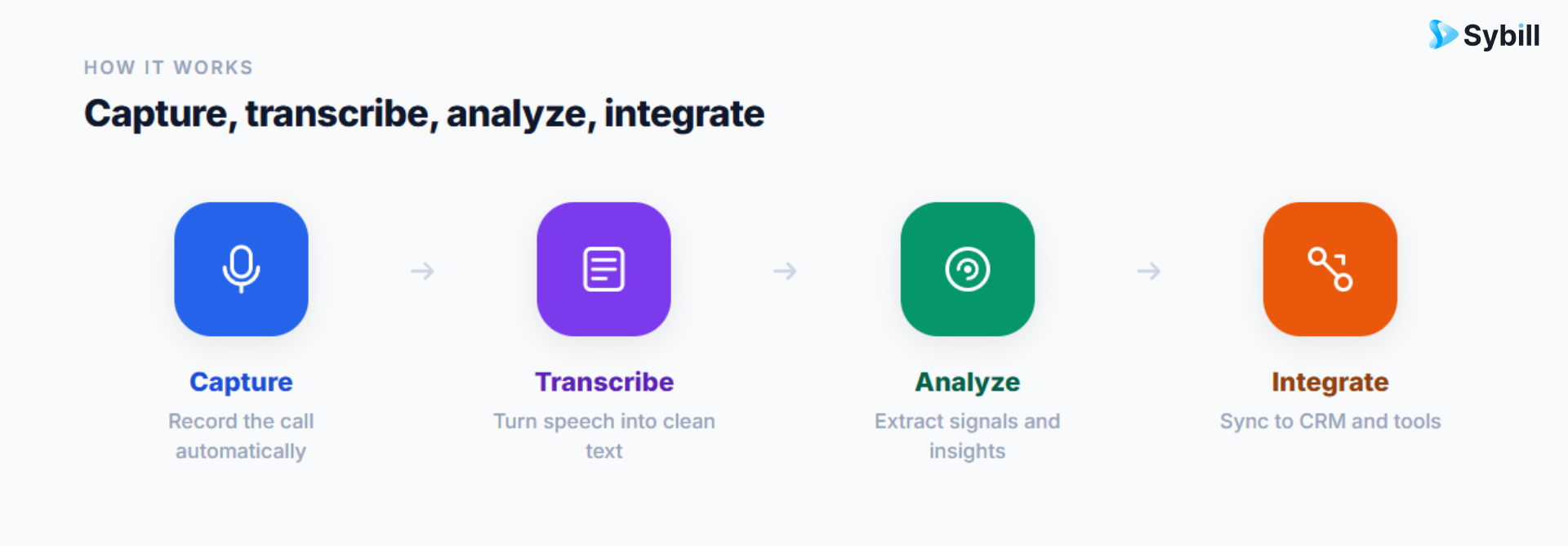
Conversation intelligence works by capturing a conversation, converting it to text, applying AI analysis to that text, and pushing the resulting structured data into downstream systems. The process runs automatically for every call, which is what allows it to scale across an entire team rather than the handful of calls a manager could review manually.
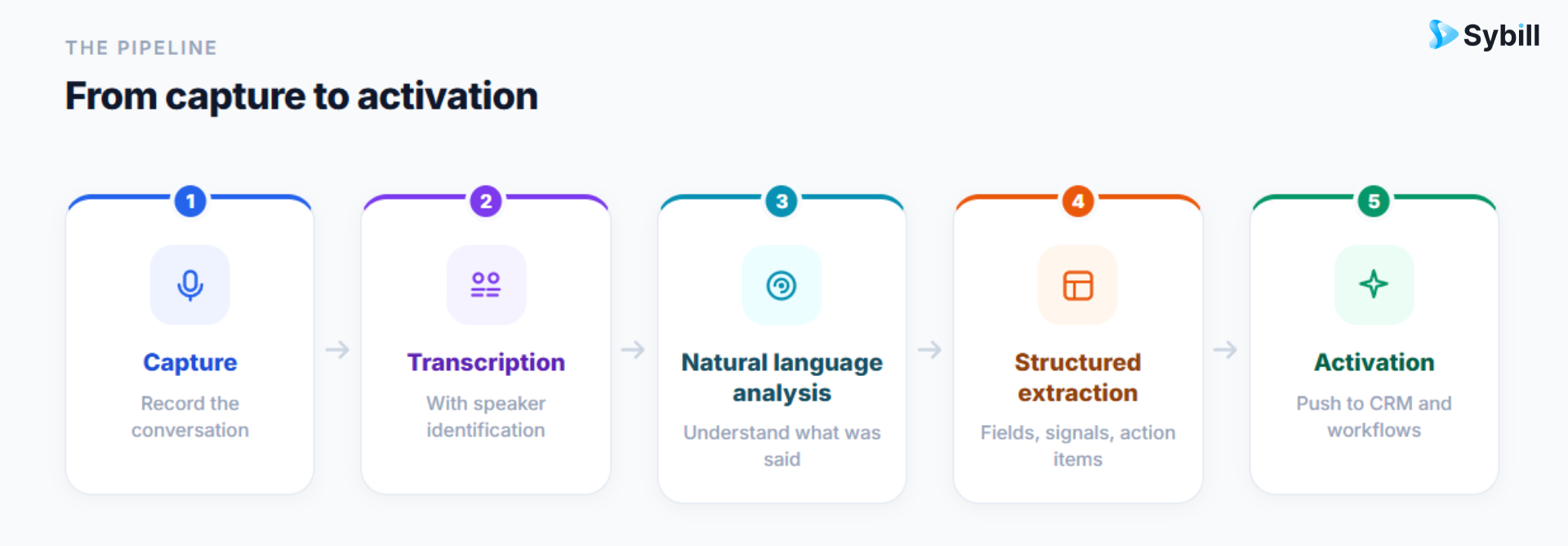
The technical pipeline moves through five stages:
The first generation of conversation intelligence stopped at stages one and two: record and replay. Modern AI conversation intelligence runs all five stages, which is why the category has shifted from passive analysis toward active execution. The platforms moving fastest are the ones that complete stage five reliably rather than leaving it to the rep.
The difference comes down to scope and purpose. Call recording captures audio. Speech analytics scores contact-center calls against compliance and quality rules. Conversation analytics aggregates conversation data into reports. Conversation intelligence does all of the analysis and then acts on it inside the sales workflow.
These four terms are often used interchangeably, which causes most of the confusion in the buying process. The table below separates them.
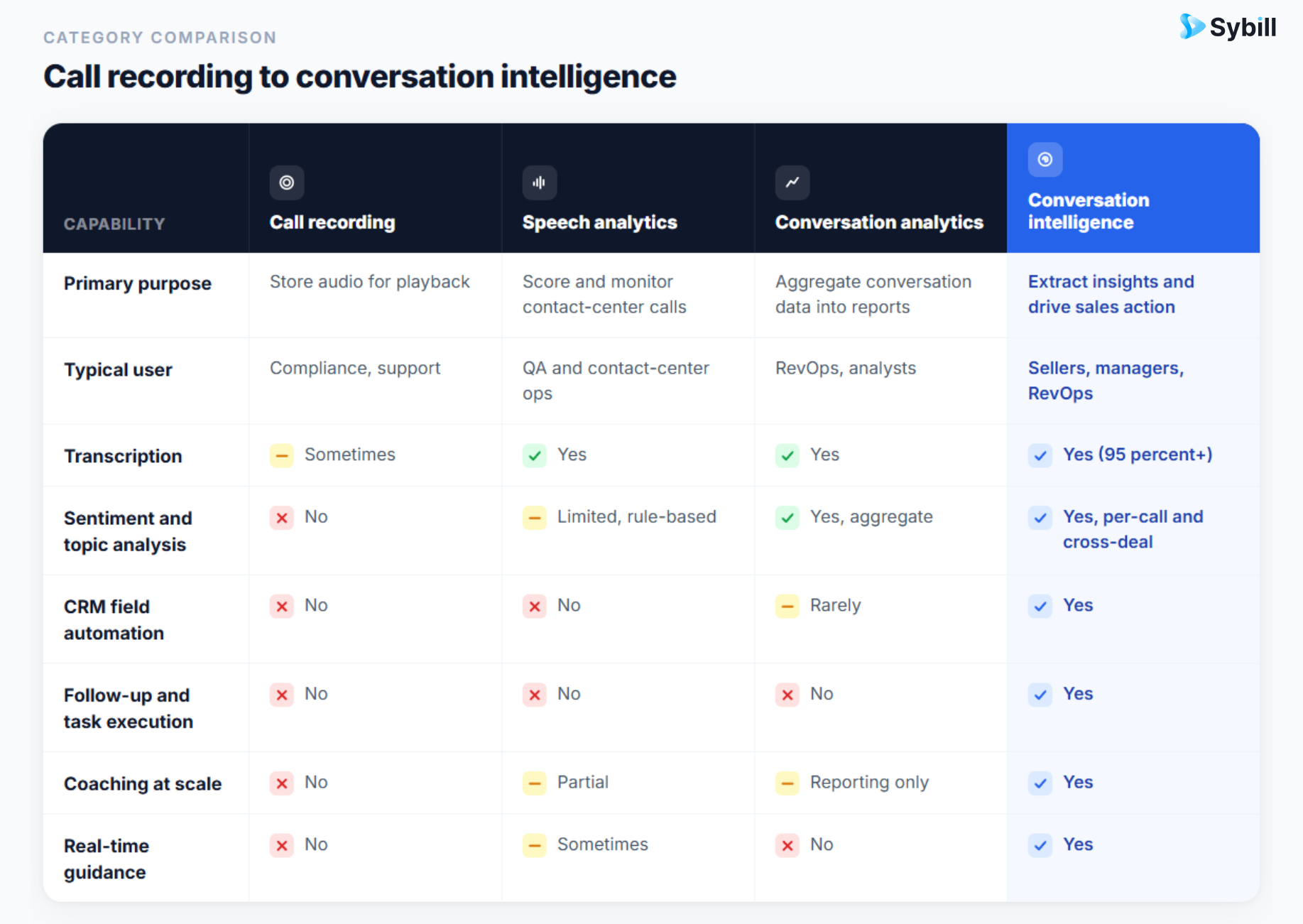
The cleanest way to remember it: call recording gives you a file, speech analytics gives you a quality score, conversation analytics gives you a dashboard, and conversation intelligence gives you an outcome. For a deeper treatment of the most common confusion, read our breakdown of conversation intelligence versus call recording.
Sales teams use conversation intelligence to convert spoken conversations into reliable pipeline data and faster execution. The driver is not curiosity about what was said; it is the cost of getting conversations wrong as buying groups grow and selling time shrinks.
Two pressures explain the adoption curve. First, 83% of business buyers expect reps to understand their needs and context before engaging. Second, reps spend roughly 30-40% of their time on non-selling activities such as data entry and admin. Conversation intelligence sits between higher buyer expectations and limited rep capacity.
The concrete benefits sales teams report include:
According to Gartner, the average B2B buying group now includes 6 to 10 stakeholders, and buyers spend only 17% of their time meeting with suppliers. When ten stakeholders are involved across dozens of interactions, human memory cannot keep up. That is the gap conversation intelligence fills.
The best conversation intelligence tools in 2026 are the ones that move beyond recording and analysis into execution. Recording is now table stakes; the differentiator is whether a platform completes the work that follows a call. The leading tools fall into three groups: execution-first platforms, leadership-analytics platforms, and structured meeting assistants.
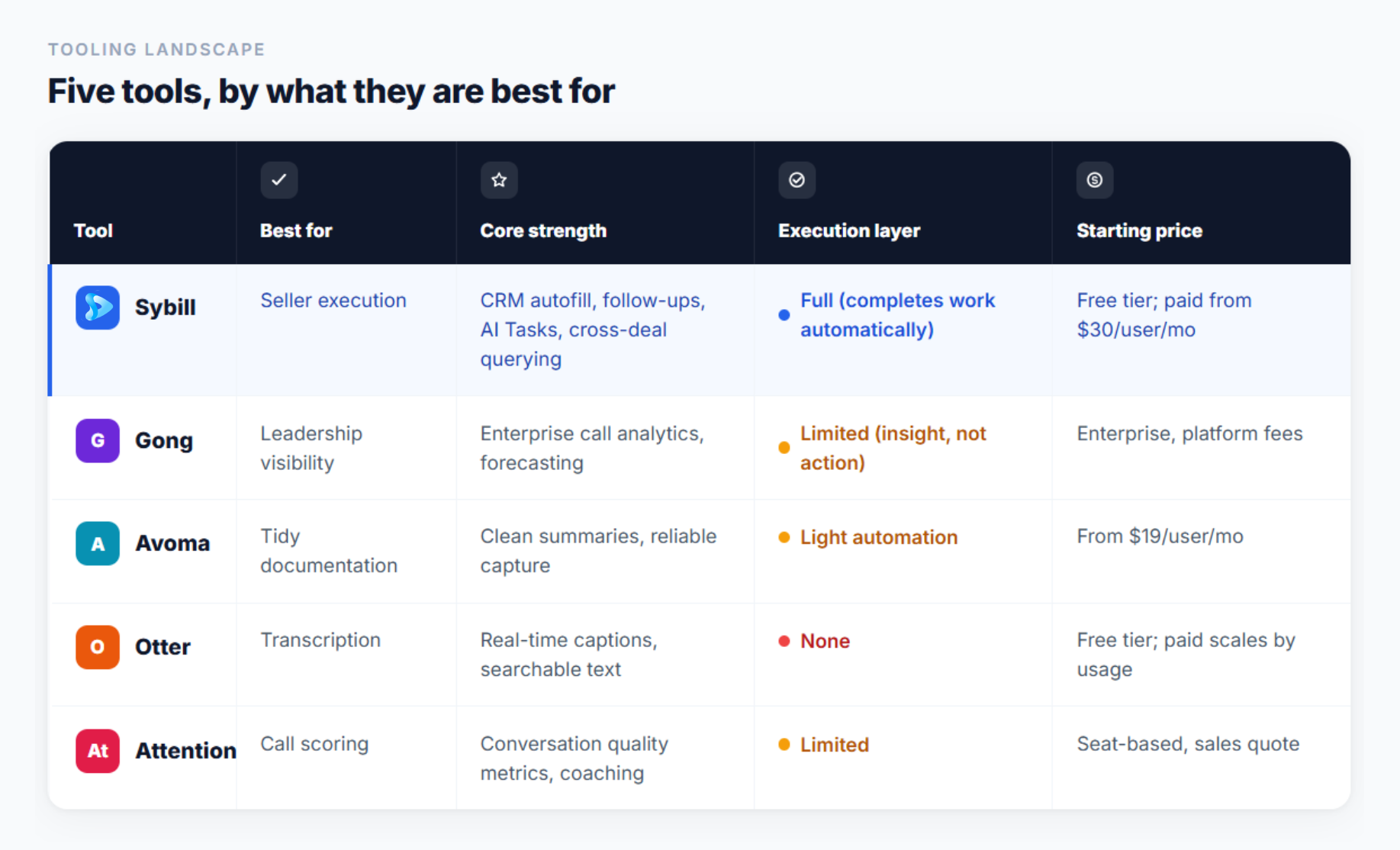
Here is how the leading platforms differ in practice.
Sybill is an execution-first conversation intelligence platform built for sellers rather than observers. It treats a conversation as the start of work, not the end of it. After every call, Sybill produces Magic Summaries organized around buyer intent and next steps, autofills CRM fields including custom and qualification fields, drafts send-ready follow-ups, and completes AI Tasks. Ask Sybill lets anyone query patterns across every deal in plain English. Sybill is the post-conversation execution layer that sits on top of any existing stack rather than a standalone CRM or engagement platform.
Get started for free with Sybill and see what conversation intelligence looks like when it actually finishes the work after the call. Get started for free with Sybill
Gong is a revenue intelligence platform optimized for leadership visibility. Its call analytics and forecasting dashboards are the deepest in the market for organizations with hundreds of reps. Gong surfaces insight but leaves most post-call execution to the rep. For a full breakdown, see our Sybill versus Gong comparison and the dedicated Sybill vs. Gong page. Many teams run both: Gong for the QBR, Sybill for daily execution, via Sybill plus Gong.
Avoma is a structured meeting assistant strong at clean summaries and reliable capture, with lighter automation. Otter is a transcription-first tool best for searchable records rather than sales execution. Attention focuses on call scoring and coaching metrics for managers. Each is capable within its scope, but none is built to reduce post-call workload the way an execution-first platform does. For the full ranked list, read our guide to the best conversation intelligence tools for sales teams.
The ROI of conversation intelligence comes primarily from reclaimed selling time, cleaner pipeline data, and higher win rates, not from the recordings themselves. The real cost of a tool is not its per-seat price; it is the rep time it fails to save.
Across Sybill usage, execution-first conversation intelligence consistently returns measurable gains:
The pattern is consistent: cheaper tools that stop at capture push the real cost onto the rep, while execution-first platforms price that work into the product. To dig into the numbers behind these gains, see our dedicated post on conversation intelligence ROI.
You choose a conversation intelligence platform by matching its primary job to your primary problem. If your reps are drowning in post-call admin, prioritize execution. If your leadership needs forecasting governance across hundreds of reps, prioritize analytics depth.
Use these questions as filters during demos:
By the end of that checklist, the strongest fit for your situation usually stands apart on its own.
Conversation intelligence is AI that listens to your sales and customer calls, writes them down, figures out what mattered, and then acts on it by updating your CRM, drafting follow-ups, and flagging risky deals. It turns conversations into structured data and completed work instead of audio files nobody replays.
Speech analytics scores contact-center calls against rule-based quality and compliance criteria, usually for QA teams. Conversation intelligence is broader and sales-focused: it uses natural language processing and large language models to extract buyer intent, objections, and next steps, then drives CRM updates and follow-ups. Speech analytics measures call quality; conversation intelligence drives revenue outcomes.
No. Call recording captures and stores audio for playback. Conversation intelligence includes recording as its foundation, then adds transcription, AI analysis, insight extraction, CRM automation, and coaching on top. You cannot have conversation intelligence without recording, but recording alone delivers none of the analysis or automation.
No. Conversation intelligence is an enhancement layer, not a system of record. The CRM stores structured data about accounts, contacts, and deals. Conversation intelligence keeps that CRM accurate by auto-populating qualification fields, logging stakeholders, and tracking next steps, so the CRM becomes trustworthy without reps updating it manually every evening.
Leading conversation intelligence platforms reach 95 percent or higher transcription accuracy in 2026, with automatic speaker identification. Accuracy can dip with heavy accents, background noise, or specialized jargon, so it is worth testing a platform on your own real calls before committing.
Yes. Smaller teams feel admin burden most acutely because each rep manages more accounts. Conversation intelligence returns selling hours through automatic CRM updates, faster follow-ups, and reduced manual work, effectively giving each rep more capacity without adding headcount. Free tiers let lean teams measure impact before committing budget.
Conversation intelligence is AI that listens to your sales and customer calls, writes them down, figures out what mattered, and then acts on it by updating your CRM, drafting follow-ups, and flagging risky deals. It turns conversations into structured data and completed work instead of audio files nobody replays.
Speech analytics scores contact-center calls against rule-based quality and compliance criteria, usually for QA teams. Conversation intelligence is broader and sales-focused: it uses natural language processing and large language models to extract buyer intent, objections, and next steps, then drives CRM updates and follow-ups. Speech analytics measures call quality; conversation intelligence drives revenue outcomes.
No. Call recording captures and stores audio for playback. Conversation intelligence includes recording as its foundation, then adds transcription, AI analysis, insight extraction, CRM automation, and coaching on top. You cannot have conversation intelligence without recording, but recording alone delivers none of the analysis or automation.