Find us at booth #83, join us for a harbor side happy hour, or catch Gorish’s talk.

Sept, 16-18 > Learn more


Tamanna Mishra

March 26, 2026
.avif)
Sales managers in 2025 can’t afford to just be quota guardians. They’re AI-enabled coaches, strategists, and motivators, juggling AI tools and human dynamics in equal measure.
Managing a sales team in 2025 requires balancing three capabilities: traditional leadership (hiring, coaching, motivation, culture), process discipline (pipeline management, forecasting, territory design), and AI fluency (deploying AI tools for CRM automation, conversation intelligence, deal coaching, and rep enablement). The most effective sales managers in the AI era use AI to handle pipeline admin, call analysis, and data hygiene — freeing their own time for the human work that drives performance: coaching reps through complex deals, building team culture, and making strategic resource decisions that AI cannot.
If you’ve already read our Sales Career Guide 2025 (the complete map from rookie rep to sales leader) or our deep dive on Top Sales Skills in the AI Age, you know how quickly the ground is shifting under every sales role. Managing a sales team today isn’t just about pushing numbers on a spreadsheet. It's about orchestrating people, processes, and platforms with intelligence that scales.
That’s why knowing how to manage a sales team in the AI era is no longer a “nice to have.” It’s the difference between building a resilient sales org that thrives in uncertainty or burning out in the chaos of quota churn.
This blog is your sales manager guide to mastering modern sales team management: blending timeless leadership with cutting-edge AI tools so your team doesn’t just keep up, but wins.
Not long ago, sales team management looked very different.
Endless spreadsheet updates, late-night pipeline reviews, and gut-feel decisions about which deals would close. Managers spent more time chasing down CRM entries than actually coaching their reps. “Management” often meant firefighting. Managers were simply reacting to missed numbers rather than steering performance proactively.
Fast forward to 2025, and the landscape has flipped. AI forecasts now flag risks before a deal even goes dark. CRMs auto-fill after every call and email, eliminating the busywork that once swallowed hours each week. Coaching insights land in near real-time, helping managers manage sales teams with precision instead of hindsight.
And the repercussions are beyond what the daily hustle looks like. Sales salaries and managers’ compensation is increasingly tied to the productivity and performance uplift AI delivers. The better you leverage AI to coach, forecast, and motivate, the bigger the upside for both your team and your paycheck.
The old stereotype of a sales manager - clipboard in hand, barking about quotas - is dead.
Today, the best leaders are equal parts empath, strategist, and technologist. A great sales manager in 2025 is defined not just by how well they motivate people, but by how skillfully they balance human instincts with machine intelligence.
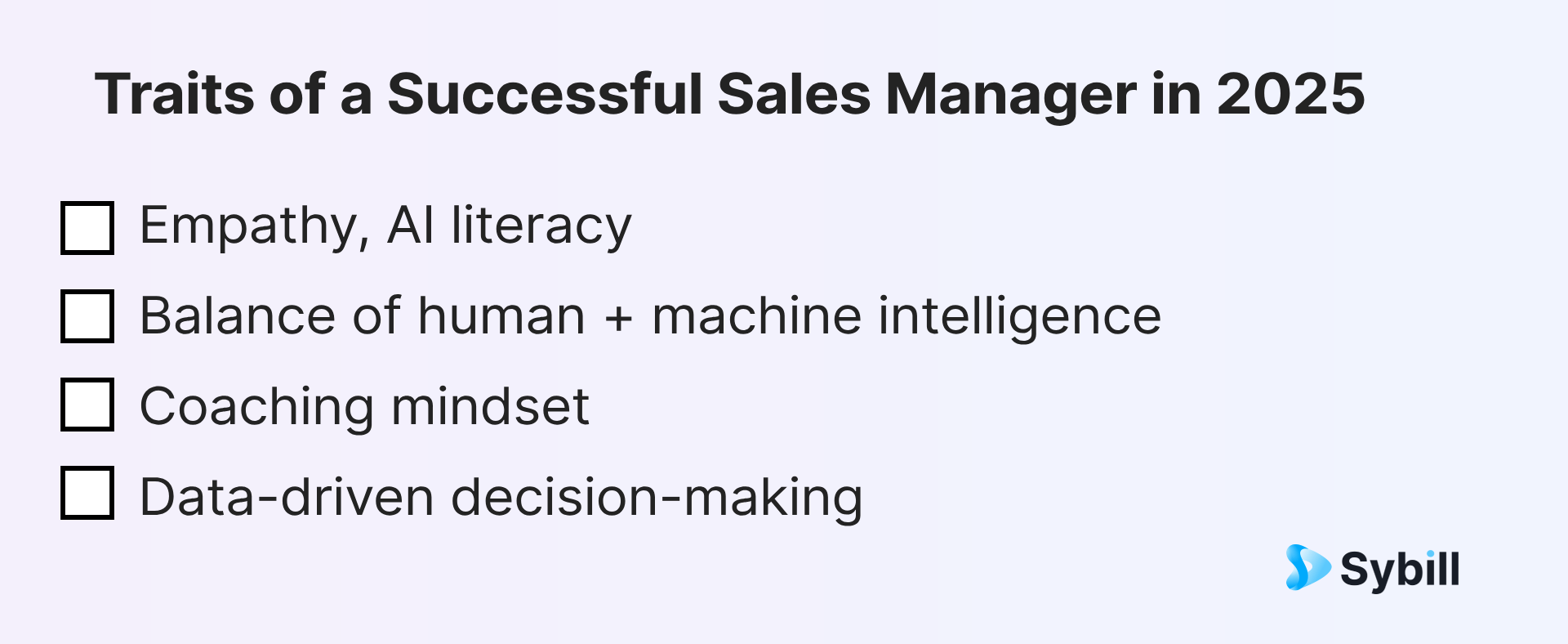
Here’s what that looks like in practice:
The difference between a good manager and a great one is how much time their reps actually spend selling, not updating fields. Leaders who manage sales teams with empathy and AI in tandem free their people to do what they do best - close. That’s what a modern sales manager guide must start with.
Every manager wants a high-performing team. But in 2025, the recipe for success has shifted. Knowing how to manage a sales team now means pairing timeless leadership principles with AI-driven execution.
Here are the non-negotiables:
Managing a team today is about alignment, not micromanagement. Managers who master both human connection and digital intelligence unlock the formula for sustained growth.
Walking into a brand-new team - whether you’ve been promoted internally or hired from outside - can feel like herding cats. The playbook for how to manage a new sales team in 2025 starts with setting the tone early and letting AI do the heavy lifting.
Here’s how smart managers approach it:
A sales manager guide for new teams goes way beyond proving you’re the smartest in the room. What you want instead is to lay a foundation of trust, clarity, and scalable systems. When you manage a sales team this way, you shorten the ramp-up curve and give your new hires a fighting chance at success.
Every sales manager eventually faces it. A rep who just isn’t hitting their numbers. The difference between good and great sales team management lies in how you tackle underperformance. In 2025, the approach is part AI-driven, part human-first.
Here’s the framework that works:
You want to be Ted Lasso with a digital sidekick. Imagine getting real-time answers from a conversational AI, flagging when a player’s losing steam or needs a morale boost. That’s what it feels like to manage sales teams with AI today. You still lead with heart, but now you have sharper vision into what’s really going on.
Poor performance in 2025 isn’t a dead end. Instead, it’s a chance to coach, course-correct, and show your value as a leader.
If you’re wondering how to manage a sales team without losing your sanity (or your Sunday evenings), the answer is simple. Let AI do the grunt work, so you can focus on leading. In 2025, the smartest managers treat AI as a co-pilot.
Here are some sales team management tools that empower sales managers.
The real win is AI tools free managers to do what only humans can - inspire, coach, and build culture.
You can’t automate trust, but you can automate the busywork that gets in its way.
The future of sales team management isn’t about choosing between people and technology. The best sales managers are already blending the two seamlessly. Good leaders know that human coaching builds trust, while AI provides the data, insights, and automation to make that coaching sharper and faster.
If you’re serious about learning how to manage a sales team in the AI age, the message is simple. Stop wasting hours on manual reporting and pipeline guesswork. Put your energy where it matters. Coaching, motivating, and building culture. And let AI handle the grind.
The core functions are planning, organizing, staffing, directing, coordinating, reporting, and budgeting. In 2025, AI strengthens each: planning with predictive forecasts, organizing with CRM automation, staffing with data-driven skill insights, directing with real-time performance insights, coordinating across distributed teams, reporting via auto-generated deal summaries, and budgeting with AI-powered revenue projections.
The 5 C’s are Contact, Convince, Close, Care, and Consistency. AI helps at every step: surfacing the right contacts, analyzing buyer signals to shape persuasion, flagging closing opportunities, automating post-sale follow-ups, and ensuring consistency through standardized playbooks.
The most in-demand skills today are leadership, coaching, analytics, adaptability, and communication. Managers who master these - and pair them with AI fluency - are the ones turning average teams into high-performing engines.