Find us at booth #83, join us for a harbor side happy hour, or catch Gorish’s talk.

Sept, 16-18 > Learn more


Tamanna Mishra

June 25, 2026
a.png)
A forecast review is a terrible place to discover that a deal is at risk.
By the time a sales manager asks, “Are we still confident this is closing this month?”, the risk has usually been sitting in plain sight for weeks. The next step was soft. The buyer said they needed to check with finance. A competitor came up in the last call. The champion went quiet after pricing was shared. Legal was mentioned, but never brought into the process. The rep marked the opportunity as Commit because the buyer “sounded positive,” but there was no confirmed mutual action plan.
The deal did not become risky during the forecast review. The forecast review only exposed the risk.
Modern B2B deals are rarely linear. Buyers research independently, involve larger committees, compare vendors quietly, and move in and out of internal alignment before they tell sales what is really happening. According to Gartner’s research on the B2B buying journey, many buyers now prefer rep-free digital buying experiences, but these self-service journeys can also increase complexity and purchase regret. Forrester’s State of Business Buying 2026 found that buying decisions now involve an average of 13 internal stakeholders and nine external participants.
That means deal risk is no longer limited to one bad call or one missing field in the CRM. It shows up across calls, emails, stakeholder behavior, budget conversations, competitive chatter, next steps, and silence.
The real question is not, “Is this deal at risk?”
The better question is, “Which signals have already told us this deal is at risk, and did we catch them early enough to do something about it?”
That is where continuous deal inspection matters. With an AI sales assistant like Sybill, revenue teams can inspect deal signals across buyer conversations, emails, CRM updates, next steps, objections, competitor mentions, and pipeline activity before forecast review turns into damage control.
Deal risk is any signal that an opportunity may not close on time, at the expected value, or at all.
It can come from the buyer, the buying committee, the competitive environment, the sales process, or the seller’s own lack of visibility. Some deal risks are obvious, such as a buyer saying the price is too high. Others are subtle, such as a champion who keeps taking meetings but never introduces the economic buyer.
Common deal risk signals include:
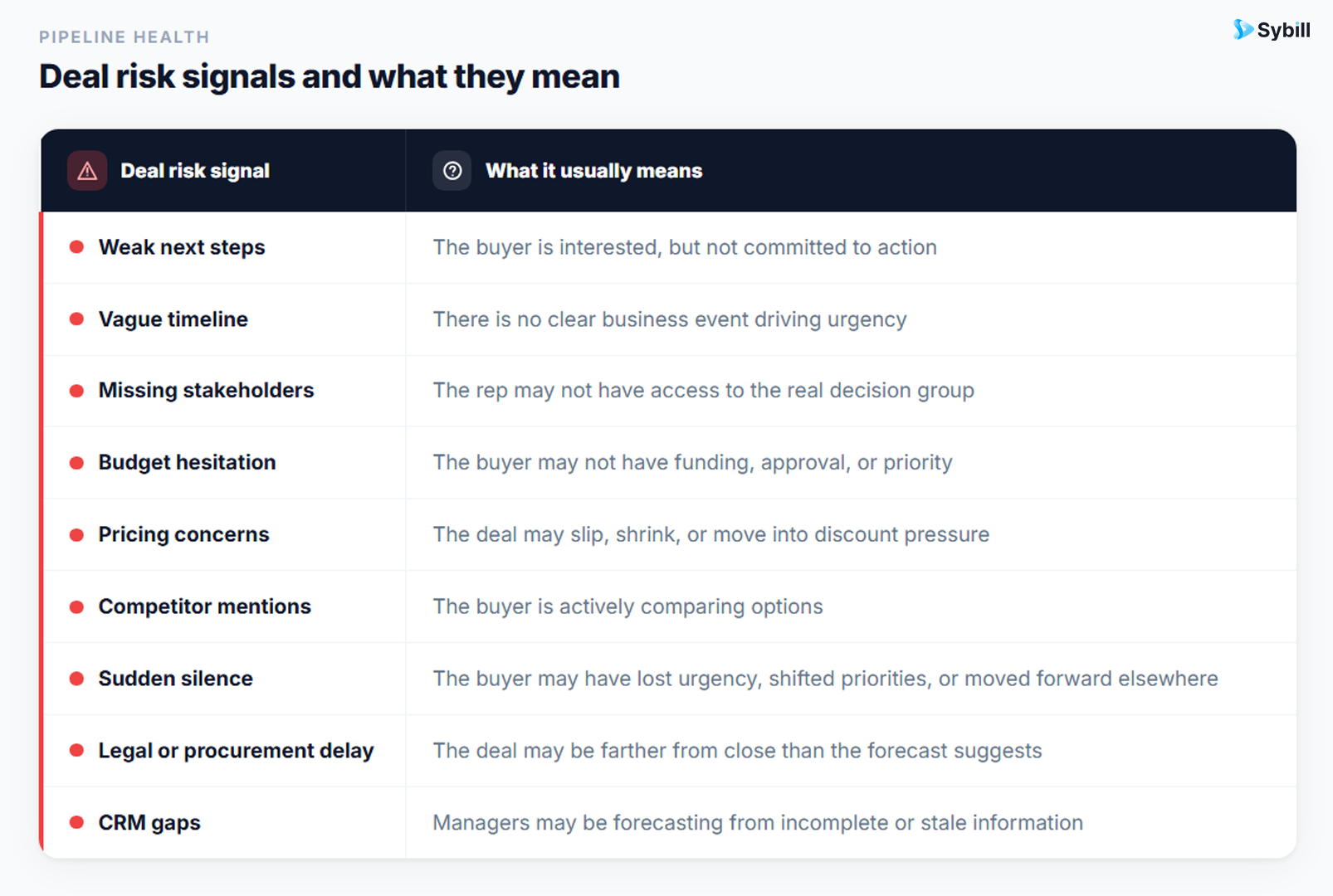
Forecast risk is often just deal risk that was not identified early enough.
Forecast reviews are meant to improve revenue visibility. In practice, many of them become interrogation sessions.
The manager asks: “What’s happening with this deal?”
The rep says: “Still looking good.”
The manager asks: “What’s the next step?”
The rep says: “They’re discussing internally.”
The manager asks: “Who is involved?”
The rep says: “I’m not totally sure, but my champion is pushing it.”
At this point, the forecast review is not inspecting a deal. It is reconstructing a deal from memory.
That is the problem. Traditional forecast reviews rely heavily on rep sentiment, CRM hygiene, and manually entered notes. But deal risk often lives outside clean CRM fields. It is hidden in the phrasing of a buyer response, the absence of a stakeholder, the way a competitor was mentioned, the lack of a confirmed date, or the delay between the last meeting and the next buyer action.
A CRM may show that the deal is in the proposal stage. The conversation may reveal that finance has not approved the budget.
A rep may forecast the deal for this month. The buyer may have said, “We’ll revisit this after our planning cycle.”
A manager may see a high-value opportunity in Commit. Sybill may surface that the buyer has not confirmed next steps, the economic buyer has never joined a call, and a competitor was mentioned twice in the last two weeks.
This is why sales teams need more than forecast calls. They need continuous deal inspection based on the actual signals buyers leave behind.
Weak next steps are one of the earliest signs of deal risk. A strong next step has a date, an owner, a purpose, and a clear buyer-side reason to continue. A weak next step sounds positive but has no commitment.
Examples of weak next steps:
“We’ll circle back internally.”
“Let us digest this.”
“I’ll share this with the team.”
“Let’s reconnect sometime next month.”
“Sounds good, we’ll be in touch.”
These statements are not automatically bad. Buyers do need time to evaluate. But if there is no confirmed action after a sales conversation, the deal has not moved. It has only paused politely.
To inspect this risk, managers should ask:
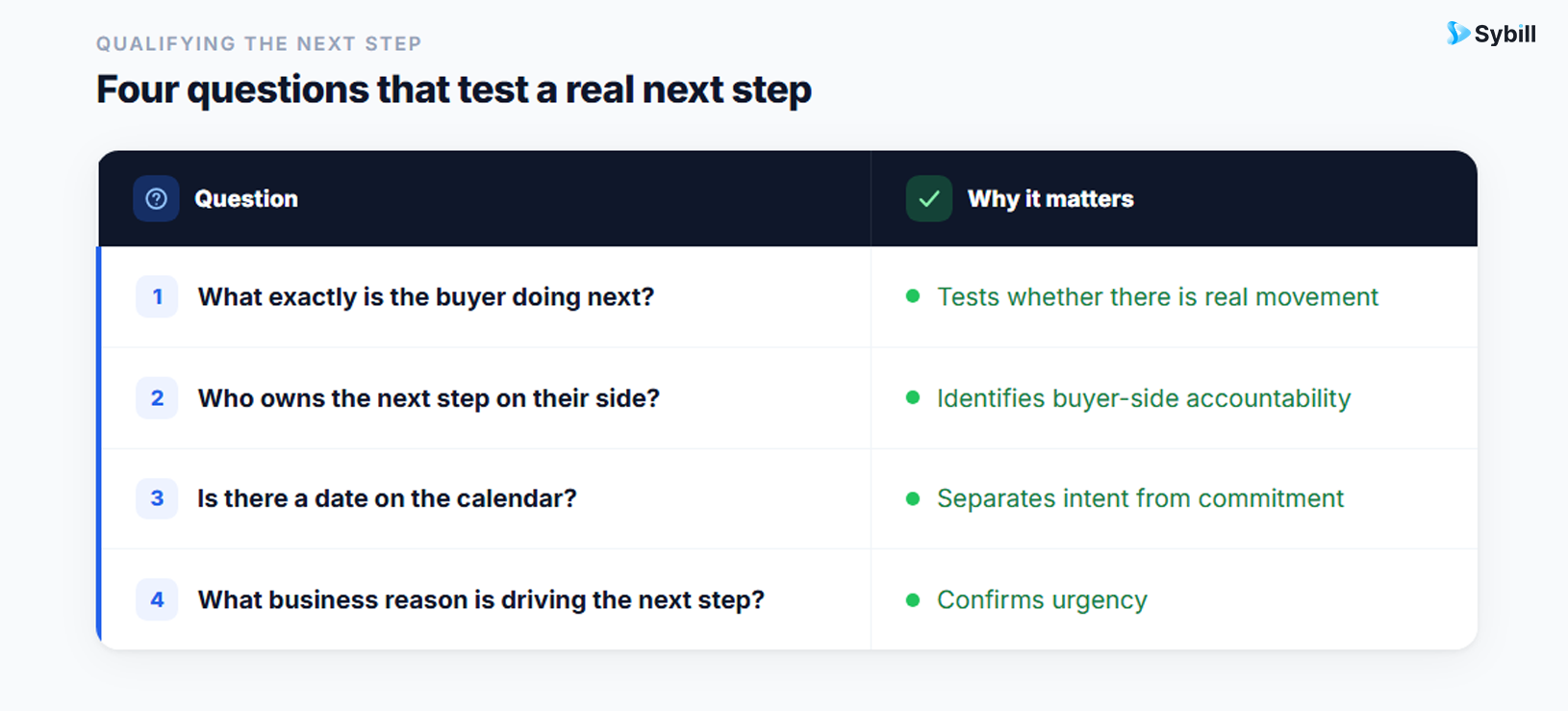
How Sybill helps:
With Sybill’s Deal Workspace, reps and managers can inspect unresolved objections, budget discussions, buying intent, and next steps from deal conversations. Instead of relying on memory or scattered notes, teams can see whether the buyer committed to a concrete action or simply ended the call on a polite note.
A close date is not the same as a buying timeline. Many deals are forecast for a certain month because that is when the rep hopes they will close. But the buyer may not have any internal reason to move by that date.
A risky timeline sounds like:
“They want to get this done soon.”
“They said this is a priority.”
“We’re aiming for end of quarter.”
“They seemed aligned with our proposed timeline.”
A healthier timeline sounds like:
“They need this live before their Q3 sales kickoff.”
“Their current contract renews on September 30.”
“They need to present the recommendation to the CFO next Friday.”
“Their RevOps team has to finalize tooling before annual planning.”
The difference is specificity. A real timeline connects the deal to a business event, internal deadline, executive priority, renewal date, implementation requirement, or operational pain.
To separate polite interest from real deal movement, managers should ask:
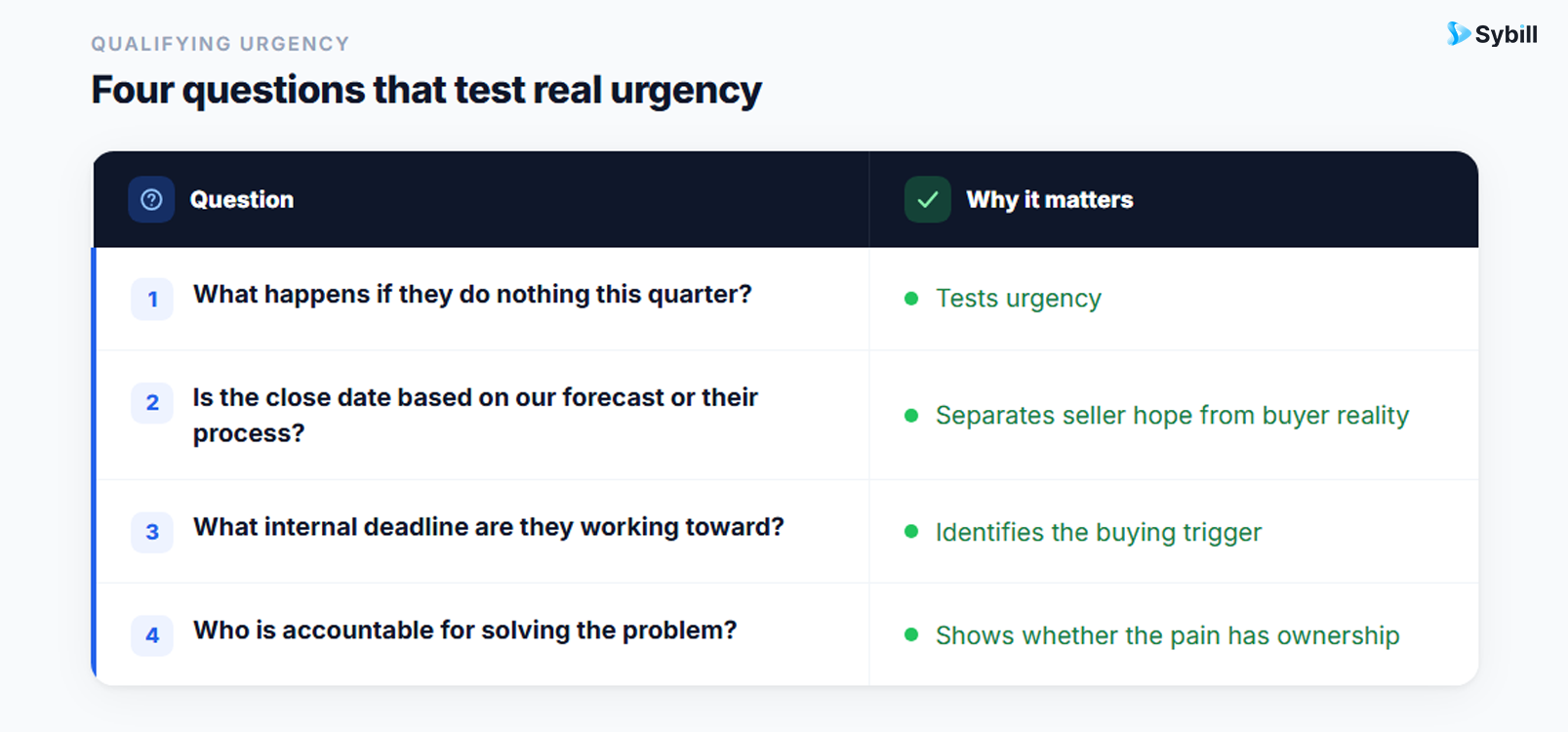
How Sybill helps:
Sybill captures buyer language from calls and follow-ups, helping teams understand whether urgency is real, implied, or missing. This gives managers better context before they accept a close date as forecastable.
A champion can love your product and still fail to get the deal approved.
In complex B2B deals, one enthusiastic user or department leader is rarely enough. If the economic buyer is not engaged, the deal may be vulnerable to budget cuts, procurement pressure, internal deprioritization, or last-minute executive scrutiny.
Signs the economic buyer is missing:
The rep has not spoken to the budget owner.
The champion says they will “socialize it internally.”
Finance or procurement is mentioned but not involved.
The buyer avoids introducing senior stakeholders.
No one can clearly explain the approval process.
The deal is being pushed by users, but not owned by an executive sponsor.
This is especially risky because stakeholder gaps often stay hidden until late in the sales cycle. The rep may have had several good calls, but all with people who influence the decision rather than own it.
To check whether the champion can actually carry the deal through approval, inspect:
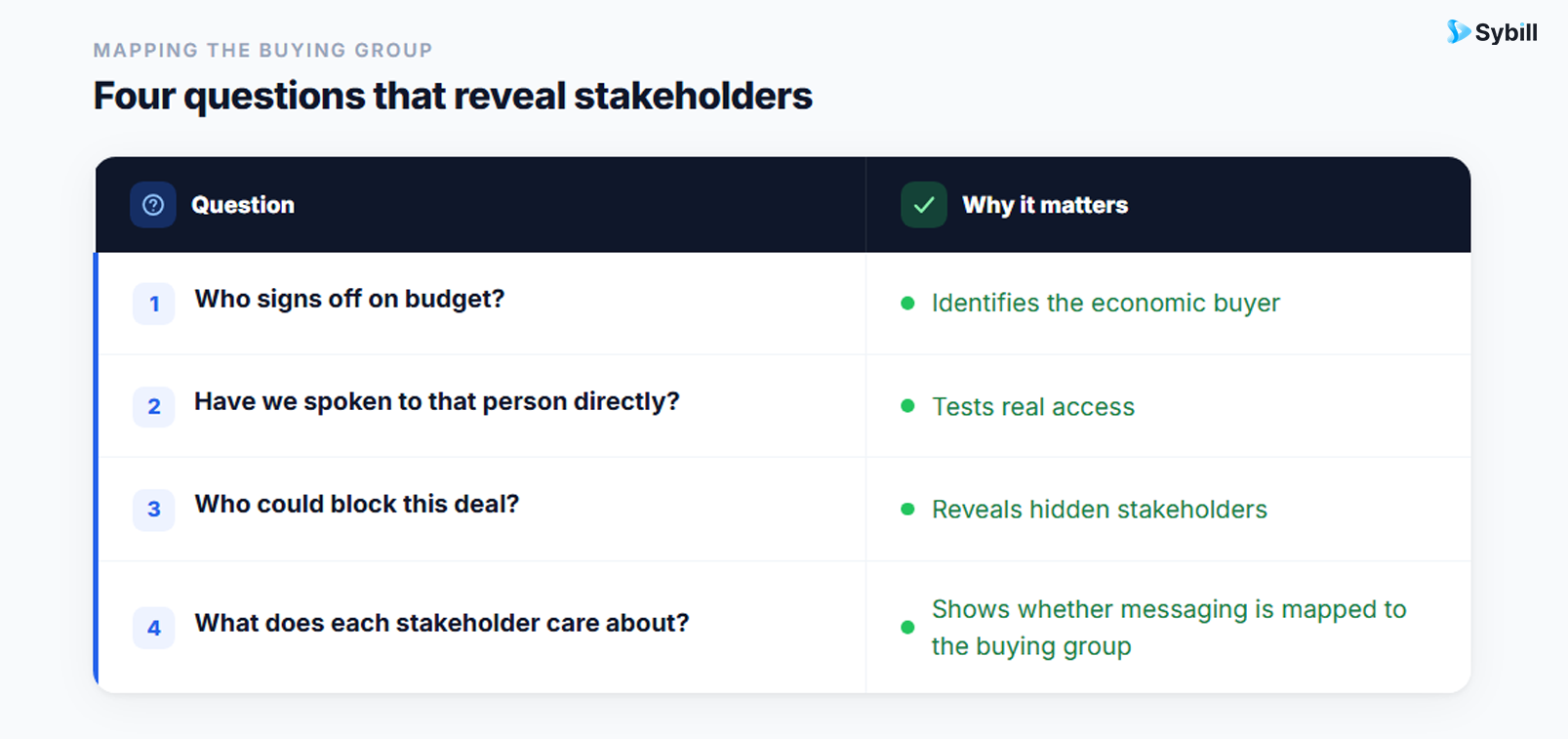
How Sybill helps:
Sybill helps teams inspect stakeholder involvement across deal conversations. Managers can look beyond activity volume and ask whether the right people are engaged, whether key stakeholders have gone silent, and whether the deal is multi-threaded enough to survive internal review.
For teams focused on pipeline health, Sybill’s sales leader use case shows how leaders can get instant visibility into performance and pipeline health without digging through CRM notes.
Budget hesitation is not always a deal killer. It is often a signal that the deal needs stronger business justification.
The danger is when the budget is mentioned, but not inspected.
Budget risk sounds like:
“We need to see if we have room for this.”
“This may need finance approval.”
“We were not expecting this price point.”
“We have other priorities this quarter.”
“Can you send over a business case?”
These are important signals. They tell the rep that the buyer may need help building internal justification. They may also indicate that the solution is valued, but not yet connected clearly enough to business impact.
To understand whether budget is a blocker, a process step, or a value gap, inspect:
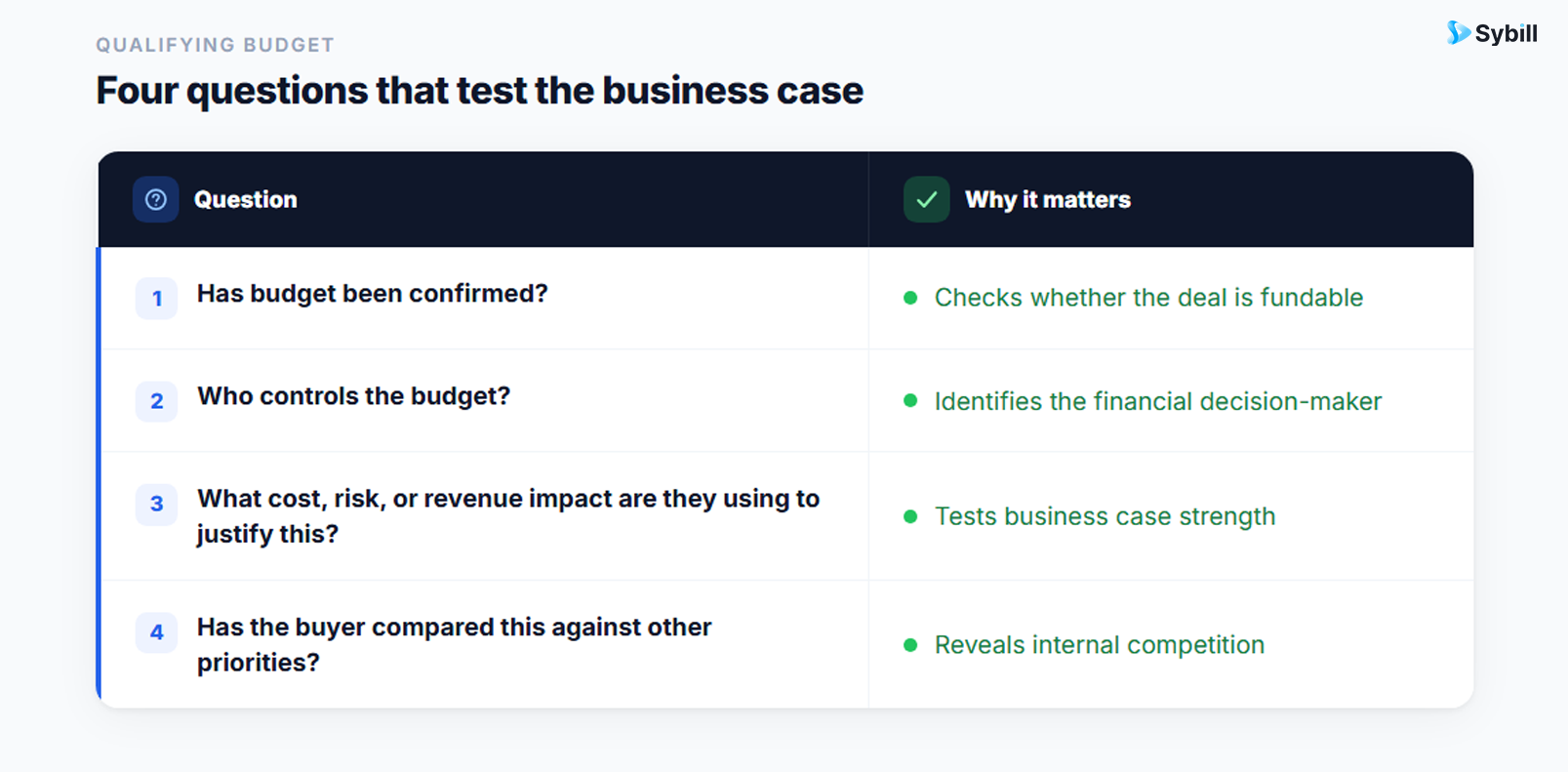
How Sybill helps:
Sybill can surface budget discussions, pricing concerns, objections, and buyer intent from calls and emails. Instead of finding out during forecast review that budget is “still being discussed,” managers can see when budget first became a concern and coach reps on the right next move.
Pricing concern is not always the same as price objection.
Sometimes pricing concerns means the buyer does not understand the value. Sometimes it means procurement is doing its job. Sometimes it means a competitor has changed the pricing frame. Sometimes it means the buyer likes the solution, but cannot justify the package being proposed.
Sales teams create risk when they treat all pricing conversations as discounting conversations.
Pricing risk sounds like:
“That’s higher than expected.”
“Another vendor came in lower.”
“We need to understand what’s included.”
“Can you sharpen the quote?”
“How flexible are you on pricing?”
Before discounting, reps and managers need to understand what kind of risk they are dealing with. Is the buyer comparing features, total cost, time to value, implementation effort, contract terms, or internal ROI?
To understand whether pricing is a value issue, a competitive issue, or an approval issue, inspect:
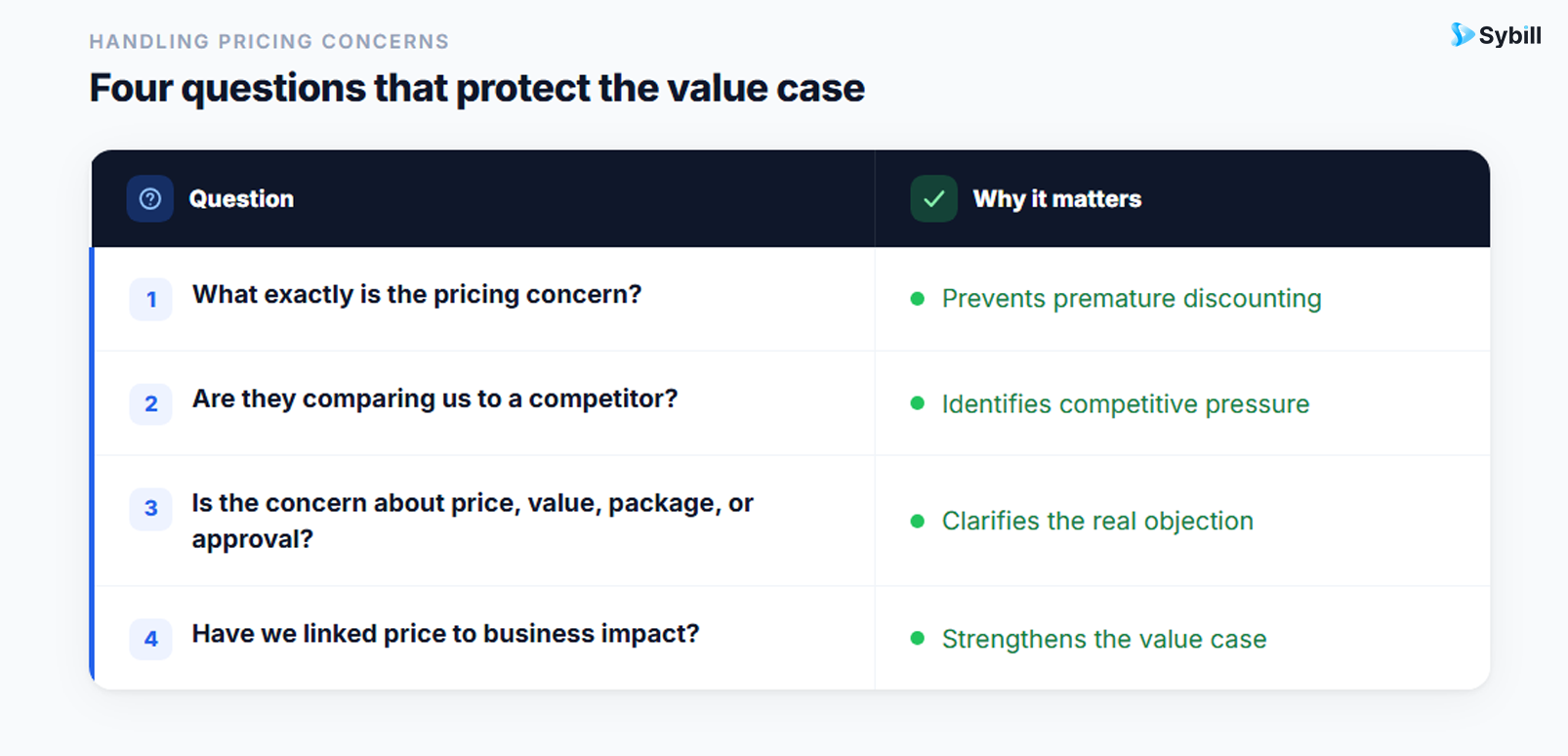
How Sybill helps:
With Sybill, reps can revisit buyer language from previous conversations and understand the context behind pricing concerns. Managers can inspect whether pricing came up once, repeatedly, or alongside competitor mentions. That context helps teams respond with better value framing instead of reflexive discounting.
A competitor mention is not always bad. In fact, it can be useful. It tells you the buyer is serious enough to compare options.
But competitor mentions become risky when the team does not know how the competitor is being positioned.
A buyer saying, “We are also looking at Competitor X,” is different from saying, “Competitor X seems easier to implement.” It is different again from saying, “Competitor X is cheaper,” or “Our VP has used Competitor X before.”
The risk is not the competitor’s name. The risk is the buyer’s reason for considering them.
To understand whether the competitor mention is harmless, active, or a serious threat, inspect:
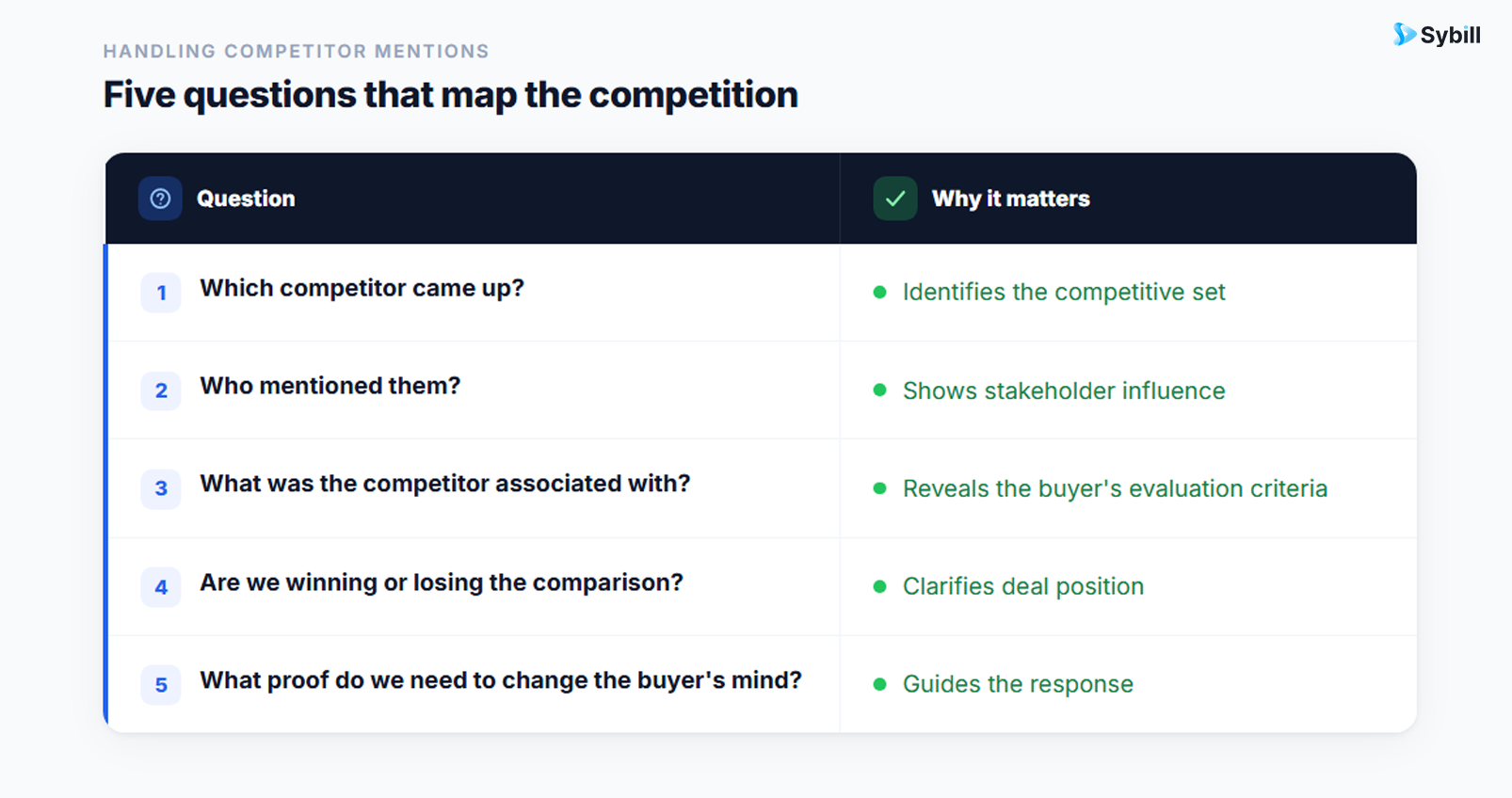
How Sybill helps:
Sybill’s competitor intelligence helps teams detect competitor mentions across calls, emails, summaries, and Slack threads. Teams can ask when a competitor first came up, which competitors are showing up most often, and why deals are being won or lost against specific vendors.
That turns competitive risk from anecdotal feedback into inspectable deal intelligence.
Sudden silence is one of the most frustrating forms of deal risk because it often follows a call that felt good. The demo went well. The buyer asked smart questions. The rep sent the follow-up. Then nothing.
Silence after a positive call can mean many things:
The buyer got busy.
The problem lost priority.
A senior stakeholder pushed back.
A competitor moved ahead.
Budget was not approved.
The champion does not know how to sell internally.
The buyer has concerns they are not ready to share.
The mistake is assuming silence is neutral. In a live deal, silence is a signal.
To understand whether silence is a normal pause or a loss of momentum, inspect:
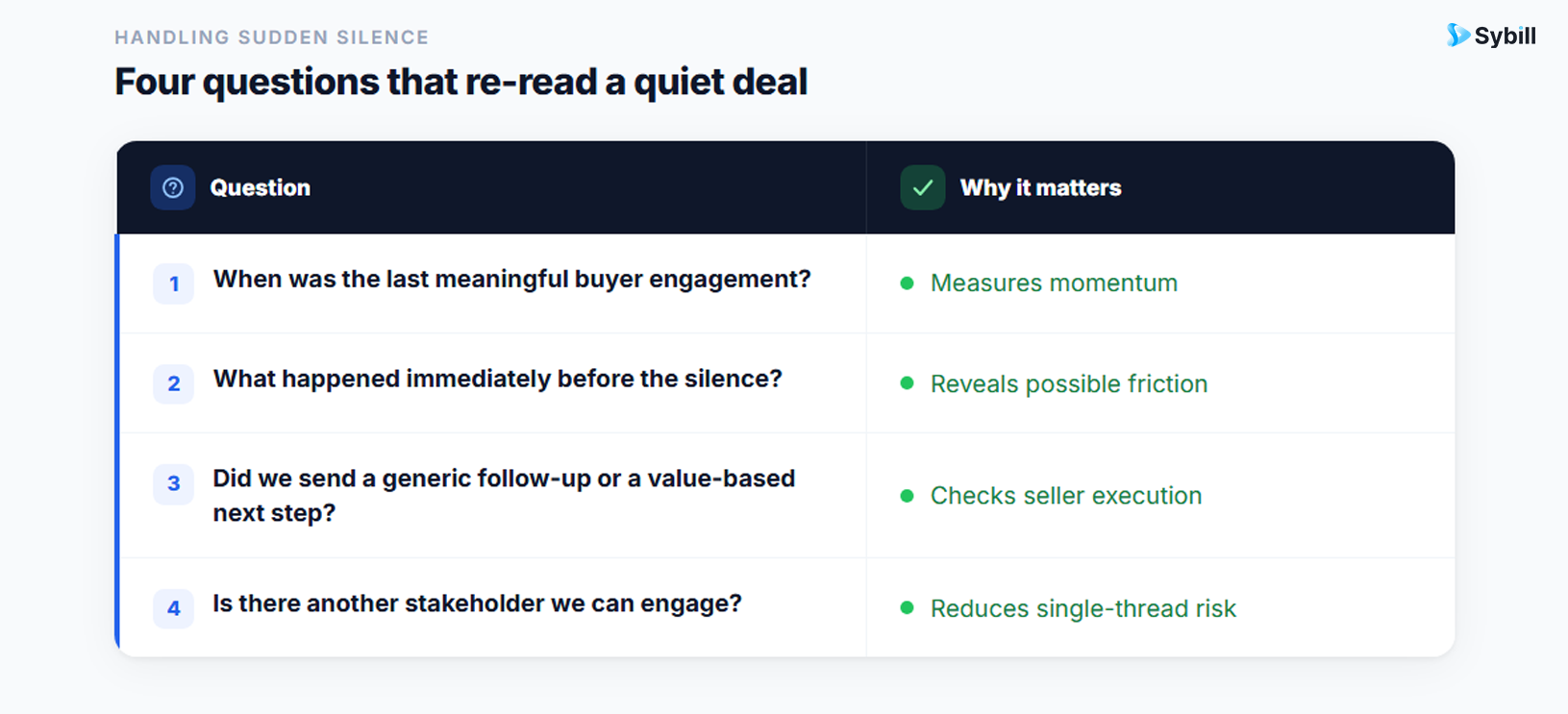
How Sybill helps:
Sybill helps reps draft personalized follow-ups, update CRM fields, and track next steps from real conversation context. If a buyer goes quiet, reps can use Sybill to understand the last known concern, the strongest value point, and the right re-engagement angle instead of sending another “just checking in” email.
Related read: AI Call Summary: From Manual Notes to Sales Intelligence
A deal can have every CRM field filled out and still be risky.
The stage can be correct. The amount can be accurate. The close date can be updated. The forecast category can be selected. But if the deal story is weak, the forecast is still fragile.
A weak deal story sounds like:
“They liked the demo.”
“They are evaluating options.”
“They asked for pricing.”
“They said this is important.”
“We should hear back soon.”
A strong deal story sounds like:
“The VP of Sales wants to reduce rep admin time before Q4 planning. The RevOps lead is evaluating CRM workflow fit. Finance needs a business case by next Tuesday. Legal review starts once pricing is approved. The main risk is that Competitor X is already used by another business unit.”
That second version gives the manager something to inspect. It has stakeholders, pain, process, urgency, risk, and next steps.
To separate a clean CRM record from a healthy deal, inspect:
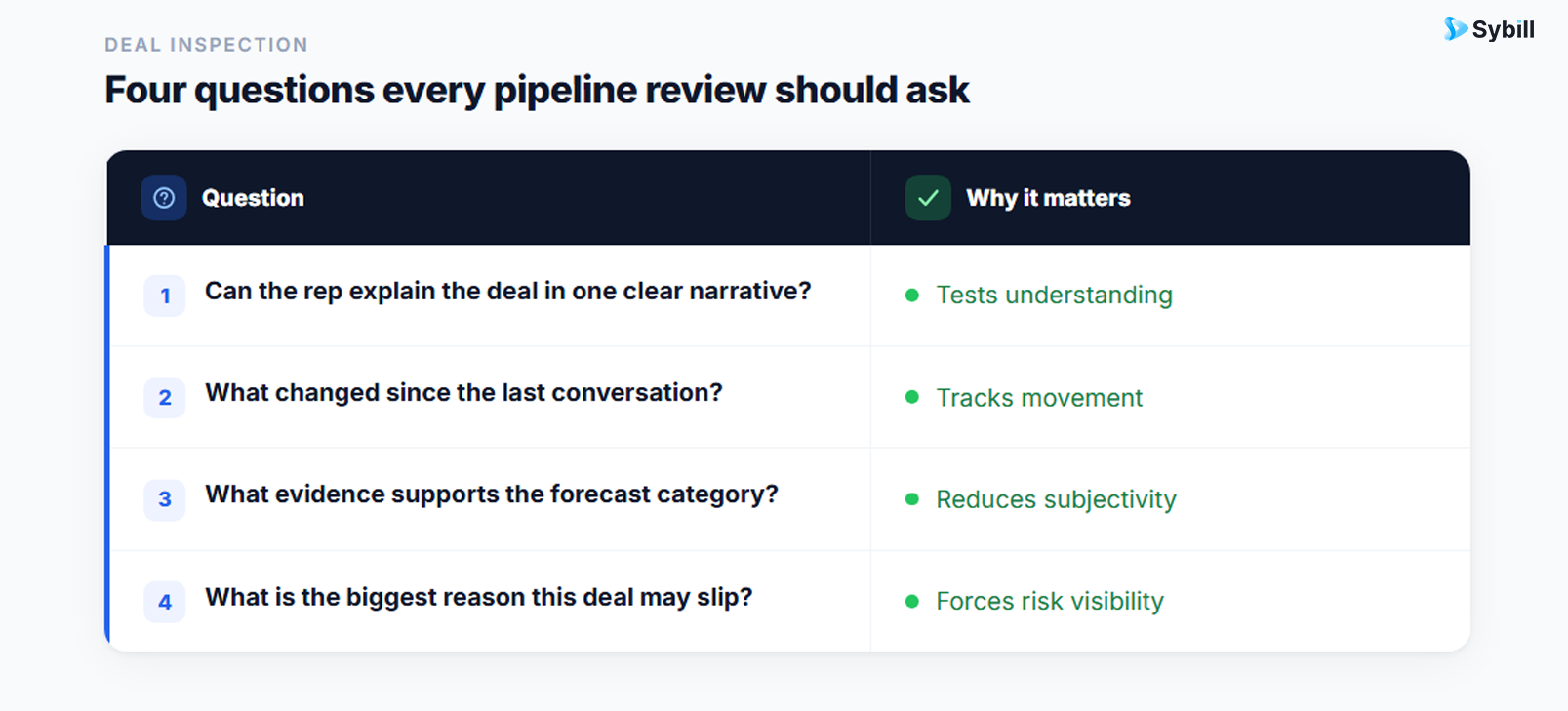
How Sybill helps:
Sybill reduces the gap between CRM data and deal reality by capturing call insights, drafting follow-ups, and autofilling CRM updates. The result is not just cleaner admin. It is a more inspectable deal narrative.
For comparison, see how Sybill differs from basic meeting assistants in Otter vs Sybill: Which AI Meeting Assistant Wins for Sales?
The final risk signal is not in the buyer conversation. It is in the sales operating rhythm.
If managers inspect deals only during forecast review, they are already late.
At-risk deals need attention while there is still time to act. That may mean multi-threading into finance, rebuilding urgency, clarifying the business case, addressing a competitor, sending a sharper follow-up, or moving the close date before the forecast becomes misleading.
Forecast review should validate pipeline health. It should not be the first time anyone inspects it.
To catch risk before the forecast call, inspect every week:
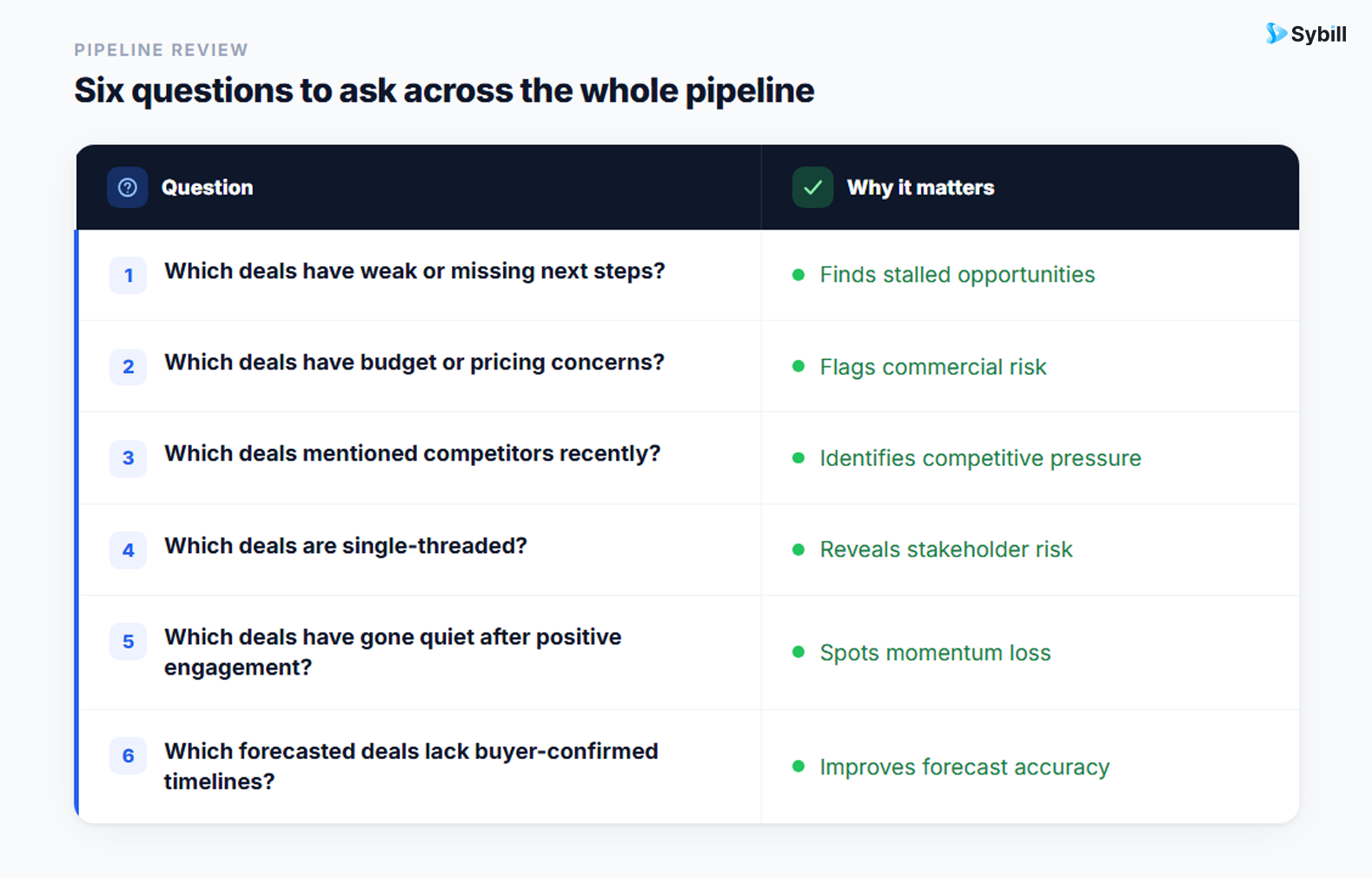
How Sybill helps:
With Ask Sybill, teams can ask plain-language questions about their pipeline instead of manually digging through calls, emails, CRM notes, and Slack threads. Examples include:
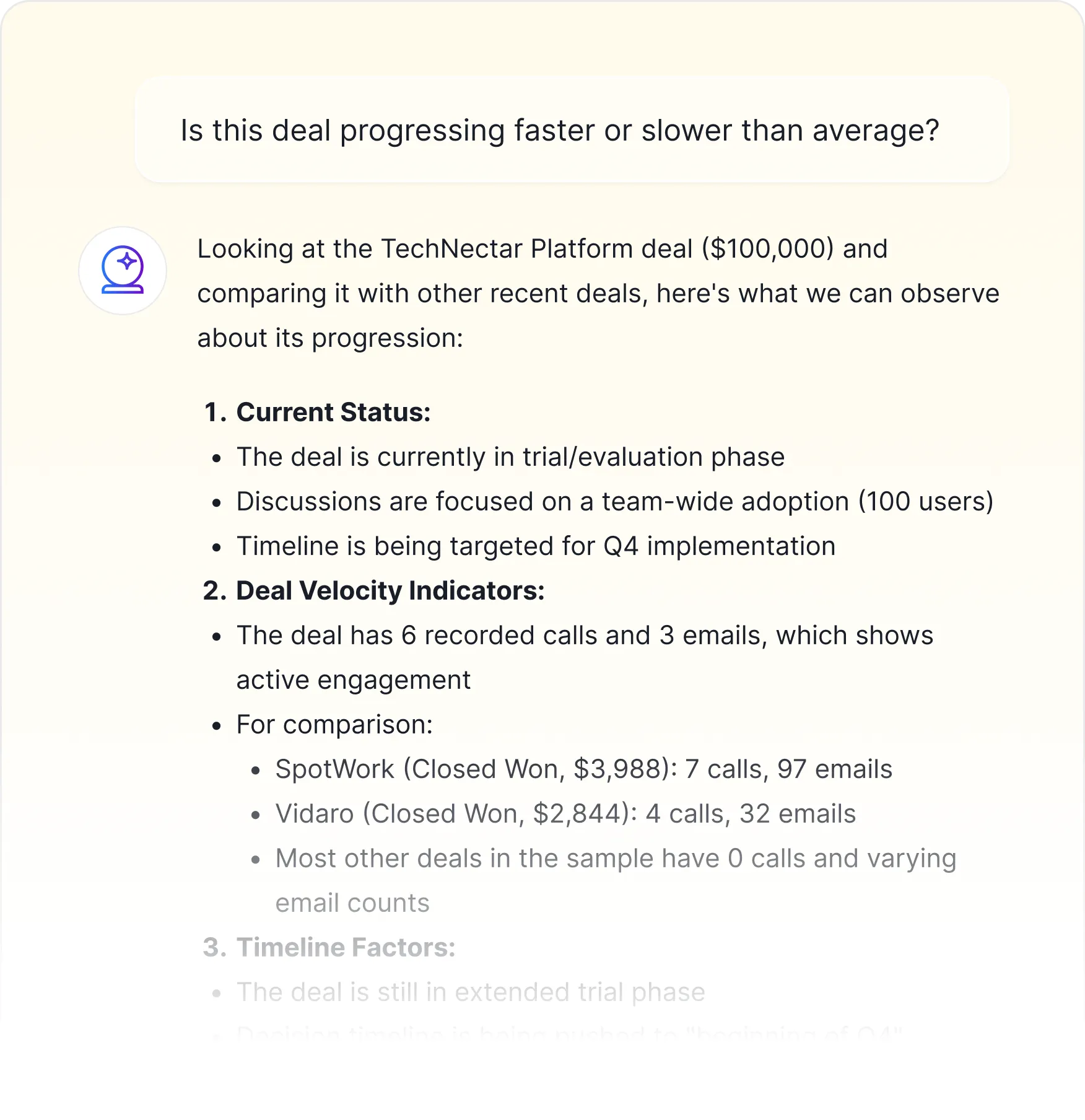
“Which deals have unresolved budget concerns?”
“Which Commit deals have no confirmed next step?”
“Which deals mentioned competitors this week?”
“Which late-stage deals are missing economic buyer involvement?”
“Which opportunities have gone quiet after pricing was shared?”
This is the shift from forecast interrogation to continuous deal inspection.
Before the next forecast review, inspect every important deal against this checklist.
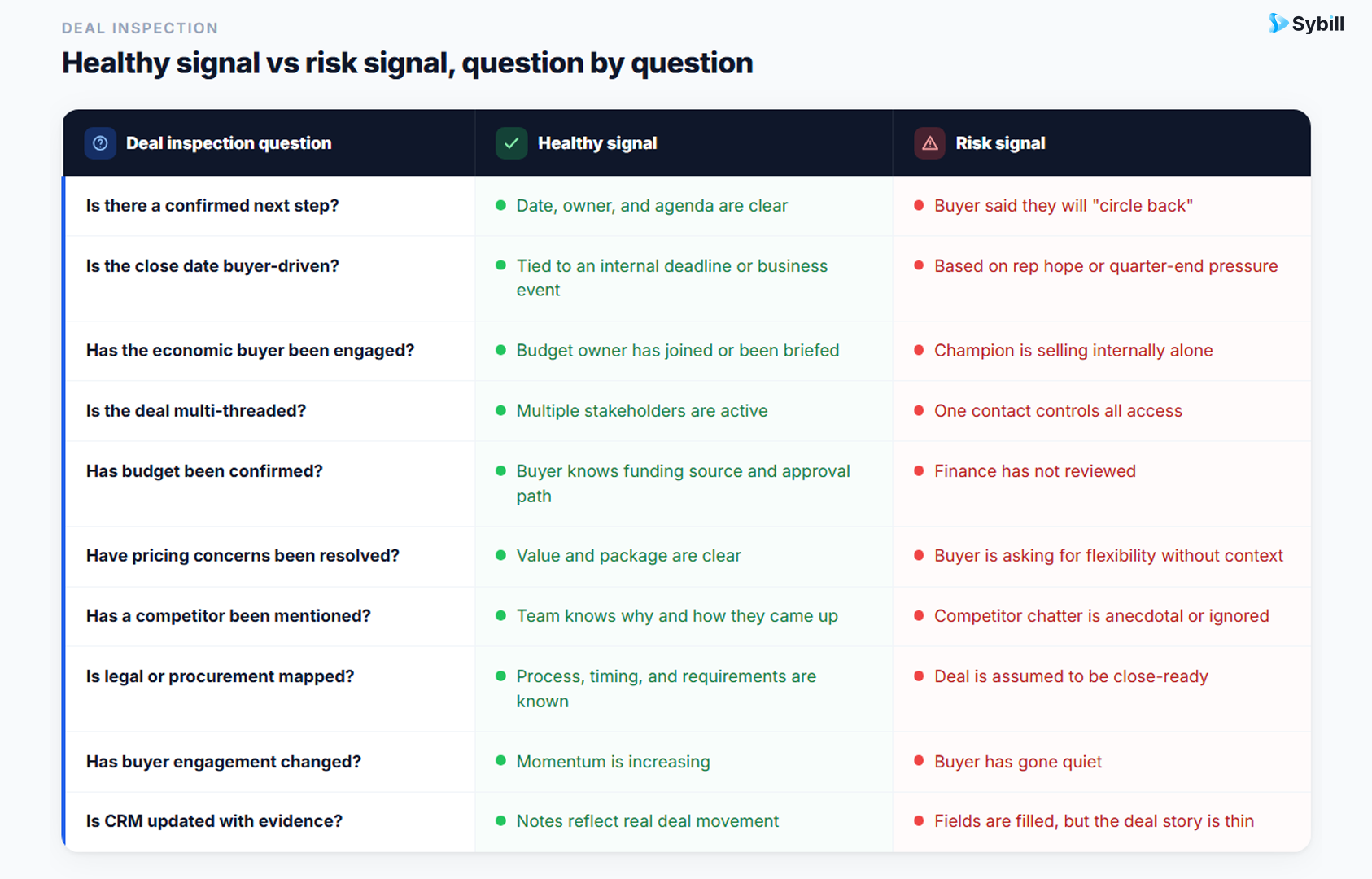
This checklist is not meant to make forecast review longer. It is meant to make it sharper. Managers should not spend the call extracting basic deal facts. They should spend it deciding what action will improve deal quality.
AI does not magically remove deal risk. It helps revenue teams see risk earlier, with more evidence and less manual effort.
Traditional forecasting often depends on stage, close date, rep judgment, and CRM hygiene. AI-powered forecasting and deal inspection can add more context by analyzing deal velocity, buyer engagement, historical win rates, conversation data, and activity patterns. Salesforce’s sales forecasting guide notes that AI-powered forecasting can look at deal velocity, buyer engagement, and historical win rates to flag at-risk deals.
For sales teams, the value is not just prediction. It is inspection.
Good AI deal inspection should help teams answer:
What changed in this deal since the last call?
What did the buyer actually say about urgency?
Which objections are still unresolved?
Who has been involved so far?
Who is missing from the buying committee?
Has a competitor entered the conversation?
Did the buyer commit to a next step?
Which deals are forecasted aggressively without enough evidence?
Which opportunities are losing momentum?
This is where generic call summaries are not enough. A summary can tell you what happened in one meeting. Deal inspection tells you what is happening across the opportunity.
Sybill helps revenue teams spot deal risk earlier by connecting buyer conversations, deal context, CRM updates, follow-ups, and pipeline visibility into one AI sales workflow.
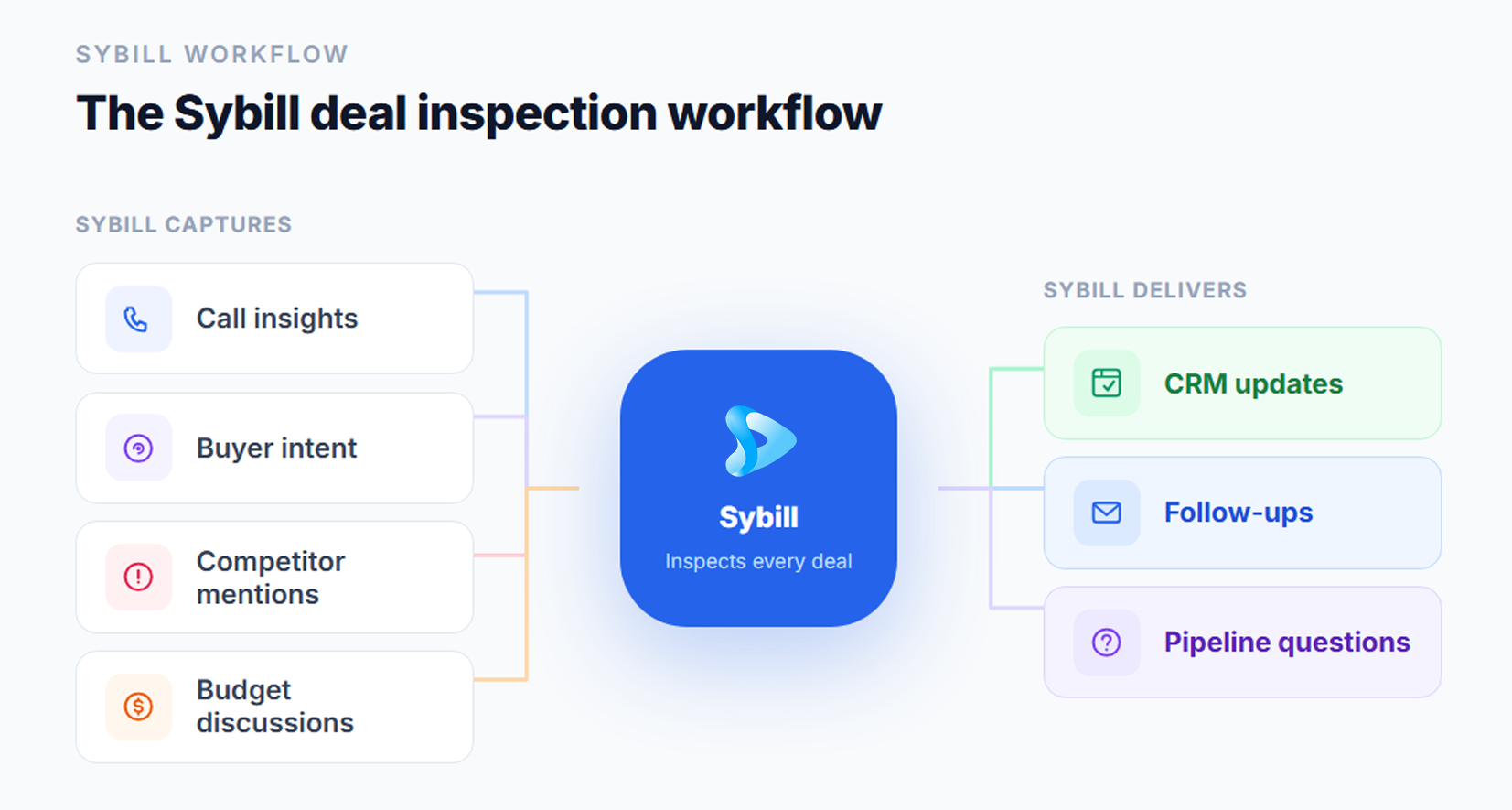
Instead of waiting for a forecast call to uncover weak next steps, missing stakeholders, budget hesitation, pricing concerns, competitor mentions, or buyer silence, teams can inspect these signals as the deal unfolds.
Here is how Sybill fits into the deal risk workflow:
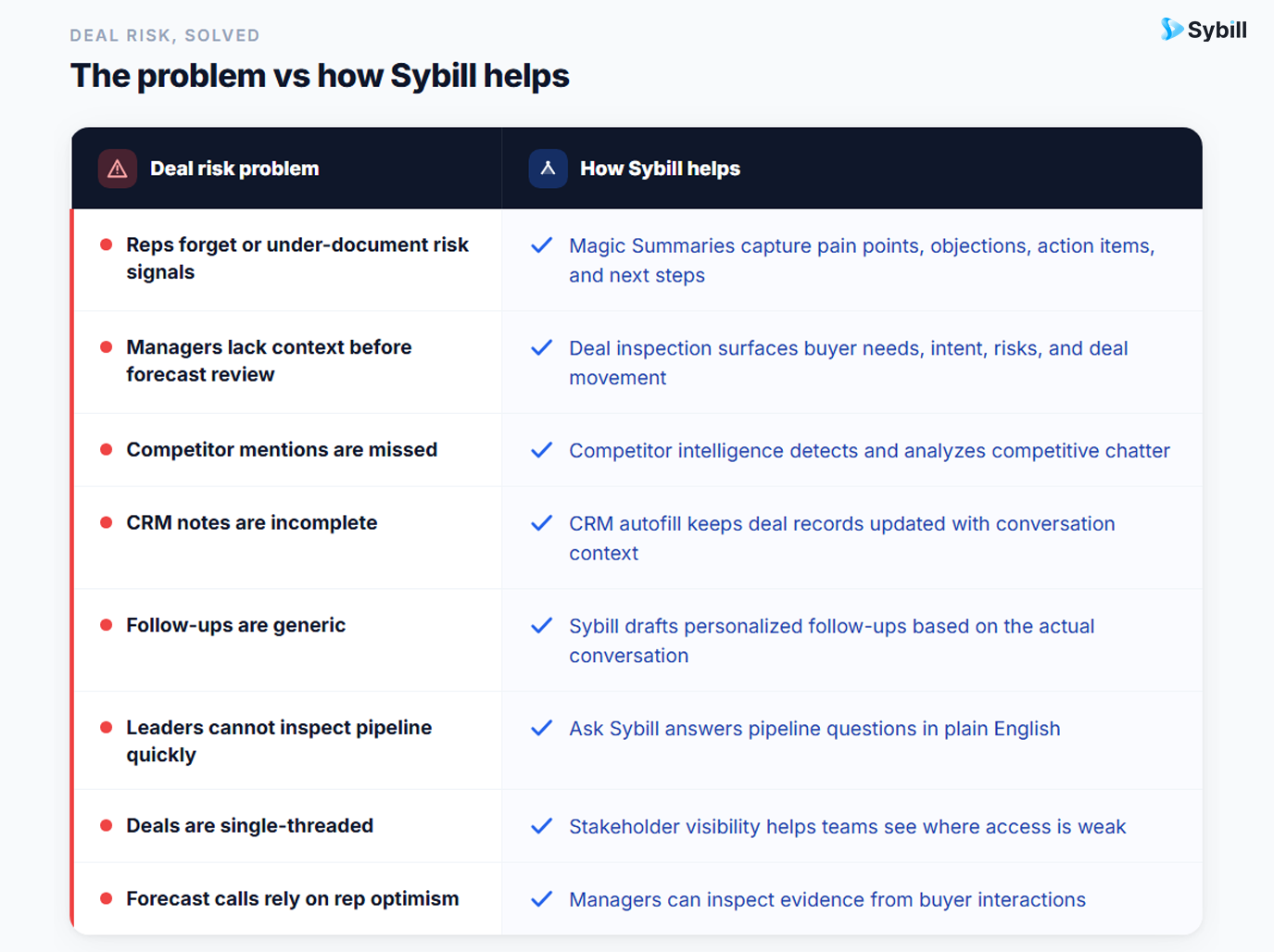
Sybill helps teams stop discovering deal risk when it is already too late.
It gives reps better deal memory. It gives managers better inspection. It gives leaders better pipeline visibility. Most importantly, it helps the team act on risk while there is still time to change the outcome.
Spotting risk is only useful if the team knows what to do next. Here are common deal risks and the right response:
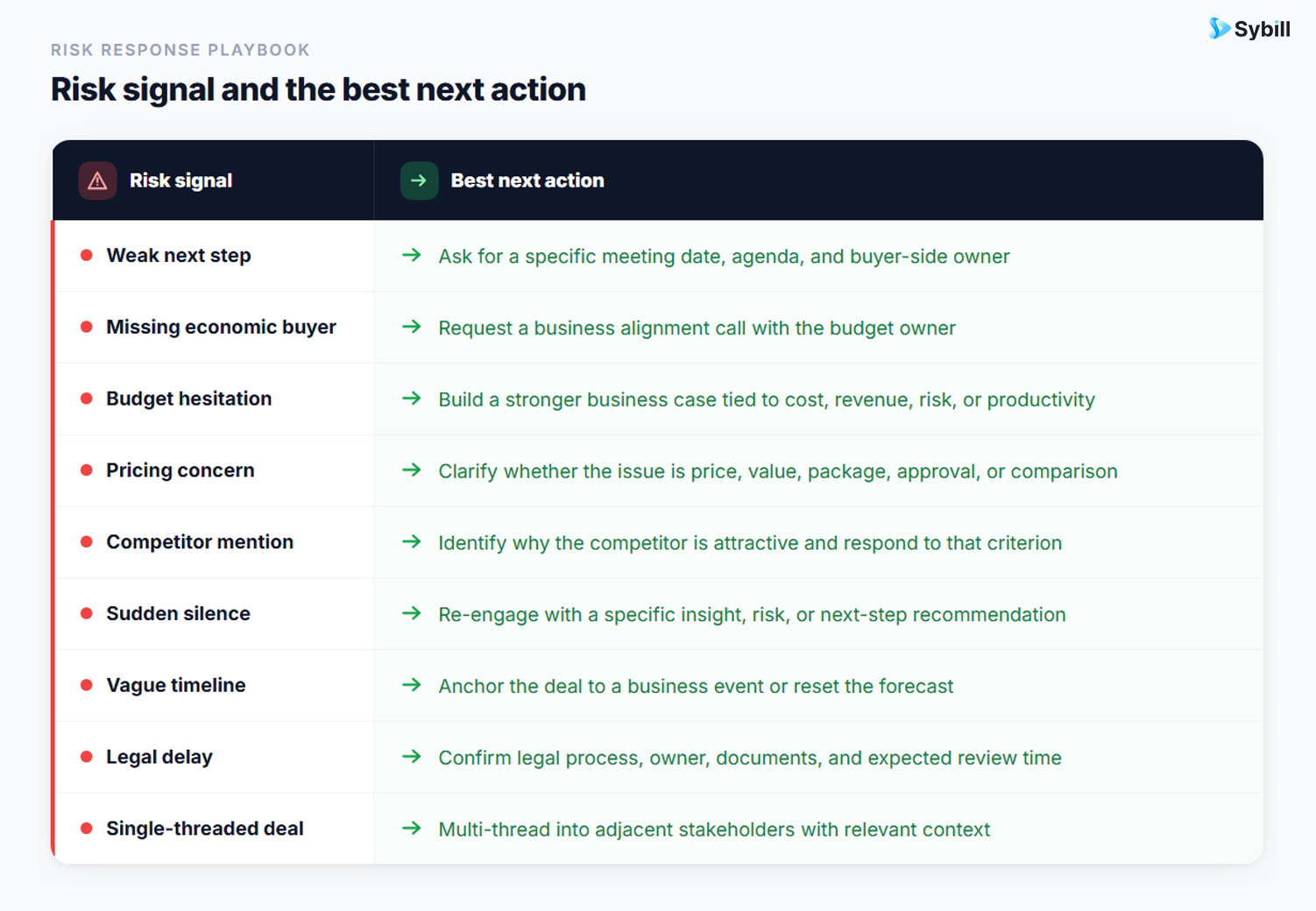
This is where managers should coach, not just challenge. A deal risk signal is not a reason to shame the rep. It is a chance to improve deal execution.
A good forecast review should not sound like a manager trying to extract a confession.
It should not depend on whether a rep remembers the exact phrasing of a buyer’s objection. It should not require digging through call recordings, Slack threads, email chains, and stale CRM notes during the meeting. It should not treat every deal as healthy until proven otherwise.
The best forecast reviews are evidence-based.
They answer:
What has changed?
What is real?
What is risky?
What action should we take next?
What should we remove from the forecast?
What needs executive help?
What needs better stakeholder engagement?
What needs a stronger business case?
When deal risk is inspected continuously, forecast review becomes more useful. The team spends less time debating opinions and more time improving outcomes.
Most deal risk does not come out of nowhere.
It appears in the missed next step. The vague timeline. The missing stakeholder. The budget hesitation. The pricing concern. The competitor mention. The buyer silence. The CRM gap. The rep optimism that is not backed by buyer evidence.
Forecast reviews can reveal these risks, but they rarely reveal them early enough.
To improve forecast accuracy, sales teams need to inspect deals before the forecast call. They need to know which opportunities are moving, which are stuck, which are single-threaded, which are under competitive pressure, and which are being carried by hope rather than buyer commitment.
Sybill helps revenue teams do exactly that. With deal inspection, buyer intent, competitor intelligence, Magic Summaries, CRM updates, follow-ups, and Ask Sybill, teams can catch deal risk while there is still time to act.
Do not wait for the forecast review to find out which deals are in trouble.
Ask Sybill before the risk becomes a number.

Deal risk is any signal that an opportunity may not close on time, at the expected deal value, or at all. It can come from weak next steps, missing stakeholders, budget concerns, pricing objections, competitor mentions, unclear timelines, legal delays, procurement issues, or reduced buyer engagement.
The most common deal risk signals are vague next steps, no confirmed meeting date, missing economic buyer, single-threaded relationships, budget hesitation, pricing concern, competitor mentions, sudden buyer silence, and CRM updates that do not reflect real deal movement.
To spot an at-risk deal before forecast review, inspect buyer conversations, next steps, stakeholder involvement, budget status, pricing discussions, competitor mentions, engagement changes, and CRM accuracy. A deal is often at risk when the buyer sounds interested but has not committed to a clear action.
Deals often slip after being marked Commit because the forecast was based on rep confidence rather than buyer evidence. Common reasons include unconfirmed budget, missing economic buyer involvement, legal or procurement delays, unresolved pricing concerns, competitor pressure, or no buyer-confirmed close timeline.
AI can help identify sales forecast risk by analyzing deal velocity, buyer engagement, historical win patterns, conversation data, CRM activity, objections, and next-step quality. This helps managers spot risk earlier instead of relying only on manual CRM updates and rep sentiment.
Managers should inspect whether each important deal has a confirmed next step, buyer-driven timeline, engaged economic buyer, clear budget path, resolved pricing concerns, mapped stakeholders, known competitors, recent buyer engagement, and CRM notes that match the actual deal story.
Sybill helps teams identify deal risk by capturing buyer conversations, surfacing objections, detecting competitor mentions, tracking buying intent, supporting deal inspection, autofilling CRM fields, drafting follow-ups, and helping managers ask pipeline questions through Ask Sybill.
Deal risk is any signal that an opportunity may not close on time, at the expected deal value, or at all. It can come from weak next steps, missing stakeholders, budget concerns, pricing objections, competitor mentions, unclear timelines, legal delays, procurement issues, or reduced buyer engagement.
The most common deal risk signals are vague next steps, no confirmed meeting date, missing economic buyer, single-threaded relationships, budget hesitation, pricing concern, competitor mentions, sudden buyer silence, and CRM updates that do not reflect real deal movement.
To spot an at-risk deal before forecast review, inspect buyer conversations, next steps, stakeholder involvement, budget status, pricing discussions, competitor mentions, engagement changes, and CRM accuracy. A deal is often at risk when the buyer sounds interested but has not committed to a clear action.