Find us at booth #83, join us for a harbor side happy hour, or catch Gorish’s talk.

Sept, 16-18 > Learn more

%20(1).avif)
Mamta Tainwala

April 17, 2026
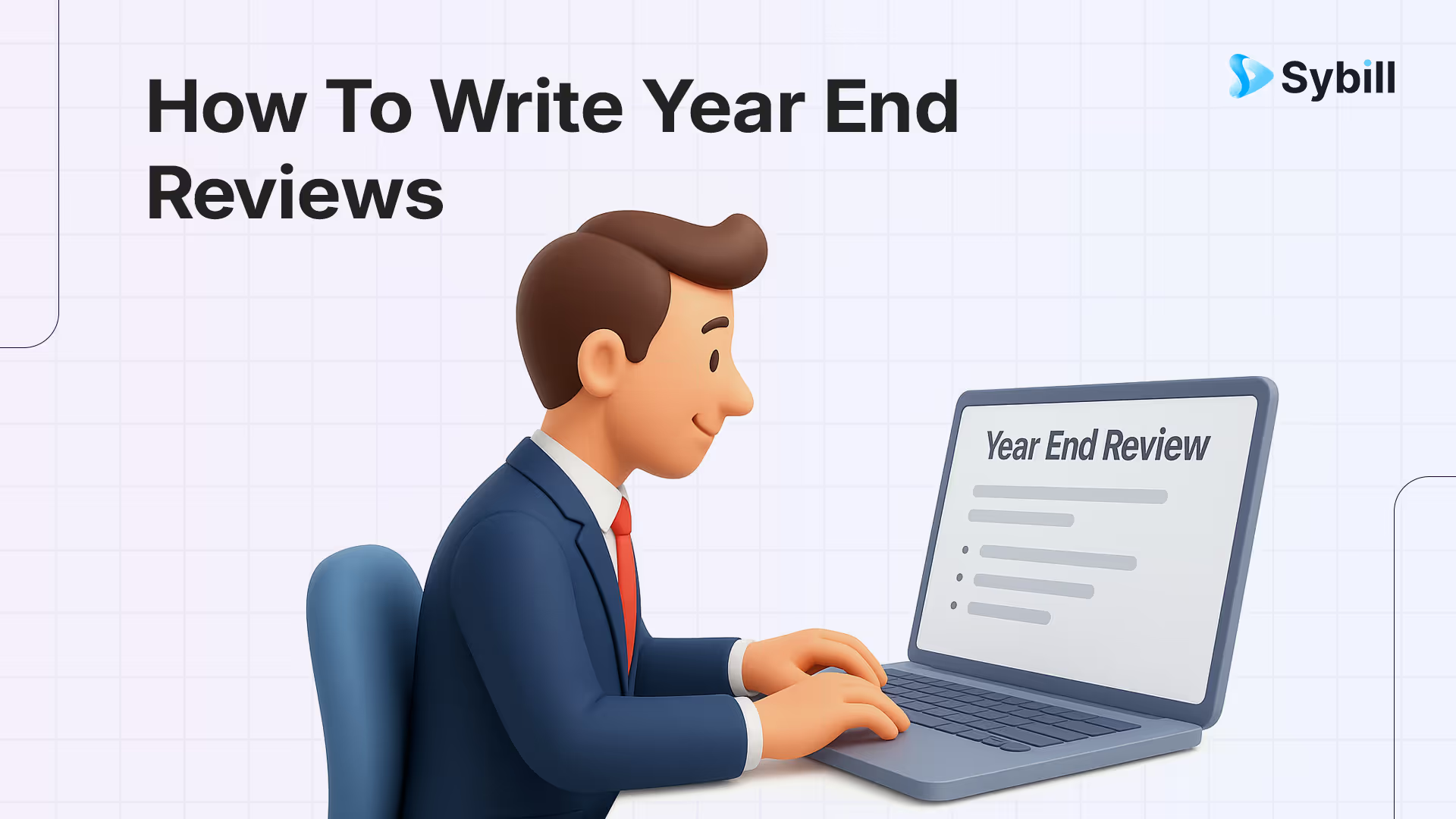
Think about every annual review scene you have ever watched on TV.
Michael Scott in The Office rambling through performance reviews.
Donna in Parks and Rec clearly knowing her worth while everyone else fumbles.
Any corporate episode in Succession where feedback is a thinly veiled power move.
Now picture that energy, but in your actual conference room.
To write effective year-end reviews, structure them in four parts: a results summary with specific metrics and quota attainment, a strengths section highlighting two to three key wins with context on why they mattered, a growth areas section with concrete examples and forward-looking development goals, and a next-year objectives section tied to team and company priorities. For sales professionals, tools like Sybill make year-end reviews dramatically easier by providing searchable records of every call, deal outcome, and CRM update throughout the year — giving both reps and managers evidence-backed performance data instead of relying on memory and last-minute scrambling in December.
For a lot of people, year end reviews feel exactly like that. Awkward. Vague. Slightly terrifying. A mix of “please validate me” and “please do not say anything that will haunt me at 2 a.m.”
The good news is that year end reviews do not have to feel like a bad sitcom episode. When done well, they are more like season finales. You recap the plot, call out character development, admit where the writing could have been better, and set up a stronger next season.
This guide will show you how to do that, whether you are:
We will keep things conversational and a little playful, but grounded in what actually works. We will pull in lessons from HR guides, performance management research, and real examples from companies that take reviews seriously.
We will also talk about how AI helpers, especially meeting assistants like Sybill, can quietly make your life easier at review time by collecting evidence for you all year instead of during a panic in December.
No vague fluff, no corporate bingo cards. Let us turn this into something useful.
Most sources agree on a simple definition:
A year end review is a structured conversation where a manager and employee look back at the past year’s performance, discuss achievements and gaps, and align on goals and development for the next year.
So, in normal people language:
Done well, it is a checkpoint that:
If your review feels like a vague monologue that could apply to anyone, something is off.
You might have seen hot takes like “annual reviews are dead” and “we only do continuous feedback now.”
Reality check: most companies still have some form of annual or year end review, even if they also do check-ins during the year. HR and leadership blogs make the same point: as long as promotions, raises, and big decisions exist, there will be at least one formal review moment.
The question is not “should we kill year end reviews” but “how do we make them less painful and more useful?”
When they work, year end reviews:
When they do not, you get:
So this guide is not just about “writing nice paragraphs.” It is about making sure this important ritual does what it is supposed to do: help people grow, not just feel judged.
Whether you are writing a self review or reviewing someone else, do not start by staring at the form. Start by gathering material.
Most good year end review guides recommend collecting: performance metrics, project outcomes, feedback, and notes before you write.
Here is what that looks like in practice.
Pull together:
If you use a meeting assistant like Sybill, this is where you quietly thank your past self. Sybill’s AI meeting summary that teams can actually use turns each call into a structured recap, so at year end you are not reconstructing the year from vibes and fragments. You can scroll through summaries instead of trying to remember what your big wins looked like back in March.
Once you have the raw material, zoom out.
Ask:
McKinsey and other sources suggest that the best year end reviews focus on patterns of behaviour and impact, not just a list of tasks completed.
You are shaping a narrative, not making a grocery list.
Let’s start with you as the employee.
Your self review is not just a formality. It sets the frame for how your manager, their manager and sometimes HR see your year. Employee focused guides stress that a strong self review can influence the conversation, highlight unseen work and help you advocate for your growth.
Here is how to write one that is honest, confident and specific, without feeling like you are auditioning for a TED talk.
Open with one or two sentences that answer the question: “How did my year go, overall?”
Skip “I worked very hard” and “it was a busy year.” Everyone could write that.
Aim for something like:
“This year I grew into a senior level contributor on the data team, led two cross functional projects that each improved reporting speed by more than 30%, and mentored two newer teammates.”
That sentence does three things at once:
You are not bragging, you are giving your reader a map.
Next, pick 3-5 meaningful achievements and talk about them clearly.
For each one, hit this arc:
For example:
“At the start of Q2, our sales team lacked a reliable way to track follow ups from discovery calls. I partnered with RevOps to design a simple process using Sybill’s AI sales assistant and our CRM, trained the team, and monitored adoption for six weeks. As a result, we saw a 20% increase in on time follow ups and a noticeable uptick in early stage deal progression.”
Notice how that example:
Year end review experts often recommend linking achievements to business impact, not just activities.
If you struggle with numbers, look for directional outcomes: fewer escalations, faster delivery, happier customers, more efficient internal processes.
If you pretend everything was perfect, your manager will either think you are unaware or hiding something. Good reviews acknowledge where things did not land.
The trick is to avoid dramatic self dragging and focus on learning.
Structure for a “miss”:
Something like:
“One of my goals was to reduce response time on urgent support tickets by 40%. We only reached about 20% improvement. I underestimated how much time would be spent training new agents and did not push early enough for changes in our routing rules. In the second half of the year I worked with our ops team to adjust escalation paths, and I want to continue that partnership next year with clearer milestones.”
Performance review guides consistently say that framing setbacks as learning and showing concrete steps forward is far better than avoiding them.
Think “considered and accountable,” not “self flagellation.”
Managers care about output, but they also care about your trajectory.
Use part of your self review to talk about how you grew:
You might write:
“At the start of the year I was mainly executing analytics tasks defined by others. Over the year I learned more about our sales funnel and started proactively proposing weekly dashboards for the sales leaders. I also presented our findings in two company wide meetings, which helped me build confidence in communicating data to non technical audiences.”
If you completed specific training or certifications, mention them. That includes internal workshops, conferences and relevant books or courses.
Modern performance systems often include behavioural or values based criteria, not just output. Large companies openly link reviews to how people embody values or leadership principles.
So, include examples of how you:
For instance:
“I leaned into our ‘customer first’ value by joining five extra customer calls with the CS team when we launched the new pricing, then shared a summary of common themes with the product so we could adjust our roadmap.”
This matters more than you think, especially when promotion or leadership opportunities are on the table.
Do not end your self review on “overall it was a good year.”
Use the last section to look forward:
Many guides suggest using year end reviews to set goals and discuss development plans that align with both personal and organisational priorities.
You could write:
“Next year I would like to take on more ownership of cross functional projects that sit between data and GTM. I am especially interested in leading a full funnel analytics initiative. To get there, I want to deepen my skills in experiment design and stakeholder communication, and I would appreciate opportunities to shadow senior PMMs during launch planning.”
This gives your manager something concrete to react to and plan around.
Now, let us flip the perspective.
Writing year end reviews as a manager is its own mini boss level. You are trying to:
Oh, and at least one person on your team is reading your review as “proof” of their worth as a human. No pressure.
The good news is that manager guides from places like McKinsey, Forbes, Teamflect and others converge on a few simple best practices.
Here is how to write reviews that are clear, humane and useful.
Before you start typing, decide how you want each review to flow. Consistency helps you be fair.
One classic structure:
You can adapt this, but keep the same basic shape for everyone at similar levels.
In your writing:
Sources on performance review best practices hammer on specificity, evidence and future orientation.
Your brain is a biased, leaky database. If you write reviews based only on what you remember from the last month, you will accidentally reward recency and overlook earlier contributions.
Better approach:
If your team uses a meeting assistant like Sybill throughout the year, this step becomes much easier. Sybill’s sales workspace built around meetings and tasks and Magic Summary features give you a timeline of deals, decisions and commitments. That creates a more objective base for your review, especially for sales and customer facing roles.
This kind of ongoing evidence collection lines up with advice from HR experts who say that continuous documentation and data driven assessments make year end reviews fairer and more accurate.
It is easy to write “shipped many features” or “closed many deals.” It is harder, but much more valuable, to explain impact.
For example:
Industry templates for year end reviews often emphasise linking performance to outcomes that matter for the business, not just listing tasks.
This also helps you distinguish between people who are busy and people who are effective.
Generic praise is emotionally nice but practically useless.
Compare:
“You are a strong communicator.”
vs.
“You are a strong communicator, especially in cross functional settings. Your weekly updates in the GTM standup helped product and customer success see the same picture, and several people mentioned that your Q2 roadmap presentation made it clear what to expect.”
The second one:
Research on performance reviews suggests that specific, behaviour based positive feedback is a powerful driver of motivation and engagement.
If you struggle with this, skim through meeting summaries, Slack threads or project docs and copy paste good moments into your draft as raw material.
Delivering critical feedback is where many managers freeze. Some swing to “too nice,” others to “brutal honesty that shocks people.”
Recent stories about companies like TikTok, Meta and Amazon show how performance review systems can become harsh or politicised when quotas or forced distributions are involved.
You may not control the system, but you do control how you talk to your people.
When writing about growth areas:
Instead of:
“You are not proactive enough.”
Try:
“In several projects this year, including the Q3 onboarding revamp, you waited for work to be assigned rather than proposing next steps. This slowed progress. I would like to see you experiment with making a first draft plan and bringing it to me or the team for feedback.”
You are not avoiding hard truths. You are delivering them in a way that preserves dignity and sets up action.
All the guides say some version of this, and they are right: the worst year end review is the one where the employee learns something huge about their performance for the first time in writing.
If someone is underperforming or at risk, they should already know from earlier conversations.
So:
If you realize you are about to write something that the person has genuinely never heard before, pause and consider a separate conversation first.
Just like self reviews should end with “here is where I want to go,” manager reviews should end with “here is how I see your next chapter.”
Concretely:
People managing people sources and performance review guides all emphasise the value of converting reviews into actionable development plans.
If you manage sales or customer facing roles, this is a natural place to link their development plan to tools like Sybill, which can support better calls, cleaner follow ups and more honest pipeline data. For example:
“To grow into a senior AE, I would like you to focus on discovery depth and multi threading. We will enable Sybill on all of your key calls so we can review summary insights, objections and stakeholder maps together in our one on ones using our deal copilot for sales leaders workflow.”
Now their development is tied to actions and tools, not just aspirations.
To make this practical, here are a couple of simple paragraph structures you can copy paste and adapt.
“This year I focused on [main theme, for example: improving our onboarding experience]. I led [project or initiative], where I [describe your role and actions]. As a result, [quantifiable or directional outcome, for example: time to first value for new customers dropped by 25%]. I also [mention secondary contributions, like mentoring or cross team work]. This work supported our broader goal of [connect to team or company objective].”
“Overall, [Name] had a [strong / solid / uneven] year in the [role]. They contributed meaningfully to [one or two key initiatives] and showed particular strength in [specific behaviours]. The main opportunities for growth are in [one or two areas, with a phrase about behaviour rather than personality]. Going into next year, I would like to see [Name] focus on [development theme], and I am committed to supporting them through [coaching, exposure, training or tools].”
These small scaffolds keep you away from vague corporate filler.
Quick reality: the best year end review is the one you do not have to build from scratch in December.
That is where AI and meeting tools come in, especially if you spend your life in calls.
Here are a few ways Sybill and related tools quietly set you up for better reviews all year.
Instead of relying on hazy memory, Sybill joins your sales and customer calls, generates detailed summaries and captures key moments like objections, competitor mentions and next steps. Its AI meeting summary that teams can actually use is designed so people can skim and act, not just archive.
At review time:
If you want to understand AI meeting tools in general, this guide to AI meeting assistants breaks down the space and how to choose.
Sybill is not just a transcription tool. It writes structured insights into your CRM and systems, like deal risks, stakeholder roles and follow up tasks, using its AI sales assistant brain.
That matters for reviews because:
If you are interested in how this plays into forecasting, check out the breakdown of how supersellers use AI for precise forecasting.
Year-end reviews should not be the only moment someone hears “here is what to work on.”
Sybill supports ongoing coaching by:
That means your year end review is basically “season recap of all the work you have been doing together,” not “sudden audit based on three random memories.”
For more sales specific context, the AI assistance for sales managers page shows how managers use Sybill as a deal coach and data source.
if you remember only one thing from all this: year end reviews are storytime with receipts.
For employees, your job is to tell the story of your year with clarity and evidence, and to pitch the next season of your character arc.
For managers, your job is to reflect that story back in a way that is honest, specific and useful, not just “good job, keep doing what you are doing.”
And for AI tools like Sybill, the job is to quietly roll the cameras all year so when you sit down to write, you are not guessing what happened.
Long enough to cover key achievements, growth areas and next year’s focus, but not a novel. Many HR guides suggest one to two pages of thoughtful content is plenty, especially if you are backing it up with a live conversation.
Be honest without catastrophising. Acknowledge where you fell short, explain context without blaming, and focus on what you have learned and what you are already doing differently. Managers and HR sources consistently say that ownership plus a concrete plan beats either defensive excuses or silence.
It can help, but you still need to bring the truth. Use AI assistants to turn bullet notes into polished paragraphs, or to help structure your thinking, but make sure the content is accurate and genuinely yours. And remember that tools like Sybill are most valuable not at writing time, but in how they collect and structure evidence across the year.