Find us at booth #83, join us for a harbor side happy hour, or catch Gorish’s talk.

Sept, 16-18 > Learn more


Tamanna Mishra

April 1, 2026
Every CRM demo looks like a dream.
Pipelines are clean. Deals move smoothly. Forecasts look predictable. Sales managers nod approvingly like everything is under control.
Then quarter-end hits.
Deals slip. Forecasts miss. And suddenly everyone is asking the same uncomfortable question:
“Was the CRM ever accurate to begin with?”
Your CRM is only as honest as the data inside it. And that data depends on busy sales reps remembering to log calls, update fields, and write notes after a long day of selling.
That is where things fall apart.
Choosing between Monday vs Pipedrive vs SugarCRM is not just about features. It is about choosing how your team works, how your pipeline behaves, and whether your data reflects reality or wishful thinking.
Let’s break it down properly.
Reality check: All three rely heavily on manual input. None solve data accuracy on their own.
Also read:
We are evaluating these CRMs based on what actually matters when your sales team is in the trenches:
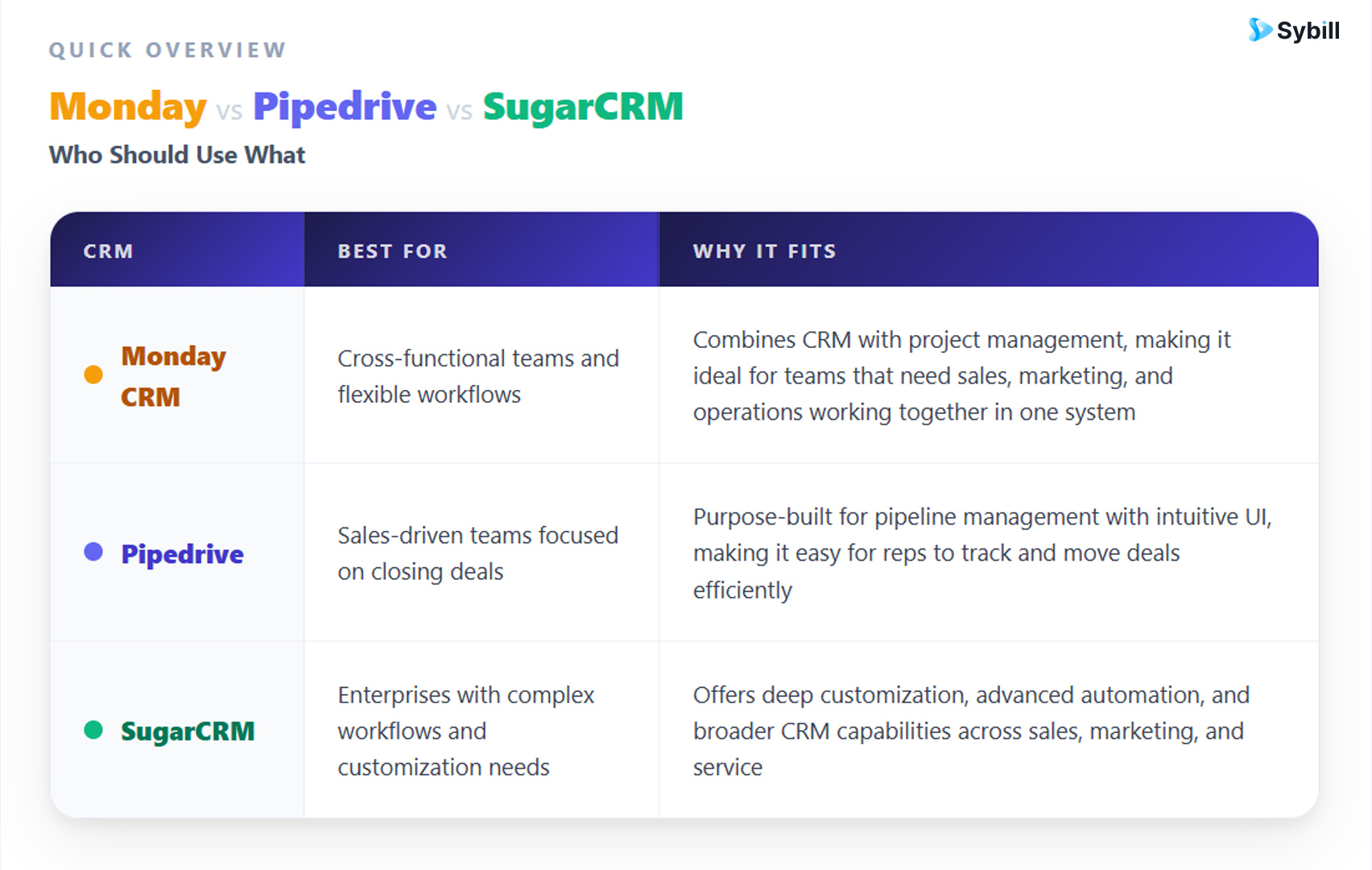
Monday started as a work management platform and evolved into a CRM.
Best for: Teams that want adaptability over rigid sales processes
Pipedrive is built specifically for sales teams.
Best for: SMB sales teams that want simplicity and speed
SugarCRM is built for customization and control.
Best for: Large organizations with complex workflows and IT support
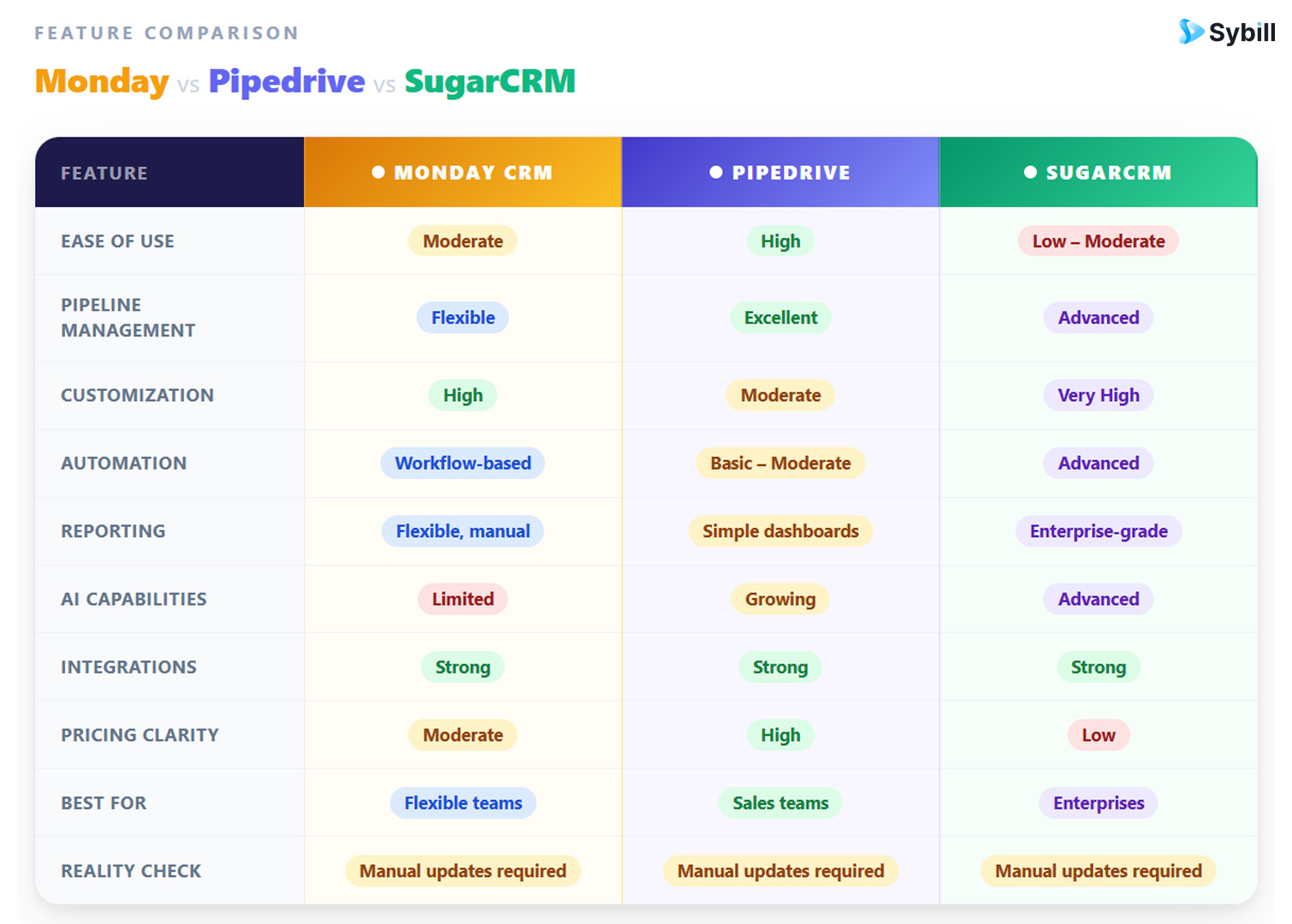
Ease of use is not about pretty dashboards. It is about whether reps update the CRM at 7 pm after their last call.
Pipelines are the heart of any CRM.
Customization sounds great until you have to maintain it.
All three CRMs offer automation. But not all automation is equal.
Here is what most automation does:
Here is what it does not do well:
That gap matters more than any feature list.
This is where most CRMs quietly fail.
Let’s call it what it is.
You can choose any CRM without results if your reps don’t fill them out or fill them with bias or memory.
Most critical deal information lives outside your CRM:
What makes it into the CRM?
So your CRM becomes a summary of memory instead of a reflection of reality.
Your CRM is not your source of truth. It is your best guess.
It does not matter if you pick:
They all rely on human input.
And humans are busy, inconsistent, and focused on closing deals, not updating systems.
So the problem persists.
This is where most teams get it wrong.
They try to fix CRM accuracy by:
That does not work.
The real fix is removing manual effort.
Instead of asking reps to update CRM, let the system do it.
Tools like Sybill automatically:
With features like:
You move from:
“Did the rep update the CRM?”
to
“The CRM updates itself based on reality.”
That shift changes everything.

But remember.
None of these solve data capture on their own.
There is no universal winner. The best CRM is the one your team actually uses consistently.
But even that is not enough. Because usage does not guarantee accuracy.
The real winner is the system that keeps your CRM honest.
Choosing between Monday vs Pipedrive vs SugarCRM is step one. Making your CRM reflect reality is the real game.
That’s where Sybill changes everything.
With features like Ask Sybill, Magic Summary, and CRM Autofill, your CRM updates itself from real conversations, not rep memory.
And your pipeline stops being a guess. And starts becoming a source of truth.
Monday is a flexible work management platform adapted into a CRM, while Pipedrive is a sales-first CRM designed specifically for managing pipelines. Pipedrive focuses on simplicity and deal tracking, whereas Monday offers broader customization across workflows. Teams prioritizing sales efficiency often prefer Pipedrive, while cross-functional teams lean toward Monday.
Yes, Monday.com can be a strong CRM tool for teams that need flexibility and customization. It works well for organizations that combine sales with project or operations workflows. However, it requires thoughtful setup and discipline to function effectively as a sales CRM, especially for pipeline tracking and forecasting.
SugarCRM originally started as an open-source CRM platform. Today, it primarily offers commercial editions, though some open-source elements still exist in limited forms. Most modern deployments use its enterprise versions, which focus on customization, scalability, and advanced data management capabilities.
Monday.com is not necessarily falling, but it faces perception challenges in CRM use cases. Its flexibility can lead to complexity, especially for sales teams that need structured pipelines. Additionally, competition from specialized CRM platforms makes it harder to position as a dedicated sales tool.
Monday.com competes with different tools depending on the use case. In CRM scenarios, competitors include Pipedrive, HubSpot, and Salesforce. In work management, it competes with platforms like Asana and ClickUp. Its broad positioning makes it versatile but also puts it up against more specialized tools.
Monday is a flexible work management platform adapted into a CRM, while Pipedrive is a sales-first CRM designed specifically for managing pipelines. Pipedrive focuses on simplicity and deal tracking, whereas Monday offers broader customization across workflows. Teams prioritizing sales efficiency often prefer Pipedrive, while cross-functional teams lean toward Monday.
Yes, Monday.com can be a strong CRM tool for teams that need flexibility and customization. It works well for organizations that combine sales with project or operations workflows. However, it requires thoughtful setup and discipline to function effectively as a sales CRM, especially for pipeline tracking and forecasting.
SugarCRM originally started as an open-source CRM platform. Today, it primarily offers commercial editions, though some open-source elements still exist in limited forms. Most modern deployments use its enterprise versions, which focus on customization, scalability, and advanced data management capabilities.