Find us at booth #83, join us for a harbor side happy hour, or catch Gorish’s talk.

Sept, 16-18 > Learn more


Richa Sharma

March 30, 2026
.avif)
Outbound sales feels like a Black Mirror episode on autoplay. Prospects are drowning in notifications, dodging cold outreach like spam filters with feelings, and swiping past anything that doesn’t instantly spark relevance.
Relying on a single channel in this environment is like trying to win a high-stakes game with a broken joystick. It’s not just ineffective but invisible.
Top sales reps aren’t waiting around for a perfect moment. They are showing up in inboxes, on feeds, in voicemails, and through videos with timing, context, and a bit of personality. That is multi-channel prospecting. Less “spray and pray,” more “right message, right place, right vibe.”
Multi-channel prospecting is an outbound sales strategy that combines email, phone, LinkedIn, video, text, and direct mail to reach buyers across the platforms where they’re most active — replacing single-channel outreach with a coordinated, layered approach. It improves outbound sales in five key ways: expanding reach by meeting prospects where they already engage, enabling personalized and contextual messaging matched to each medium, increasing response rates through repeated visibility across channels, shortening sales cycles by maintaining momentum with layered follow-ups, and building trust faster through consistent multi-touchpoint presence. To implement it effectively, start by researching each prospect’s communication preferences, select channels based on their role and persona, build a structured cadence (typically 10–14 days) that flows across channels, and continuously analyze performance data by channel to optimize your approach.
In this blog, we will break down how multi-channel prospecting turns random cold outreach into a strategic, high-conversion game plan. You will learn how it increases replies, builds trust faster, and helps you move deals forward before your competitors even get seen.
Ready to escape the sales simulation? Let’s dive in.
.png)
Outbound sales is when you take the first step. You're not sitting around waiting for leads to fill out a form or book a demo. You are the one making the move. It's direct. It's proactive. And when done right, it's powerful.
At its core, an outbound strategy is about reaching the right people with the right message at the right time. It’s not just dialing numbers from a list or blasting cold emails into the void. It’s strategic outreach that’s built around context, timing, and value.
A solid outbound sales strategy includes a few key parts:
This starts with your ICP. Not just anyone with a job title, but those who actually feel the pain your product solves. Relevance beats reach every time.
Good messaging doesn’t feel like a template. It shows that you’ve done your homework, understand their world, and have something worth their time.
Some prospects respond to email. Others to LinkedIn or a well-timed call. A great strategy doesn’t guess but adapts.
One touchpoint rarely does the trick. Real relationships are built over time, with value-driven follow-ups that show you're not just chasing a quota.
Outbound is all about sparking real conversations. And in a world where buyers are flooded with noise, showing up with relevance and consistency is what sets closers apart from spammers.
Multi-channel prospecting is how modern reps cut through the noise.
It means reaching out to potential customers across various platforms: email, phone, LinkedIn, video, text, and sometimes even traditional mail. You are not banking on one message in one inbox. You’re showing up wherever your buyer pays attention.
Think of it like building a presence, not just sending a message. One email might get lost. One call might go to voicemail. But showing up on LinkedIn, following up with a video, and sending a sharp email? That’s how you stay top of mind.
This approach isn’t about throwing everything at the wall. It’s more strategic to choose the right channel for the right moment and use each one with intention. Some channels are more suitable for initiating conversations. Others are better for building trust or nudging a stalled deal forward.
Top sellers don’t rely on luck or volume. They layer their outreach. They test. They adapt. And that’s why their prospects respond. Multi-channel prospecting doesn’t just increase the chances for supersellers but changes the game completely.
Outbound sales isn’t about being everywhere just for the sake of it. It’s about showing up in the right places with the right approach. That’s where multi-channel prospecting flips the script.
Here’s how multi-channel prospecting helps boost your outbound sales efforts:
Not every buyer lives in their inbox. Some are scrolling LinkedIn, some answer calls, and a few respond to a short video faster than a wall of text. By showing up across multiple touchpoints, you increase your chances of being noticed. More visibility leads to more engagement. Simple math. It ensures you meet them where they are:
More channels = more chances to be seen.
More chances = higher engagement.
More engagement = better odds.
You don’t talk to everyone the same way in real life. Prospecting should be no different. Use email to go deep, LinkedIn to build credibility, phone calls to add urgency, and video to add some human energy. Multi-channel gives you the flexibility to match your message with the moment.
Multi-channel prospecting lets you match your message to your medium:
It shows you are paying attention. In outbound sales, attention is the currency that brings revenue.
Most people aren’t ignoring you. They just didn’t see your message. A one-channel approach can be easily overwhelming. However, when someone sees your name appear in their inbox, feed, and missed calls, they start to take notice. Familiarity creates curiosity, and curiosity leads to replies.
Multiple touchpoints not only boost engagement but also move conversations forward faster.
You don’t have to wait 3 days for an email reply. You could follow up on LinkedIn the next day and send a nudge via voicemail later that afternoon.
This layered outreach helps you stay top of mind. And that’s critical, because most sales are lost to inaction, not rejection.
And faster responses = faster pipeline movement = faster wins. That’s how you avoid the long, slow death of an ignored deal.
.png)
Trust isn’t built with one message. It’s earned over time, through consistency, value, and tailored sales prospecting.
Each channel adds another dimension to your persona:
This layered, consistent communication builds a real sense of connection. Prospects begin to recognize you. Familiarity is the first step toward building trust.
Multi-channel prospecting isn’t just about doing more. It’s about doing the right things, in the right places, with better timing.
If you’re relying on just one method to reach your prospects, you’re missing out on key opportunities. Multi-channel prospecting is a proven sales prospecting technique. It combines email, phone, social media, video, and other touchpoints to maximize your chances of connecting with your target buyer.
Today’s top-performing reps don’t wait for replies; they adapt their outbound sales strategy to where their buyers are most active. Here’s how to implement it step-by-step.
Start with solid research. Multi-channel only works if you know who you are targeting and how they prefer to communicate.
.png)
Pro tip: Create a “channel preference cheat sheet” by persona. For example, CTO = email + direct call. Marketing Director = LinkedIn + video.
Each buyer has a communication sweet spot. Your job is to find it and match your outreach to it.
.png)
Pro tip: If you are not getting replies after 3 attempts, try switching channels.
A cadence is a structured sequence of outreach activities over a period. Multi-channel cadences increase touchpoints without feeling spammy.
A sample 12-day multi-channel cadence could look like:
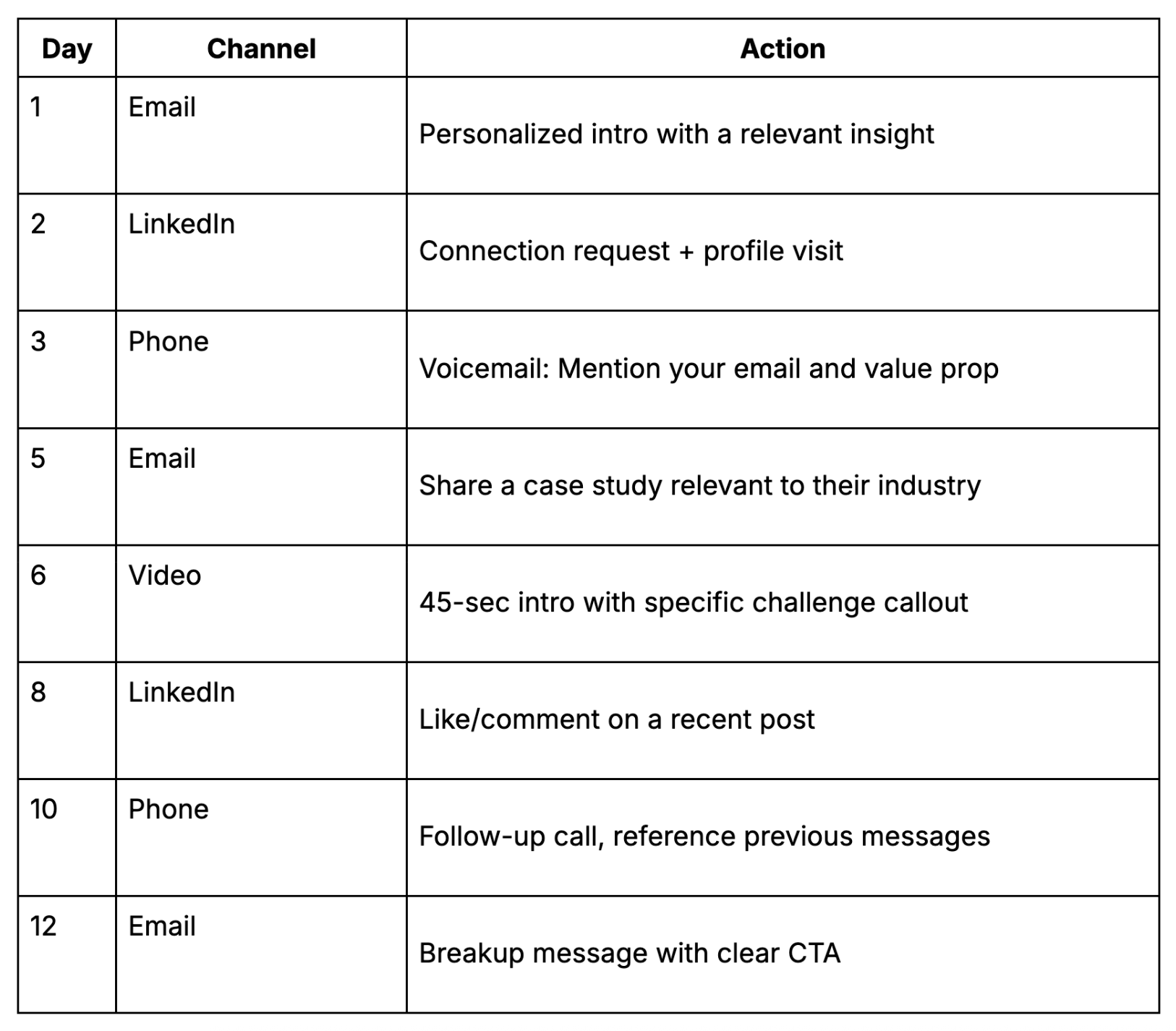
Pro tip: Pre-record your video templates, but personalize the first few seconds with their name and context.
The most effective outbound sales strategies are founded on data, not assumptions. Multi-channel prospecting is only effective if you measure and tweak.
Pro tip: Adjust your cadence monthly based on what’s converting. The market shifts, your process should, too.
Multi-channel prospecting is a mindset. It turns your outbound sales from cold and generic into personalized and strategic. Combining the right sales prospecting techniques with buyer insights and consistent testing improves your connection rates. It also helps you build more meaningful conversations and drive better results.
The reps who consistently win in outbound aren’t lucky. They are intentional. They know their audience, they know where to show up, and they know how to adjust their approach when needed.
Multi-channel prospecting isn’t a trend. It’s the baseline for modern outreach. It helps you stay visible in a noisy market, reach people on their terms, and build genuine connections more quickly. That is how deals get done.
One email won’t carry your pipeline. One call won’t build trust. Success comes from consistently showing up with timing, context, and relevance.
The market is loud. Buyers are busy. Timing is everything. The one who adapts, observes, and moves smart is the one who makes it to the end. The more strategic your approach, the better your odds.
Your buyers are already out there. Time to meet them where they are and make it count.