
Find us at booth #83, join us for a harbor side happy hour, or catch Gorish’s talk.

Sept, 16-18 > Learn more


Tamanna Mishra

July 16, 2026
%20(40).png)
Predictive sales analytics is the use of historical sales data, current pipeline activity, buyer engagement, CRM records, and conversation signals to estimate what is likely to happen next in the revenue cycle. Revenue teams use it to prioritize accounts, identify deal risk, improve pipeline health, forecast revenue, guide coaching, detect expansion opportunities, and spot churn signals before they become missed targets.
The board wants a number. The CRO wants confidence. Sales managers want reps to explain why a “commit” deal has had no buyer reply in 12 days. Someone opens the CRM, someone opens a spreadsheet, someone says “based on my gut,” and suddenly the forecast call starts to feel less like revenue leadership and more like an improv show with quotas.
That is usually when teams start caring about predictive sales analytics.
Fair. But late.
Predictive sales analytics should not appear only when the quarter is already wobbling. Used well, it helps revenue teams decide where to focus, which opportunities need intervention, which reps need coaching, which customers may expand, and which accounts are drifting toward churn.
In other words, predictive sales analytics is not just a forecasting feature. It is a revenue operating layer.
IBM defines predictive analytics as using historical data with statistical modeling, data mining, and machine learning to predict future outcomes. SAS frames predictive analytics similarly: the goal is to move beyond knowing what happened and estimate what is likely to happen next.
For sales teams, that “next” is everything.
Which accounts are worth pursuing? Which deals are real? Which forecast calls are theater? Which customers are quietly unhappy? Which reps are winning because of skill, and which reps are winning because they inherited the good patch?
Predictive sales analytics helps answer those questions before the missed number writes the story for you.
[Image idea: Header image showing predictive sales analytics across the full revenue lifecycle, from prospecting and pipeline health to coaching, expansion, churn prevention, and revenue planning.
Alt text: Predictive sales analytics across the revenue lifecycle from prospecting to pipeline health, coaching, expansion, and revenue planning.]
Predictive sales analytics uses historical sales data, current pipeline activity, buyer engagement, CRM records, and conversation signals to estimate future sales outcomes.
Those outcomes can include:
The important part is that predictive analytics does not stop at reporting the past.
A basic sales report says, “Your team created $2 million in pipeline last month.”
A better dashboard says, “Enterprise pipeline is up, but stage two conversion is falling.”
Predictive sales analytics says, “These 11 enterprise deals are likely to stall because they have weak next steps, no economic buyer, and declining engagement.”
That is the difference between looking in the rear-view mirror and seeing the pothole before the tire is gone.

Predictive analytics becomes especially powerful when it includes both quantitative and qualitative data. Gartner recommends combining quantitative and qualitative analysis to make pipeline analytics and sales forecasts more credible to executive stakeholders.
That matters because sales is not only a math problem. It is also a buyer behavior problem.
Sales forecasting is the most obvious use case for predictive analytics because forecasting is where revenue uncertainty gets expensive.
Salesforce’s guide to sales forecasting notes that AI-driven forecasting can use historical sales data, pipeline activity, market signals, behavioral trends, deal velocity, buyer engagement, and win rates to flag at-risk deals.
Good. Necessary. Still not enough.
Forecasting tells you where the number may land. Predictive sales analytics should help you change where it lands.
That means moving predictive intelligence earlier in the revenue lifecycle. Before the forecast call. Before the renewal scare. Before the rep says, “They went dark, but I think we are still good.”
Narrator: they were not still good.
The highest-value use cases happen across the entire lifecycle:

Sybill helps revenue teams answer deal questions, automate CRM updates, prepare for meetings, create sales assets, manage follow-ups, and inspect pipeline execution from actual sales context, not just manually entered CRM fields.
Because a forecast based only on CRM fields is like judging a movie by its Wikipedia plot summary. Technically useful. Deeply incomplete.
Prospecting is where a lot of sales waste begins.
Not because reps are lazy. Because too many teams still treat territory planning like a treasure hunt with a spreadsheet.
Predictive sales analytics can help teams identify which accounts are more likely to convert based on historical patterns, firmographic fit, buying triggers, engagement, market movement, and similarity to previous closed-won customers.
Useful prospecting signals include:
The goal is not to turn reps into robots who chase a score. The goal is to make sure expensive human selling time is not spent equally on accounts that are not equally likely to buy.
Predictive prospecting is not “spray smarter.” It is focus.
A sales team with 2,000 target accounts does not need 2,000 “personalized” emails that all sound like they were assembled in a content sweatshop. It needs a sharper view of which 200 accounts deserve real attention this month.
That is where predictive analytics can help sales and marketing align better. Marketing can identify clusters of accounts showing intent. Sales can layer in relationship and deal context. RevOps can compare conversion by source, segment, and motion. Leadership can stop pretending all pipeline is created equal.
Because it is not.

Deal risk rarely announces itself politely. It does not walk into the forecast call wearing a name tag that says, “Hi, I am about to slip into next quarter.”
It hides in soft signals:
None of these is automatically bad. But in the right combination, they are smoke.
Predictive sales analytics helps teams identify deal risk by analyzing CRM data, buyer engagement, conversation signals, stage progression, close-date movement, and stakeholder involvement.
Common predictive deal risk signals include:
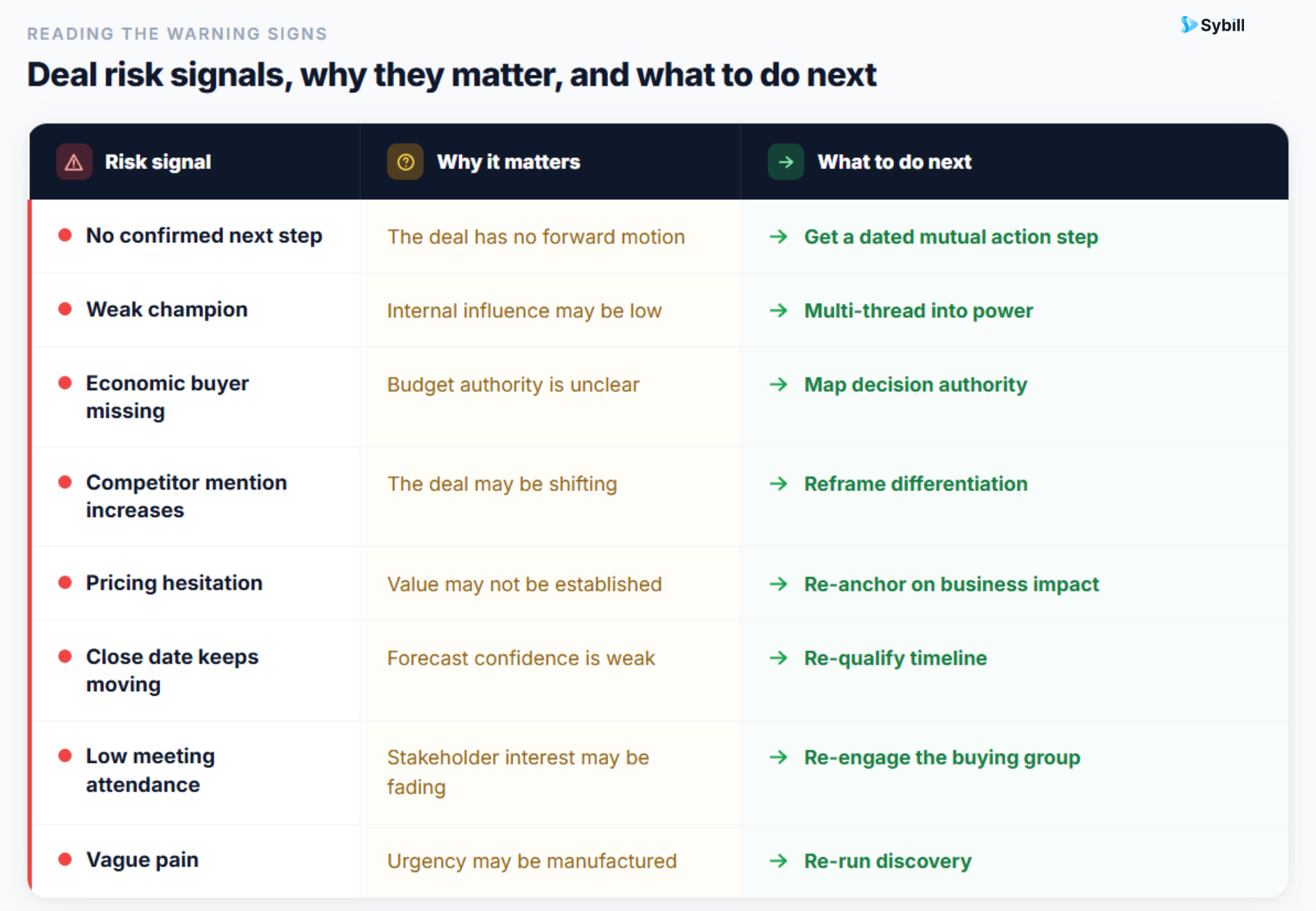
This is exactly where CRM-only analytics breaks down.
A CRM may tell you the deal is in proposal stage. It may not tell you that the buyer sounded lukewarm, the CFO was never in the room, pricing came up three times, and your champion has stopped replying.
Sybill’s CRM integration shows why this matters. Ask Sybill can query across conversation data and Salesforce CRM data to answer questions like “Which deals are at risk?”, “What competitor mentions increased this quarter?”, and “Show me calls where the buyer discussed budget.”
That is the shift revenue teams need. Not just “what stage is this deal in?” but “what evidence says this deal is healthy?”
Pipeline health is one of the most abused phrases in sales.
A team says it has 3x pipeline coverage and everyone exhales. But 3x bad pipeline is not health. It is clutter with a revenue target.
Predictive sales analytics helps leaders inspect pipeline quality, not just pipeline quantity.
Good pipeline analysis looks at:
Gartner’s sales analytics guidance specifically calls out the need to improve consistency in pipeline data, increase the value of pipeline review and forecast processes with actionable manager metrics, and combine quantitative and qualitative analysis to make sales forecasts credible to executive stakeholders.
That is the grown-up version of pipeline inspection.
Not “do we have enough pipeline?”
Instead:
“Do we have enough believable pipeline, at the right stage, with the right buyer evidence, owned by reps who can actually convert it?”
That is a very different conversation.
This is also why Ask Sybill is useful for revenue teams. It lets teams ask questions about deals, accounts, and pipeline instead of hunting through CRMs, call transcripts, and email threads.
For example:
That is how predictive analytics becomes practical. It moves from static dashboard to living inspection system.
Most sales coaching is too reactive.
A deal is lost. A manager listens to one call. Everyone discusses what could have been done better. Fine. But at that point, the buyer has already picked someone else, and your “learning moment” is wearing a closed-lost label.
Predictive sales analytics can make coaching earlier and more precise.
Instead of relying only on manager intuition, teams can identify patterns such as:
This changes the coaching conversation from vague feedback to evidence-backed action.
Bad coaching: “You need to create more urgency.”
Better coaching: “In your last five stalled deals, the buyer never confirmed business impact, success criteria, or decision timeline. Let us work on discovery questions that create urgency earlier.”
That is useful. That is specific. That does not make the rep want to fake a Wi-Fi outage.
Sybill’s AI agents for sales managers guide describes how AI can analyze pipeline, deals, rep performance, calls, emails, CRM, and calendar data to surface forecast risks, deal recommendations, and coaching opportunities.
This is where predictive sales analytics becomes a manager multiplier.
It does not replace the manager. It stops the manager from spending three hours digging through call recordings just to discover the obvious: the rep is not asking who owns the budget.
Read more: How sales managers can use AI agents for pipeline, coaching, and forecast reviews
Predictive sales analytics is not only for net-new sales.
In recurring revenue businesses, expansion is often where the best growth hides. The customer already trusts you. The account already has context. The buying committee may already understand the category.
But expansion does not happen just because customer success had a nice QBR.
Predictive analytics can identify accounts that are more likely to expand based on:
The useful signal is not just “this customer logged in 42 times.”
It is, “Three new stakeholders from the enterprise team joined the last two calls, asked about use case expansion, and mentioned rolling this out to another region.”
That is an expansion signal with actual meat on the bone.
Revenue teams can use predictive expansion analytics to trigger plays like:
This is where sales, customer success, and RevOps need a shared view. If expansion signals live in call notes, CS updates, email threads, and someone’s memory, they will get missed.
And missed expansion is still missed revenue. It just sounds less dramatic than churn.
Churn is often treated like a customer success problem. That is cute. Also dangerous.
Churn is a revenue problem. Sales sold the promise. CS owns adoption. Product shapes value. Leadership owns the revenue plan. Everyone has fingerprints on the outcome.
Predictive sales analytics can help spot churn risk before renewal month becomes a hostage negotiation.
Common churn signals include:

The key is to connect what customers do with what customers say.
Usage data can tell you activity is down. Conversation intelligence can tell you why. Maybe adoption is low because onboarding failed. Maybe the buyer’s team changed. Maybe a competitor entered. Maybe the customer never got the business outcome they expected.
Predictive analytics becomes more accurate when it combines customer behavior, CRM data, and conversation context.
That is also why sales call summaries matter beyond the call itself. Sybill’s Magic Summary helps capture meeting outcomes, pain points, next steps, and key details so important customer context does not disappear after the call.
Revenue planning is where optimism goes to get a spreadsheet.
Every leadership team wants to know:
Predictive sales analytics helps revenue leaders model these decisions based on real conversion patterns, not annual planning folklore.
For example:

Forecasting tells leaders what may happen this quarter. Predictive revenue planning helps leaders decide what to do next quarter, next half, and next year.
That is the strategic leap.
A CRO does not only need a cleaner forecast. They need a better explanation of the revenue engine.
Why does mid-market move faster but expand less? Why do enterprise deals need more executive engagement? Why are healthcare deals slower but stickier? Why does one rep win technical buyers while another keeps losing at security review?
Predictive analytics helps answer these questions with patterns, not anecdotes.
Predictive sales analytics is only as good as the data underneath it.
And yes, that is the part everyone likes to ignore because “AI will fix it.”
No. AI will not magically rescue a CRM full of stale close dates, fake next steps, and notes that say “good call.”
Predictive models need reliable inputs. For revenue teams, that usually means combining structured data from CRM with unstructured and semi-structured data from calls, emails, meetings, and customer interactions.
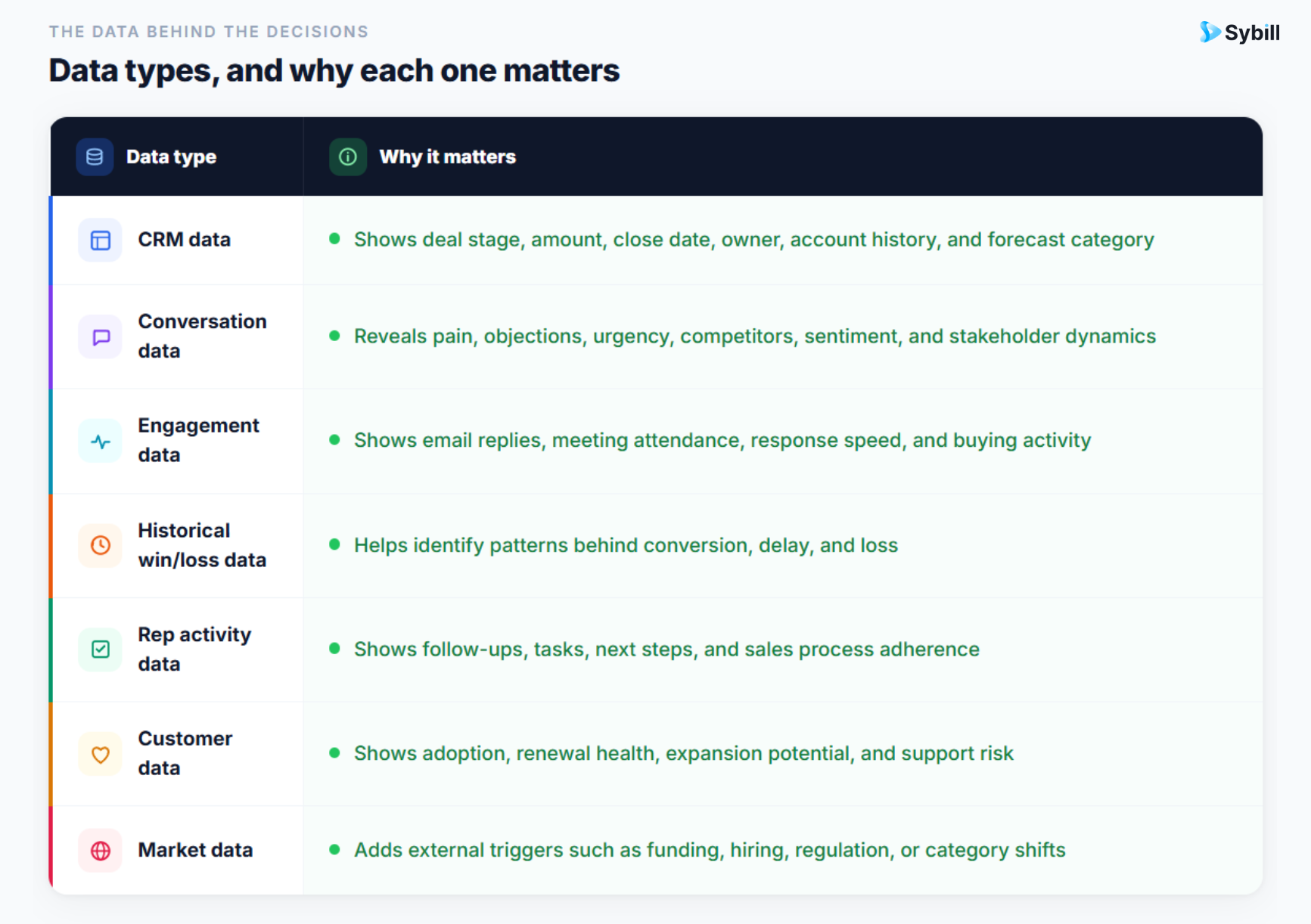
The missing layer for many teams is conversation context.
CRM fields can say “budget confirmed.” But where did the buyer confirm it? Who said it? Was it the champion or the CFO? Was it confirmed as allocated budget or “we can probably find money if this becomes a priority”?
Those are different realities. Predictive analytics needs to know the difference.
Sybill’s CRM Autofill and CRM integration help by pulling sales conversation details into CRM, including budget mentions, competitor mentions, pain points, and deal risk signals.
That makes CRM data less dependent on rep memory and post-call admin discipline, which, let us be honest, is not where revenue teams usually want to place their entire operating model.
The hard part of predictive sales analytics is not creating another chart.
The hard part is getting enough reliable deal context into the system, then turning the prediction into action.
That is where Sybill fits into the revenue lifecycle.

Sybill helps revenue teams capture what happens in sales conversations, automate CRM updates, generate follow-ups, inspect deals, answer pipeline questions, and coach from real buyer context. Its sales leader page positions the platform around deal status, pipeline health, coaching, forecasting, and growth strategy.
In plain English: Sybill helps revenue teams stop managing deals from incomplete CRM breadcrumbs.
For predictive analytics, that matters in five ways.
Predictive analytics needs to understand what buyers actually said. Pain points, objections, competitor mentions, budget language, stakeholder dynamics, and next steps often live in calls and emails.
Sybill helps turn that context into usable sales intelligence instead of leaving it buried in transcripts.
CRM data is the base layer for most sales analytics. But if reps update CRM late, vaguely, or inconsistently, predictive models inherit the mess.
Sybill can help automate CRM updates from sales conversations, reducing manual admin and improving field quality.
Predictive deal scores are useful only if managers can inspect the “why.”
Sybill’s deal risk content highlights Ask Sybill for plain-English questions like “which deals are at risk and why,” along with pipeline visibility, buyer intelligence, and competitor intelligence.
That makes risk inspection faster and less dependent on rep narration.
Sales managers should not have to manually search through every call to find coaching moments.
Sybill can help surface patterns across rep performance, pipeline, deals, CRM, calls, emails, and calendar data, giving managers better inputs for coaching and forecast review.
With Ask Sybill, teams can ask questions across deals, accounts, and pipeline instead of manually piecing together answers from CRM, call notes, transcripts, and email threads.
That is what revenue teams actually need from AI.
Not another dashboard shrine. Not another “insights” tab nobody opens. Answers that help them make the next move.
The right metrics depend on the use case. A prospecting model should not be judged like a churn model. A coaching signal should not be treated like a forecast number.
Here is a practical breakdown.

The trick is tracking the metrics that trigger action.
For example:
A predictive signal without a workflow is just a horoscope with better branding.
Predictive sales analytics fails when teams treat it like software magic instead of a revenue discipline. The usual culprits are painfully familiar.
If stages, close dates, amounts, and next steps are wrong, predictions will be wrong. Garbage in, garbage forecast.
CRM data rarely captures the full buyer story. Without call and email context, predictive analytics may miss the emotional and political reality of a deal.
If one rep moves deals to proposal after a demo and another does it after verbal approval, stage-based prediction becomes nonsense.
A risk score is not enough. Managers need to know why a deal is risky and what to do next.
Predictions do not create revenue by existing. They need to trigger specific actions across reps, managers, RevOps, and customer success.
More meetings do not always mean more buying intent. More emails do not always mean more momentum. Predictive analytics must separate activity from progress.
Budget hesitation, weak urgency, internal conflict, stakeholder silence, and vague decision criteria can matter as much as stage or amount.
Gartner’s guidance on pipeline analytics and forecasting emphasizes credible forecasting through both quantitative and qualitative analysis, which is exactly the point.
The best predictive systems do not just calculate probability. They explain risk, reveal evidence, and recommend action.
You do not need to begin with a perfect model, a data warehouse saga, and twelve cross-functional meetings named “Phase 1 alignment.”
Start smaller. Start with one expensive blind spot.
Choose one use case first:
Do not try to predict everything at once. That way lies dashboards no one trusts.
For deal risk, signals may include no next step, no economic buyer, pricing hesitation, competitor mention, or close-date movement.
For expansion, signals may include adoption, new stakeholders, positive sentiment, and adjacent use-case mentions.
Fix the fields that matter for the use case. Not every field. Just the ones required to make a better decision.
Use calls, emails, and meeting summaries to capture the buyer context CRM misses.
This is where tools like Sybill’s Magic Summary, CRM Autofill, and Ask Sybill can help teams turn real interactions into usable deal intelligence.
Decide what happens when a signal appears.
If a commit deal has no next step, who reviews it? If a rep repeatedly loses on pricing, what coaching happens? If churn risk rises, who reaches out?
Every predictive system should get smarter. Review whether flagged deals actually slipped, whether expansion signals led to growth, and whether coaching signals improved conversion.
The point is not only to predict outcomes. It is to improve them.
If you learn that enterprise deals close faster when the CFO is involved before proposal, make that part of the playbook. If you learn that competitor mentions plus pricing hesitation predict loss, coach that moment earlier.
Predictive analytics should become sales behavior, not just sales reporting.
Predictive sales analytics is not a prettier forecast.
It is how revenue teams stop managing sales like a postmortem.
Used well, it helps teams prioritize the right accounts, spot deal risk earlier, inspect pipeline health, coach reps with evidence, find expansion opportunities, prevent churn, and plan revenue with fewer fantasy assumptions.
But the prediction is only as good as the data behind it. CRM fields matter. Historical sales data matters. Buyer engagement matters. Conversation signals matter.
That is why revenue teams need more than dashboards. They need systems that capture what buyers actually say, connect that context to deals and accounts, and make the next best action obvious.
Sybill helps revenue teams do exactly that by turning sales conversations, CRM records, follow-ups, deal context, and pipeline questions into usable sales intelligence. So leaders can see risk earlier, managers can coach smarter, reps can act faster, and forecasts can be built on evidence instead of collective optimism.

Predictive sales analytics uses historical sales data, current pipeline activity, CRM records, buyer engagement, and conversation signals to estimate future revenue outcomes. It helps teams predict deal progression, win probability, churn risk, expansion opportunities, and forecast accuracy.
Sales forecasting estimates future revenue. Predictive sales analytics is broader. It can support forecasting, but it can also help teams prioritize prospects, identify deal risk, improve pipeline health, coach reps, find expansion opportunities, and detect churn signals.
Revenue teams need clean CRM data, historical win/loss data, pipeline activity, buyer engagement data, call and email insights, rep activity data, customer health signals, and account-level context. The strongest predictive systems combine quantitative CRM data with qualitative conversation intelligence.
AI can analyze large volumes of CRM, call, email, pipeline, and customer data to identify patterns that humans may miss. It can flag risky deals, surface coaching opportunities, identify expansion signals, improve forecast confidence, and help revenue teams take action faster.
They usually fail because the CRM data is poor, the sales process is inconsistent, conversation context is missing, predictive scores are treated as black boxes, or no action workflow is attached to the insight. A prediction only matters if it changes what the team does next.
Predictive sales analytics uses historical sales data, current pipeline activity, CRM records, buyer engagement, and conversation signals to estimate future revenue outcomes. It helps teams predict deal progression, win probability, churn risk, expansion opportunities, and forecast accuracy.
Sales forecasting estimates future revenue. Predictive sales analytics is broader. It can support forecasting, but it can also help teams prioritize prospects, identify deal risk, improve pipeline health, coach reps, find expansion opportunities, and detect churn signals.
Revenue teams need clean CRM data, historical win/loss data, pipeline activity, buyer engagement data, call and email insights, rep activity data, customer health signals, and account-level context. The strongest predictive systems combine quantitative CRM data with qualitative conversation intelligence.








