Find us at booth #83, join us for a harbor side happy hour, or catch Gorish’s talk.

Sept, 16-18 > Learn more


Tamanna Mishra

April 27, 2026

Jake is a good rep. A solid rep. The kind of rep who once believed AI in sales would turn him into the Tony Stark of closing deals. He imagined an Iron Man suit for selling.
Predictive AI in sales analyzes historical data to forecast outcomes like deal close probability, lead scores, churn risk, and optimal outreach timing, while generative AI in sales creates new content like follow-up emails, call summaries, proposals, and personalized outreach sequences. Most sales AI tools use only one type, creating insight without action (predictive) or action without strategy (generative). Sybill unifies both by using predictive signals to identify deal risks and buyer intent while simultaneously generating summaries, follow-ups, CRM updates, and mutual action plans — closing the gap between knowing what is happening and executing on it.
Instead, he got six browser tabs and a new type of chaos.
Jake now uses one AI tool to take notes, another to write emails, another to check deal risk, another to coach him, another to update CRM, and one that just sits there because he forgot what it does. He bought into the hype. All of it. Yet he is still behind on follow-ups, still cleaning up CRM data, still scrambling at month end.
This is the real story behind predictive vs generative AI in sales. Every tool Jake uses is either predictive or generative. One tries to guess what will happen. The other tries to help him act. None combine both into one workflow. Which is why Jake has more AI than ever but sells no faster than he did two years ago.
Sales teams did not fail AI. AI tools failed the workflow. And that is where the next wave of sales tech begins.
Related read: Predictive vs generative AI explainer
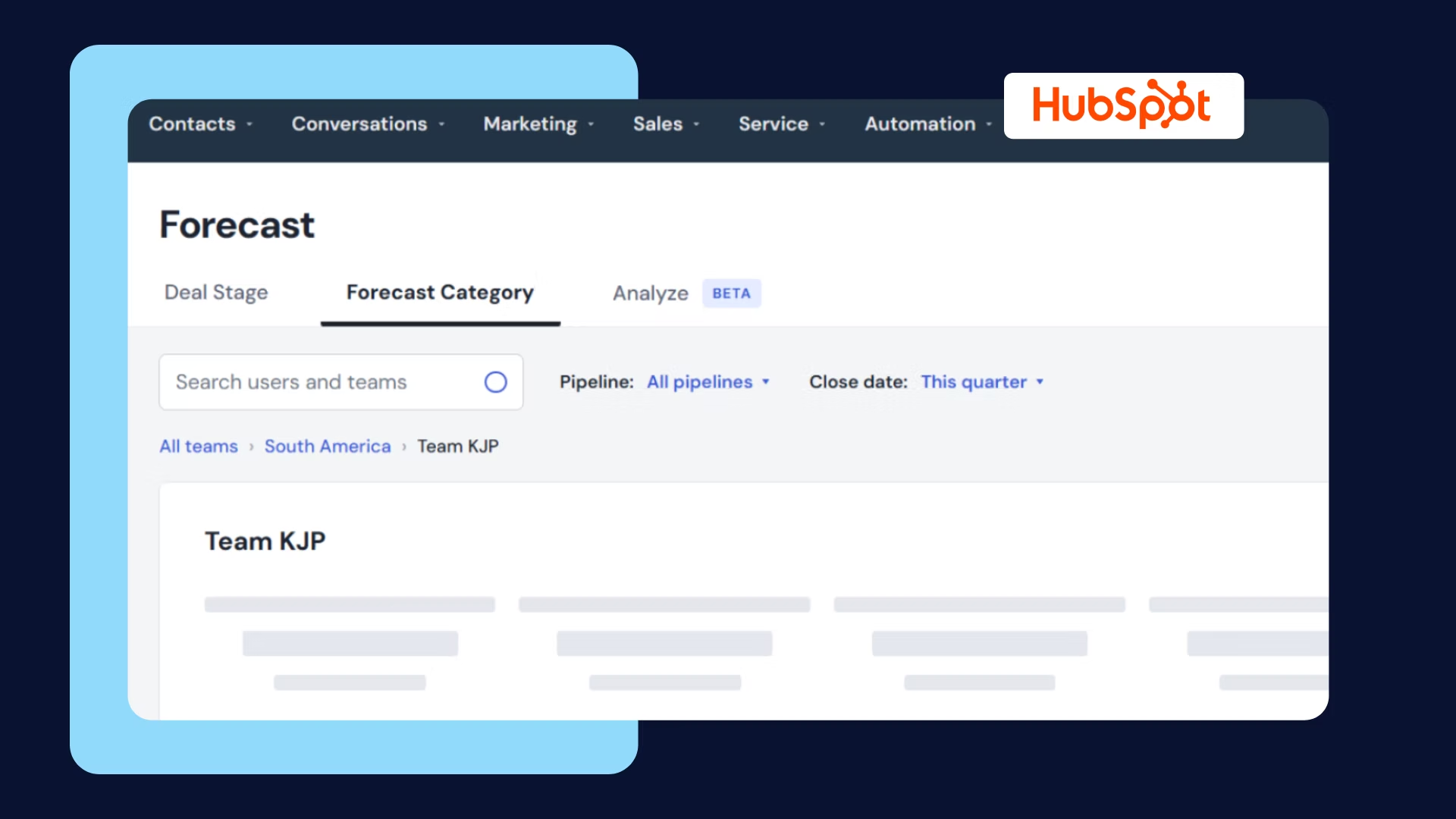
Predictive AI has been the shiny object in sales tech for years. Tools like Clari, Gong Forecast, and HubSpot Predictive Lead Scoring promise to show reps exactly where deals stand and what might happen next. And to be fair, they do a decent job at reading the tea leaves.

This sounds powerful. And it is. But here is the catch.
Predictive AI cannot act on any of it.
It does not send the follow-up. It does not update CRM. It does not fix the missing stakeholder. It does not create the next step. Predictive AI in sales is excellent at telling you what is broken and absolutely terrible at doing anything about it.
Which is why Jake still goes home late on Fridays.
If predictive AI is the analyst in the corner pointing out problems, generative AI is the enthusiastic intern who writes very fast but does not always know what is going on. Sales teams rely heavily on generative AI in sales because it feels helpful, and honestly, because it feels magical on a good day.

These tools excel at busywork.
They can type faster than any human, summarize conversations in seconds, and fill out fields that used to drain entire afternoons.
But here is the truth that hurts.
Generative AI has no idea if what it is doing is strategically useful.
Generative AI can document the deal. It cannot drive the deal. And that is why, even with great generative ai examples, teams still struggle with unpredictable pipelines and missed follow-ups.
Here is the uncomfortable truth about ai in sales. Predictive AI and generative AI both work, but only on their own islands. Predictive tools tell you what is going wrong. Generative tools help you write about it. Neither moves a deal meaningfully forward because neither handles the full workflow.

That is why the gaps show up everywhere.
These missing pieces are not product shortcomings. They are architectural gaps. As long as predictive vs generative AI sit in separate tools, the workflow will always break in the middle. Reps end up stitching insights from one system with actions from another. Managers get dashboards instead of outcomes. Pipelines stay unpredictable.
Sales does not need more AI features. Sales needs an AI engine that understands what is happening and acts within the same workflow.
The future of AI in sales is not another note-taker, another risk score, or another email generator. The next wave of sales tech will stop forcing teams to choose between predictive vs generative AI and instead combine both inside a single decision-to-execution loop. Sales teams will finally use AI that understands what is happening in a deal and acts on it within the same workflow.
This is the evolution beyond disconnected generative ai examples or standalone predictive models. It is AI that predicts, decides, and executes. And it is the kind of AI stack that will define the top-performing sales teams over the next few years.
Most AI tools in sales operate like single-gear machines. They either predict what might happen or generate content after it happens. Sybill does both inside one unified workflow. It is built for teams that want AI in sales to actually move deals forward rather than just describe them.
Sybill captures and analyzes real buyer behavior to surface insights that normal CRMs miss.
All of this, available conversationally through Ask Sybill.
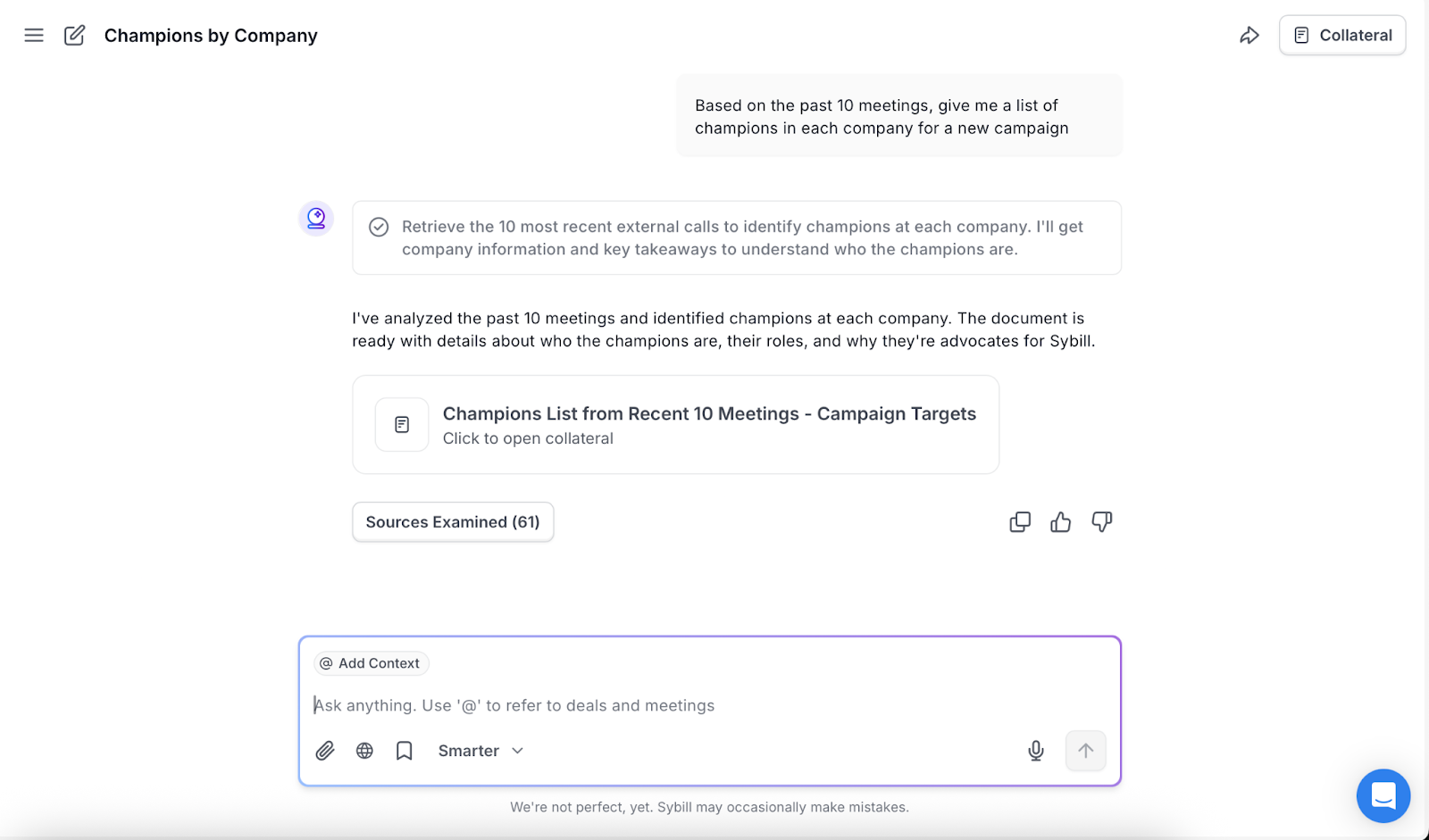
These are predictive AI examples that give reps clarity the moment it matters.
Once Sybill understands what is happening in a deal, it handles the execution layer too.
These generative AI examples are powered by the predictive layer above.
This is where Sybill becomes a full revenue operating system.
Prediction flows directly into execution. Execution updates the workflow. Nothing gets lost between tools because there are no disconnected tools.
Sybill, clearly, is not just another generative AI note-taker. Or a predictive AI revenue forecaster.
It is a revenue operating system built for the next wave of AI in sales.
The future of AI in sales is not a choice between generative AI vs predictive AI. It is the combination of both inside one workflow.
Teams that consolidate their stack instead of expanding it will outpace competitors who still juggle disconnected tools.
Predictive + generative AI will separate fast-moving, high-performing revenue teams from those stuck in manual loops. Early adopters will see faster deal cycles, cleaner pipelines, and stronger execution across every stage.
Try Sybill free to see it in action.
Predictive vs generative AI refers to two different approaches to AI in sales. Predictive AI analyzes past behavior to identify risk, intent, and deal patterns. Generative AI creates content like emails, summaries, and CRM updates. Predictive AI tells reps what is happening. Generative AI helps them act. Sales teams need both working in one workflow to accelerate deals and improve accuracy.
Common predictive AI examples in sales include forecasting tools like Clari, deal risk detectors such as Gong Forecast, and CRM scoring systems like HubSpot Predictive Lead Scoring. These predictive AI tools highlight risk, prioritize deals, and surface buyer intent. They are powerful, but they cannot act on insights unless paired with generative AI capabilities inside the same workflow. Sybill achieves that.
Top generative AI examples include AI note-takers like Otter, call summarizers like Fireflies, and email assistants like Lavender. These tools automate writing, documentation, and follow-ups. However, generative AI alone cannot understand buyer intent or deal risk. To drive actual revenue outcomes, generative output must be guided by predictive intelligence inside one unified sales engine. Sybill facilitates that.