Find us at booth #83, join us for a harbor side happy hour, or catch Gorish’s talk.

Sept, 16-18 > Learn more

%20(1).avif)
Mamta Tainwala

March 10, 2026
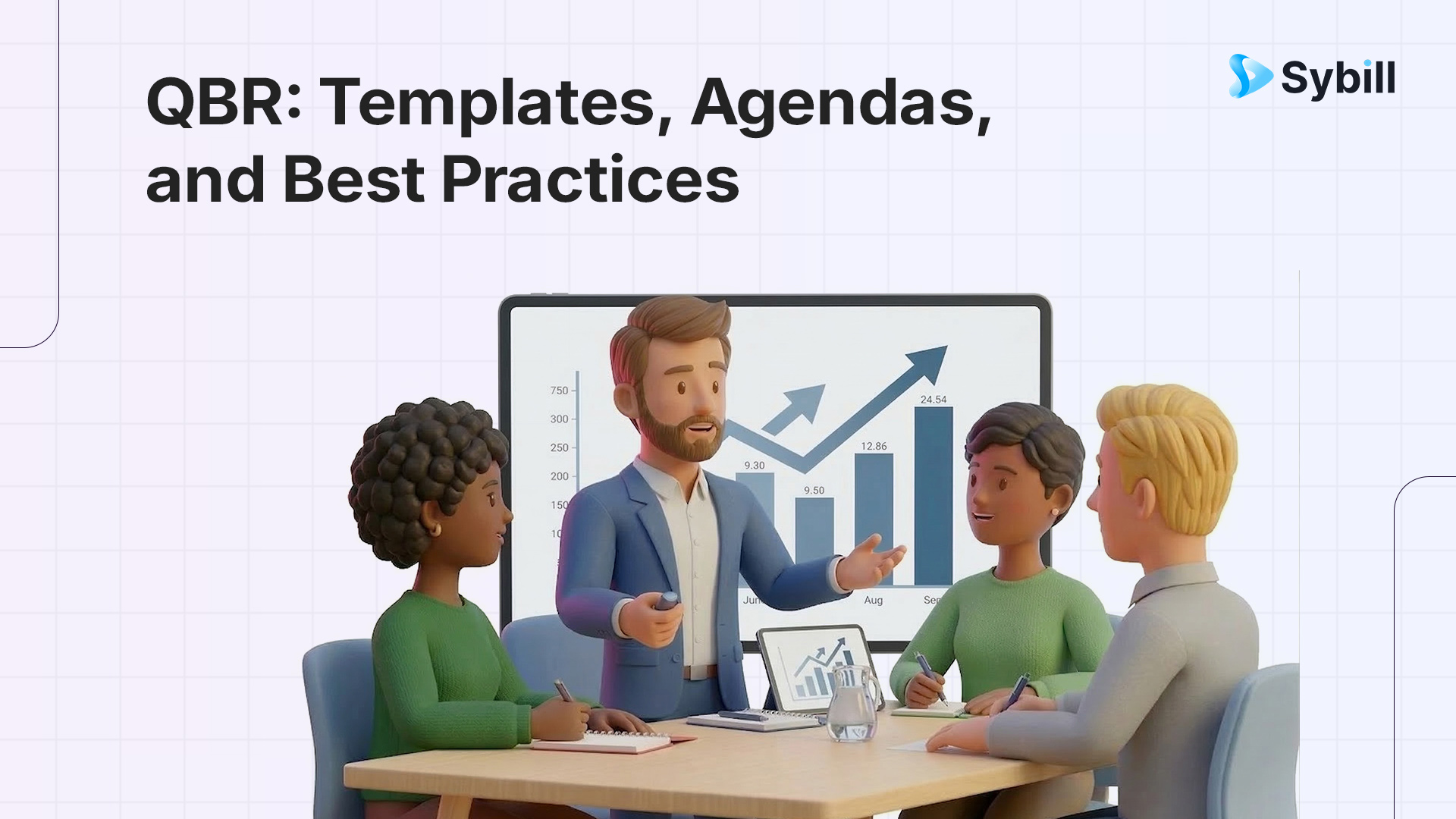
Most quarterly business reviews are bad. Not maliciously, not lazily, just structurally bad. The agenda is vague. The data is pulled together the night before. The customer sits through 40 slides of metrics they did not ask for and leaves with no clear sense of what happens next.
And then everyone agrees to "do another one next quarter."
A great QBR is one of the highest-leverage activities in your sales and customer success playbook. It builds trust, surfaces expansion opportunities, prevents churn before it becomes a crisis, and creates the kind of strategic relationship that makes switching vendors feel genuinely costly.
The difference between a forgettable QBR and an exceptional one is not talent. It is structure, preparation, and follow-through.
This guide gives you all three.
In this guide, we will cover:
A quarterly business review, or QBR, is a structured meeting held once a quarter between your team and a customer (or internally across your go-to-market teams) to review performance, evaluate progress against goals, and align on priorities for the next 90 days.
The purpose of a quarterly business review is not to impress. It is to create genuine alignment. The customer should leave knowing that your team understands their business, has delivered real value, and has a clear plan for the next quarter. Your team should leave knowing exactly where the account stands and what needs to happen next.
If either side leaves confused, the QBR did not work.
For a deeper look at how internal and external QBRs differ in purpose and structure, the internal QBR vs customer QBR breakdown is worth reading alongside this guide.
Before diving into templates and agendas, it helps to understand the principle underneath all of it.
A great QBR is customer-centric. It is built around their goals, their outcomes, and their language, not your product's feature set or your team's internal metrics. The moment a QBR starts feeling like a vendor presentation, it has lost the customer.
A great QBR is also brutally honest. Teams that use QBRs to paper over problems lose the customer's trust the moment the problems become undeniable. Teams that address problems directly, especially before the customer brings them up, almost always come away with stronger relationships.
And a great QBR has clear next steps. Every QBR should end with a documented action list, owned by named individuals on both sides, with timelines. If you leave a QBR and nothing is assigned to anyone, the meeting produced nothing but goodwill, and goodwill has a short half-life.
Here is a quarterly business review agenda format that works for most B2B SaaS accounts. Adapt the timing based on your account tier, but keep the structure consistent.
Total meeting time: 45 to 60 minutes
Section 1: Partnership Recap (5 minutes) Open with a quick reminder of where things stood at the start of the quarter. What goals did the customer set? What commitments did your team make? This prevents the rest of the conversation from happening in a vacuum.
Section 2: Performance Review and Value Delivered (15 minutes) Present the metrics that matter to the customer, not your platform's engagement data for its own sake. If their goal was to reduce manual CRM work by two hours per rep per week, show that number. If their goal was faster deal cycles, show deal velocity trends. Tie everything back to their business outcomes.
This section is much easier to build when your CRM notes accurately capture what the customer cared about from the very first discovery call. When that context is missing, you end up presenting data that looks impressive internally and lands flat externally.
Section 3: What Has Been Hard (10 minutes) Name the friction points before the customer does. Did adoption lag in one team? Was there a feature gap that created workarounds? Did a support ticket take longer to resolve than it should have? Customers do not expect perfection. They do expect honesty, and they remember whether they heard it from you or had to bring it up themselves.
Section 4: Customer's Goals for Next Quarter (10 minutes) Ask, listen, and document. What are the customer's top priorities for the next 90 days? How are their business goals shifting? Who is newly involved in decisions? This section informs everything from your expansion strategy to how you'll prepare for the next QBR.
Section 5: Joint Action Plan and Next Steps (10 minutes) Close with a shared document: what your team is committing to, what you need from the customer, and what the timeline looks like. Send this within 24 hours of the meeting. It is the proof that the conversation was real.
Ready to walk into your next QBR fully prepared? Get started for free with Sybill and let AI build your account brief before you even open a slide deck.
Not every account deserves the same format. Here is how to calibrate:
High-value, strategic accounts: Run the full agenda with a 60-minute meeting. Bring a senior stakeholder from your side. Get a VP or economic buyer from the customer's side. Use a polished deck with customer-specific data. Follow up the same day.
Mid-tier accounts: A 45-minute video call with a focused four-section agenda works well. The key investment here is the data: make sure the value section is specific to their outcomes, not a generic overview. Nurturing these accounts with consistent QBRs often unlocks expansion opportunities that purely reactive CS motions miss entirely.
Smaller or low-touch accounts: A structured 30-minute call or even a well-written async QBR document can work. The goal is to maintain the rhythm of accountability and check-in, even at reduced effort. Customer retention metrics often reveal that small accounts churn for simple reasons: nobody reached out, nobody followed up, nobody noticed the usage dropped. A lightweight QBR cadence prevents a lot of that.
Most QBR questions are too polite. "How has your experience been?" produces "pretty good, thanks." These questions produce real insight:
"What does success look like for you at the end of next quarter, specifically?"
"If you could change one thing about how we work together, what would it be?"
"Who else in your organization is affected by how this tool performs?"
"What are the two or three business priorities that are keeping your leadership team up at night right now?"
"Is there anything we promised during the sale that you feel we have not delivered on?"
That last one makes account managers uncomfortable. It is also the question most likely to surface a fixable problem before it becomes a reason to churn. Understanding churn signals early is how the best retention teams operate, and those signals often live in the answers customers give when you are honest enough to ask the hard questions.
Mistake 1: Skipping the internal QBR first Walking into a customer QBR without first running an honest internal review is like showing up to a presentation you have not rehearsed. Your team needs to be aligned on the account story before you tell it externally. Sales efficiency and account health data should live in the same conversation before they reach the customer.
Mistake 2: Making the QBR about your product This is the single most common reason QBRs feel like vendor meetings rather than partnership conversations. Your customer's goals are the organizing principle. Your product is the mechanism. That order of priority should be obvious in every section of your agenda.
Mistake 3: Presenting data the customer did not ask for A QBR is not a data dump. Piling in every available metric signals that you have not thought about what actually matters to this customer. Pick three to five numbers that map directly to their stated goals and build your story around those.
Mistake 4: Not following up This one erases the value of the entire meeting. If the action items from the QBR are never sent, never tracked, and never referenced at the next QBR, the customer will eventually stop taking the meetings seriously. Automated follow-up emails built from your call notes ensure that the commitments made in the room actually make it into writing before the customer has moved on to their next three meetings.
Mistake 5: Only running QBRs when renewal is coming This is the most expensive mistake on the list. A QBR positioned as a renewal defense mechanism does not build trust. It signals that your attention is episodic. Running QBRs consistently throughout the year, regardless of renewal timing, is what makes them feel like a genuine partnership investment rather than a sales play. The balance between acquisition and retention shifts significantly in your favor when existing customers feel consistently supported rather than only attended to when a contract is expiring.
The fastest path to a great QBR is a reusable framework you can personalize quickly for each account. Here is what that looks like in practice:
Start with a standard deck structure: partnership recap, value delivered, what has been hard, customer goals for next quarter, and joint action plan. Build one version of this that lives in your template library.
Before each QBR, pull the account's specific data into each section. This is where good call summaries and up-to-date CRM fields save enormous amounts of prep time. A rep who can search across all of their past interactions with an account and pull a coherent story in minutes is infinitely better prepared than one who is pulling recordings and emails the night before.
The slide deck itself matters less than you might think. Customers care about the conversation, not the formatting. A QBR template in Google Slides, PowerPoint, or Notion that has clear sections and your account's actual data is always more effective than a beautifully designed deck built on generic numbers.
Sybill's templates library includes a QBR-ready win/loss dashboard and a range of account-level views that give sales and CS leaders the data they need for both the internal review and the customer-facing presentation, without manual data assembly.
The hardest part of running a great QBR is not the meeting itself. It is the 48 hours before it.
Gathering account history, pulling usage data, reconstructing what was promised during the sale, remembering the nuances from the last customer conversation: all of that prep typically takes two to three hours for a thorough account manager. Multiply that across a book of business and the time cost of running QBRs consistently becomes a genuine obstacle.
Sybill's Magic Summaries capture every call in structured, searchable detail. Pain points, objections, commitments, buyer signals, and key next steps all live in your CRM automatically, updated after every interaction without a rep lifting a finger. When QBR prep time arrives, the account history is already assembled.
Deal summaries give your team a comprehensive view of how each account has evolved across the entire relationship lifecycle, calls and emails combined. That context is what separates a generic QBR from one that makes a customer feel genuinely understood.
After the QBR, Sybill drafts the follow-up email in your voice, capturing the key decisions and commitments from the meeting. Customers receive a timely, contextual recap that reinforces the partnership and keeps both sides accountable for what was agreed.
That is the loop: better prep, better conversations, better follow-through, better retention.
Get started for free with Sybill and give your team the context they need to walk into every QBR as the most prepared person in the room.
A quarterly business review (QBR) is a structured meeting held once every quarter to review performance against goals, evaluate the value delivered, and align on priorities for the next 90 days. In B2B SaaS, QBRs are typically held between account teams and customers, though internal QBRs within go-to-market teams serve a complementary purpose.
The primary purpose is alignment. A QBR ensures that your team and your customer have the same understanding of how the relationship is performing, what success looks like, and what both sides are committing to for the quarter ahead. Secondary purposes include surfacing expansion opportunities, identifying churn risks early, and reinforcing the strategic value of your product beyond its day-to-day usage.
A strong quarterly business review template includes a partnership recap, a value delivered section tied to customer-specific outcomes, an honest assessment of what has been difficult, a forward-looking section on the customer's goals for next quarter, and a joint action plan with named owners and timelines. Keeping it to five sections forces you to prioritize what actually matters.
The most effective format is a 45 to 60 minute meeting with a five-section agenda shared with the customer ahead of time. Slides are optional but useful for presenting data. The conversation should take up more time than the presentation. End with a joint action document sent within 24 hours.
Frame QBR questions around the customer's business, not your product. Ask about their priorities, what has been harder than expected, what success looks like next quarter, and who else is involved in the decisions your product influences. Avoid questions that can be answered with "pretty good, thanks." Specificity in your questions produces specificity in the answers.
You can build a lightweight version using the five-section structure outlined in this guide. For a more data-driven view, Sybill's templates library includes QBR-ready formats built for sales and CS teams that pull from real account data rather than static placeholders.
Once a quarter is the standard cadence, and it earns its name: frequent enough to catch issues early, infrequent enough to have a meaningful quarter's worth of data to discuss. High-value accounts should receive full QBRs each quarter. Mid-tier accounts can often be served well with a lighter quarterly check-in and a fuller review twice a year.
A great quarterly business review is not a big production. It is an honest conversation, well prepared, with a clear plan at the end. That combination, done consistently across your account base, is one of the most reliable ways to reduce churn, surface expansion, and build the kind of customer relationships that survive competitive pressure.
The accounts that remember you at renewal time are the ones where they felt the partnership was real. QBRs, done right, are how you make it real.
A quarterly business review (QBR) is a structured meeting held once every quarter to review performance against goals, evaluate the value delivered, and align on priorities for the next 90 days. In B2B SaaS, QBRs are typically held between account teams and customers, though internal QBRs within go-to-market teams serve a complementary purpose.
The primary purpose is alignment. A QBR ensures that your team and your customer have the same understanding of how the relationship is performing, what success looks like, and what both sides are committing to for the quarter ahead. Secondary purposes include surfacing expansion opportunities, identifying churn risks early, and reinforcing the strategic value of your product beyond its day-to-day usage.
A strong quarterly business review template includes a partnership recap, a value delivered section tied to customer-specific outcomes, an honest assessment of what has been difficult, a forward-looking section on the customer's goals for next quarter, and a joint action plan with named owners and timelines. Keeping it to five sections forces you to prioritize what actually matters.