Find us at booth #83, join us for a harbor side happy hour, or catch Gorish’s talk.

Sept, 16-18 > Learn more


Mamta Tainwala

January 29, 2026
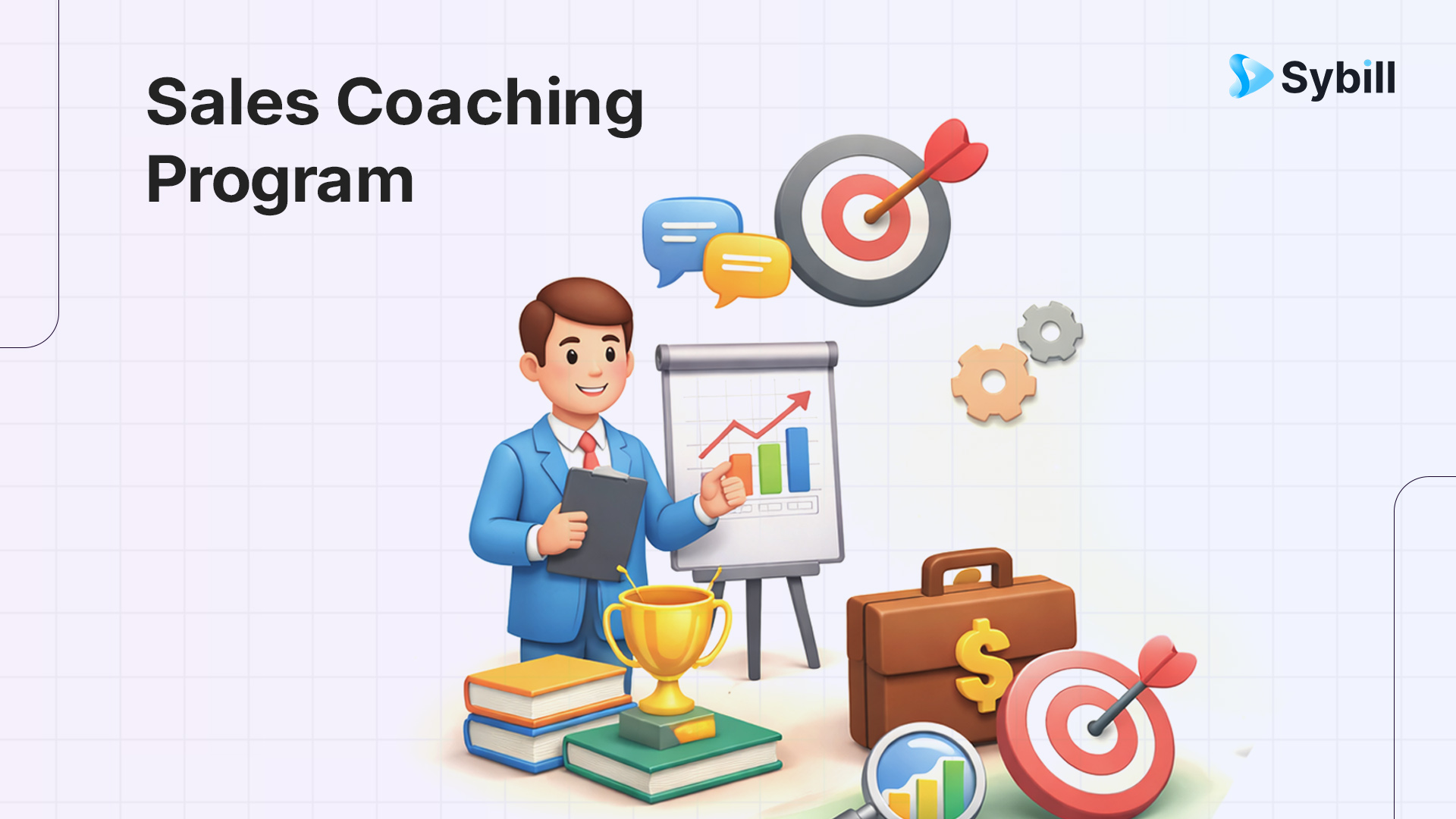
A sales coaching program that drives revenue needs six core components:
1. Clear goals tied to business outcomes
2. Defined competency frameworks so reps know what "good" looks like
3. Recorded calls and conversation data to coach from reality not memory
4. Structured weekly coaching sessions using observation-question-teach-practice format
5. Deliberate practice through role-plays and skill drills, and
6. Metrics tracking both behaviors (talk-to-listen ratio, discovery questions asked) and outcomes (win rate, deal size).
The biggest mistakes are coaching only struggling reps, giving vague feedback like "be more confident," and not following up to see if behavior actually changed. AI tools now surface coaching moments automatically from every call, so managers spend less time hunting for insights and more time developing reps. Teams with formal coaching programs see 16.7% higher revenue growth and can cut new hire ramp time in half.
With all that you already have to do, coaching is another big piece that Managers feel they could definitely use some help with. Let’s say you have 5 reps that make 10 discovery calls a week. That’s 50 calls a week, and 1000 calls a month! Having to remember what went on in those calls and give feedback once a month does not seem like a task that’s humanly possible. Most sales leaders stick with quarterly reviews, giving vague feedback like "be more confident," and hope your reps figure it out. Or they could take the help of AI and the new age tools and see coaching for what it really is: the single highest-leverage activity for driving consistent revenue growth.
While 96% of sales and marketing professionals agree that coaching significantly affects sales performance, only 26% of reps feel they actually receive quality coaching. That's not just a gap. That's a chasm. And it's costing you deals.
The difference between a sales team that crushes quota and one that limps through the quarter often comes down to one thing: whether coaching is treated as a nice-to-have or as the strategic engine that powers everything else. Generic training programs and sporadic feedback don't cut it anymore. Buyers are smarter, sales cycles are longer, and your reps need continuous, personalized development to win in today's market.
This guide walks you through building a sales coaching program that actually works. Not the kind that looks impressive in a deck but dies in execution. The kind that turns average performers into closers, reduces ramp time, and creates a culture where every rep is improving every week.
A sales coaching program is a structured system for developing your team's selling skills through consistent observation, feedback, and practice. But here's where most organizations screw it up: they confuse training with coaching.
Training is what happens when you're ramping new hires on your product, teaching them your pitch deck, or running them through objection handling scenarios. It's important, but it's not coaching. Coaching is the ongoing process of analyzing real sales conversations, identifying behavior patterns, and helping reps level up specific skills in the context of actual deals.
Think of it this way. Training is like learning to drive in an empty parking lot. Coaching is what happens when you're navigating rush hour traffic and someone's in the passenger seat helping you read the road, anticipate problems, and make better decisions in real time.
The best sales coaching programs have three core characteristics:
Consistency over intensity. Weekly 30-minute coaching sessions beat quarterly two-hour reviews every single time. Reps need frequent feedback loops to build new habits, not marathon sessions they forget about by next week.
Specificity over generality. "Be more consultative" isn't coaching. "You asked three closed-ended questions in a row during discovery, which shut down the conversation. Next time, try this framework" is coaching. The difference is whether your feedback is actionable or aspirational.
Behavior-focused over outcome-focused. You can't directly control whether a deal closes. You can control whether your rep asks the right qualifying questions, handles objections confidently, and follows up strategically. Coach the behaviors that drive outcomes, not just the numbers.
Here's what separates programs that work from programs that sound good in theory but fail in practice: execution and measurement. You need clear frameworks for what good looks like, systems for capturing real conversation data, and ways to track whether your coaching is actually changing behavior and moving metrics.
Let's kill a myth right now: coaching isn't just for struggling reps. Some sales leaders only coach when someone's missing quota or a deal's going sideways. That's like only going to the dentist when you have a cavity. Reactive coaching is damage control, not development.
Here's what happens when you build a real coaching program:
Your onboarding time gets cut in half. New reps ramp faster when they're not just consuming training content but actively practicing, getting feedback, and iterating on real calls. Instead of waiting six months to hit quota, they're contributing in three.
Your win rates actually improve. When you analyze successful calls, codify what's working, and coach the entire team on those patterns, you're essentially cloning your best behaviors across all your reps. One top performer's discovery framework becomes the team's discovery framework.
Your pipeline becomes more predictable. Coaching creates consistency. When every rep is qualifying to the same standard, handling objections with similar rigor, and advancing deals based on real buyer signals rather than hope, your forecast accuracy goes up and surprise slippage goes down.
Your top performers stay longer. Great reps don't just want to hit quota. They want to grow. A strong coaching culture signals that you're invested in their development, which directly impacts retention. Lose a top rep and you're not just losing their number, you're losing institutional knowledge and customer relationships.
You stop having the same problems over and over. Without coaching, the same mistakes repeat across your team. Reps talk too much in discovery. They cave on pricing. They fail to multi-thread. Coaching breaks these patterns by creating awareness and providing alternatives.
The ROI is massive. According to research, organizations with formal coaching programs see a 16.7% improvement in annual revenue growth compared to those without. That's not incremental improvement. That's the difference between hitting plan and blowing it out.
But here's the catch: building a coaching program requires time, structure, and commitment. You can't half-ass it with monthly check-ins and expect results. If you're going to do this, do it right.
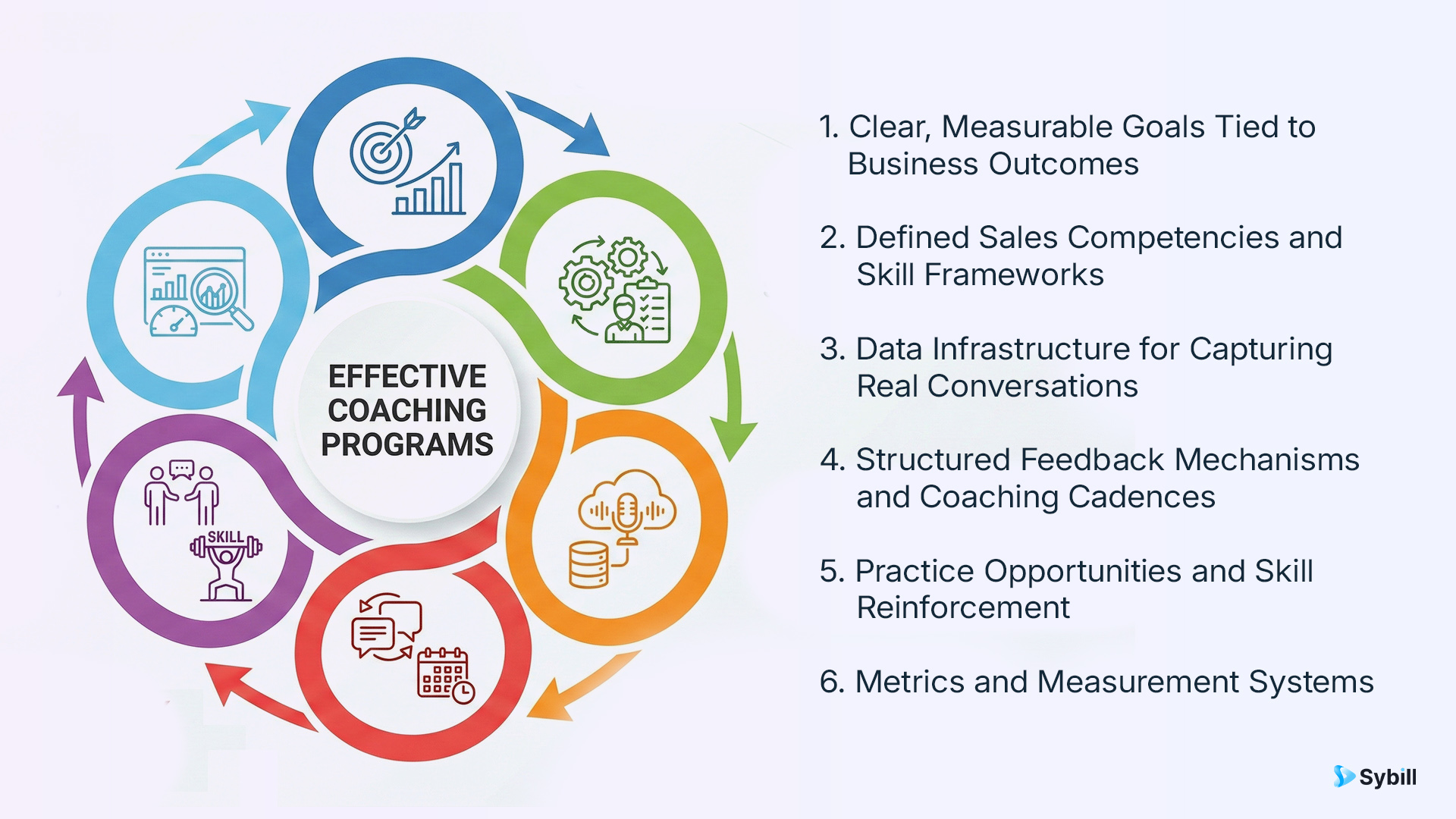
Building a coaching program from scratch can feel overwhelming. Where do you even start? Here's the framework that works, broken down into six essential components:
Your coaching program needs a North Star. What are you actually trying to improve? Don't just say "make the team better." Get specific.
Are you trying to increase your team's average deal size? Then coach on multi-threading, executive alignment, and value articulation. Are you trying to shorten your sales cycle? Then coach on qualification rigor, next-step clarity, and decision criteria mapping.
Your goals should cascade from business priorities down to individual skill development. If the company needs to expand into a new market segment, your coaching should focus on the discovery questions and objection handling specific to that buyer persona.
Set both team-level and individual goals. Maybe your team goal is to improve win rate from 22% to 28% this quarter. But Rep A needs to work on qualification discipline, Rep B needs to sharpen their demo skills, and Rep C needs to learn how to navigate procurement. One-size-fits-all coaching is the fastest way to waste everyone's time.
You can't coach what you can't define. The best programs identify the specific skills that drive success in their sales motion and create clarity around what good looks like at each level.
Start by analyzing your top performers. What do they do differently? How do they structure discovery? How do they handle pricing conversations? How do they build urgency without being pushy? Turn those observations into competency models.
Common competencies include:
For each competency, define what proficiency looks like at different levels. A junior SDR's discovery skills look different from a senior enterprise AE's. Create rubrics so reps know exactly what they're working toward and managers can assess objectively.
Here's where most coaching programs break down. You can't coach based on memory and impressions. You need actual data from real sales conversations.
This means recording calls. All of them. Not just the ones that went well or the ones where something went wrong, but every customer interaction. This is where conversation intelligence becomes non-negotiable.
With recorded calls, you can:
But recording alone isn't enough. You need a way to extract insights from those conversations at scale. That's where AI comes in. Instead of listening to 20 hours of calls to find coaching moments, modern tools surface the key patterns automatically. Which reps are dominating talk time? Who's asking open-ended questions? Where are deals stalling?
Tools like Sybill act as your coaching assistant, analyzing every call and surfacing insights about talk-to-listen ratios, buyer engagement signals, objection patterns, and next-step clarity. This gives managers the specific, evidence-based coaching moments they need without drowning in data.
Consistency beats intensity. The best coaching happens in small, frequent doses, not marathon feedback sessions once a quarter.
Establish a coaching cadence that fits your team's needs:
During coaching sessions, follow a clear structure. The best managers use a framework like this:
Observe: Watch the call or review the data together Question: Ask the rep what they noticed, what went well, what they'd change Teach: Share specific insights or frameworks that could have helped Practice: Role-play the scenario or plan how to apply the lesson in the next call Follow-up: Check in next session to see if the behavior changed
The questioning piece is critical. When you jump straight to telling, reps become dependent on you. When you ask good questions, they develop judgment and learn to self-diagnose. "What do you think caused the buyer to disengage there?" is more powerful than "You talked too much."
You can't coach someone to better discovery skills in theory. They need reps (the practice kind, not the salesperson kind).
Build practice into your program:
The best practice happens in context. After coaching a rep on multi-threading, send them into their next call with the specific goal of identifying two additional stakeholders. After working on qualification, have them use BANT or MEDDPICC on their next discovery call and debrief afterward.
Repetition is everything. One coaching session doesn't create behavior change. Consistent practice over weeks does.
If you can't measure it, you can't improve it. Your coaching program needs clear metrics to track whether it's working.
Track both leading indicators (behaviors) and lagging indicators (outcomes):
Behavioral metrics:
Outcome metrics:
The magic happens when you connect the two. Does improving talk-to-listen ratio actually correlate with higher win rates on your team? Does asking more open-ended questions lead to larger deal sizes? Use the data to validate your coaching focus and adjust when something isn't moving the needle.
Review these metrics in your coaching sessions. Show reps the trend lines. "Your talk-to-listen ratio has improved from 65/35 to 55/45 over the last month, and your win rate went from 20% to 26%. Let's keep pushing." Data makes progress visible and motivates continued improvement.
Ready to stop guessing and start coaching with real insights? Sybill analyzes every sales call to surface coaching opportunities automatically, from talk-to-listen ratios to buyer engagement signals to objection patterns. Get started for free and see how AI can help you build better reps faster.
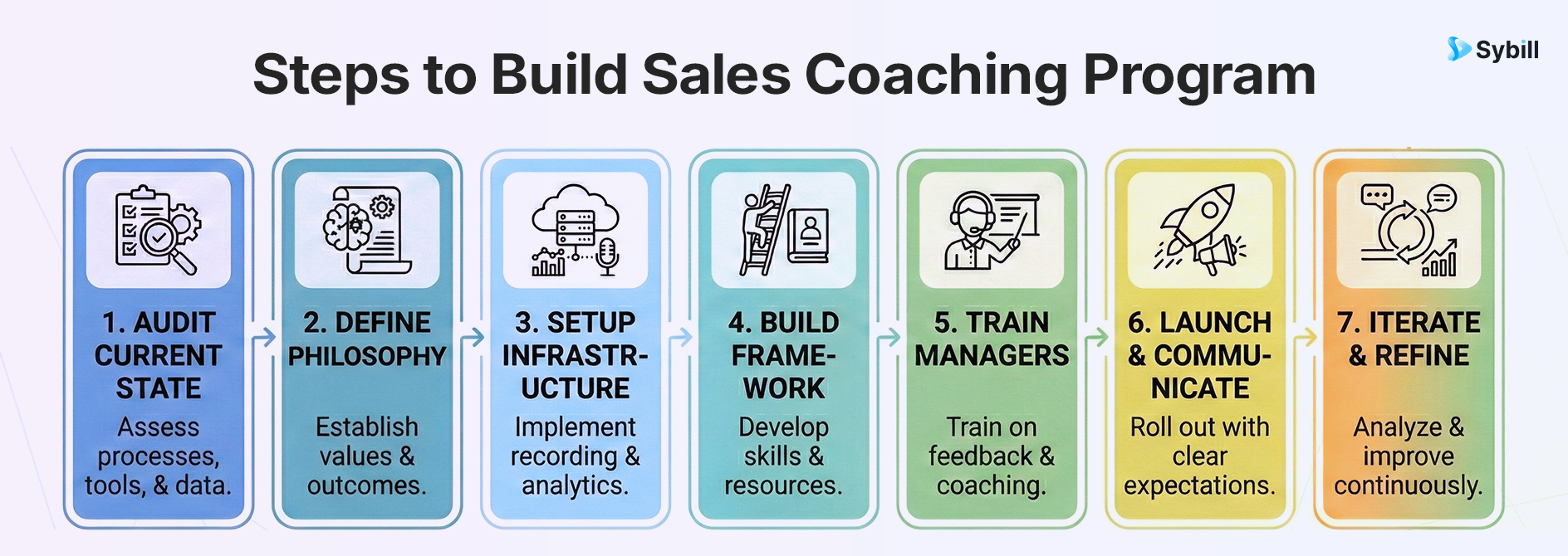
Knowing what a good coaching program looks like is one thing. Actually building one is another. Here's your step-by-step playbook:
Before you build anything, figure out where you are. What coaching happens today? Is it structured or random? Do managers know what to coach on, or are they winging it?
Talk to your reps. Ask them directly: "What coaching would help you most right now?" You'll be surprised how candid they'll be when asked.
Review your metrics. Where are the gaps? Are deals stalling in discovery? Are you losing to competitors on price? Are new reps taking too long to ramp? Let the data tell you where coaching can have the biggest impact.
Listen to calls. Randomly sample 10-15 calls across your team and take notes. What patterns emerge? Where are reps consistently strong? Where do they struggle?
Get clear on how coaching will work on your team. Write it down. Make it explicit.
Will coaching be mandatory or optional? (Hint: make it mandatory. Optional coaching becomes no coaching.)
How much time will managers dedicate weekly? A good benchmark is 4-6 hours per week for every 8-10 reps.
What's your feedback style? Are you direct and candid, or do you prefer a softer approach? Consistency across managers matters, so align on this upfront.
How will you balance positive and constructive feedback? A good rule is the 3:1 ratio. For every piece of constructive feedback, highlight three things the rep did well. This keeps morale high and makes people receptive to improvement areas.
This is the unsexy but critical piece. You need systems to capture, store, and analyze sales conversations.
Implement a conversation intelligence platform. Whether it's Sybill, Gong, Chorus, or another tool, you need something that records calls, transcribes them, and surfaces insights. Manual note-taking doesn't scale.
Integrate with your CRM so call data flows into deal records automatically. When a manager is reviewing a stuck opportunity, they should be able to see what was discussed, what objections came up, and what was promised without hunting through multiple tools.
Set up a call library organized by skill or scenario. Tag your best discovery calls, best demos, best objection handling moments. This becomes your training library for new hires and struggling reps.
Now get specific about what you're coaching. Define the 5-7 core competencies that matter most in your sales motion.
For each competency, create a coaching playbook:
For instance, a discovery competency playbook might include:
These playbooks become your training manual for managers. Instead of every manager inventing their own approach, you're scaling best practices.
Here's an uncomfortable reality: most sales managers have never been trained to coach. They got promoted because they were great reps, not because they knew how to develop others.
Invest in manager enablement. Teach them:
Run manager role-plays. Have them practice delivering feedback, running one-on-ones, and navigating tricky scenarios. If you expect managers to role-play with reps, they need to practice too.
Roll out your program with clarity. Don't just announce it in a team meeting and hope people figure it out.
Explain why you're doing this. Reps need to understand that this isn't remedial or punitive. It's how you're investing in their success.
Set expectations around time commitment, cadence, and what coaching sessions will look like.
Start small if needed. Pilot with one team or one manager, learn what works, then scale. Perfection is the enemy of progress here.
Your first version won't be perfect. That's okay. Build feedback loops so you can continuously improve.
Survey reps quarterly: "What's working in coaching? What's not? What would make this more valuable?"
Review metrics: Are the behaviors you're coaching actually improving? Are those behavior changes driving better outcomes?
Adjust your focus areas as the business evolves. If you launch a new product, coaching priorities shift. If you enter a new market, you're coaching different skills.
The best coaching programs are living, breathing systems that adapt to what the team needs, not static programs that run the same way forever.
Even well-intentioned coaching programs fail. Here are the landmines to avoid:
If coaching only happens when someone misses quota or loses a big deal, you've created a negative association. Coaching becomes punishment, not development.
The fix: Coach everyone, including your top performers. Your best reps often have the highest ceiling for growth. Plus, when they see coaching as standard, it destigmatizes it for everyone else.
"You need to make more calls" isn't coaching. "You need to book more meetings" isn't coaching. That's scorekeeping disguised as feedback.
The fix: Focus on the how, not just the what. Instead of "make more calls," coach on call opening techniques, voicemail strategies, or objection handling that increases connect rates. Activity follows skill improvement.
"Be more confident." "Build better rapport." "Show more urgency." None of this is actionable.
The fix: Get specific. Reference actual moments from actual calls. "At the 18-minute mark when the buyer asked about pricing, you hesitated and started discounting immediately instead of asking about budget parameters. Next time, try this approach..."
Specificity makes feedback stick. Vague advice gets nodded at and forgotten.
You can't effectively coach a rep on a call without understanding the deal context, the buyer persona, where they are in the sales cycle, and what happened in previous conversations.
The fix: Use Deal Summaries and CRM data to understand the full picture before coaching. When you know the buyer's pain points, the competitive landscape, and the deal history, your coaching becomes relevant instead of generic.
Managers who dominate coaching sessions are training reps to be passive. You're building dependency, not capability.
The fix: Follow the 70/30 rule. Reps should talk 70% of the time, you talk 30%. Ask questions, let them self-diagnose, guide them to insights rather than spoon-feeding answers.
You coach on qualification in Monday's one-on-one, then never check if the rep actually improved their qualification discipline in subsequent calls. Without follow-up, coaching is just conversation.
The fix: Create accountability loops. End every coaching session with clear commitments. "By our next session, you'll have run discovery on three new opps using the SPIN framework. We'll review how it went." Then actually review it.
Running your team through a two-day sales training and calling it coaching is like going to the gym once and expecting six-pack abs.
The fix: Training teaches concepts. Coaching applies those concepts to real situations and reinforces them through repetition. You need both, but they serve different purposes. Training is the download. Coaching is the operating system upgrade.
Ten years ago, coaching was manual, sporadic, and completely dependent on a manager's bandwidth and memory. If they didn't happen to sit in on your call or review it later, that coaching moment was lost forever.
AI has fundamentally changed what's possible. And if you're not leveraging it, you're coaching with one hand tied behind your back.
Remember how coaching used to work? A manager would:
This approach had obvious problems. It didn't scale. It was subject to recency bias (you remember the last call, not the pattern across 50 calls). It was exhausting for managers, which meant it often didn't happen consistently.
Modern conversation intelligence platforms do the listening for you. Every call gets recorded, transcribed, and analyzed automatically. But the real breakthrough isn't transcription, it's insight extraction.
AI-powered coaching tools can now:
Surface coaching moments automatically. Instead of hunting through calls, the AI flags moments worth reviewing: when a rep fumbled an objection, when they talked over the buyer for three minutes straight, when they failed to ask a follow-up question after the buyer revealed a pain point.
Analyze patterns at scale. AI can look across every rep's last 100 calls and identify trends. "Sarah's talk-to-listen ratio is 65/35, 15 points above the team average and correlating with a 12% lower win rate. This is coachable." You'd never catch that manually.
Provide real-time feedback. Some tools now give reps in-the-moment nudges during calls. "You've been talking for 4 minutes straight. Try asking a question." This creates micro-learning loops where behavior change happens faster.
Personalize coaching at scale. With AI, you can give every rep personalized insights based on their specific conversation patterns, not generic team feedback. Rep A needs to work on qualification. Rep B needs objection handling. Rep C needs to multi-thread more effectively. AI makes this level of customization possible even on a 50-person team.
Build searchable coaching libraries. "Show me all calls where we successfully handled the security objection." "Find examples of great C-level discovery calls." AI makes your call library actually useful instead of a black hole of untagged recordings.
Here's where tools like Sybill specifically fit into your coaching program. While you're building frameworks and running one-on-ones, Sybill is doing the heavy lifting on insight generation.
After every call, Sybill's Ask Sybill feature lets managers ask conversational questions across their entire team's call data:
Instead of manually combing through transcripts, you get instant, sourced answers. This transforms coaching from reactive to proactive. You're identifying problems and coaching on them before they tank deals, not after.
The CRM autofill capability means your deal context is always up-to-date. When you're coaching on a specific opportunity, you have the full history: what was discussed, what objections came up, what next steps were promised. Coaching becomes contextual and relevant, not generic and speculative.
The behavioral AI analyzes buyer engagement signals that humans miss. "The buyer checked out when you started talking about features. They leaned in when you discussed ROI." These insights help reps understand not just what they said, but how it landed.
AI is powerful, but it's not a coaching program in a box. It's a tool, not a replacement for thoughtful human development.
AI can't:
The best coaching programs use AI for what it's great at (data analysis, pattern recognition, insight surfacing) and humans for what they're great at (relationship building, contextual judgment, motivation, strategic thinking).
Think of AI as your coaching assistant that does the prep work, surfaces the insights, and tracks the metrics, freeing you up to do what only you can do: develop your people.
Scaling coaching across your team doesn't have to mean sacrificing quality. Sybill gives every manager on your team instant access to coaching insights from every call, so you can maintain high coaching standards even as you grow. Start your free trial and see how AI helps you coach at scale.
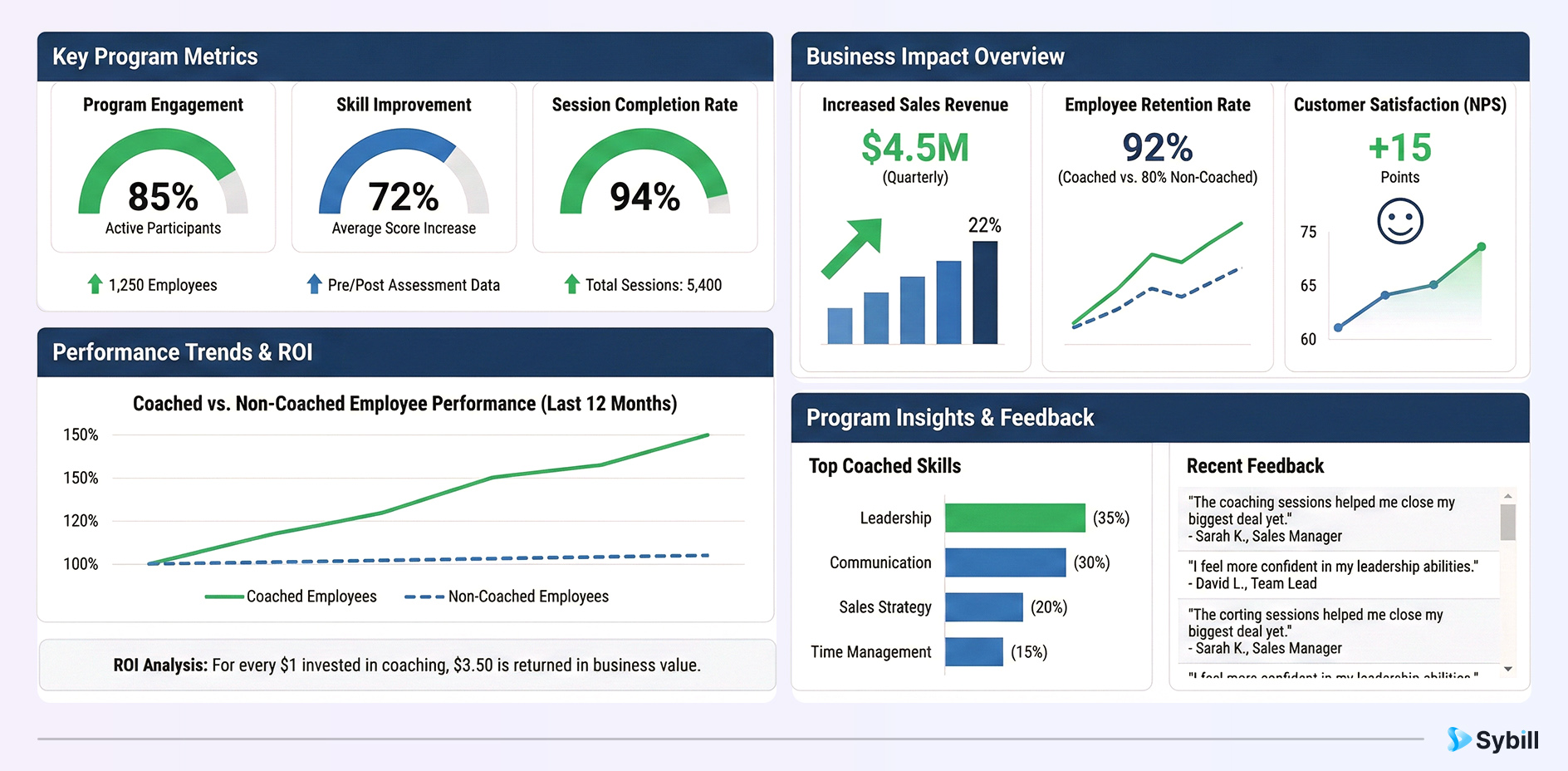
You've built the program. You've trained the managers. Your reps are getting consistent coaching. Now the question every exec asks: is it working?
Here's how to prove the value of your coaching program with data, not just gut feel.
These metrics tell you if coaching is landing before it shows up in revenue:
Skill assessment scores. If you're using competency rubrics, track whether reps are moving from "developing" to "proficient" to "expert" in key areas. Quarterly assessments show progress over time.
Call quality metrics. Monitor talk-to-listen ratios, question frequency, objection handling success rates, and next-step clarity. These should improve as coaching takes effect.
Knowledge retention. After training on a new framework or methodology, test whether reps are actually using it. Are they asking BANT questions? Are they multi-threading? Spot check their calls.
Coaching session attendance and engagement. Are reps showing up to sessions? Are they doing the pre-work? Are they implementing what they learn? Participation metrics reveal buy-in.
Time to proficiency for new hires. A good coaching program should reduce ramp time. If new reps are hitting quota in 4 months instead of 6, that's coaching ROI right there.
These metrics show business impact:
Win rate by rep and by team. This is the big one. If your team win rate goes from 24% to 30% over two quarters of coaching, you've just proven massive value. Track it by rep to see who's improving fastest.
Average deal size. Better discovery leads to better qualification leads to bigger opportunities. Track whether coached reps are closing larger deals.
Sales cycle length. Effective coaching on qualification, multi-threading, and deal strategy should shorten cycles. If your average deal closes in 45 days instead of 60, you're freeing up capacity and accelerating revenue.
Quota attainment. What percentage of reps hit quota? Strong coaching programs see this number climb quarter over quarter as skills improve across the board.
Customer retention and expansion revenue. This is often overlooked, but coaching on customer success and expansion conversations drives retention and upsell. Track it.
The most sophisticated teams connect leading and lagging indicators to prove causation.
For example:
This analysis proves which coaching priorities actually move the needle, so you can double down on what works and stop wasting time on what doesn't.
If you want to get financial about it, here's the formula:
Revenue impact of improved win rate: If coaching improves win rate by 5% and your pipeline is $10M per quarter, that's an extra $500K in closed deals. Annualized, that's $2M.
Time saved through faster ramp: If you reduce ramp time by 2 months and your average rep's quota is $600K/year, that's $100K in additional productivity per new hire. Multiply by number of new hires.
Retention savings: If strong coaching reduces turnover by 15% and the cost of losing a rep (recruiting, training, lost productivity) is $150K, calculate your savings.
Compare these gains to your program costs (manager time, tools, enablement resources). If you're spending $200K annually on coaching and generating $2M+ in incremental revenue, that's a 10x ROI.
Build a quarterly coaching scorecard that you share with leadership:
Make the ROI visible. When leadership sees that coaching directly drives revenue, you'll get continued investment and support.
Sales training is typically a one-time or periodic event focused on teaching knowledge and skills (like onboarding new hires on your product or running a workshop on a new sales methodology). Sales coaching is an ongoing, personalized development process where managers observe real sales behaviors, provide specific feedback, and help reps continuously improve. Think of training as learning the playbook and coaching as refining how you execute it in real game situations. You need both, but they serve different purposes.
Best-in-class sales managers spend 30-40% of their time coaching their team. For a manager with 8-10 reps, this typically translates to 4-6 hours per week minimum. This includes one-on-ones, call reviews, deal strategy sessions, and skill development activities. If a manager is spending less than 3 hours per week on coaching, it's not enough to drive meaningful improvement. The ROI on manager coaching time is one of the highest-leverage investments you can make in sales performance.
No, but the right tools make coaching significantly more effective and scalable. At minimum, you need a way to record and review sales calls. Everything else (frameworks, one-on-ones, feedback sessions) can be done with basic tools. That said, conversation intelligence platforms like Sybill dramatically reduce the time required to analyze calls and surface coaching insights, which means managers can coach more effectively in less time. For most teams, the productivity gain from AI-powered coaching tools pays for itself within weeks.