Find us at booth #83, join us for a harbor side happy hour, or catch Gorish’s talk.

Sept, 16-18 > Learn more

%20(1).avif)
Mamta Tainwala

March 27, 2026
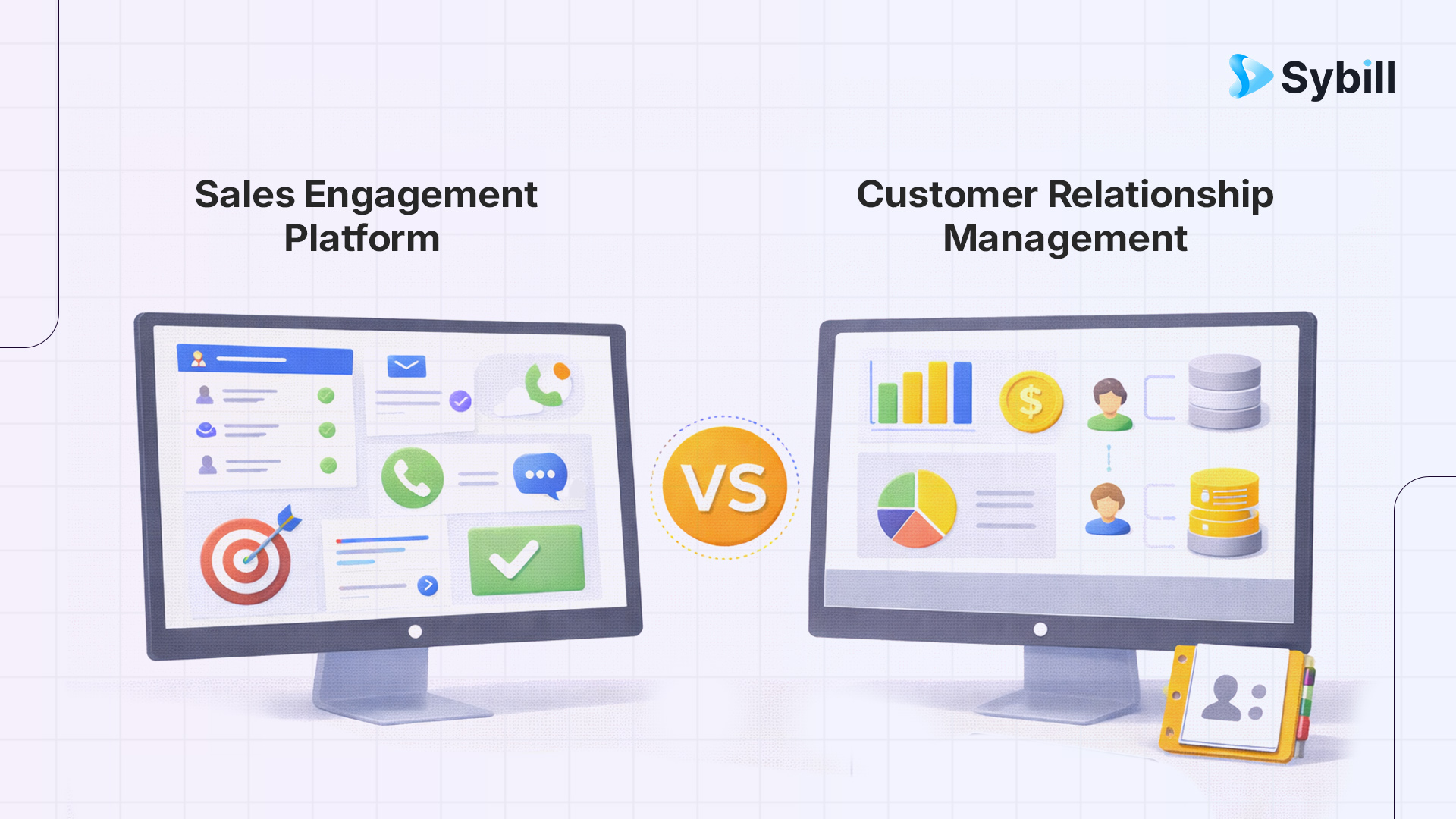
A CRM without a sales engagement platform is like having a cookbook but no kitchen. You've got all the recipes, all the ingredients listed, but you still have to manually chop, measure, cook, and time everything yourself.
A sales engagement platform without a CRM is like having a fully automated kitchen but no recipe book. The appliances are doing their thing, but you're just pressing buttons and hoping for the best.
You need both. The cookbook tells you what to make. The kitchen does the heavy lifting. Together, they turn cooking from an exhausting chore into an efficient system.
The same logic applies to your sales tech stack. Your CRM is your system of record - it knows your customer history, tracks your pipeline, and stores every interaction. Your sales engagement platform is your automation engine - it executes outreach, sequences follow-ups, and drives prospect engagement.
Most sales teams have one or the other. The best teams have both, integrated so seamlessly that reps barely notice where one ends and the other begins.
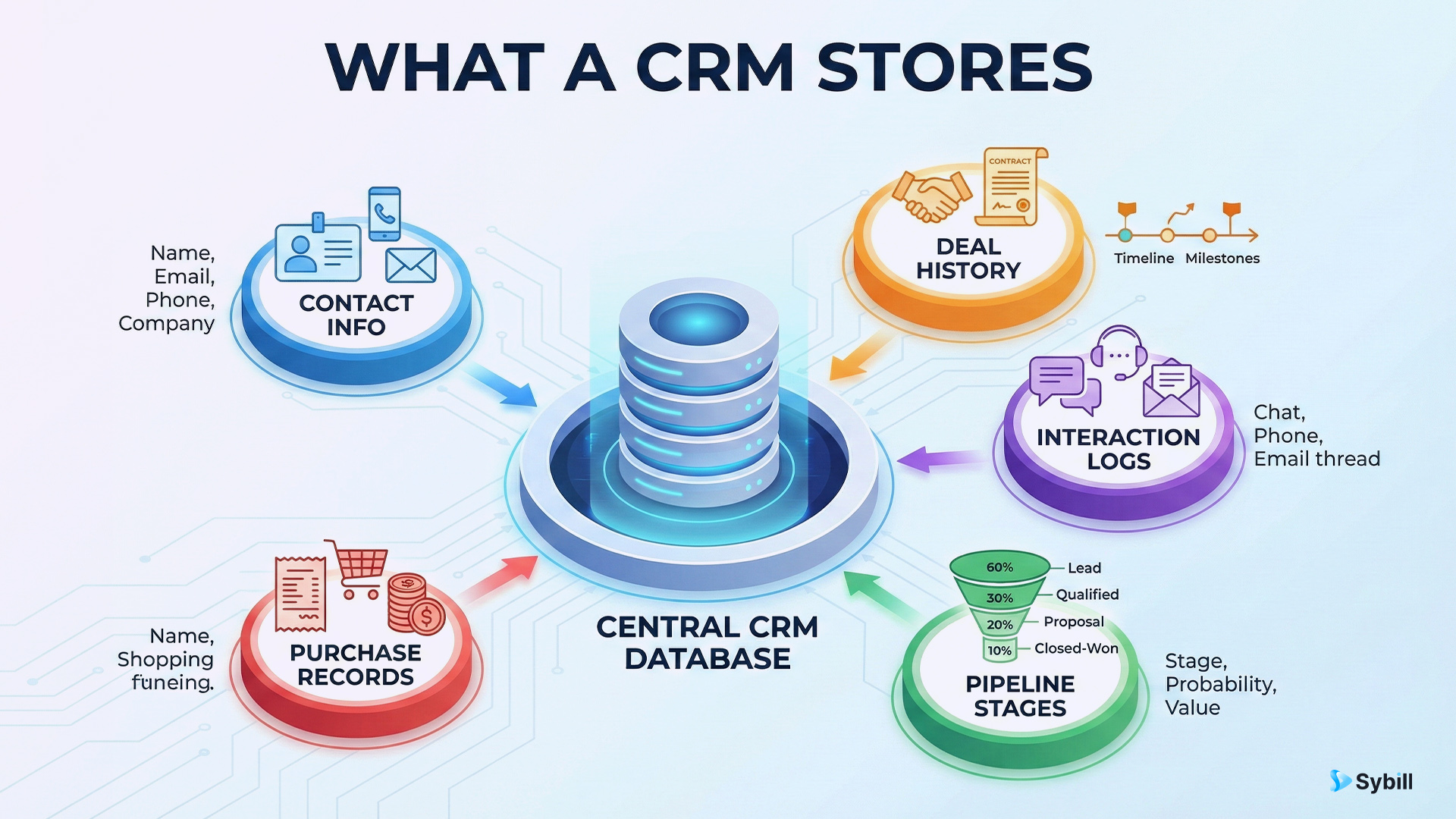
A Customer Relationship Management (CRM) system is software that stores and organizes all your customer and prospect data in one centralized place. Think of it as your company's customer database on steroids.
Your CRM holds:
The CRM is your system of record. It's where data lives. It's what your sales team, marketing team, customer success team, and sometimes even finance and product teams all reference to understand who your customers are and what's happening with them.
Popular CRMs include Salesforce, HubSpot, Pipedrive, Zoho, and Microsoft Dynamics. Each has different strengths, but they all serve the same core purpose: organize customer data so you can manage relationships at scale.
CRMs excel at a few specific things:
Centralized data storage. Instead of customer information living in spreadsheets, email inboxes, and individual reps' notebooks, it's all in one system. This means when a rep leaves, their knowledge doesn't walk out the door with them.
Pipeline and deal tracking. CRMs show you exactly where every deal sits in your sales process. How many deals are in discovery versus negotiation? What's the total value of your pipeline? Which deals are projected to close this quarter?
Reporting and analytics. Want to know your average deal size, sales cycle length, or win rate by industry? Your CRM can tell you. It turns all that customer data into business intelligence.
Cross-functional visibility. When marketing, sales, and customer success all use the same CRM, everyone sees the same customer information. No more "wait, didn't someone already talk to this account?" confusion.
Long-term relationship management. CRMs are built for the entire customer lifecycle. From first touch to renewal to expansion, the CRM tracks it all.
Here's where CRMs fall short, and why you're probably frustrated with yours:
Actually getting reps to use them. Studies show CRM adoption hovers around 40% for many teams. Reps see CRMs as an administrative burden, not a tool that helps them sell. Data entry feels like punishment.
Driving action. Your CRM can tell you who your customers are and what's happened. It's not great at telling you what to DO next. It's reactive, not proactive.
Automating outreach. Most CRMs don't have sophisticated multi-channel sequencing, personalized cadence management, or intelligent follow-up automation. They might let you send an email, but they won't orchestrate a coordinated touchpoint strategy across email, phone, and social.
Real-time sales intelligence. CRMs are historical databases. They show you what happened yesterday, last week, last quarter. They're not analyzing calls in real-time to tell you the prospect just mentioned a competitor or showed buying signals.
Personalization at scale. Your CRM stores data. It doesn't automatically use that data to craft personalized outreach for each prospect. That's still on you.
This is why sales teams that only use a CRM struggle with velocity. The CRM stores the information, but it doesn't help you act on it quickly or intelligently.
A sales engagement platform is software designed to help sales reps execute their outreach strategy across multiple channels (email, phone, social, video) in a coordinated, automated, and measurable way.
If your CRM is a library, your sales engagement platform is the librarian who knows exactly which book you need, brings it to you, reminds you to return it, and suggests three more you'd probably like.
Sales engagement platforms help reps:
Popular sales engagement platforms include Outreach, SalesLoft, Apollo, and increasingly, AI-powered options like Sybill that go beyond just sequencing to provide real-time conversation intelligence and automated CRM updates.
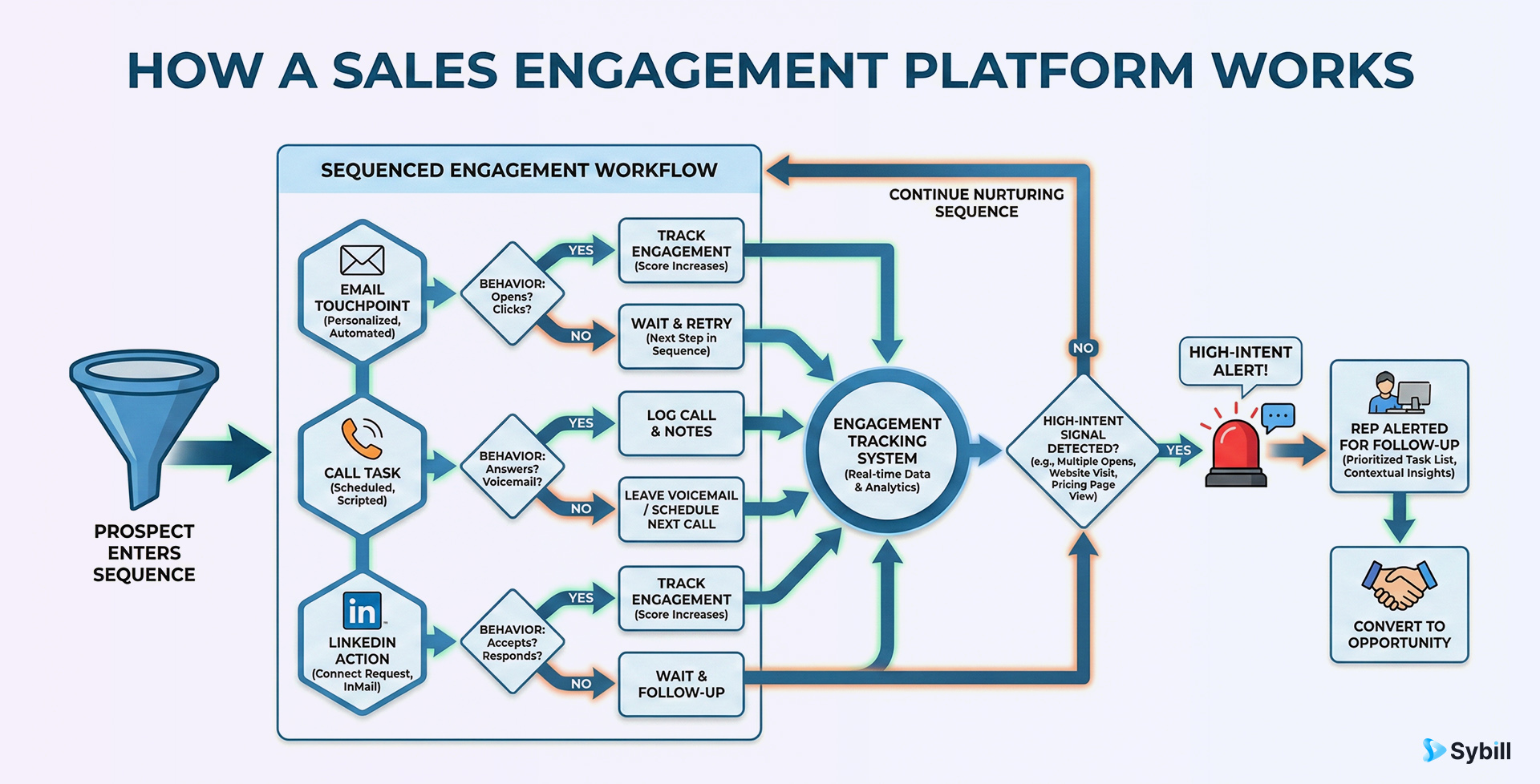
Sales engagement platforms shine in areas where CRMs are weak:
Automating repetitive tasks. Instead of manually sending follow-up emails or remembering to call prospects on day 5, the platform does it for you. Reps just execute the steps as they pop up.
Multi-channel orchestration. A good sales engagement platform coordinates touchpoints across email, phone, social media, and video. It knows if someone didn't respond to your email but engaged on LinkedIn, and adjusts the next touch accordingly.
Personalization at scale. Templates with dynamic fields let you send hundreds of emails that feel personalized because they reference the prospect's company, role, pain points, or recent activity.
Real-time engagement data. You know the moment a prospect opens your email, clicks a link, or visits your pricing page. This gives reps the ability to follow up when interest is highest.
Performance analytics. Which email subject lines get the best open rates? Which call scripts lead to more meetings? Sales engagement platforms A/B test and surface what's working.
Coaching and best practice replication. Managers can see which sequences top performers use, which talk tracks convert, and which cadences produce results. Then they can share those with the team.
Sales engagement platforms also have limitations:
They're not databases. They don't replace your CRM for storing customer information, managing deals, or providing a 360-degree view of accounts.
They don't manage the full customer lifecycle. Sales engagement platforms are built for outbound prospecting and deal acceleration. They're not great for customer success, support, or long-term account management.
They create data silos if not integrated. If your sales engagement platform doesn't sync with your CRM, you end up with activity data living in one place and customer data in another. That's a mess.
They require strategy, not just setup. Spinning up sequences doesn't automatically generate pipeline. You need good messaging, proper targeting, and smart cadence design. The platform is a tool, not a strategy.
Let's cut through the confusion with a direct comparison.
Purpose:
Primary users:
Core function:
Data flow:
Automation:
Analytics:
Integration necessity:
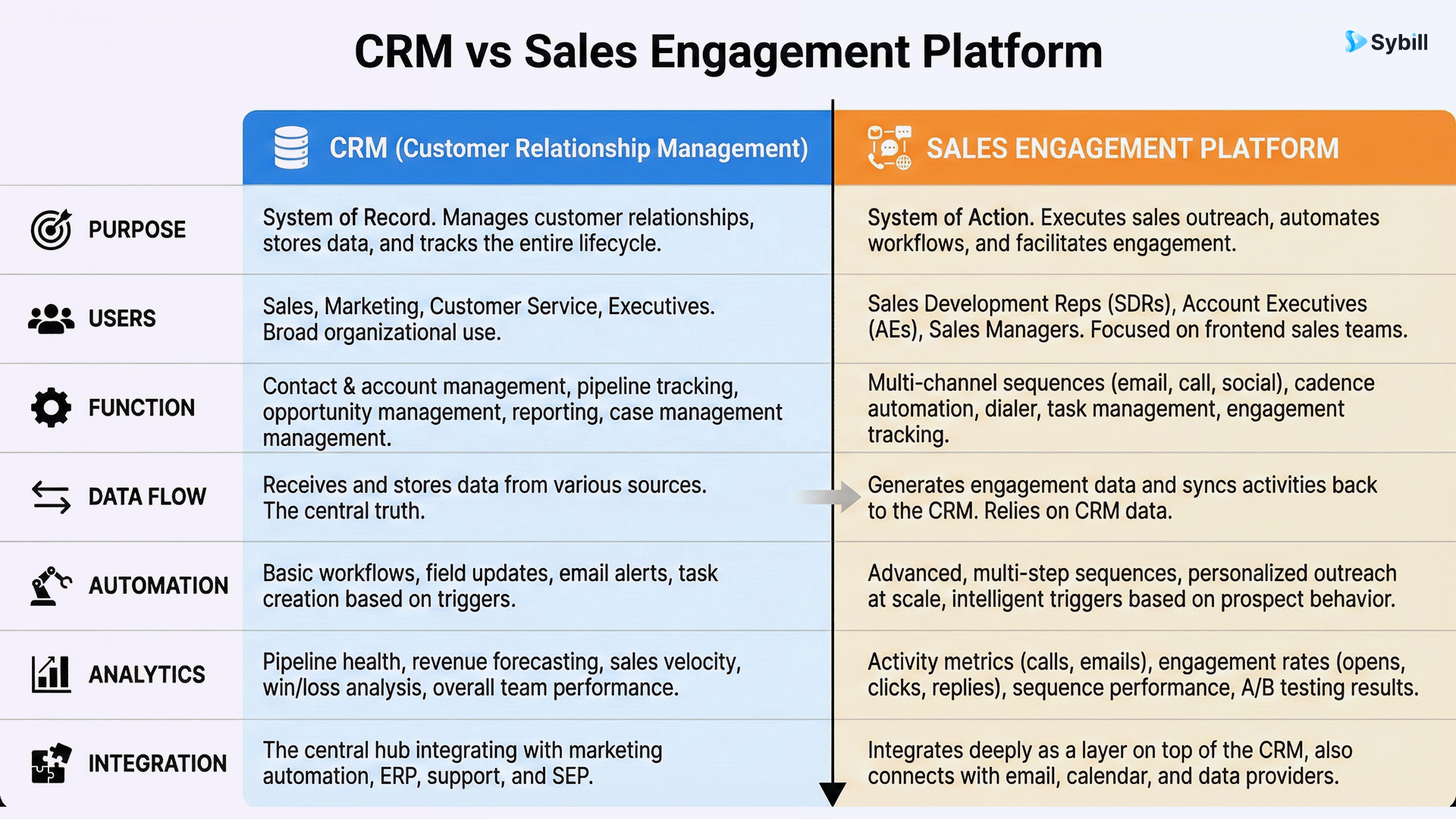
The critical insight: CRMs answer "who are our customers and what's their history?" Sales engagement platforms answer "how do we reach prospects effectively and what should we do next?"
Both questions matter. That's why you need both tools.
Here's the uncomfortable truth: if you're only using a CRM, your reps are drowning in manual work. If you're only using a sales engagement platform, you have no system of record and no cross-functional visibility.
The magic happens when you integrate both.
When your sales engagement platform syncs with your CRM, you get:
Automatic activity logging. Every email sent, call made, and meeting booked in your sales engagement platform automatically logs to the CRM. Reps don't double-enter data. Managers get visibility without nagging.
Context-aware sequences. Your sales engagement platform can pull CRM data (industry, company size, previous interactions) to personalize outreach without manual customization.
Behavioral triggers. When a prospect takes a high-intent action (visits pricing page, downloads case study), your CRM can automatically enroll them in a targeted sequence in your sales engagement platform.
Deal progression based on engagement. When a prospect responds positively or books a meeting, your sales engagement platform can update the deal stage in your CRM automatically.
Unified reporting. You can see both what outreach is happening (sales engagement data) and what results it's producing (CRM deal data) in one view.
This integration eliminates the biggest pain point sales teams face: the gap between having customer data and using it to drive action.
Let's walk through how a sales rep's day changes when both systems work together:
8:00 AM: Rep opens their CRM and sees 5 high-priority deals. The CRM shows deal stage, stakeholders, and recent activity.
8:15 AM: Rep checks their sales engagement platform, which surfaces today's action items: 3 calls to make, 7 emails to send (auto-drafted with personalization), 2 LinkedIn touches.
9:00 AM: Rep makes calls. The sales engagement platform logs each call attempt, duration, and outcome to the CRM automatically. If the rep connects and the prospect shows interest, the deal stage updates in the CRM.
10:00 AM: Rep gets a notification from the sales engagement platform: A prospect opened yesterday's email three times and clicked the pricing link. Rep pulls up the CRM to see the full context (previous conversations, stakeholders, deal size), then sends a personalized follow-up referencing the pricing interest.
11:00 AM: Rep runs a CRM report showing which accounts haven't been touched in 30 days. They bulk-enroll those accounts into a re-engagement sequence in the sales engagement platform.
2:00 PM: A prospect replies to an automated sequence saying they want a demo. The sales engagement platform automatically books it on the rep's calendar and updates the CRM deal stage to "Demo Scheduled."
Notice how the rep never manually logged an activity, never had to remember to follow up, and always had context. That's the power of integration.
Want to see how AI takes this integration to the next level? Get started for free with Sybill and experience how conversation intelligence auto-fills your CRM after every call, drafts personalized follow-ups, and surfaces deal risks before they kill your pipeline.
Sales teams that integrate their sales engagement platform with their CRM see measurable improvements:
CRM data quality increases 60-80%. When activity logging is automatic, your CRM actually reflects reality instead of being a graveyard of outdated information.
Time spent on admin drops 40-50%. Reps aren't manually entering data or crafting one-off emails. They're executing sequences and letting automation handle the busywork.
Lead response time decreases. When high-intent engagement (email opens, link clicks) triggers alerts, reps follow up while interest is hot, not days later when the moment has passed.
Pipeline visibility improves. Managers can see both leading indicators (outreach activity, engagement rates) and lagging indicators (pipeline value, close rates) in one view.
Forecast accuracy goes up. When the CRM has complete activity data from the sales engagement platform, deal health scores are more accurate, making forecasts less guesswork.
The sales engagement vs CRM debate is getting more nuanced because AI is blurring the lines. Modern AI-powered sales tools are doing things that traditional CRMs and sales engagement platforms couldn't.
The traditional CRM pain point is data entry. Reps hate it. It takes forever. And it's often incomplete or wrong.
AI is fixing this. Tools like Sybill's Deal Summaries analyze every sales call and email, then automatically populate CRM fields with:
This means your CRM is actually useful because it's accurate and complete without reps spending hours on data entry.
Traditional sales engagement platforms automate sequences, but they don't optimize them intelligently. AI changes that.
Modern sales engagement tools use AI to:
For example, Sybill's Magic Summaries capture what was said in a call AND what wasn't said (buyer hesitation, enthusiasm, objections). Then AI uses that context to draft follow-ups that feel genuinely personal because they're grounded in the actual conversation.
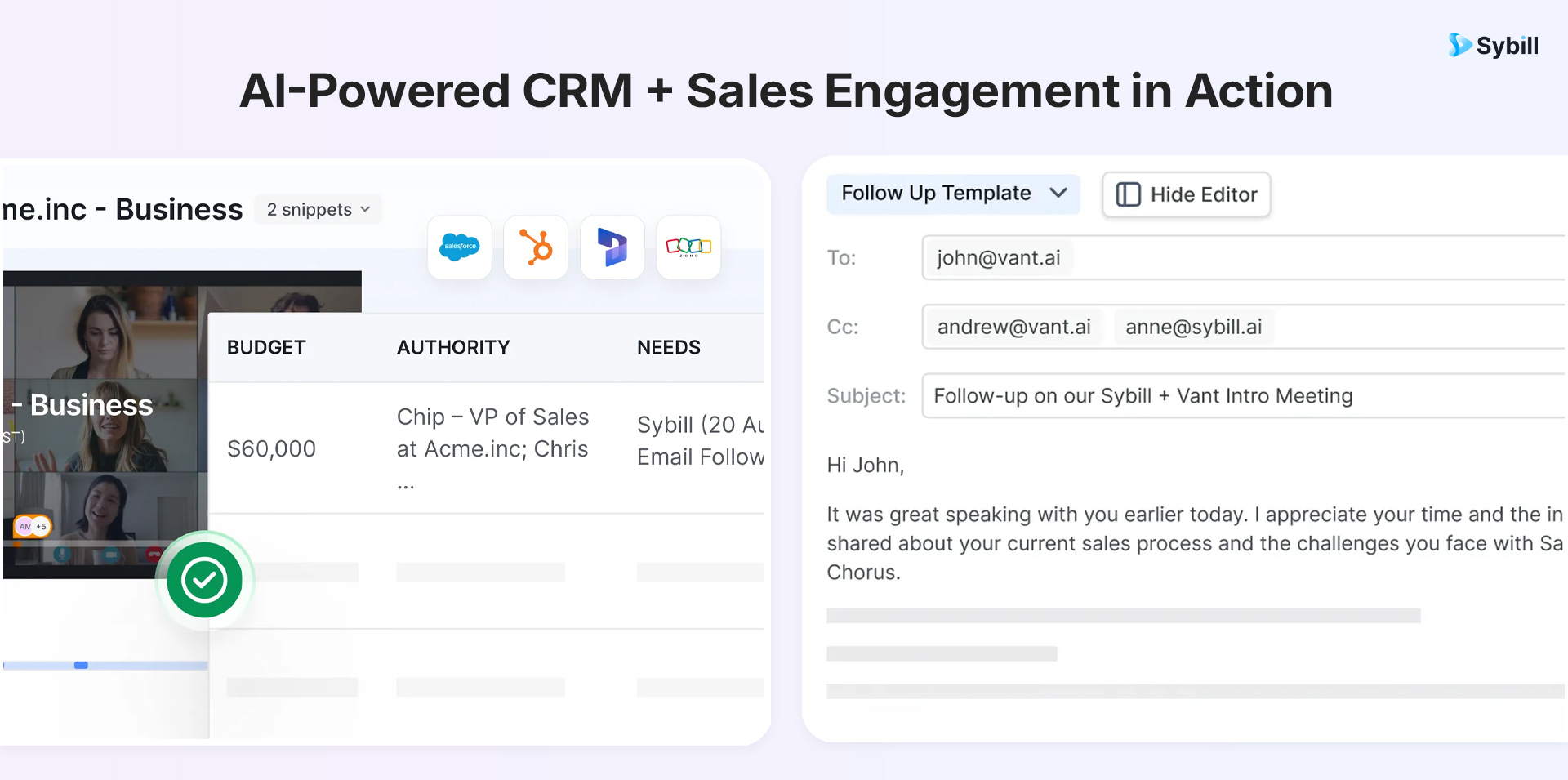
Here's where it gets really interesting. The newest category emerging is AI sales assistants that combine CRM automation and sales engagement intelligence in one platform.
Instead of having separate tools for storing data and driving outreach, you have one AI that:
This is the direction the market is moving. Not CRM vs sales engagement platform, but integrated AI that makes both functions seamless.
Sybill is built for this future. It's not just a note-taker or a CRM updater or a sequence tool. It's an AI sales assistant that handles the entire workflow from call intelligence to CRM hygiene to follow-up execution.
If you're building or evaluating your sales tech stack, here's what matters.
Customization: Can you add custom fields, stages, and workflows that match YOUR sales process, not a generic template?
Integration capabilities: Does it play nice with your other tools (sales engagement platforms, marketing automation, customer success software)?
Reporting flexibility: Can you build the reports you actually need, or are you stuck with pre-built dashboards that don't answer your questions?
User adoption: Is the interface intuitive enough that reps will actually use it, or is it so complex that adoption will be a constant battle?
AI capabilities: Does it offer intelligent features like predictive scoring, automated data entry, or smart insights, or is it just a database?
Multi-channel support: Does it handle email, phone, social, and video, or just one channel?
Personalization options: Can you customize at scale with dynamic fields, conditional logic, and A/B testing?
CRM integration depth: Does it just send data to your CRM, or does it pull context back to inform sequences?
Analytics and optimization: Does it show you what's working and help you improve, or just track metrics?
AI and automation: Does it use AI to optimize send times, personalize content, or prioritize prospects, or is it just basic automation?
Whatever CRM and sales engagement platform you choose, integration is non-negotiable. But not all integrations are created equal.
Native integrations are best. They're built by the vendors to work together seamlessly. They sync in real-time and handle edge cases.
Third-party integration tools (like Zapier) can work but often have delays, hit rate limits, and break when either platform updates.
Custom API integrations give you the most control but require developer resources and ongoing maintenance.
The key test: Can a rep take an action in one tool and see it reflected in the other without manual work? If yes, your integration works. If not, fix it.
The lines between these categories will continue to blur. Here's where we're going.
Instead of logging into separate tools for CRM data and engagement insights, you'll just ask an AI assistant questions:
The AI handles routing to the right system, pulling data, and taking action. You never think about which tool does what.
AI won't just tell you what happened. It'll predict:
This is already starting with tools like Sybill's conversation intelligence that analyze call sentiment and engagement to forecast deal health.
Future sales engagement won't be about sequences. It'll be about AI understanding each prospect's behavior, preferences, and context, then crafting perfectly timed, perfectly tailored outreach that feels one-to-one even when you're running a hundred deals.
Your CRM data (past purchases, industry, role) combines with engagement data (email behavior, content interests) and conversation intelligence (what they said on calls) to create outreach that's truly personalized.
Some tasks will become fully automated:
Reps focus on the high-value work (discovery, demo, negotiation). AI handles everything else.
Let's answer the original question directly: Do you need both a CRM and a sales engagement platform?
You need a CRM if:
You need a sales engagement platform if:
You need both if:
The ROI calculation is simple: Does the time saved on manual work + the revenue gained from better execution exceed the cost of the tools? For most B2B sales teams, the answer is yes within the first quarter.
No. Sales engagement platforms are built for executing outreach, not storing comprehensive customer data across the entire lifecycle. They don't handle deal management, cross-functional visibility, customer success workflows, or long-term relationship tracking the way a CRM does. Think of a sales engagement platform as a powerful tool that sits on top of your CRM, using its data to drive action. But it's not a replacement. Teams that try to use only a sales engagement platform end up with data silos, limited reporting, and no system of record. The tools are complementary, not interchangeable.
The best CRM depends on your company size, budget, and complexity. Salesforce is the most powerful and customizable but also the most expensive and complex. It's ideal for enterprise teams with dedicated admins. HubSpot is more user-friendly and affordable, making it great for small to mid-market teams, especially those also using HubSpot's marketing tools. Pipedrive is even simpler and more affordable, perfect for small sales teams. Zoho offers good value for budget-conscious teams. The key is to match the CRM's complexity to your needs.
Sales engagement platforms are for one-to-one or one-to-few outreach by sales reps targeting specific prospects. Marketing automation is for one-to-many campaigns targeting broad audiences. Sales engagement is manual (rep-initiated sequences), while marketing automation is fully automated (triggered campaigns). Sales engagement focuses on sales qualified leads moving through the pipeline, while marketing automation focuses on lead generation and nurturing. The tools have different metrics too. Sales engagement tracks reply rates, meeting bookings, and conversion to opportunity. Marketing automation tracks campaign open rates, lead scores, and MQL generation. That said, the lines are blurring as both categories add features from the other. Some teams use marketing automation for top-of-funnel and sales engagement for mid-to-bottom-of-funnel. The handoff point is usually when a lead becomes sales-qualified.