Find us at booth #83, join us for a harbor side happy hour, or catch Gorish’s talk.

Sept, 16-18 > Learn more

%20(1).avif)
Mamta Tainwala

January 16, 2026
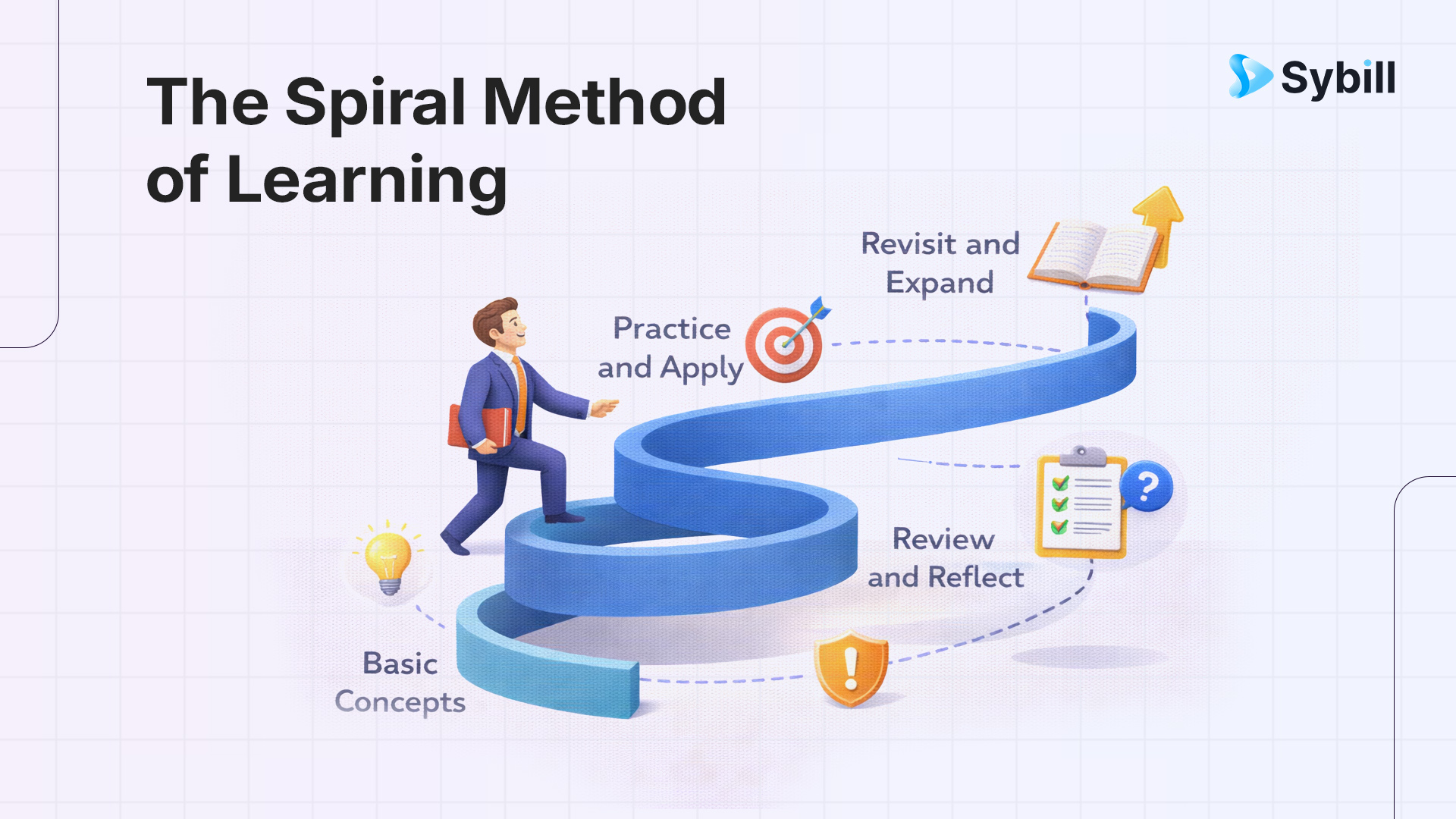
Remember that montage in The Karate Kid where Daniel-san waxes cars for what feels like forever? Paint the fence. Sand the floor. He's confused, annoyed, maybe questioning his life choices. Then Mr. Miyagi throws a punch, and suddenly Daniel realizes he's been learning karate all along. Each repetition building on the last, muscle memory spiraling deeper until the movements become second nature.
That's the spiral method of learning in action, and it's exactly how the best sales reps level up their game.
Here's the thing about traditional sales training: it doesn't stick. You send your team to a two-day workshop, they come back pumped with 47 new frameworks, and by next Tuesday they've forgotten everything except where they parked. That's because most training follows what's called "block learning," where you cram everything into one intense session and hope it magically transfers to the field.
Spoiler alert: it doesn't.
The spiral method flips this on its head. Instead of learning something once and calling it done, you revisit concepts repeatedly at increasing levels of complexity. Each time you circle back, you understand it deeper. You connect more dots. You actually internalize it instead of just nodding along in a conference room.
For sales teams dealing with complex B2B cycles, objection handling that evolves by the quarter, and buyers who've read the same playbooks you have, the spiral method isn't just nice to have. It's the difference between reps who grow and reps who plateau.
The spiral method (also called spiral curriculum or spiral learning) is an educational approach where you learn foundational concepts first, then revisit them multiple times with increasing depth and complexity.
Think of it like this: In round one, you learn what discovery questions are. In round two, you practice how to ask them without sounding like a robot. In round three, you learn when to deploy them based on buyer signals. In round four, you're improvising new ones mid-call because you understand the underlying psychology.
Each loop of the spiral builds on what came before. You're not starting from zero each time. You're adding layers of sophistication, context, and nuance.
This concept was formalized by psychologist Jerome Bruner in the 1960s, but it's been battle-tested everywhere from medical education to military training. The reason? It works with how human memory actually functions, not how we wish it functioned.
Here's an uncomfortable stat: research shows that people forget up to 50% of newly learned information within days if there's no reinforcement. Within a month? You're looking at 70% memory loss.
This phenomenon, called the Forgetting Curve, was discovered by Hermann Ebbinghaus back in the 1880s. And it's been ruining corporate training budgets ever since.
The spiral method directly counters this. By revisiting material at strategic intervals, you interrupt the forgetting curve. Each review session reactivates neural pathways, strengthens retention, and moves information from short-term to long-term memory.
For sales coaching, this means your reps aren't just hearing about objection handling once in onboarding. They're encountering it again in role-plays. Again in call reviews. Again when analyzing lost deals. Each time with more context, more real-world examples, and more sophistication.
Let's get tactical. Here's what spiral learning looks like when you're building revenue-generating machines instead of just checking the "training complete" box.
This is where you introduce core concepts at their simplest level. For a new SDR, this might be:
You're not diving into nuance yet. You're building the vocabulary and mental models they need to operate. Think of this as installing the operating system before you start downloading apps.
Now you revisit those same concepts, but you're adding the dimension of execution. The SDR who learned what discovery is now practices it through:
They're still working with the same core material, but the complexity has increased. They're not just defining discovery anymore—they're doing it.
Third time around the spiral, you're teaching judgment. The rep has done discovery calls. Now they need to learn:
This stage is where AI-powered sales coaching becomes incredibly valuable. Tools like Sybill can surface patterns across dozens of calls—showing reps exactly when certain approaches work and when they backfire, based on real buyer reactions, not just anecdotal advice from that one rep who's been here since the company had three employees.
In the final spiral (which never really ends, by the way), your rep understands the principles so deeply they can adapt them on the fly. They know why certain discovery questions work. They understand the psychological triggers. They can improvise new approaches because they've internalized the fundamentals.
This is when reps start teaching newer teammates. This is when they contribute to your playbook instead of just following it. This is when they stop needing you to hold their hand through every deal.
Ready to accelerate your team's learning curve? Get started for free with Sybill and turn every sales call into a coaching opportunity with AI-powered insights that help reps improve faster.
Most sales training programs are built like college finals: cram everything in at once, test immediately, then promptly forget it all. It's efficient for the training department's calendar. It's terrible for actual skill development.
Here's why the spiral approach wins:
Traditional training treats every topic as independent. You do a module on cold calling. Then one on email outreach. Then one on demo delivery. Each stands alone.
With spiral learning, each concept reinforces and connects to others. When you revisit cold calling the second time, you're not just repeating the script. You're integrating what you learned about buyer psychology from the discovery module. You're applying insights from recent lost deals. You're weaving everything together into a coherent skill set.
Block learning creates the illusion of mastery. Your rep crushes the role-play in the training room, gives you a thumbs up, and you think they're good to go. Then they freeze on their first real call because there's no muscle memory, no pattern recognition, no deep understanding.
Spiral learning builds retention through spaced repetition. By the time a rep encounters a concept for the third or fourth time, it's not new information anymore. It's familiar territory they're refining. The cognitive load is lower, comprehension is higher, and the skills actually stick.
Here's something most training programs ignore: your buyers are getting smarter too. The objections you faced six months ago have evolved. The competitive landscape has shifted. The economic climate changed.
The spiral method builds continuous learning into your culture. You're not just training once and assuming the playbook is permanent. You're constantly revisiting, updating, and deepening expertise as the market changes. Your team doesn't just know last quarter's best practices—they're actively building next quarter's.
Quick sidebar because these terms get mixed up constantly: spiral learning and spaced learning are related but different.
Spaced learning is about the timing of training sessions. Instead of one eight-hour bootcamp, you spread learning over time—a concept supported by decades of cognitive science research showing that our brains need processing time between learning sessions.
Spiral learning is about the content structure. You revisit the same topics repeatedly, each time at greater depth.
The magic happens when you combine them. You space out your training sessions (avoiding the fire hose effect) AND you structure the content so each session builds on previous ones (avoiding the "what did we even learn last time?" effect).
For AI sales training programs, this combination is gold. AI can help you identify exactly which concepts each rep needs to revisit, when they need that reinforcement, and how to layer in complexity based on their actual performance data, not just a rigid curriculum timeline.
Alright, enough theory. Let's talk implementation. Here's how to actually build spiral learning into your sales team without turning into that manager who's always launching "new initiatives."
You can't spiral through everything. Start by identifying the 5-7 core skills that actually move the needle for your team:
These become your spiral curriculum. Everything else is supplementary.
For each core competency, plan at least 3-4 encounters:
First encounter: Introduction and overview (onboarding or enablement session)
Second encounter: Practical application (role-plays, shadowing, first attempts with safety nets)
Third encounter: Pattern analysis (call reviews, win/loss analysis, peer learning)
Fourth encounter: Mastery and coaching others (advanced scenarios, handling edge cases, becoming the teacher)
The key is making each encounter meaningfully different. If you're just repeating the same slide deck three times, that's not spiral learning—that's just boring your team to death.
This is where most companies screw up. They build training in a vacuum, divorced from what's actually happening in the field.
The best spiral learning programs pull directly from recent calls, deals, and market feedback. When you revisit "objection handling" for the third time, you're not using the same generic examples from two years ago. You're analyzing the objection that came up in four deals last week. You're studying how your top performer handled it. You're workshopping new responses together.
Sales enablement AI makes this dramatically easier. Instead of manually combing through call recordings or relying on reps' selective memory of what happened, AI can surface the exact moments worth studying, identify patterns across your entire team, and even suggest which skills need reinforcement based on performance data.
Learning doesn't happen during the training session. It happens in the reflection afterward.
After each encounter with a core skill, create space for reps to:
This metacognition—thinking about thinking—is what transforms information into actual expertise. And yes, it feels touchy-feely and takes time. Do it anyway. The ROI is absurd.
The spiral never really ends. Even your most senior reps should be encountering core concepts in new contexts, with fresh challenges, at higher stakes.
Set up structures that make this happen naturally:
When learning is baked into your operating cadence instead of being "that thing we do during kickoff," the spiral sustains itself.
Let's make this concrete. Imagine you're teaching your team to handle the objection: "Your price is too high."
First spiral (Week 1 - Onboarding): Your new AE learns the basic framework. Price objections usually mean one of three things: budget constraints, unclear value, or comparing to cheaper alternatives. They memorize a few response templates.
Second spiral (Week 4 - Role-Play): The AE practices responding to price objections in simulated scenarios. They try different approaches, get immediate feedback, and start building intuition about what feels natural versus scripted.
Third spiral (Week 8 - Call Review): The AE reviews a recording of their actual call where a prospect brought up price. Using AI-powered coaching tools, they can see not just what they said, but how the buyer reacted—tone shifts, engagement levels, verbal cues. They identify what worked and what fell flat. They notice they addressed the objection but didn't quantify ROI. They set a goal to weave in specific value metrics next time.
Fourth spiral (Week 12 - Advanced Workshop): The team does a deep-dive on pricing psychology and negotiation tactics. Now the AE isn't just responding to price objections—they're anticipating them, reframing conversations around value before price comes up, and confidently defending your premium positioning. They share their approach with newer reps, reinforcing their own mastery by teaching it.
See the progression? Same core skill. Four completely different encounters. Each building on the last. By week 12, that AE doesn't just have a script for price objections—they have deep, transferable understanding they can apply to any variation of that objection.
You're going to mess this up at first. Everyone does. Here are the predictable ways it goes wrong and how to course-correct:
You revisit a concept after three days and wonder why no one's improved. Reps need time between spirals to actually apply what they learned, encounter real-world scenarios, and process the information.
Fix: Space your spirals at least 2-4 weeks apart, depending on complexity. Give reps time to fail, succeed, and experiment between training sessions.
You just repeat the same content three times and call it "spiral learning." That's not spiraling—that's just annoying.
Fix: Each encounter should introduce new dimensions. First time: what. Second time: how. Third time: when and why. Fourth time: edge cases and exceptions. Map this out explicitly when designing your curriculum.
You try to build a spiral curriculum for 47 different skills and your team is in constant training mode. Nobody's actually selling.
Fix: Focus on your core 5-7 competencies. Everything else gets learned through normal coaching and experience. Protect your team's time to actually do the job.
You put everyone through the same spiral at the same time, regardless of where they actually are in their development.
Fix: Personalize the spiral based on performance data. Your top performer doesn't need another session on basic discovery—they need advanced stakeholder mapping. Your struggling SDR needs to spiral through fundamentals again before moving to complex scenarios. Deal coaching tools can help you identify exactly where each rep needs reinforcement.
Want to build a learning culture that actually sticks? Get started for free with Sybill and use AI to identify skill gaps, surface coaching moments, and track improvement across your entire team.
You implement spiral learning but never actually track whether it's working. You're spiraling blind.
Fix: Define clear metrics for each core competency. What does "good" look like? How will you measure improvement? Track leading indicators (talk-to-listen ratio, discovery question count) and lagging indicators (conversion rates, deal velocity) to prove the spiral is working.
Here's where things get interesting. Traditional spiral learning works, but it's labor-intensive. You need managers with time to coach, systems to track development, and consistent execution across the entire team.
Most companies don't have that. What they have is managers drowning in forecast calls, reps who all learn differently, and zero visibility into what's actually working.
This is where AI changes the game entirely.
Instead of guessing which skills need reinforcement, AI analyzes every call, email, and deal to surface patterns. It tells you: "Your team struggles with multi-threading—they're single-threading 73% of opportunities." Now you know what to spiral through next.
Tools like Sybill can analyze hundreds of interactions across your team and identify skill gaps that would take humans weeks to spot manually.
Not everyone learns at the same pace. Not everyone needs the same content at the same time.
AI can create individualized learning paths. Rep A needs to revisit discovery because they're talking too much and listening too little. Rep B has discovery dialed in but fumbles objections. Rep C is crushing everything except competitive positioning.
Instead of one-size-fits-all training, you get personalized spirals tailored to actual performance gaps, not assumed ones.
The best time to learn isn't in a conference room next Tuesday. It's immediately after you blow a call. Or right before a high-stakes meeting.
AI-powered platforms can deliver coaching in the moment—surfacing relevant content, suggesting approaches, and even analyzing your last interaction to show exactly what to improve. This creates micro-spirals throughout the day, not just during formal training sessions.
Human memory is terrible. Managers think they know who's improving and who's stagnating, but it's mostly recency bias and gut feel.
AI tracks improvement objectively. It can show you that a rep's discovery skills have measurably improved over six weeks—more open-ended questions, better listening ratios, stronger qualification. Or it can show you that despite three training sessions, nothing's changing. Now you know where to intervene.
Here's the hard truth: you can implement perfect spiral learning and still fail if your culture doesn't support it.
Continuous learning isn't about adding more meetings to the calendar. It's about creating an environment where getting better at the craft is part of the job, not something that happens despite the job.
Celebrate improvement, not just results. When a rep masters a skill they struggled with, acknowledge it publicly. When someone shares a learning from a lost deal, praise the self-awareness, not just the win rate.
If your team sees that growth is noticed and rewarded, they'll engage with spiral learning differently. It stops being "more training I have to sit through" and becomes "how I get better at my craft."
Spiral learning requires trying new approaches, which means occasionally failing. If your culture punishes failure, reps will stick to what's safe, and the spiral stalls.
Build an environment where it's okay to test new objection handling techniques, even if they fall flat. Where reps can share mistakes in call reviews without fear of judgment. Where experimentation is encouraged, not just tolerated.
Your best teachers aren't always managers. Often they're the rep who just figured something out and remembers what it was like to struggle.
Create structures for peer learning:
When reps teach each other, two things happen: the learner gets relevant, practical guidance, and the teacher deepens their own mastery. It's spiral learning on steroids.
Traditional sales training typically uses a "block learning" approach—you learn everything about a topic once in a concentrated session, then move on to the next topic. Spiral learning revisits core concepts multiple times at increasing levels of complexity. Instead of learning objection handling once during onboarding, you encounter it again during role-plays, again during call reviews, and again during advanced workshops, with each session building deeper expertise. This approach dramatically improves retention and skill transfer because it works with how human memory actually functions, not against it.
Generally, you want 2-4 weeks between encounters with the same concept, depending on its complexity. This spacing allows reps to apply what they learned in real scenarios, encounter challenges, and build questions for the next session. Too short (a few days) and you haven't given them time to process and practice. Too long (several months) and you're back to square one with the forgetting curve. The key is finding the sweet spot where material is still somewhat familiar but reps have gained enough experience to appreciate the added complexity.
No, and that's not the goal. AI accelerates and scales coaching, but it doesn't replace the human element. Think of AI as handling the analytical heavy lifting—identifying patterns, surfacing coaching moments, tracking improvement, and providing data-driven insights. Human coaches provide context, motivation, emotional intelligence, and the kind of nuanced judgment that AI can't replicate. The most effective approach combines both: AI-powered tools like Sybill handle the repetitive analysis and pattern recognition, freeing up managers to focus on high-impact coaching conversations where human expertise actually matters. It's augmentation, not replacement.