Find us at booth #83, join us for a harbor side happy hour, or catch Gorish’s talk.

Sept, 16-18 > Learn more

%20(1).avif)
Mamta Tainwala

February 14, 2026
TL;DR: Fireflies is a solid meeting notetaker for any team. Gong is a revenue intelligence platform built for sales leadership. Sybill is an AI sales assistant built for the reps who actually close deals. All three record and transcribe calls, but that's where the similarities end. This guide breaks down what each tool actually does after the call ends, what it costs, and which one fits your team's size, budget, and selling style.
Signing up for a gym, buying a fitness tracker, and hiring a personal trainer all technically count as "investing in fitness." But only one of those actually changes your body. The gym gives you access. The tracker gives you data. The trainer gives you a plan, holds you accountable, and adjusts your form in real time.
Sales AI works the same way. Fireflies gives you access to what was said on your calls. Gong gives you data about how your team is performing. Sybill shows up like a trainer who was on the call with you, writes your post-workout plan (the follow-up email), logs your progress automatically (CRM updates), and tells you exactly where you're losing form before your next session.
All three tools record sales calls. That's the gym membership. The question is what happens after you walk through the door: which one actually helps your reps get on base? Which one moves deals forward after the meeting ends?
That's the question this comparison sets out to answer. While Sybill, Gong, and Fireflies are increasingly mentioned in the same breath, they're fundamentally built for different jobs. One is a universal meeting notetaker. One is a revenue intelligence platform for leadership. And one is a deal-moving machine built for the reps on the front lines.
Before we get into the details, let's get clear on what these three products are trying to be. Because the confusion usually starts right here.
Fireflies is an AI meeting assistant. It records, transcribes, and summarizes meetings across Zoom, Google Meet, Teams, and other platforms. It's built for anyone who takes meetings, not just sales teams. The core value is: "I don't want to take notes." It does that job well.
Gong is a revenue intelligence platform. It captures calls and uses that data to power coaching dashboards, deal tracking, forecasting, and analytics for sales leadership. The core value is: "I want visibility into what my team is doing." It's built for CROs and VPs of Sales who need to manage large orgs.
Sybill is an AI sales assistant for account executives. It captures calls, but then it actually does the post-call work: writing follow-up emails in your voice, filling CRM fields with accurate deal data, creating pre-meeting briefs, generating sales assets, and giving reps instant answers about any deal through Ask Sybill. The core value is: "I want my reps selling, not doing admin."
Same starting point (recording calls). Three very different destinations.
All three tools record and transcribe sales calls. That's table stakes in 2026. The differences are in accuracy, speed, and what happens with the transcript afterward.
Fireflies supports transcription in 100+ languages and works across virtually every conferencing platform. It delivers live, real-time transcripts during the meeting, which is a nice touch for teams that want to follow along in text. The transcription quality is solid for clear audio, though users report dips in accuracy with crosstalk, strong accents, or heavy industry jargon.
Gong's transcription is generally considered among the best in the category, with strong speaker separation and keyword tracking. It's designed to feed downstream analytics, so the transcripts are structured for coaching and deal review rather than for quick post-call reference.
Sybill's transcription is built specifically for sales conversations. It understands sales terminology, picks up on nuances like objection handling and buyer sentiment, and feeds directly into Magic Summaries that are ready within minutes of the call ending.
Bottom line: If raw transcription across many languages and platforms is your priority, Fireflies has the widest reach. If you care most about what happens with the transcript after the call, Sybill and Gong pull ahead.
This is where the three tools start diverging sharply.
Fireflies generates AI summaries organized by topics, action items, and key moments. They're clean and useful for quick post-meeting reference. But they're general-purpose summaries, not sales-specific. You'll get a recap of what was discussed, but not structured insights about buyer pain points, deal risks, or next steps tied to your sales methodology.
Gong's summaries feed into its broader analytics engine. The focus is less on giving the rep a quick recap and more on powering dashboards and coaching workflows. Managers can see talk ratios, topic trends, and engagement patterns across calls. The rep experience tends to be secondary to the leadership view.
Sybill's Magic Summaries are purpose-built for sales. They extract buyer pain points, areas of interest for each prospect on the call, objections, next steps, buying intent, and even small talk details that help build rapport in future conversations. Users consistently report 95%+ perceived accuracy, and the summaries land in your inbox, Slack, and CRM within minutes.
The kicker: Sybill also analyzes non-verbal cues from prospect video feeds, picking up on engagement, skepticism, and excitement that words alone don't capture. No other tool in this comparison does that.
Bottom line: Fireflies gives you meeting notes. Gong gives your manager analytics. Sybill gives you sales intelligence you can act on immediately.
This is where the gap becomes a canyon.
Fireflies can push meeting notes and summaries to your CRM. It's a one-way data dump: the transcript and summary get attached to the relevant contact or deal record. Useful for documentation, but it doesn't update specific CRM fields or adapt to your sales methodology.
Gong connects to your CRM and can log call data, but the primary CRM value is in deal tracking and forecasting for managers. Reps still do a significant amount of manual CRM work. Some users report that Gong's complexity means it takes 2 to 3 months for teams to fully adopt it, and many reps treat it as a managerial oversight tool rather than something that helps them personally.
Sybill's CRM Autofill works differently. It reads your CRM fields, learns how your team writes entries, and automatically populates deal data from calls and emails. Whether you run MEDDPICC, BANT, or a custom framework, Sybill fills every relevant field after every interaction. No manual mapping. No rep effort. 100% fill rate.
The result: your CRM becomes a genuine source of truth instead of a graveyard of "Good call, will follow up" entries. Sales managers can actually trust the pipeline because the data reflects what buyers actually said, not what reps remembered to log.
Bottom line: Fireflies documents calls in your CRM. Gong tracks deals for managers. Sybill makes your CRM accurate without reps lifting a finger.
Fireflies has started offering follow-up drafts through its AskFred AI assistant, but it's not the tool's core strength. The emails tend to be generic and require significant editing before they're ready to send.
Gong provides call transcripts and insights that reps can use to write follow-ups, but it doesn't draft them automatically. Reps still need to manually build follow-up emails using the information from Gong's interface.
Sybill drafts personalized follow-up emails after every call, automatically. The emails are written in your voice and tone (Sybill learns your writing style), reference specific conversation points, buyer pain points, and next steps from the actual call. Reps review, tweak if needed, and send. Users report sending follow-ups 80% faster than before.
You can also create custom templates for different deal stages, adjust length and tone with a few clicks, and ensure every follow-up feels handcrafted rather than templated.
Bottom line: Only one of these three tools actually writes your follow-ups for you, and does it well.
This is where the "so what?" question gets really interesting for sales leaders.
Fireflies lets you search across your meeting library using its AskFred feature. You can find specific moments, keywords, or topics across past calls. It's helpful for retrieval but limited to meeting content only.
Gong offers deal analytics and can surface patterns across calls for coaching purposes. However, Gong's query capabilities are limited to single deals at a time (reviewing up to 10 calls and 80 emails per deal), which makes it difficult to spot trends across your entire pipeline.
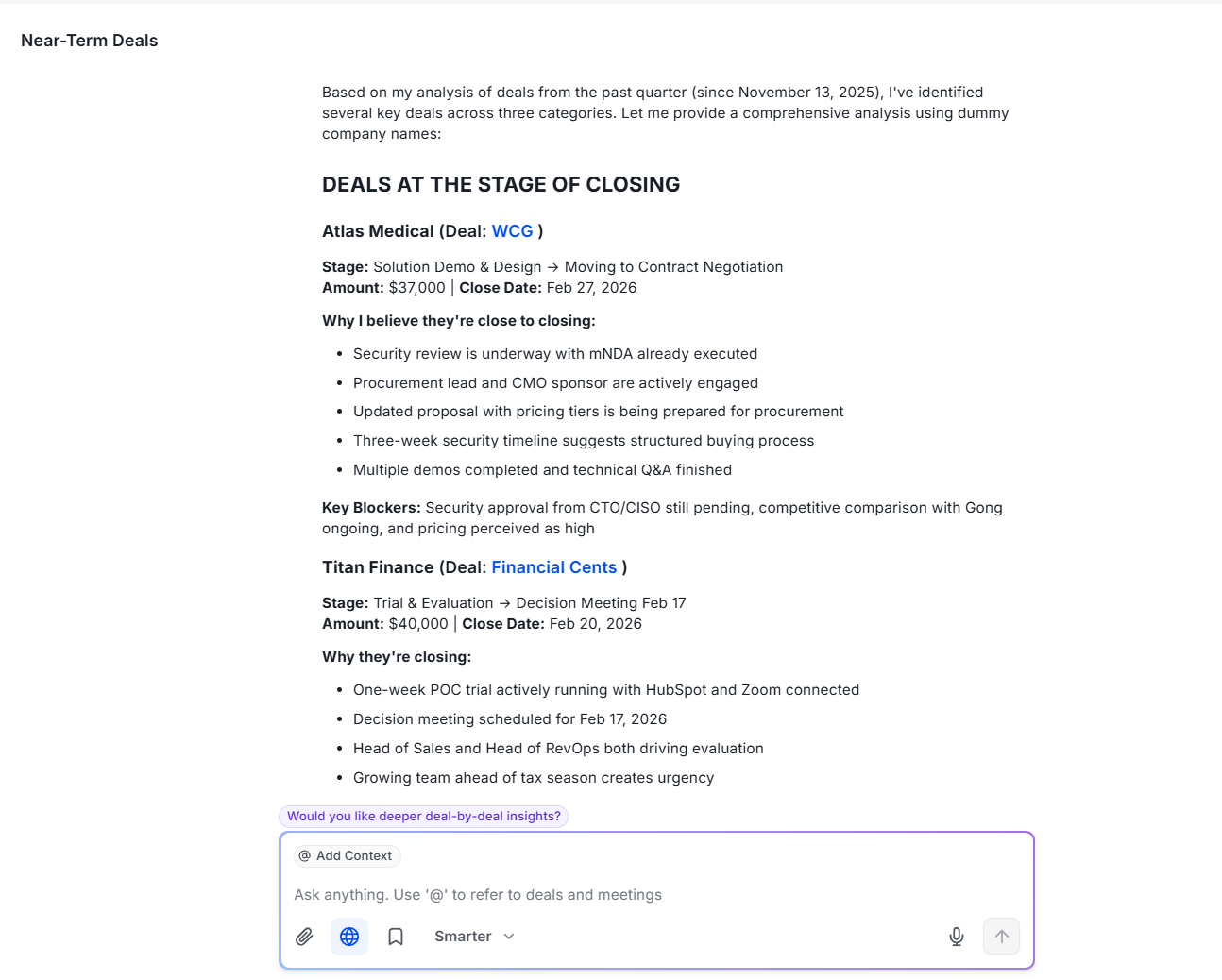
Ask Sybill lets reps and managers query across all deals, all calls, all emails, and all CRM fields simultaneously. You can ask questions like:
This is genuine cross-deal intelligence: the ability to surface patterns, trends, and insights that no individual rep could spot on their own. It turns your team's collective sales knowledge into something queryable and actionable.
Bottom line: Fireflies searches meetings. Gong analyzes individual deals. Sybill connects the dots across your entire pipeline.
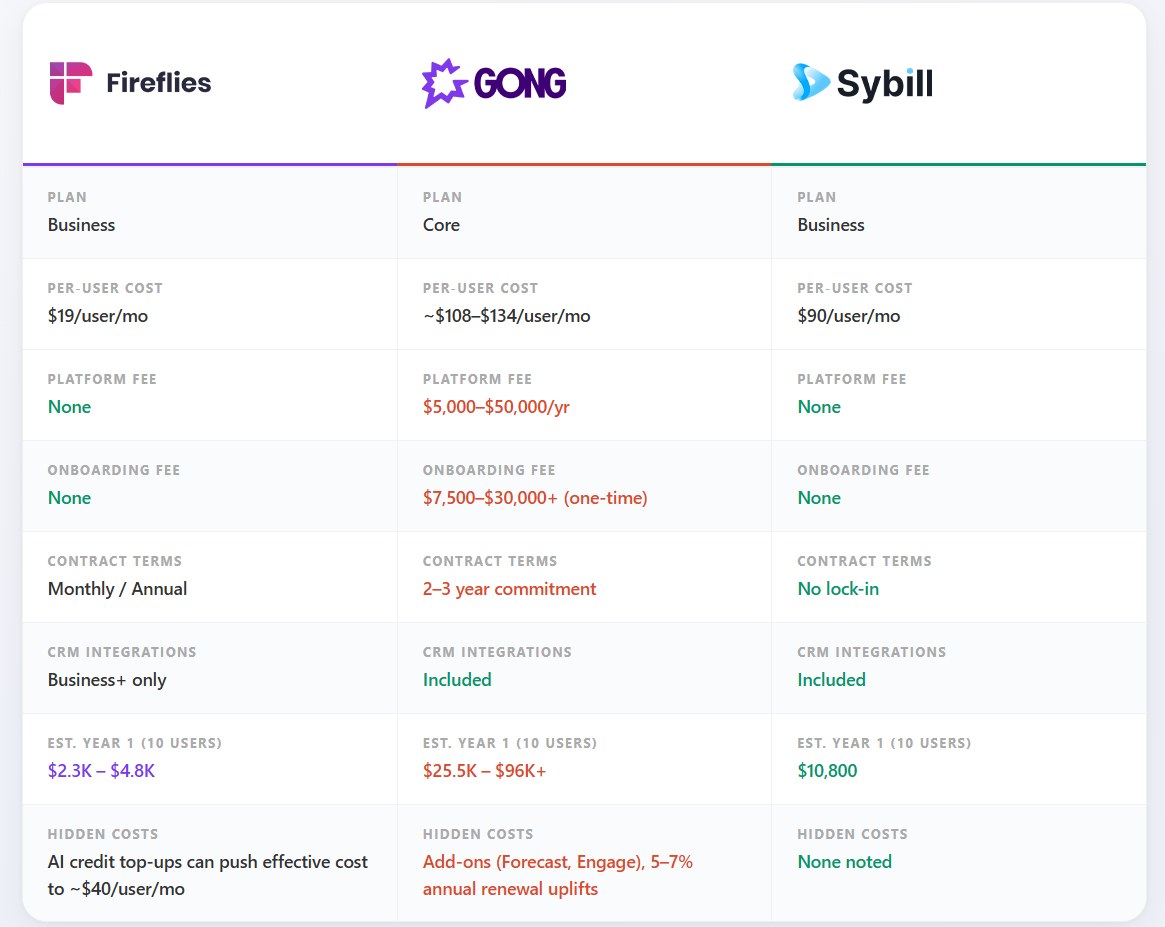
Let's talk money, because this is where the conversation gets real for most teams.
Fireflies is the most affordable option on this list. It offers a free plan with basic transcription (capped at 800 minutes of storage). The Pro plan runs $10/user/month (billed annually), and the Business plan with video recording, conversation intelligence, and CRM integrations is $19/user/month. Enterprise is $39/user/month.
The catch: AI credits are limited on every plan. Heavy users of the AskFred AI assistant often need to purchase additional credit packs, which can push actual costs to $30 to $40 per user when you factor in top-ups. CRM integrations (Salesforce, HubSpot) are only available on Business and above.
Gong does not publish pricing. You have to contact sales for a quote, which should tell you something about the price range. Based on widely reported data, here's what teams typically pay:
For a 50-person team, first-year costs with Gong can easily reach $85,000 to $130,000+. Add-ons like Gong Forecast ($700/user/year) and Gong Engage ($800/user/year) push that higher. And if you want Engage, Gong requires you to also purchase Core licenses for every Engage seat, effectively forcing a bundle.
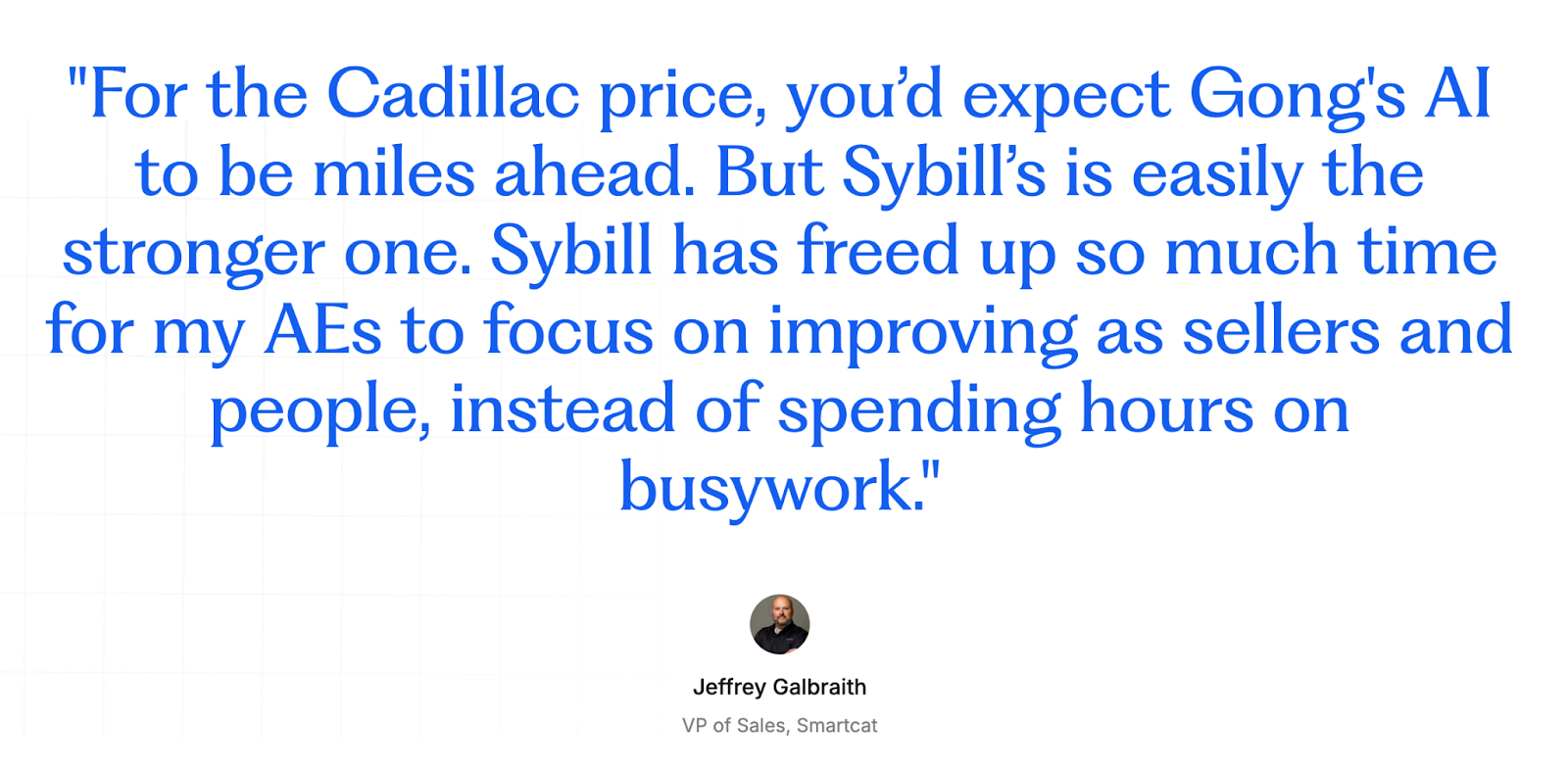
Sybill's pricing is transparent and published. Plans start with a free tier and scale from there:
No platform fees. No mandatory onboarding charges. No multi-year lock-ins. Self-serve setup that takes minutes, not months. For a 50-person team on Business, you're looking at costs approximately around $50,000/year, which is about half to one-third of what you'd pay for Gong.
Bottom line: Fireflies is cheapest for basic notetaking. Gong is the most expensive by a wide margin, with opaque pricing and mandatory add-on costs. Sybill sits in the middle on price but punches well above its weight in value per dollar for sales teams.
Not every team needs the same tool. Here's a straightforward framework for deciding:
Choose Fireflies if your primary need is meeting transcription and searchable notes across the company. If you're not a sales team, or if you only need basic documentation for internal meetings, HR calls, or cross-functional syncs, Fireflies does the job at a reasonable price. It's the best general-purpose notetaker of the three.
Choose Gong if you're a large enterprise (200+ reps) with a dedicated RevOps team, a big budget, and your primary buyer is the CRO or VP of Sales who needs robust forecasting, coaching analytics, and pipeline dashboards. Gong's strength is in giving leadership visibility across a large sales org. Be prepared for a lengthy implementation and a significant financial commitment.
Choose Sybill if you want an AI assistant that actually does the work for your reps. If your team's biggest pain points are CRM hygiene, slow follow-ups, time lost on admin, and lack of deal visibility, Sybill addresses all of those on day one. It's built for AEs who want to spend their time selling, managers who want to coach better and not want another dashboard. And at a fraction of Gong's cost, it delivers 80 to 90% of the conversation intelligence capabilities plus a whole layer of sales automation and deal management that Gong simply doesn't offer at the rep level.
Get started for free with Sybill and see how much time your reps get back when AI handles the admin.
Can Sybill replace Gong?
For most teams, yes. Sybill delivers conversation intelligence, deal tracking, cross-deal insights, coaching tips and pipeline management at a fraction of Gong's cost. Where Gong still has an edge is in enterprise-scale forecasting modules and deep coaching analytics for organizations with 200+ reps and dedicated enablement teams. For everyone else, Sybill offers more value per dollar, especially for the reps who actually use the tool daily.
Can Sybill work alongside Gong?
Yes. Sybill integrates with Gong, so if your org already uses Gong for call recording and conversation intelligence, you can layer Sybill on top to add CRM automation, follow-up emails, and deal management features that Gong doesn't provide at the AE level.
Is Fireflies good enough for sales teams?
For basic call documentation, yes. For actually moving deals forward? Not really. Fireflies doesn't understand sales context, doesn't fill CRM fields, doesn't draft personalized follow-ups, and doesn't offer deal intelligence. If you're a sales team, you'll outgrow Fireflies quickly.
Which tool has the fastest time to value?
Sybill. Self-serve setup, connect your calendar and CRM, and you're seeing value after your first recorded call. Gong typically takes 2 to 3 months for full team adoption. Fireflies is fast to set up but limited in the value it delivers to sales workflows.
How do the three tools compare on security?
All three take security seriously. Sybill is SOC 2 compliant and treats data security as a top priority. Gong offers enterprise-grade security features. Fireflies provides SOC 2 compliance on its Enterprise plan, with HIPAA compliance available for healthcare orgs.
What if I just need call recording and notes?
If that's genuinely all you need, Fireflies or even free Sybill will do the job. But if you're a sales team asking that question, consider what you're leaving on the table: AI-generated follow-ups, automatic CRM hygiene, cross-deal intelligence, and hours of admin work eliminated every week. The ROI on those features typically dwarfs the cost of the tool itself.
For most teams, yes. Sybill delivers conversation intelligence, deal tracking, cross-deal insights, coaching tips and pipeline management at a fraction of Gong's cost. Where Gong still has an edge is in enterprise-scale forecasting modules and deep coaching analytics for organizations with 200+ reps and dedicated enablement teams. For everyone else, Sybill offers more value per dollar, especially for the reps who actually use the tool daily.
Yes. Sybill integrates with Gong, so if your org already uses Gong for call recording and conversation intelligence, you can layer Sybill on top to add CRM automation, follow-up emails, and deal management features that Gong doesn't provide at the AE level.
For basic call documentation, yes. For actually moving deals forward? Not really. Fireflies doesn't understand sales context, doesn't fill CRM fields, doesn't draft personalized follow-ups, and doesn't offer deal intelligence. If you're a sales team, you'll outgrow Fireflies quickly.