Find us at booth #83, join us for a harbor side happy hour, or catch Gorish’s talk.

Sept, 16-18 > Learn more

%20(1).avif)
Mamta Tainwala

May 15, 2026
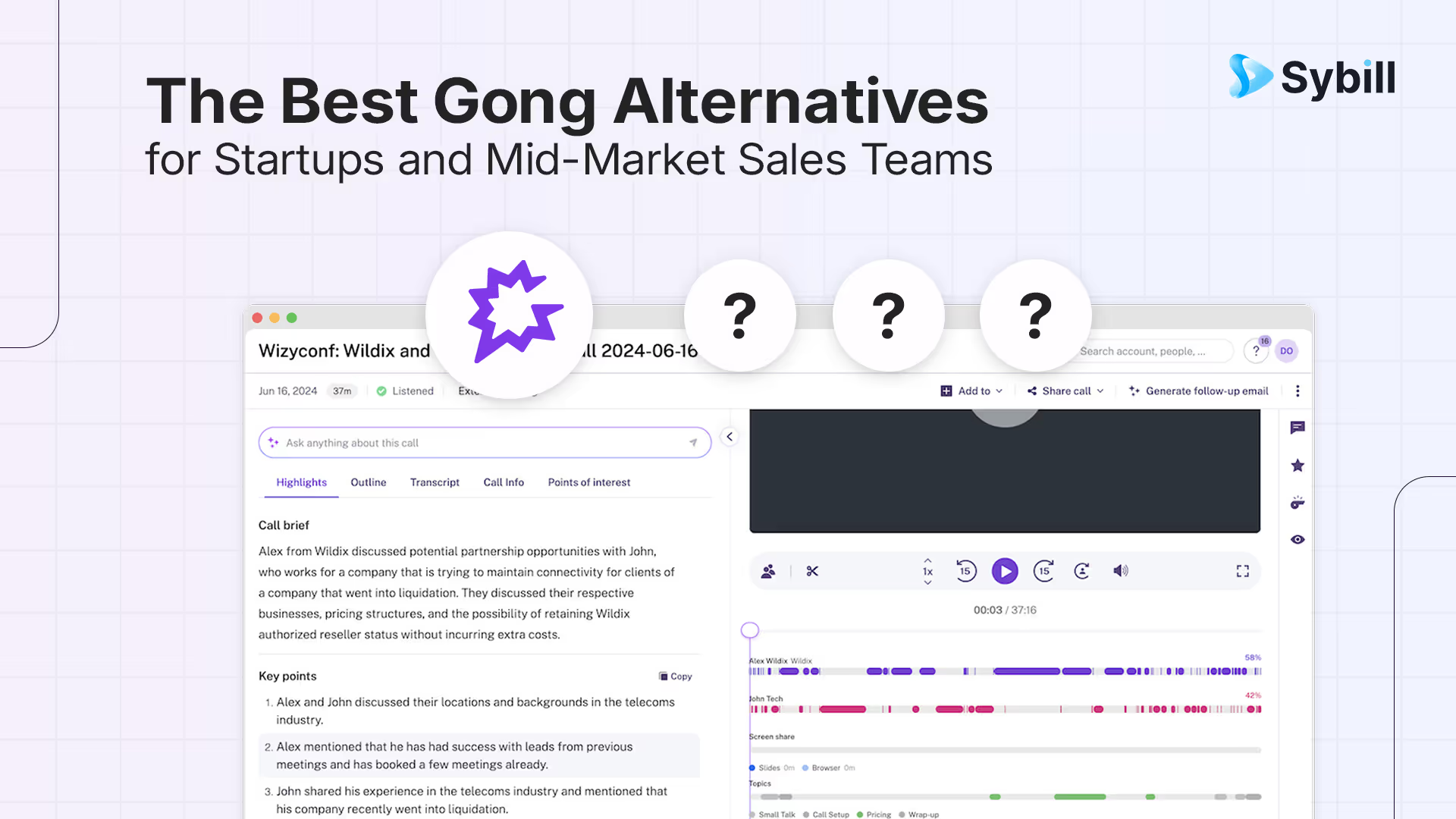
Remember that episode of Breaking Bad where Walter White casually drops a duffel bag filled with $737,000 in cash on Skyler's bed and she just... stares at it in horror? That's basically what happens when a Series A startup's CFO sees the Gong pricing proposal for the first time. Except instead of drug money, it's your actual operating budget, and instead of Skyler's shocked expression, it's your finance team asking if you accidentally added an extra zero.
Here's the uncomfortable conversation nobody in sales tech wants to have: Let’s assume Gong is phenomenal. Like, legitimately excellent. As if their conversation intelligence is top-tier. The analytics are comprehensive. The coaching features are sophisticated. It's the Cadillac of revenue intelligence platforms.
The best Gong alternatives for startups and mid-market sales teams in 2026 are Sybill (best overall alternative with AI summaries, CRM autofill, follow-up drafting, and deal intelligence at a fraction of Gong's price), Chorus by ZoomInfo (best for teams already using ZoomInfo for contact data), Clari Copilot (best for revenue forecasting integration), Fireflies (best budget-friendly conversation capture), Fathom (best free notetaker for small teams), and Avoma (best for meeting lifecycle management). The primary reason teams switch from Gong is pricing — Gong's enterprise contracts often exceed $1,200/user/year — but the deeper reason is that mid-market teams need execution features like automated follow-ups and CRM autofill more than they need the analytics and coaching dashboards that justify Gong's premium at enterprise scale.
But here's the thing about Cadillacs: most people don't need one. Especially when the sticker price includes a $5,000 to $50,000 annual platform fee, $1,200 to $1,600 per user annually, mandatory multi-year contracts paid upfront, and professional services fees that can hit $30,000 for enterprise implementations. For a 50-person sales team, you're looking at $85,000 to $130,000+ in year one. For a 100-person team? Try $170,000 to $200,000+. Before add-ons.
If you're a Fortune 500 company with deep pockets and a massive sales organization, where decision making has nothing to do with actual improvement in performance, Gong makes sense. But if you're a Series A startup burning through runway, or a mid-market company that needs conversation intelligence without a six-figure commitment? You need alternatives that could deliver even 80-90% of the value at 20-40% of the cost.
Let's talk about what actually works when Gong's pricing doesn't.
Before we dive into alternatives, let's be clear about why Gong specifically doesn't work for many growing companies. It's not just about the headline price. It's about the structure.
The Platform Fee: Even before you add a single user, you're paying $5,000+ annually just for access. For a 10-person startup, that's $500 per person before you even get to the per-user cost. That platform fee doesn't scale down for small teams, which means smaller companies subsidize enterprise customers.
Multi-Year Lock-In: Gong typically requires 2-3 year commitments, often paid annually upfront. If you're a startup trying to conserve cash flow, writing a check for $100,000+ upfront for a three-year contract is existentially risky. What if your sales motion changes? What if you need to downsize the team? You're stuck.
Forced Bundling: Want Gong Engage for prospecting? You'll need to license Gong Core for every user too, effectively doubling your per-user cost. The modular pricing that existed a few years ago has been replaced with aggressive bundling that pushes you toward $250/user/month packages whether you need all those features or not.
Onboarding Costs: Professional services packages start around $7,500 and can exceed $30,000 for enterprise implementations. You're not just paying for software, you're paying for consultants to help you use it.
Automatic Price Increases: Most Gong contracts include automatic renewal uplifts of 5-15% annually. That $170,000 first-year deal becomes $195,500 in year two, $224,825 in year three. The pricing escalates faster than your revenue (hopefully).
No Monthly Billing: Unlike most modern SaaS tools, Gong doesn't offer month-to-month options. You can't test it for a quarter, see if it works, and then commit. You're signing annual contracts minimum.
For early-stage companies or mid-market teams operating on tighter budgets, this pricing structure feels less like "premium enterprise software" and more like "financial hostage situation." You need conversation intelligence, CRM automation, and deal insights. You just don't need to mortgage your Series A to get them.
Here's the reality: most sales teams don't need every feature in Gong's enterprise platform. They need core functionality that works reliably without requiring a dedicated admin and a procurement committee.
Must-haves for startups and mid-market teams:
Nice-to-haves (but not deal-breakers):
The truth is, for most startups and mid-market teams, you need a tool that handles the fundamentals exceptionally well, integrates smoothly with your existing stack, and gets out of your way so reps can sell. You don't need a platform that requires three months of onboarding and a dedicated RevOps person to maintain.
Let's get specific. Here are the tools that deliver strong conversation intelligence, CRM automation, and deal insights without requiring venture-scale budgets.
Full disclosure: Sybill is designed specifically for account executives and mid-market teams that want enterprise-grade intelligence without enterprise-grade costs.
Pricing:
What makes Sybill different: While Gong is built for sales leadership and analytics, Sybill is built for the reps doing the selling. It's designed to automate the busywork (CRM updates, follow-up emails, meeting prep) so AEs can focus on conversations, not admin.
The standout feature is Ask Sybill, which functions like ChatGPT for your entire deal pipeline. Instead of digging through transcripts and CRM fields, you can ask questions like "Which prospects mentioned budget concerns in the last two weeks?" or "Show me all calls where competitors were mentioned" and get instant, sourced answers. This cross-deal intelligence is something most conversation tools (including Gong) don't offer at this price point.
CRM automation: Sybill's autofill is legitimately excellent. After every call, it updates MEDDICC fields, BANT criteria, next steps, pain points, and custom fields automatically. The entries read like a human wrote them, not a bot. And unlike some tools that update a few generic fields, Sybill handles custom fields and complex qualification frameworks.
Multi-speaker accuracy: Sybill's transcription is trained specifically on sales conversations, which means it handles multi-speaker calls, industry jargon, and overlapping speech better than generic transcription models.
Setup time: Most teams are live in under 30 minutes. Connect your calendar, meeting platform, and CRM, and you're done. No professional services required.
Best for: Startups and mid-market teams (10-200 reps) that want conversation intelligence, automatic CRM hygiene, and deal insights without the Gong price tag or complexity. Particularly strong for teams where reps hate CRM updates and managers want better pipeline visibility.
Cost comparison: A 50-person team on Sybill Business pays $47,400/year. The same team on Gong pays $85,000-$130,000+ in year one. You're saving $40,000-$80,000 annually while getting 80-90% of the functionality.
Avoma positions itself as a "meeting lifecycle assistant" that handles scheduling, note-taking, and post-meeting workflows.
Pricing:
Strengths:
Limitations:
Best for: Teams that want an all-in-one meeting platform (scheduling + notes + intelligence) without paying for multiple tools. Works well for mid-market companies (50-150 people) that value simplicity and transparency.
Cost comparison: A 50-person team on Avoma Business pays $23,400/year. Still way less than Gong, though you'll likely need the revenue intelligence add-on to match functionality.
Fathom focuses on speed and ease of use. It's lightweight, gets out of your way, and just works.
Pricing:
Strengths:
Limitations:
Best for: Solo sellers, tiny startups (under 10 people), or teams that value simplicity above all else. If your use case is "I need my calls recorded and transcribed quickly without fuss," Fathom nails that.
Chorus (now part of ZoomInfo) is Gong's direct competitor at the enterprise level. It's not cheap, but it's often more negotiable than Gong.
Pricing:
Strengths:
Limitations:
Best for: Mid-market to enterprise teams (100+ reps) that are already invested in the ZoomInfo ecosystem and want tight data integration. If you're using ZoomInfo for prospecting data, Chorus makes sense as your conversation intelligence layer.
Cost comparison: A 50-person team might pay $50,000-$70,000/year. Still substantial, but 30-40% less than Gong's typical pricing.
Let's break down what functionality you actually get across different budget tiers:
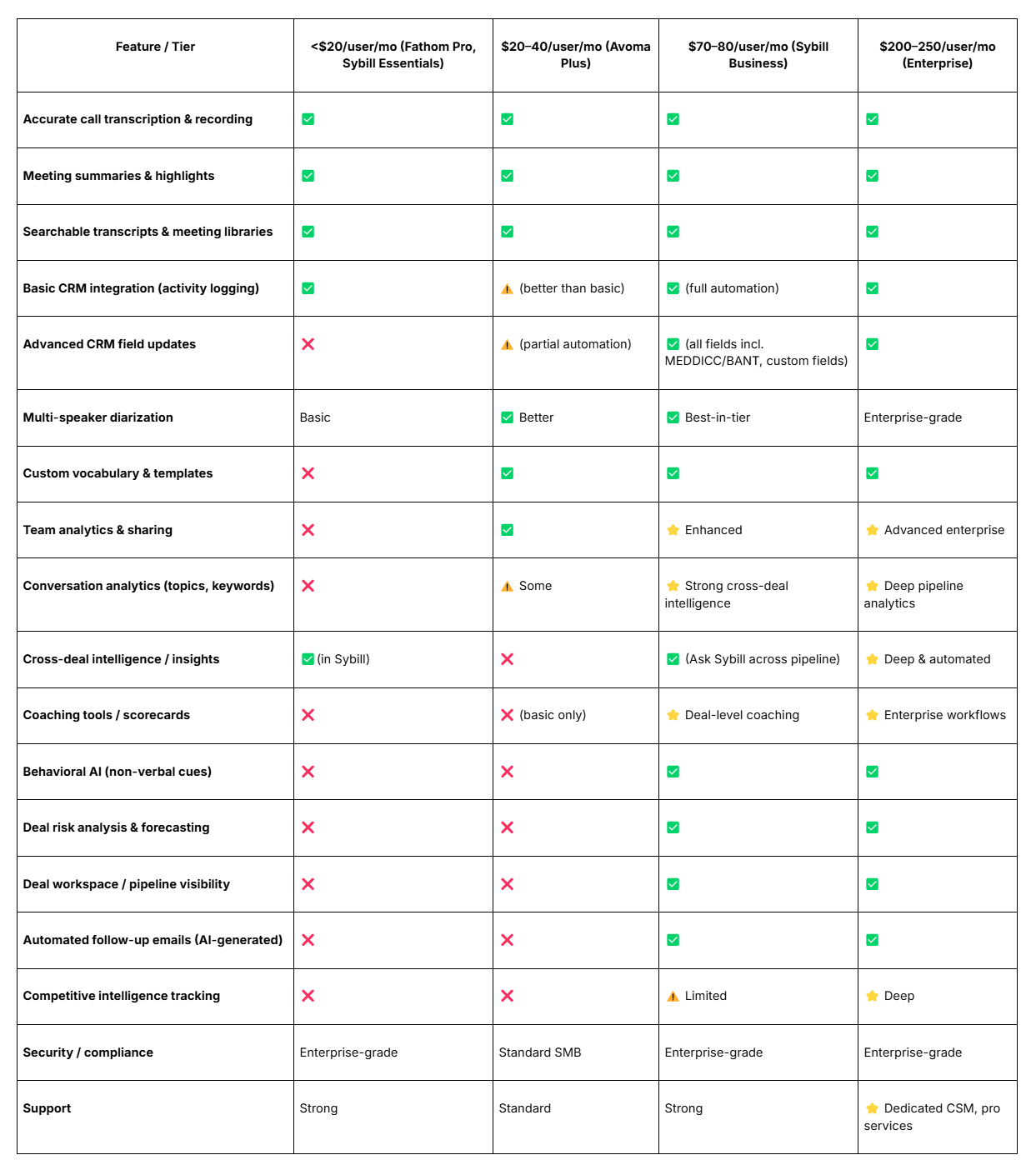
The pattern: The jump from $20/month to $80/month tools gets you comprehensive CRM automation and deal intelligence. The jump from $80/month to $250/month gets you improvements in analytics depth and enterprise features.
Here's my framework for making this decision:
If you're a solo seller or micro-team (1-5 people): Start with Sybill Essentials. Get comfortable with call recording and transcription with the free trial, understand the full use of the product. If you like it, and need more, upgrade to their paid tiers ($19/month). Don't overthink it.
If you're an early-stage startup (5-20 people) with tight cash: Sybill Essentials ($19/user/month) especially if you want to start automating CRM updates and reducing admin work for your reps.
If you're a growing startup (20-50 people) and CRM hygiene is a nightmare: Sybill Business ($79/user/month). The automatic CRM updates alone will save each rep 4-6 hours per week, and the Ask Sybill feature gives you deal intelligence that rivals tools 3x the price.
If you're mid-market (50-150 people) and want simplicity: Sybill Business if you prioritize CRM automation and deal insights over scheduling features.
If you're mid-market to enterprise (150+ people) with complex needs: Consider Sybill Enterprise (custom pricing, still a fraction of Gong) or Chorus only if you're deep in the ZoomInfo ecosystem.
When evaluating alternatives, look beyond the headline pricing. Here are the hidden costs that kill budgets:
Implementation Time: Tools that require weeks of onboarding (Gong, sometimes Chorus) have a hidden cost in lost productivity. Sales teams can't use the tool fully for months. Simpler tools (Sybill, Fathom) are typically productive within days.
Admin Burden: If a tool requires a dedicated admin to maintain integrations, update field mappings, and troubleshoot issues, that's effectively adding a $50,000-$100,000/year headcount to your total cost. Modern tools should be self-serve.
Change Management: Complex platforms require training, documentation, and ongoing enablement. Simpler tools require less hand-holding, faster adoption, higher actual usage rates.
Lock-In Risk: Multi-year contracts paid upfront create massive switching costs. If the tool doesn't work, or if your sales motion changes, you're stuck. Monthly or annual billing with flexible terms reduces this risk significantly.
Add-On Creep: Platforms that push bundled pricing or charge separately for features you thought were included (looking at you, Gong Engage) can balloon costs 30-50% beyond initial quotes.
Choose tools with:
If you're trying to get buy-in for a Gong alternative, here's how to pitch it:
Frame it around time savings: "Our 30 AEs spend 6 hours per week on CRM updates, follow-up emails, and call notes. That's 180 hours per week, or 9,360 hours per year. At a $150K fully-loaded cost per AE, we're burning $211,500 annually on admin work. Sybill Business at $79/user/month for 30 users costs $28,440/year and recovers 70% of that time. Net savings: $147,000+ in recovered selling time."
Compare alternatives explicitly: "Gong quoted us $135,000 for year one with a three-year commitment ($405,000 total). Sybill delivers 85% of the functionality for $28,440/year with annual billing. That's $106,560 saved in year one, $318,000 saved over three years. Even if we need to add seats or upgrade, we're saving $200,000+."
Highlight cash flow: "Gong requires $405,000 upfront for a three-year contract. Sybill is $28,440 annually. The cash flow difference is $376,560 in year one. That capital can fund two additional AE hires, which drives more revenue than marginal analytics features."
Emphasize flexibility: "Annual contracts let us adapt if our sales motion changes. If we need to scale up, scale down, or pivot, we're not locked into a three-year commitment. That optionality is worth a lot in an uncertain market."
CFOs love: clear ROI calculations, cash flow preservation, flexibility, and avoiding vendor lock-in. Frame your pitch accordingly.
Let's be honest: there are scenarios where Gong's premium pricing could be tried to justify.
You should consider Gong if:
You should skip Gong if:
If you're already on Gong and looking to switch, here's how to make it smooth:
Timing: Start the evaluation process 6-9 months before your Gong contract renews. Most contracts have 60-90 day termination notice requirements.
Data Export: Gong allows data export, but it's not always comprehensive. Work with your new vendor to understand what historical data can be migrated (transcripts, recordings, metadata). Sybill offers a seamless integration where all your data can be transported and your CRM can be backfilled at nominal costs.
Pilot Phase: Run the new tool in parallel with Gong for 30-60 days. Have reps use both and compare outputs. This validates that the alternative meets your needs before you cut over completely.
Change Management: Communicate the switch clearly. Emphasize what's better (easier to use, faster, more automated) and what's different (maybe fewer dashboards, but more actionable insights).
Cost Savings Message: Frame the switch as "we're investing in tools that help reps sell, not tools that create dashboards for managers." This messaging usually resonates with AEs.
Negotiate Your Exit: Gong may offer discounts to retain you. Use your alternative quotes as leverage. Sometimes you can get 30-40% off Gong pricing if they think you're leaving.
Once you've chosen your Gong alternative, here's how to get value quickly:
Week 1: Connect the Basics
Week 2: Configure and Customize
Week 3: Enable and Onboard
Week 4: Optimize and Scale
The key difference from Gong: you should see value in week 1, not month 3. Modern alternatives are designed for fast time-to-value.
For most sales calls, yes. In fact Sybill takes pride in having the most excellent transcription accuracy (>95% in real-world multi-speaker multi-lingual scenarios). Gong's edge is in highly complex calls with 6+ speakers and heavy background noise, but even then the difference is marginal. The bigger differentiator is how tools handle speaker diarization (who said what) and sales-specific jargon.
Depends on the alternative. Sybill's CRM automation is on par with or exceeds Gong's for field updates, qualification frameworks (MEDDICC, BANT), and custom field handling. If CRM automation is your priority, choose Sybill without a doubt.
Yes. Many teams run both tools in parallel, sometimes just for 30-60 days to validate the alternative works before fully switching. This reduces risk. Just be mindful that you're paying for both during the overlap, so keep the parallel phase short. We also know of teams that use Sybill on top of Gong for it’s phenomenal AI capabilities at affordable costs.