Find us at booth #83, join us for a harbor side happy hour, or catch Gorish’s talk.

Sept, 16-18 > Learn more

%20(1).avif)
Mamta Tainwala

February 24, 2026
Value selling is not a script. It's a discipline. Here's what separates reps who execute it from reps who just know what it means:
There's a scene in Mad Men where Don Draper pitches the Kodak Carousel not as a slide projector, but as a time machine. "It takes us to a place where we ache to go again." The client is in tears. The deal is done.
That is value selling. Not "our projector has superior optics and a 140-slide capacity." The outcome the buyer desperately wants, articulated so clearly that price becomes almost irrelevant.
Most B2B sales conversations are still playing the specs game. They lead with features, stack up integrations, and then brace for the price negotiation. Value selling flips the script. The conversation starts with the buyer's world, their problems, their goals, their definition of success, and works backward to your solution. When you get it right, the buyer is essentially closing themselves.
This guide breaks down value selling into a practical framework any rep can use, with specific techniques for discovery, positioning, and AI-powered execution.
Value selling is a customer-focused sales methodology built around one core principle: buyers don't purchase products, they purchase outcomes. Your job as a seller is not to explain what your product does. It is to make the buyer viscerally understand what life looks like after their problem is solved, and how your solution gets them there.
It is closely related to solution selling and consultative selling, but value selling goes a step further: it quantifies the outcome wherever possible and anchors every conversation in the buyer's specific business context, not a generic benefit statement.
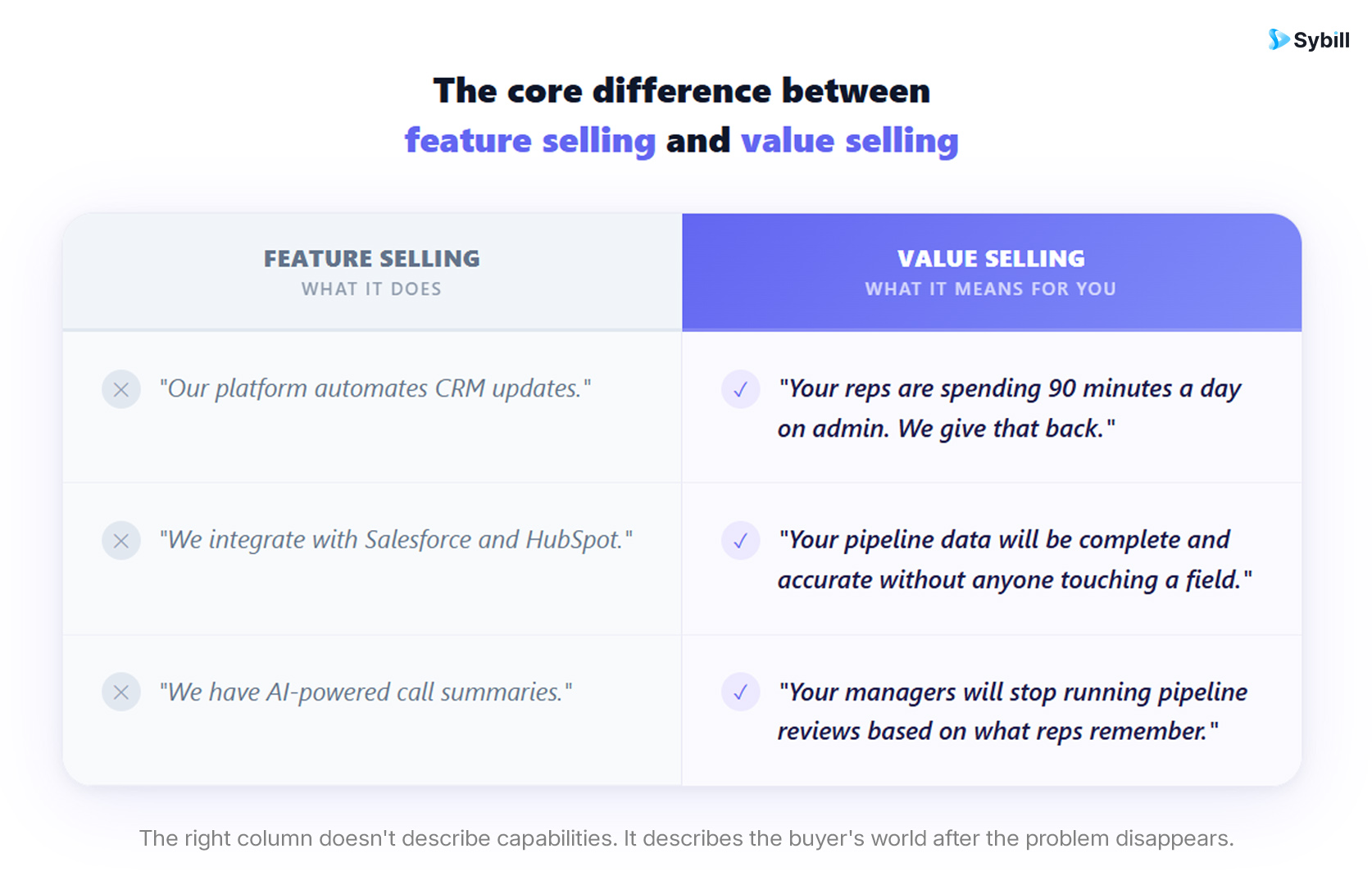
Value selling consistently outperforms feature-led selling in complex B2B environments. It produces larger deal sizes because buyers who understand the ROI of a solution are less focused on minimizing price. It reduces late-stage deal risk because value is established early, not discovered during procurement review. It shortens negotiation cycles because there's less to argue about when the outcome is clear.
So why don't more reps do it? Three reasons.
First, it requires deep discovery. You cannot lead with value if you don't know the buyer's actual pain, not the surface version they volunteered, but the downstream business impact of that pain. Most reps rush discovery or mistake rapport-building for it.
Second, it takes discipline to stay curious on a call when you already think you know what the buyer needs. The instinct to start pitching kicks in early and often.
Third, it is hard to execute consistently across a team when there's no feedback loop. A rep might do outstanding value-based discovery on Monday and revert to feature mode by Thursday. Without visibility into call behavior, managers can't coach the pattern.
This is exactly where AI-powered tools like Sybill close the gap, which we'll get to in a moment.
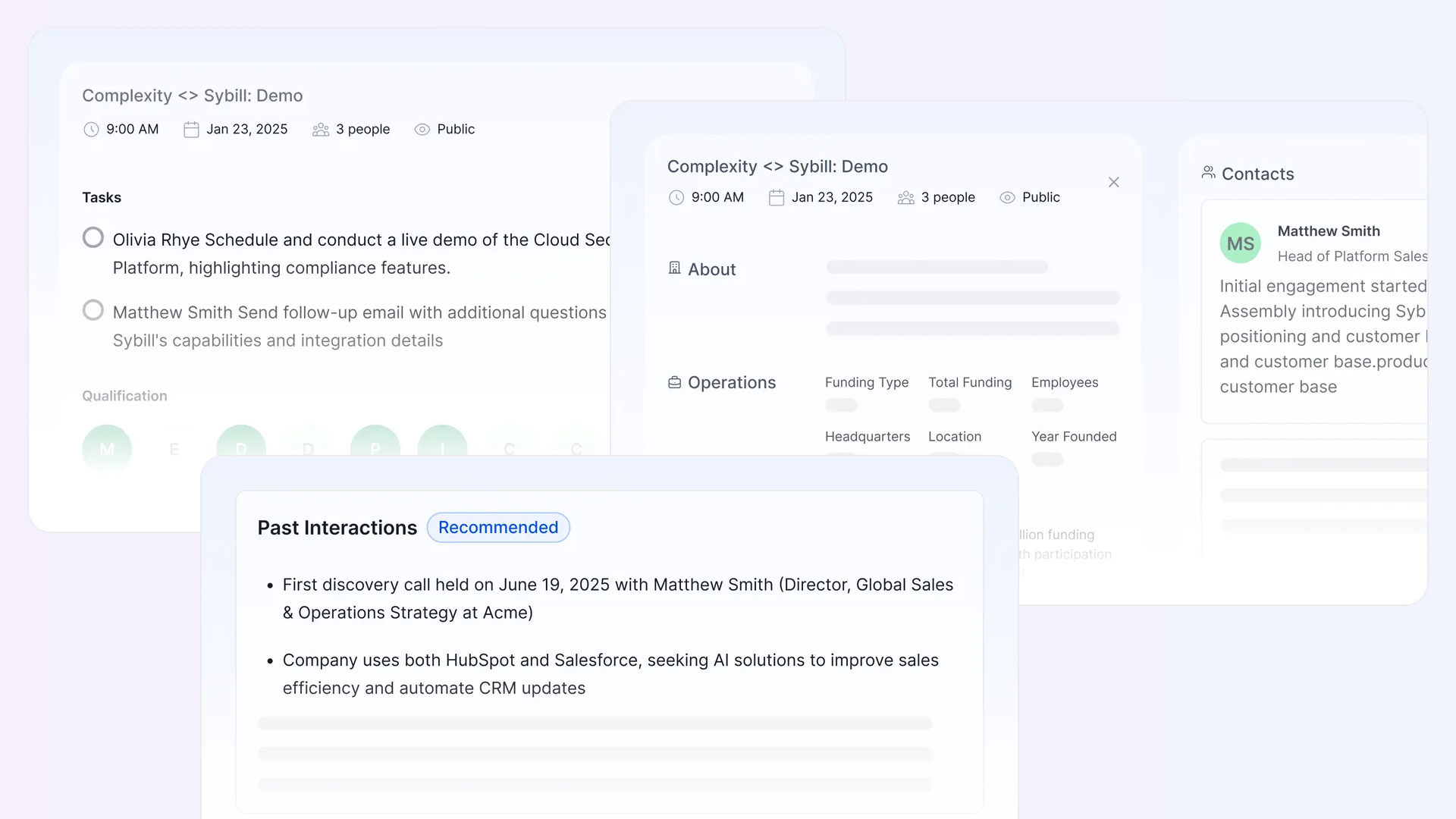
Value selling starts before the call. Reps who walk in knowing only the prospect's job title and company name are not prepared to have a value conversation. Effective pre-call prep means understanding the prospect's business model, the metrics they likely care about, the competitive pressures in their market, and any recent signals (funding rounds, hiring trends, news) that might create urgency.
Sybill's pre-meeting briefs automate this preparation. Before every call, the rep gets a concise brief pulling from full deal history, previous interactions, CRM data, and context on the prospect, so they walk in ready to ask sharp questions instead of generic ones.
The first ten minutes of a value selling call should feel like a well-prepared doctor's consultation, not a product demo. Your job is to understand the patient before you prescribe anything.
This means asking questions that surface not just symptoms but root causes and downstream impact. The SPIN selling framework is a strong companion methodology here. Situation and Problem questions open the conversation. Implication questions are where value selling lives: they help the buyer quantify what the problem is actually costing them in time, money, pipeline, or morale. Need-Payoff questions then let the buyer articulate value in their own language, which is far more persuasive than anything you can say yourself.
The simple version: ask what, ask why it matters, ask what it costs them not to fix it, then let them describe their ideal outcome. By the time you respond, you're not pitching. You're confirming.
Once you understand the buyer's world, every capability you present should be translated into their specific context. Not "we do X," but "given what you told me about Y, here's how that changes."
This is where reps often slip back into feature mode. The discipline is to always ask yourself: "So what does this mean for them, specifically?" before saying it out loud.
For a concrete example: if a sales manager tells you their reps are losing two hours a day to admin and it's hurting pipeline coverage, the value statement isn't "Sybill auto-fills your CRM." It's "your reps get two hours back every day, which for your team of eight translates to 16 hours of selling time a week, from day one."
Numbers make value real. If you can connect your outcome to a metric the buyer already cares about, whether it's quota attainment, win rate, or time-to-close, the conversation changes register entirely.
In value selling, price objections are almost always a signal that value was not established early enough. By the time a buyer says "this feels expensive," they're telling you they don't yet see the return clearly enough to justify the investment.
The proactive move is to build ROI into the conversation before it becomes a negotiation. This doesn't mean producing a formal ROI calculator on slide 14. It means weaving the math into the discovery conversation naturally:
"You mentioned reps are spending 90 minutes a day on admin. If we cut that to 20 minutes, you're essentially adding a new rep's worth of selling time without hiring. What would that number mean for your pipeline?"
When the buyer has done this math themselves, price becomes a much smaller obstacle.
Value selling doesn't stop when the call ends. The follow-up email is one of the most underused tools for reinforcing the value conversation. A strong post-call follow-up restates the buyer's stated problem in their own words, ties your solution to their specific outcome, and makes the business case explicit.
Most reps send some version of "Great to connect today, here's a recap." That's not a value follow-up. A value follow-up sounds like this: "You mentioned your team is losing two days a week to manual data entry. Here's specifically how we address that, and what three of your peers saw in the first 30 days."
Sybill's AI follow-up email drafts this automatically from call context, referencing the specific pain points, language, and next steps discussed on the call. It's a follow-up that sounds like the rep was paying close attention, because the AI was.
Value selling is a methodology that requires consistent execution to pay off. Most teams understand the theory. The breakdown happens in practice.
The three most common failure points:
Discovery gets rushed. Reps feel pressure to get to the product demo. They ask a few surface questions, hear a plausible pain point, and pivot to slides. Without deep discovery, you don't have the context to build a value case. You have a guess.
Value language isn't reinforced after the call. The rep had a strong discovery conversation, but the follow-up email was generic. The value connection was made once and never documented. By the next call, it's faded.
Coaching doesn't reach the call level. Managers review pipeline, not conversations. They see that a deal stalled but not that the rep never established business impact during discovery. Without visibility into what actually happened on the call, coaching stays surface-level.
This is where AI sales coaching tools like Sybill make a material difference. Sybill captures the full call, flags where value language appeared or was absent, surfaces buyer engagement signals, and gives managers structured coaching briefs per rep. The pattern becomes visible. The coaching becomes specific.
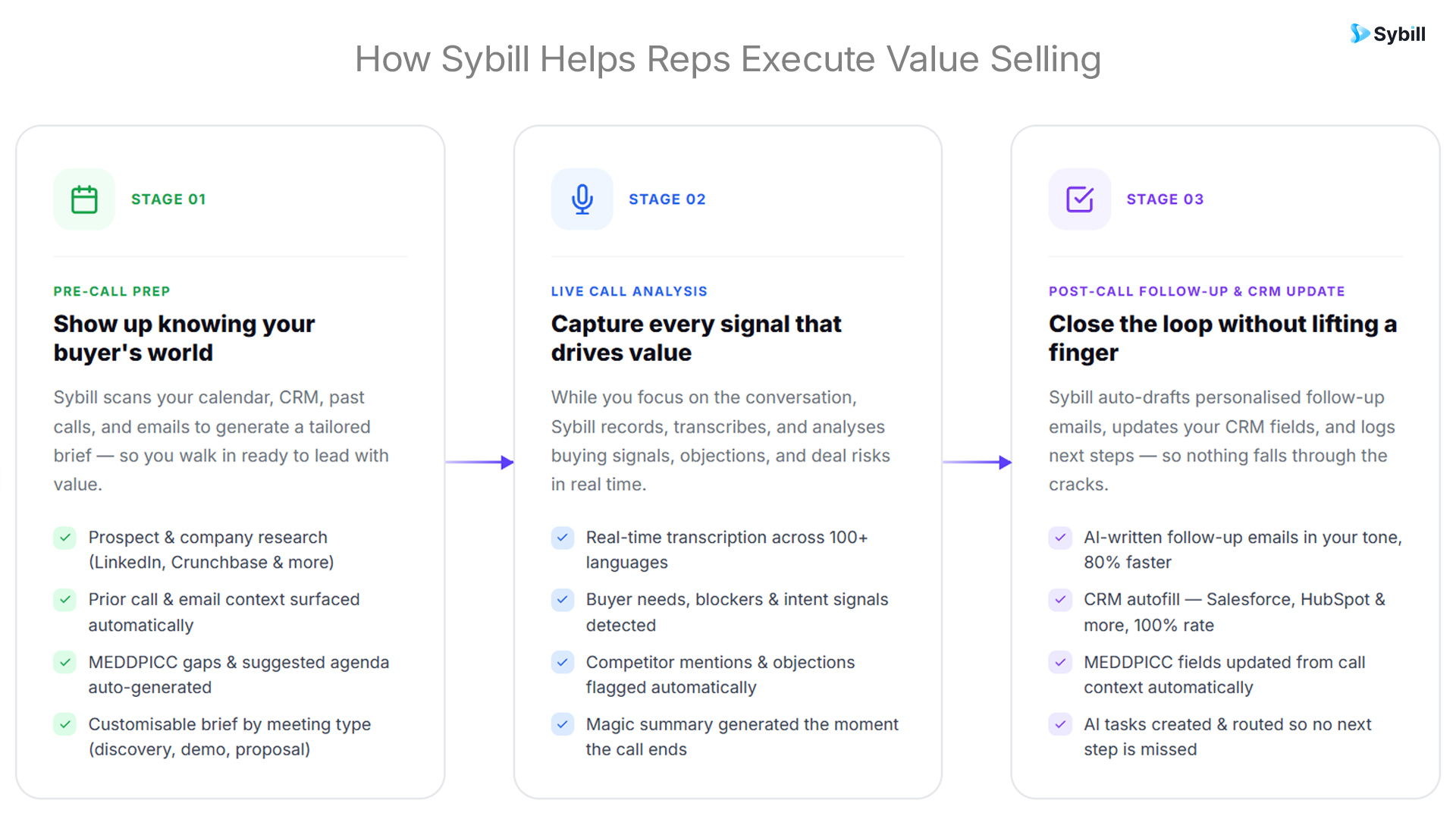
Value selling is a skill. Sybill is the infrastructure that makes it executable at scale.
Before the call: Pre-meeting briefs give reps the context to ask sharp discovery questions instead of generic ones. Deal history, prior conversation highlights, and buyer context are delivered automatically before each meeting.
During the call: Sybill's non-verbal AI analysis tracks prospect engagement in real time on video calls. Reps and managers can see which moments generated interest, which caused a buyer to disengage, and which stakeholders are nodding versus tuning out. This is the kind of signal that helps refine value messaging, not just on one call, but across the entire team's approach.
After the call: Magic Summaries capture pain points, buyer language, and next steps in a structured format and push them into the CRM automatically. AI follow-up emails are drafted from that context within minutes. The value conversation that happened on the call doesn't evaporate into a vague internal note. It's documented, actionable, and accessible.
Across the pipeline: Ask Sybill lets managers query across all deals to surface how often value language appears in calls, where price objections are emerging, and which discovery questions are correlating with strong outcomes. That's how you build a coaching culture around value selling, not through observation of one call, but through patterns across hundreds.
Ready to close on value, not price? Get started for free with Sybill and see how the whole methodology becomes executable.
The gap between reps who understand value selling and reps who execute it consistently every day is largely an information gap. The rep who shows up prepared asks better questions. The rep who captures buyer language in a follow-up reinforces the value case. The manager who can see discovery quality across a team can coach the pattern.
AI closes all three gaps. Preparation is automated. Follow-ups are drafted from real context. Coaching is grounded in call data. For a deeper look at how AI fits into the broader sales motion, the AI in sales breakdown on the Sybill blog is worth reading alongside this one.
What is value selling in B2B sales?
Value selling is a sales methodology where reps focus on communicating and quantifying the business outcome their solution delivers, specific to each buyer's context, rather than listing features or competing on price. The goal is for buyers to purchase based on ROI and impact rather than cost.
How is value selling different from solution selling?
Solution selling focuses on identifying and solving the buyer's problem. Value selling goes a step further by quantifying the outcome and anchoring the conversation in financial or operational impact. The two methodologies overlap significantly and are often used together.
What questions do you ask in value selling?
Strong value selling discovery questions surface not just the problem but its downstream impact. Examples include: "What's the cost of not solving this in the next six months?", "How does this affect the metrics you're measured on?", and "If we got this right, what would change for your team?"
How do you handle price objections with value selling?
Price objections in value selling are typically a signal that value wasn't established clearly enough during discovery. The best response is to return to the buyer's stated outcome and quantify it: "You mentioned this problem is costing your team X hours a week. At your team's billing rate, that's $Y. Does the investment still feel expensive in that context?"
How can AI tools help with value selling?
AI tools like Sybill help reps prepare for discovery calls with automated pre-meeting briefs, capture buyer language and pain points during calls, draft follow-ups that reinforce the value conversation, and give managers visibility into where value language appears or is absent across the team's calls.
What industries use value selling most effectively?
Value selling is most effective in complex B2B sales environments with longer sales cycles, multiple stakeholders, and solutions where ROI can be meaningfully quantified. This includes SaaS, professional services, enterprise software, financial services, and consulting.
What's the biggest mistake reps make in value selling?
Rushing discovery. Most reps move to solution positioning before they've fully understood the business impact of the buyer's problem. Without that foundation, every value statement is a guess. Deep, patient discovery is the single most important skill in value selling.
Value selling is a skill. Executing it consistently is a system. Try Sybill for free and see what happens when every call, every follow-up, and every coaching conversation is grounded in real buyer context.
Value selling is a sales methodology where reps focus on communicating and quantifying the business outcome their solution delivers, specific to each buyer's context, rather than listing features or competing on price. The goal is for buyers to purchase based on ROI and impact rather than cost.
Solution selling focuses on identifying and solving the buyer's problem. Value selling goes a step further by quantifying the outcome and anchoring the conversation in financial or operational impact. The two methodologies overlap significantly and are often used together.
Strong value selling discovery questions surface not just the problem but its downstream impact. Examples include: "What's the cost of not solving this in the next six months?", "How does this affect the metrics you're measured on?", and "If we got this right, what would change for your team?"