Find us at booth #83, join us for a harbor side happy hour, or catch Gorish’s talk.

Sept, 16-18 > Learn more


Tamanna Mishra

August 27, 2026
%20(74).png)
Solution selling is a problem-led sales approach in which a seller diagnoses a buyer's challenge, establishes its impact, and recommends only the products or services needed to achieve a defined outcome. It works best for complex or high-value purchases where buyers need a tailored answer rather than a standard pitch. It fails when reps assume the problem, force-fit their offering, or treat discovery as a formality. Effective solution selling combines buyer evidence, commercial judgment, and disciplined follow-through.
Solution selling means diagnosing a buyer's specific business problem and connecting it to a tailored solution that can produce an agreed outcome. The seller leads with the buyer's current situation, consequences, and desired future state rather than a product tour.
A product-led seller presents capabilities and waits for a fit. A solution seller establishes the problem, tests whether it is worth solving, and introduces only relevant capabilities.
If every discovery call ends with the same demo, the discovery was decorative.
The term is used broadly for problem-led selling. Solution Selling® is also a formal methodology offered by Richardson. Keith Eades's The New Solution Selling documented a structured approach to buyer needs, decision-makers, milestones, and mutually agreed solutions.
This guide focuses on the broadly applicable practice.
Organizations describe the stages differently. This process captures the discipline of diagnosing before recommending.
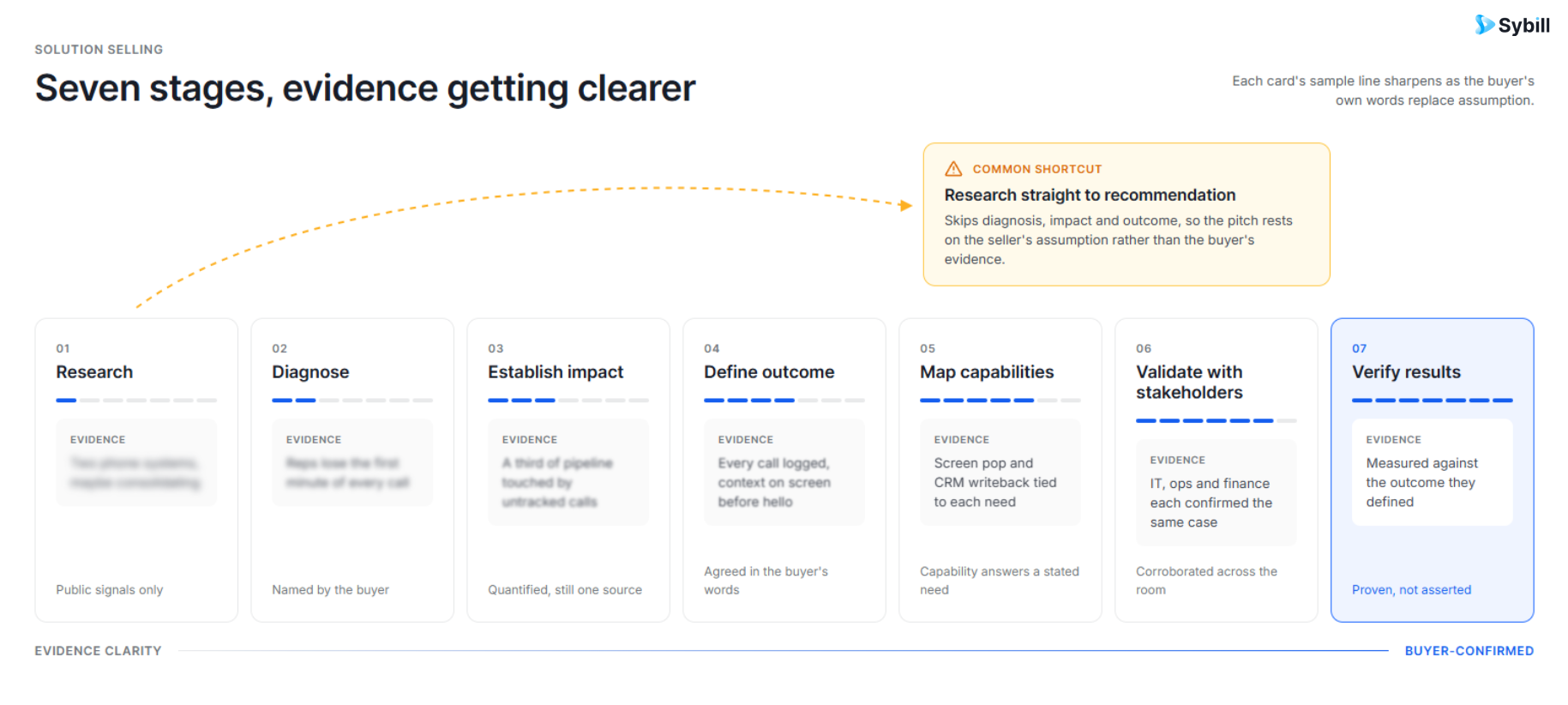
Research the account, industry, role, recent changes, systems, and likely constraints. Use that information to form a problem hypothesis.
A hypothesis creates relevance. It does not decide the answer.
Instead of “Let me show you our automation platform,” try: “Teams with a similar sales motion often lose context between calls and CRM updates. Is that happening here, or is the larger problem elsewhere?”
Buyers frequently describe symptoms first. “Our CRM data is unreliable” could reflect poor process design, excessive fields, weak adoption, fragmented tools, or late manual updates.
Ask what happens, who is affected, and what the team has tried. Continue until both sides can distinguish the problem from its symptoms.
A problem is not automatically a buying priority. Determine its operational, financial, strategic, or personal consequences.
Does incomplete CRM data waste manager time? Does it weaken forecasts? Do late follow-ups reduce buyer confidence? Does the process prevent reps from spending time with customers?
Quantify impact only when credible inputs exist. Otherwise, document the consequence without inventing a number. Sybill's value selling guide explains how to build a defensible value case.
Define what should be different after the problem is solved. Make the future state specific enough to evaluate later.
“Improve productivity” is vague. “Reps stop writing notes manually, agreed CRM fields update after interactions, and managers can inspect current buyer evidence” is usable.
Different stakeholders may define success differently. Sales leaders may prioritize visibility, RevOps may prioritize data quality, and reps may prioritize less administration.
Now the seller can recommend a solution. Every proposed capability should connect to a buyer-confirmed problem or success criterion.
The seller needs enough command of the product, services, integrations, implementation requirements, and limitations to construct an honest recommendation.
Do not turn this stage into a feature tour. More capabilities do not make a recommendation more tailored.
The person describing the problem may not control the budget, evaluate security, or own implementation. Test the recommendation with those who do.
Look for conflicting needs, unspoken risks, and different definitions of value. Technical fit cannot compensate for disagreement about the problem, urgency, or outcome.
Agree on a specific next action, owner, purpose, and date.
After implementation, compare results with the success criteria. Solution selling should end with evidence that the problem was addressed.
Suppose a sales leader asks for a meeting transcription tool. A product seller may immediately demonstrate accuracy and integrations. A solution seller first asks why call documentation has become a priority.
The conversation reveals that transcription is only the visible request. Reps write notes manually, CRM records remain incomplete, follow-ups vary, and managers lack current buyer context.
The actual problem is the loss of usable deal information between customer conversations and subsequent work.
Product knowledge still matters. The difference is when and how it enters the conversation.
Product selling suits simple, low-risk purchases. Solution selling earns its cost when the problem or recommendation carries meaningful complexity.
Consultative selling begins with the buyer's broader situation and may reframe the problem or recommend a different path. Solution selling focuses more narrowly on diagnosing a particular problem and mapping it to a solution the seller can provide.
The approaches often combine. A seller may begin consultatively, reframe the issue, and then use solution-selling discipline. Read Sybill's consultative selling guide for the broader approach.
Solution selling works best when:
It is usually excessive when:
Harvard Business Review's The End of Solution Sales argues that informed buyers can increasingly define solutions without a seller's help. Asking buyers to explain obvious problems before presenting familiar capabilities adds little value.
Modern solution sellers arrive with an informed hypothesis, test whether the buyer framed the right problem, and contribute insight about implications, tradeoffs, and implementation risk.
Customer focus alone is not enough. A Journal of Marketing study found that customer orientation had a continuously positive relationship with customer attitudes but an inverted U-shaped relationship with sales performance. Listening matters, but it still needs commercial judgment and direction.
Strong questions move the conversation from a reported symptom to a shared understanding of the problem, consequences, and outcome.
For more structured discovery, Sybill's SPIN Selling guide explains how to sequence Situation, Problem, Implication, and Need-Payoff questions. The SPICED sales guide provides a framework for organizing situation, pain, impact, critical event, and decision evidence across the deal.
Solution selling depends on evidence accumulated across the deal. Pain may emerge in one call, impact in another, implementation risk in an email, and conflicting success criteria later.

Sybill's Pre-Meeting Briefs restore context from previous calls, emails, CRM data, and other deal activity before the next conversation. Magic Summaries can structure buyer problems, impact, desired outcomes, objections, and next steps. Deal Workspace carries that context across interactions rather than reducing the deal to its latest meeting. Reps use Ask Sybill to identify what is confirmed, unclear, or disputed. CRM Autofill and contextual follow-ups move verified information into dependent systems and actions.
AI should not decide that a buyer has a problem, manufacture ROI, or convert a seller's assumption into customer evidence. It should preserve sources, expose gaps and contradictions, and help the seller ask a better next question. The recommendation remains a human commercial decision.
Fuller CRM fields and completed training do not prove the methodology is working.
Start with leading indicators:
Then monitor lagging outcomes such as stage conversion, no-decision rate, discounting, sales-cycle length, win rate, implementation success, retention, and expansion.
Compare similar teams, segments, and periods. Product fit, pricing, competition, market conditions, and execution also affect results. Correlation after adoption does not establish causation.
Solution selling is not the ability to make a product sound relevant. It is the discipline to understand a buyer's problem well enough that the recommendation becomes specific, defensible, and sometimes smaller than the seller originally expected.
AI can preserve evidence and remove administration. The seller must still diagnose honestly and recommend only what fits.
Want to see how buyer needs, impact, objections, and next steps can stay connected across an entire deal? Explore Sybill and see how sales conversations become persistent deal context.
Solution selling means diagnosing a buyer's specific problem and recommending a tailored combination of products or services that can produce an agreed outcome. The seller leads with questions and buyer evidence rather than product features.
There is no universal four-type classification. One commonly used model divides selling into transactional, solution, consultative, and provocative selling. Transactional selling prioritizes a straightforward exchange, solution selling maps a defined problem to an answer, consultative selling explores the buyer's wider context, and provocative selling challenges how the buyer understands the problem.
Yes, but it must adapt to informed buyers. Modern solution selling works when sellers validate the buyer's diagnosis, establish impact, align stakeholders, and contribute useful insight. It becomes ineffective when reps ask basic questions merely to steer every prospect toward the same product.
Solution selling means diagnosing a buyer's specific problem and recommending a tailored combination of products or services that can produce an agreed outcome. The seller leads with questions and buyer evidence rather than product features.
There is no universal four-type classification. One commonly used model divides selling into transactional, solution, consultative, and provocative selling. Transactional selling prioritizes a straightforward exchange, solution selling maps a defined problem to an answer, consultative selling explores the buyer's wider context, and provocative selling challenges how the buyer understands the problem.
Yes, but it must adapt to informed buyers. Modern solution selling works when sellers validate the buyer's diagnosis, establish impact, align stakeholders, and contribute useful insight. It becomes ineffective when reps ask basic questions merely to steer every prospect toward the same product.