Find us at booth #83, join us for a harbor side happy hour, or catch Gorish’s talk.

Sept, 16-18 > Learn more


Tamanna Mishra

March 26, 2026
.avif)
Agile selling is a survival edge in today’s zero-grace-period world. New role? New territory? New product? You’re expected to hit the ground sprinting, not just running.
Agile selling is a sales methodology, popularized by Jill Konrath, that prioritizes rapid learning and fast adaptation over experience and tenure. An agile seller can get up to speed on a new product, market, or territory in weeks rather than months by focusing on the minimum viable knowledge needed to have credible conversations, then iterating based on real buyer feedback. The core agile selling skills are rapid information absorption, experimentation with messaging and tactics, quick recovery from setbacks, and the ability to extract patterns from early interactions to improve faster than the competition.
Buyers don’t care if you're still onboarding. Quota sure doesn’t. That’s where agile selling shines. Coined and evangelized by Jill Konrath, agile selling is the superpower of learning fast, applying faster, and closing smarter, especially when the ground is constantly shifting.
Forget the 90-day ramp. The modern sales rep has 30 days (if that) to sound credible, build trust, and show results. Agile sales teams aren’t the ones with the most experience. They’re the ones who adapt fastest. Whether you’re switching industries, launching a new GTM play, or selling to a totally new buyer persona, sales agility is how you keep up - and win big.
Let’s break down what agile selling actually means, why it works, and how to build it into your motion starting today.
Agile selling is the ability to rapidly absorb new information and put it into action. Eventually, the goal of agile selling is to close deals faster in unpredictable, fast-moving conditions.
It’s the difference between the old “learn for 90 days” playbook and the new “sell confidently in 30” reality.
Coined by Jill Konrath, agile selling isn’t just another rigid methodology. It’s a mindset shift in sales reps that values speed, adaptability, and confidence over tenure.
Sales environments shift constantly. New competitors, product updates, shifting buyer behaviors. So - and Jill Konrath confirms this - reps need sales agility, not just experience.
But why the urgency? Current onboarding programs are failing sales teams. Only 54% of companies report that their onboarding boosts productivity, and 62% admit their onboarding is ineffective. Despite this, most reps are still expected to be quota-ready in the first 90 days. No grace period for slow learners.
Let’s now say you’re a rep transitioning from SMB tools to enterprise SaaS. Within 30 days, you’re speaking the new buyer’s language, navigating complex objections, mastering the competition - and closing her first enterprise deal. That’s agile selling in action, and it’s how high-performance reps win when speed matters most.
Modern sales is anything but stable.
New GTM strategy? Coming in hot.
Product updates? Weekly.
Buyer behavior? A moving target.
Your territory, your tools, your team, even your ICP can shift before your pipeline does. If your mindset in sales is built around predictability, you’re going to burn out fast.
That’s why sales agility matters. Jill Konrath calls it the agile mindset - the ability to learn fast and not freeze when the pressure piles on. It’s about staying sharp, not stuck. Because in modern sales, the reps who adapt are the ones who advance.
And agile sellers know how to keep evolving without losing their edge or drowning in change.
Think of it like Edge of Tomorrow.
You prospect. You fail. You regroup. You sell better the next day.
That’s sales adaptability in action. Iteration, not perfection.
While originally from software, the 4 agile steps apply to sales too:
Sales onboarding isn’t keeping up with the pace of modern selling. By the time most reps finish onboarding, the product’s changed, the buyer persona’s shifted, and the sales playbook feels stale. Enter: agile selling.
Instead of waiting 90+ days to ramp, agile sellers use rapid learning sales strategies to hit the ground running. They don’t aim for mastery. They aim for situational credibility fast.
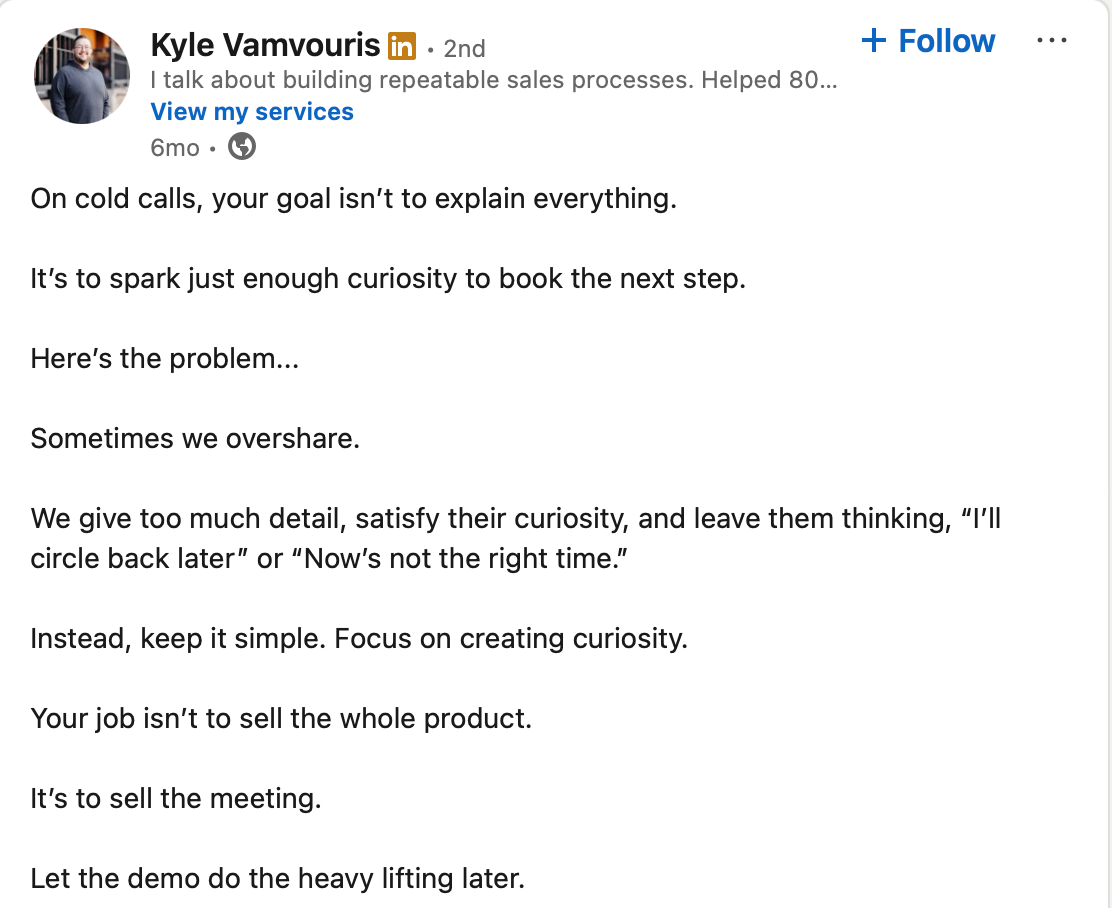
As sales consultant Kyle Vamvouris puts it in the context of cold calling, “Your job isn’t to sell the whole product. It’s to sell the meeting.”
Here’s how to become a pro agile seller, and sell like one, too.
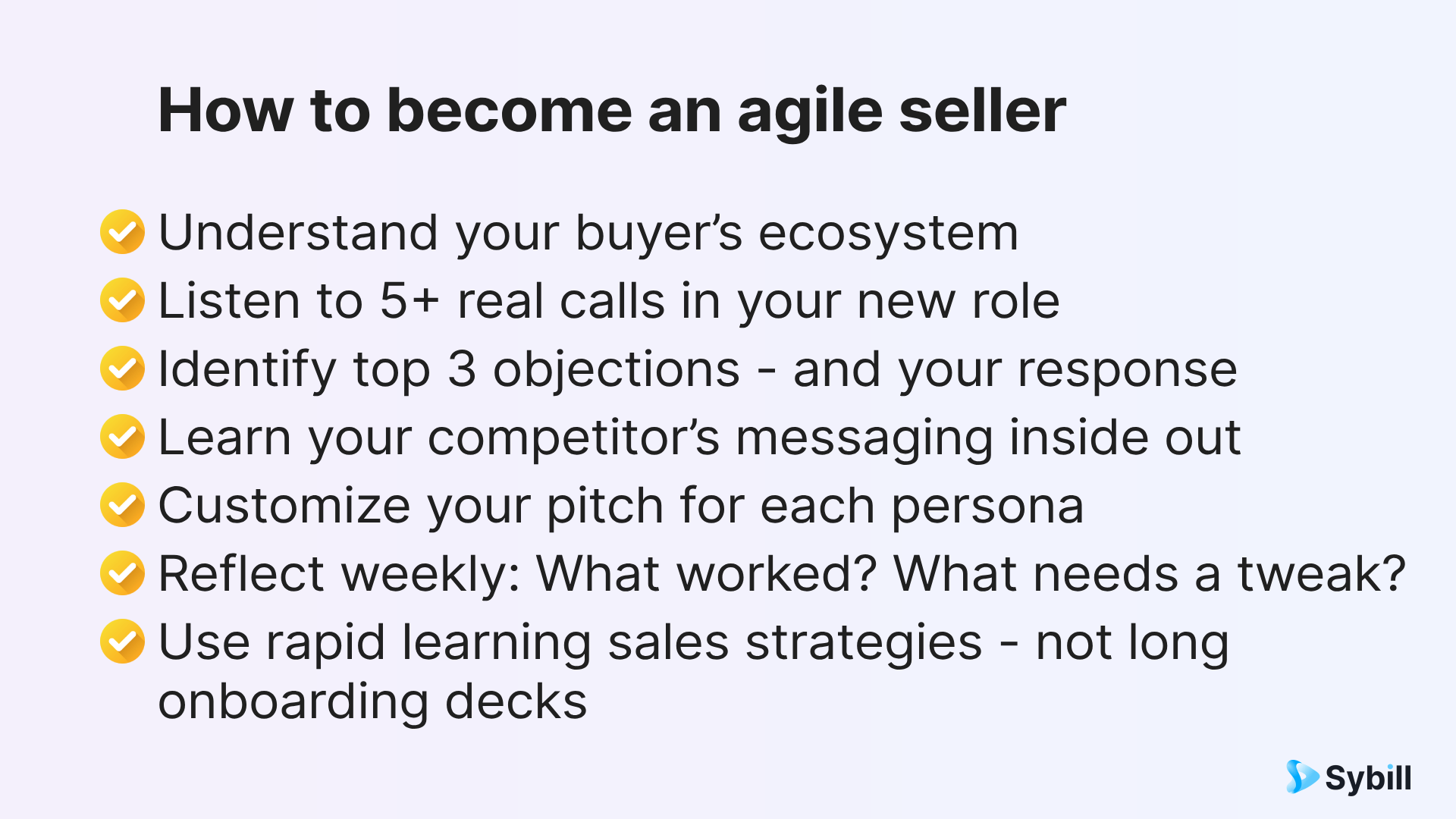
Agile sellers prioritize buyer understanding over product memorization.
They research customer challenges, vertical trends, and decision dynamics to sound credible, fast.
Pro tip: Customize your pitch for each persona. Use Pre-Call Brief to always know who’s attending each call and what motivates them.
Your buyer has options. Know what you’re up against.
Study top competitors, track frequent objections, and fine-tune your narrative.
Pro tip: Identify top 3 objections, and your response. Ask Sybill responds conversationally when you ask about competitor mentions and real objections across deals, helping you adjust your pitch on the fly.
Agile selling thrives on practice, not perfection.
Reps who role-play, review past calls, and reflect on feedback ramp faster and close smarter.
Pro tip: Reflect weekly. What worked? What needs a tweak? Use Recurring Prompts on Ask Sybill to do this. Click here to know more.
Traditional sales onboarding says “give it time.” Agile selling says “get selling.” Choose speed. Choose context. Choose to be the rep who figures it out faster than anyone else.
Sales agility is what separates the reps who survive disruption from the ones who thrive in it. In a dynamic sales environment, reps can’t rely on static playbooks or outdated onboarding. They need the ability to shift gears fast, absorb change, and translate chaos into momentum.
.png)
Whether it’s a new product, a new territory, or a completely new role, agile selling is essential. Here’s where agile selling really pays off, and how agile sellers make it work.
Sales transformation doesn’t wait for reps to catch up.
Suddenly you’ve got a new manager, new territory, or an entirely new value prop to pitch. Agile sellers don’t panic. They prioritize learning what’s changed and who their new buyers are.
How to respond:
Quick win: Cut the confusion and rebuild pipeline confidence in days, not weeks.
New features. New pricing. New value story.
In these moments, reps who rely on memorized pitches fall flat. Agile sellers immediately adjust, reframing the pitch around what the buyer now cares about.
How to adapt:
Quick win: Confident messaging = more booked meetings, even during launch chaos.
Moving from SDR to AE? SMB to Enterprise? The job changes, and so must your mindset. Agile selling helps you upskill faster by focusing on real conversations, not more theory.
How to ramp:
Quick win: Shorten the ramp and close your first deal in under 30 days.
Localization is beyond just language and culture. It’s about nuance. What works in fintech won’t fly in healthcare. Agile sellers tune in fast to cultural, regulatory, and buyer behavior shifts.
How to adjust:
Quick win: Build credibility quickly, even in unfamiliar territory.
The benefit of agile selling is that you cope with change. But more importantly, sales agility turns change into a competitive edge.
You win faster. Your outreach is sharper. You handle objections with more confidence. And because you’re learning directly from buyer signals, not just training decks, your coaching ROI shows up in weeks, not quarters.
In a world where change is constant and buyers are unpredictable, agile selling is how supersellers stay sharp. Jill Konrath nailed the core truth: you don’t need decades of experience to succeed. You need sales agility, or the ability to learn fast, pivot faster, and speak with confidence in any situation.
Modern sales techniques are about showing up prepared, adapting in real time, and learning directly from your buyers. The reps who do this well? They have the opportunity to outperform veterans.
Because the faster you learn, the sooner you win.
Use Pre-Call Briefs to show up smart and situationally credible.
Use Personalized Emails to contextually follow up within minutes, not days.
Use Ask Sybill to stay one step ahead of every objection, stakeholder shift, or deal risk, without digging through your notes.
Sales agility is the ability to respond quickly and effectively to changes in your sales environment, whether it’s a new product, buyer behavior, or internal process.
An agile strategy is flexible and iterative. In sales, it means constantly refining messaging, outreach, and tactics based on real-time buyer data.
Agile is built on short, focused iterations. You learn, act, measure, and improve - all fast.