Find us at booth #83, join us for a harbor side happy hour, or catch Gorish’s talk.

Sept, 16-18 > Learn more

%20(1).avif)
Mamta Tainwala

August 5, 2026
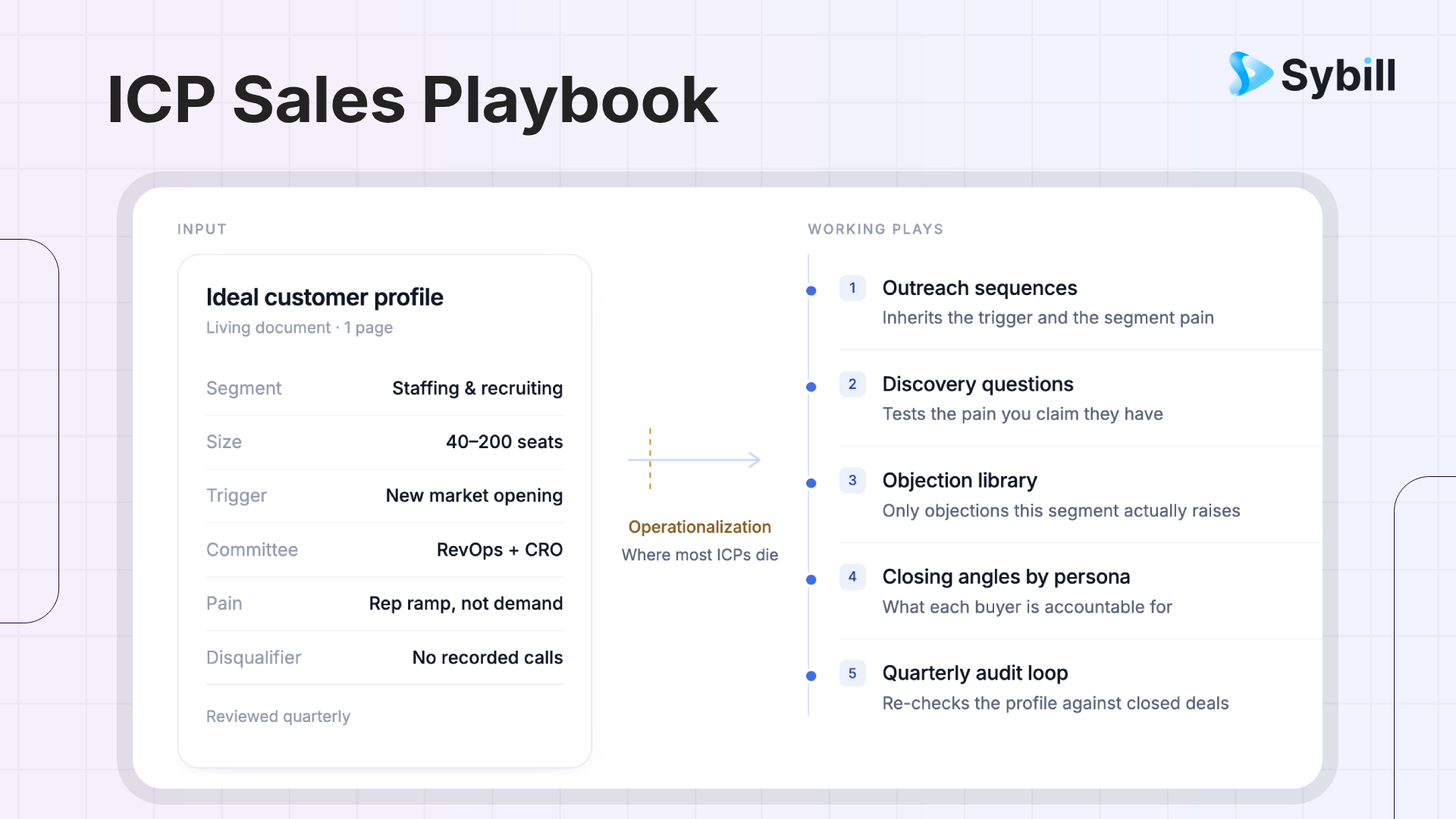
ICP sales means operationalizing your ideal customer profile into the actual mechanics of selling: outreach written to ICP pain points, discovery questions built from ICP challenges, an objection library organized by segment, closing angles matched to each persona's buying triggers, and a quarterly audit that refines the profile from win-loss data. The ICP that lives in a slide deck closes nothing; the one embedded in scripts and plays compounds every quarter.
This post is the operationalization manual. If you are still building the profile itself, start with our complete ICP guide; if you want the definitional grounding, the ICP fundamentals piece covers it. Here, we assume the profile exists and answer the harder question: now what?
ICP sales is the practice of letting the ideal customer profile drive every stage of the sales motion: who gets prospected, what the outreach says, which discovery questions get asked, how objections get answered, and what closing angle each stakeholder hears. It matters because precision compounds: less time on bad-fit leads, higher reply rates from relevant messaging, and faster cycles from anticipating segment-specific concerns.
The distinction worth making immediately: having an ICP and running ICP sales are different achievements, and most teams stop at the first. The profile gets built in a planning offsite, admired, and filed, while the actual selling continues on instinct. McKinsey's personalization research makes the stakes concrete: 76% of buyers say personalized communication is a key factor in considering a brand, and 78% say it makes repurchase more likely. Personalization at that standard is impossible without a profile driving it, and a profile that drives nothing is a poster.
Alignment is the quiet second dividend: when sales and marketing work from one written ICP, the lead-quality argument mostly dissolves, and research compiled by HubSpot has long linked tight sales-marketing alignment to materially better retention and win rates. The mechanism is boring and real: shared definitions produce shared targets.
The five steps below are the conversion process from poster to playbook.
A playbook-grade ICP needs five data layers: firmographics (industry, size, growth stage, tech stack), decision-maker insights (titles, responsibilities, buying authority), buying triggers (funding, hiring, leadership changes), common objections and pain points, and preferred channels. The layer most teams skip is the richest: the verbatim language your best customers used before they bought.
The first four layers come from your CRM and enrichment tools, and the fill-in template below structures them. The fifth layer is the one that separates playbooks that sound like your buyers from playbooks that sound like your deck, and it lives in your call recordings: how did your best-fit customers describe their problem before they knew your vocabulary for it? What triggered the search? What almost stopped the deal?
Sybill has analyzed around 33 million sales conversations, and the pattern holds everywhere: buyers and vendors describe the same problem in different words, and outreach written in the buyer's dialect wins. Buyer intelligence extracts that dialect across your call base systematically, and Ask Sybill makes it queryable: "How do our closed-won customers in fintech describe their pain in first calls?" is a template input, not a research project.
The working template (fill per segment):
ICP-aligned outreach references the segment's specific trigger and pain in the first two lines, ties the value proposition to a problem that segment verifiably has, and closes with a low-friction ask. The test: could this message have been sent to any other segment? If yes, it is not ICP outreach yet.
The before/after that makes the standard concrete:
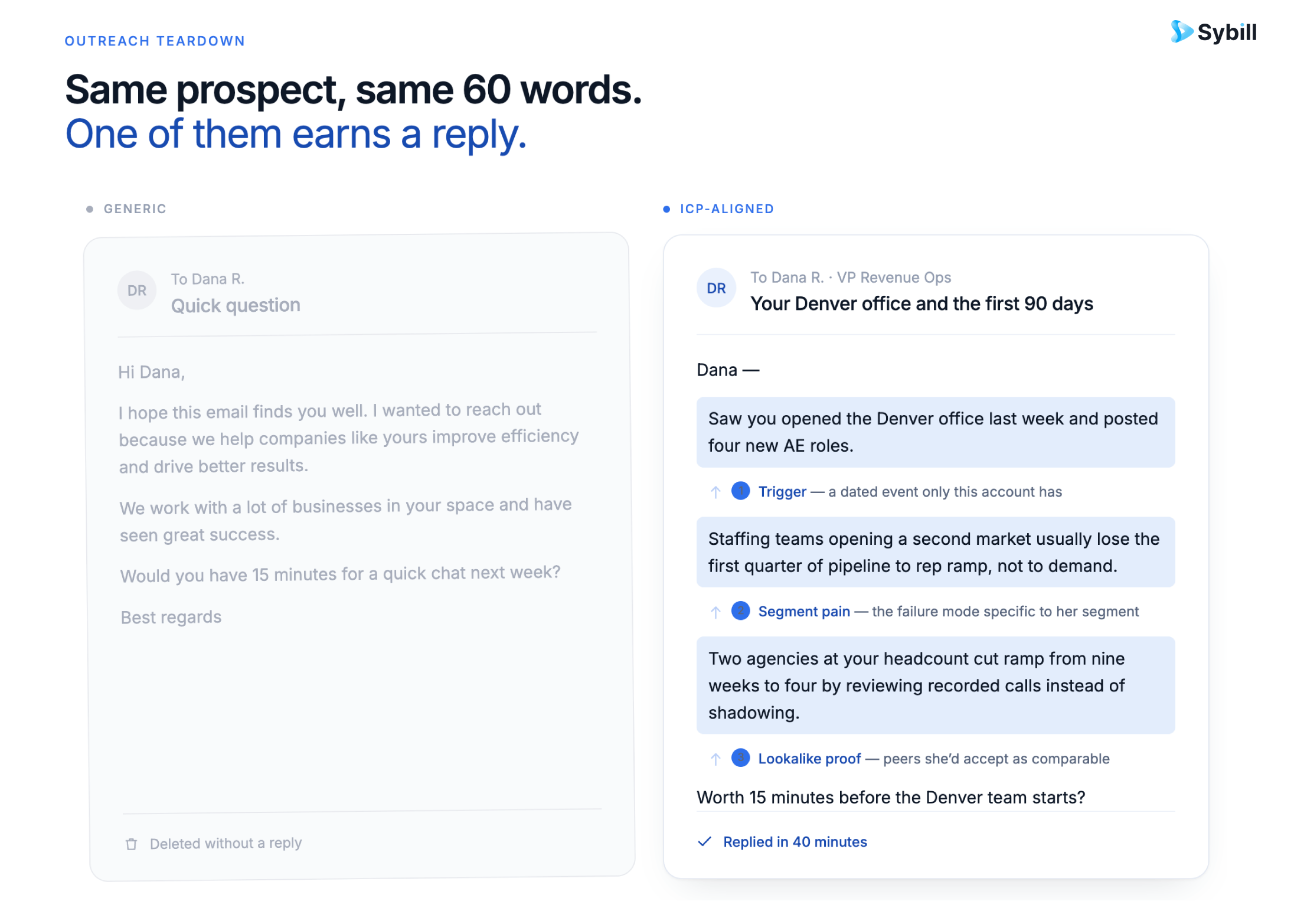
Generic: "We help companies improve sales efficiency. Want to chat?"
ICP-aligned: "Saw [Company] is scaling its sales team. Most teams hit a pipeline-visibility wall at exactly this stage, and [Solution] is how [Similar ICP Company] got through it. Worth 20 minutes?"
The second one works because every element is doing segment-specific work: the trigger (hiring), the pain (visibility at scale), the proof (a lookalike customer). Apply the same standard per channel: cold email leads with the ICP pain in the subject line; cold calls open with the trigger event, not "did I catch you at a bad time"; and LinkedIn engages before it asks, because social selling that skips the social part is just cold outreach with a profile photo.
One structural note: trigger-based targeting is what makes all of this scalable. The ICP defines who; the triggers define when; and lead scoring built on both defines the morning's priority list.
ICP-driven discovery prepares question paths for the segment's five most common challenges: questions that surface the pains they know, expose the ones they have not named yet, and position your solution as the logical response. Discovery built this way feels like expertise to the buyer, because it is.
The craft here is preparation without recitation. Map each ICP segment's top five challenges, and for each, script the opening question plus two follow-ups that deepen it. A rep walking into a discovery call with that map runs a conversation that keeps landing on relevant ground, which buyers experience as "they get us" rather than "they researched us." Our discovery question bank supplies the raw material; the ICP supplies the selection.
Qualification closes the loop: the ICP is also the disqualification standard. A qualification framework scored against ICP fit keeps the pipeline honest, and deal inspection verifies the fit claims against what was actually said, so "ICP match" stays an evidence label instead of an optimism label. Every bad-fit deal disqualified early is rep attention returned to a real one, and returned attention is the entire economic point of running ICP sales.
Your ICP's real voice is in your calls. Sybill mines every conversation for the pain language, objections, and triggers each segment actually uses, then keeps your playbook honest with evidence. Get started for free with Sybill.
Every ICP segment objects predictably, which makes objections preparable: build a library organized by segment, where each entry acknowledges the concern, answers with proof from a lookalike customer, and offers a risk-lowering next step. Great teams do not handle objections better in the moment; they hear fewer surprises.
The three perennials, with the ICP-based pattern:
.png)
"We don't have the budget." Translation: the ROI is not yet believed. The response reframes cost of inaction with a lookalike: "That is exactly why [ICP Company] moved: they were losing [quantified cost] to [the segment's pain]. Worth walking through their numbers?" Budget objections are proof problems wearing finance costumes.
"We already use [Competitor]." Translation: no compelling reason to switch has landed. Acknowledge, then aim at the gap: "Most of our best customers started there. [ICP Company] switched when [Competitor]'s [specific gap] started costing them [specific outcome]. Is your team hitting that yet?" The gap must be real and segment-relevant, which is what competitor intelligence across your calls keeps current: you learn which competitor claims are landing and which weaknesses buyers volunteer, deal by deal.
"Not the right time." Translation: prioritization is unsettled and implementation feels risky. The response prices the delay: "[ICP Company] moved before this became urgent, because teams that wait on [problem] typically hit [consequence]. Worth checking whether that risk applies here?"
Two build notes for the library itself. First, source it from evidence: your recorded calls contain every objection each segment has actually raised, in context, with the responses that worked, which is far better raw material than a brainstorm. Second, drill it: objection handling is a rep skill as much as a script asset, and role-play practice plus the full objection-handling guide turn the library from a document into a reflex.
Closing angles differ by stakeholder because buying triggers do: CFOs sign for ROI and risk reduction, sales leaders for pipeline efficiency and revenue impact, end users for daily workflow relief. The playbook maps each ICP persona to its angle. Then a quarterly audit keeps the entire system honest: win rates by segment, cycle length by segment, funnel conversion by stage, with underperforming segments triggering profile or messaging revisions.
The closing map is the shortest section of the playbook and the one reps consult most: one line per persona, stating what they buy and what proof convinces them. Multi-stakeholder deals then become sequencing exercises (which angle, to whom, in what order) instead of one pitch sprayed at a committee.
The audit is what makes ICP sales a system rather than a project. Quarterly, review:
Teams that run this loop for four quarters end up with an ICP no competitor can copy, because it is built from proprietary evidence: their deals, their conversations, their patterns. That is the compounding moat, and it shortens the cycle a little more every iteration.
Here is the reframe that separates teams that get value from ICP work from teams that get a nice slide: the ICP is not a description of truth, it is a testable claim about where your revenue comes from, and the playbook is the apparatus that tests it every day. Outreach tests the pain hypothesis. Discovery tests the challenge map. Objection patterns test the segment definitions. Win-loss data grades the whole thing quarterly.
Run it that way and the profile gets sharper every quarter while your team's effort concentrates on the buyers most likely to say yes. File it in a deck and it is a very well-formatted guess.
The evidence layer underneath (what your buyers actually said, segment by segment, call by call) is Sybill's job: captured, structured, and feeding every step above while your reps do the selling.
Get started for free with Sybill or book a demo and build the playbook on evidence.
ICP stands for ideal customer profile: a data-backed definition of the companies most likely to buy, succeed with, and expand on your product, covering firmographics, decision-makers, buying triggers, pain points, and channels. ICP sales is the practice of letting that profile drive prospecting, messaging, discovery, objection handling, and closing.
The ICP describes the ideal company (industry, size, stage, stack); buyer personas describe the individual people inside it (the CFO, the sales leader, the end user), each with their own priorities and objections. A working playbook uses both: the ICP decides which accounts to pursue, and personas decide how to sell to each stakeholder.
Five steps: enrich the profile with evidence including buyers' verbatim language, convert it into segment-specific outreach, build discovery paths around the segment's known challenges, prepare an objection library organized by segment, and map closing angles per persona, then audit win rates and cycle times by segment quarterly to refine the profile.
Audit quarterly, revise when the evidence demands it. Quarterly reviews of win rate, cycle length, and stage conversion by segment reveal drift early; feed win-loss findings back into the profile so it reflects this year's best customers rather than the founding cohort. A static ICP quietly expires within a few quarters in fast-moving markets.
Substantially. AI analysis of your closed-won conversations surfaces the shared traits, trigger events, pain language, and objection patterns of your best customers, which are exactly the inputs an ICP needs and exactly what manual analysis misses at scale. AI then keeps the profile honest by checking live deals against it continuously.
ICP stands for ideal customer profile: a data-backed definition of the companies most likely to buy, succeed with, and expand on your product, covering firmographics, decision-makers, buying triggers, pain points, and channels. ICP sales is the practice of letting that profile drive prospecting, messaging, discovery, objection handling, and closing.
The ICP describes the ideal company (industry, size, stage, stack); buyer personas describe the individual people inside it (the CFO, the sales leader, the end user), each with their own priorities and objections. A working playbook uses both: the ICP decides which accounts to pursue, and personas decide how to sell to each stakeholder.
Five steps: enrich the profile with evidence including buyers' verbatim language, convert it into segment-specific outreach, build discovery paths around the segment's known challenges, prepare an objection library organized by segment, and map closing angles per persona, then audit win rates and cycle times by segment quarterly to refine the profile.