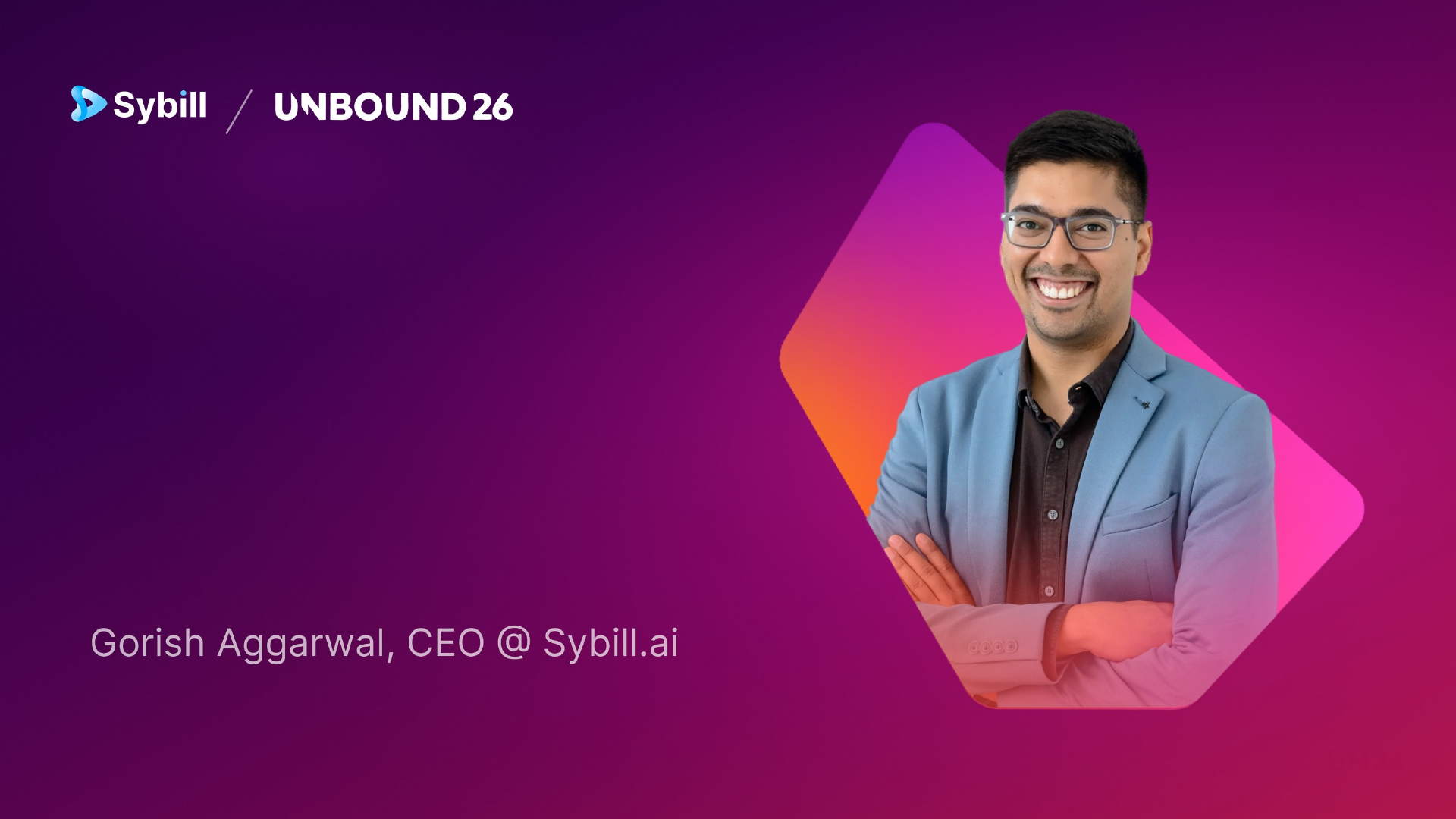
Find us at booth #83, join us for a harbor side happy hour, or catch Gorish’s talk.

Sept, 16-18 > Learn more


Mamta Tainwala

June 8, 2026
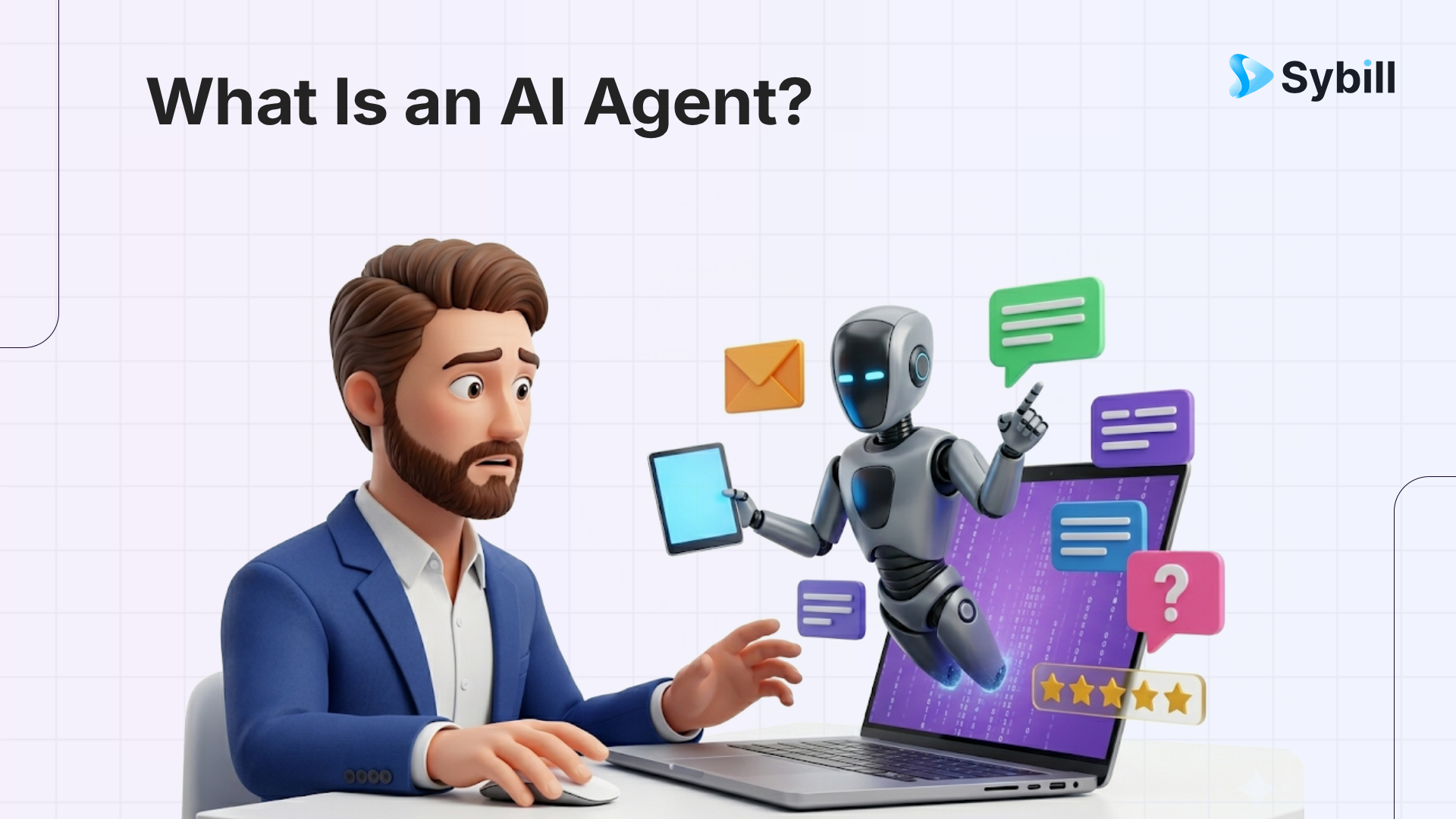
An AI agent is a software system that can perceive its environment, make decisions, and take actions autonomously, without requiring a human to prompt it at every step. Unlike a chatbot, which responds only when you ask it something, an AI agent operates continuously in the background, monitors inputs, and executes tasks on its own.
The simplest definition: an AI agent is software that has a goal, a set of tools to accomplish that goal, and the ability to act without constant human instruction.
Gorish Aggarwal, CEO of Sybill AI, who ran one of the earliest documented personal agent setups using OpenCLAW, describes it this way: "Agents are not simply tools that save you time. They compound smartness over a period of time." The agents he runs today know his preferences, his team members, his deal context, and his communication style, because that knowledge has been building for months.
That compounding intelligence is what separates agents from every other category of AI tool.

Before going deeper on agents, it helps to understand where they sit in the broader AI landscape. There are three distinct levels most people interact with today.
Level 1: Conversational AI (ChatGPT, Claude, Gemini) You open a browser tab, type a question, and get an answer. The interaction ends there. Nothing persists, nothing runs in the background, and nothing happens unless you initiate it. Most people start here.
Level 2: Embedded AI (Copilot, Slack AI, CRM AI) AI is baked into a tool you already use. It has access to the data inside that tool, whether that's your emails, your Slack messages, or your CRM records, and it can surface insights, draft replies, or answer questions about that data. Sybill's Magic Summary and CRM Autofill features operate at this level: connected to your calls and your CRM, surfacing intelligence without you having to dig for it.
Level 3: Autonomous Agents The agent runs on its own. It monitors incoming signals, decides what to do, uses tools to act, and writes what it learned to memory so the next action is better. A human doesn't need to ask. This is where things get genuinely powerful, and genuinely different from everything before it.
Most people are at Level 1 or 2. Agents are Level 3.

Every AI agent, regardless of what it's built on, has the same four underlying components.
1. Interface This is how the agent receives inputs and how it communicates back to you. Interfaces can be Slack, WhatsApp, email, iMessage, a web app, or any channel where information flows. For Gorish's personal agents, the interface is Slack. For Sybill, it's wherever your sales calls happen, your email inbox, and your CRM, all connected so that intelligence flows to the right place automatically.
2. Orchestration This defines when the agent activates and what triggers it. Does it run every morning at 8am? Does it fire the moment a new email arrives? Does it run a weekly sweep of your pipeline? Orchestration is the agent's schedule and decision logic, essentially the rule set that determines when and why it acts.
3. Model This is the underlying language model, whether Claude, GPT-4, Gemini, or an open-source alternative. The model is the reasoning layer. Interestingly, as Gorish points out, the model layer is now the most commoditized part of the stack. Models are improving and converging rapidly, which means the real differentiation in agent quality comes from the other three components, especially context.
4. Context This is the most important and most underbuilt component in the industry. Context is everything the agent needs to know to act well on your behalf: your preferences, your communication style, your team structure, your deals, your customers, your past decisions. Without rich context, even a sophisticated agent produces generic output.
Sybill is fundamentally a context layer for sales teams. Every call recorded, every follow-up sent, every deal updated, feeds into a growing body of intelligence about buyers, reps, objections, and deal dynamics. When an AI acts on that intelligence, whether to surface deal risk, coach a rep, or draft a follow-up, it does so with context that makes the output genuinely useful rather than generic.
The clearest way to understand the difference is in what happens when you're not there.
A chatbot waits. It does nothing until you ask. Every interaction starts from scratch, with no memory of what came before. It has no tools, no ability to read your calendar or check your CRM or send an email on your behalf. It is purely reactive.
An AI agent acts. It monitors your environment, detects what needs to happen, decides whether to act autonomously or ask for your input, executes the action using connected tools, and then writes what it learned to memory so the next action is better. It is proactive.
Here's a concrete example. Gorish runs a scout agent that monitors every incoming message across WhatsApp, iMessage, LinkedIn, email, and Sybill call recordings. When a new message arrives, the scout agent classifies it, routes it to the right specialized agent (personal, GTM, product, etc.), and those agents draft responses, create tasks, or schedule meetings based on pre-set rules and accumulated context. No human touch needed until the agent surfaces something that requires a decision.
A chatbot cannot do any of that. Not because the underlying model is weaker, but because the architecture is fundamentally different.
If you want to understand what makes a particular agent tick, look at these four files or components. They are the building blocks every well-designed agent is made of.
Soul file (soul.md) This is the agent's job description, personality, and behavioral rules. It defines what the agent is responsible for, how it communicates, what it should escalate versus handle autonomously, and what it is never allowed to do. Think of it as the character definition for this particular agent. Gorish's chief-of-staff agent Donna, for example, is defined as direct, anticipatory, and empowered to push back when Gorish is avoiding a difficult task.
Memory This is everything the agent has learned and stored about the world it operates in. Memory can be simple text files (good for fewer than ten items) or structured databases (better when the agent needs to choose from many records). Gorish maintains memory files on every person he interacts with: team members, investors, customers, prospects, and personal contacts. The agent knows the history of every relationship and uses that to make each interaction sharper than the last.
Skills These are reusable, specific instruction sets for repeatable tasks. A scheduling skill, for example, contains all the rules for how meetings should be set up: preferred durations, buffer times, virtual versus in-person defaults, time slots to offer. The agent reads the skill file every time it handles a scheduling task. Skills are what let agents perform complex tasks consistently without being re-taught each time.
Heartbeat This is the agent's operational rhythm. Daily morning briefings at 8am. Pipeline reviews every Friday. Immediate action on new inbound emails. The heartbeat defines when the agent is active and what it does on each trigger. It is the orchestration layer made concrete.
Memory is what separates a useful agent from a great one, and it's the most under-discussed component in most agent conversations.
When an agent completes a task, if it writes what it learned to memory, the next time it faces a similar task it starts from a better position. Over weeks and months, this compounds. The agent knows your preferences more precisely. It knows the context around your relationships and deals. It makes fewer errors and requires fewer corrections.
This is directly analogous to what happens when a good human assistant builds context over time. The first week they're making educated guesses. Six months in, they know what you need before you ask.
For sales teams, this is the exact problem Sybill solves at an organizational scale. Every call, every follow-up, every deal outcome feeds into a shared intelligence layer. When a rep goes into a renewal, they're not starting from scratch. When a manager does a deal inspection, the context on that account is already assembled. When a new rep ramps, the institutional knowledge doesn't live only in other people's heads.
That compounding memory is what makes AI agents qualitatively different from every productivity tool that came before.
The clearest way to make this concrete is with actual use cases. Here's how autonomous agents are being used in GTM contexts today.
Task management from conversations Every call, Slack message, or email that creates a commitment gets captured as a task, linked back to the conversation it came from, assigned a priority, and tracked to completion. When a task is done, it gets checked off automatically. No manual logging.
LinkedIn inbox automation Incoming LinkedIn messages are classified (spam versus real), routed based on the sender's seniority and relevance, and responded to with appropriate context. Gorish was able to respond to a roundtable invitation within an hour because his agent flagged it as high-priority and drafted a response before he ever opened LinkedIn.
Deal qualification and pipeline review Sales teams can connect their CRM and call recordings to an agent built around a qualification rubric (MEDDPICC, BANT, or a custom framework) and ask: which deals are qualified, which aren't, and why? Sybill's deal inspection capability does exactly this, surfacing risk signals and qualification gaps without requiring a manager to manually review every deal.
Pre-meeting briefings Before each call, an agent assembles everything relevant about the account: recent interactions, open tasks, deal status, competitor mentions, and known objections. Sybill's pre-meeting briefs deliver this automatically, so reps show up informed without spending twenty minutes pulling context from three different systems.
Follow-up automation After a call, an agent writes the follow-up email, updates the CRM, creates action items, and routes anything that needs a human decision. Sybill's email follow-up and AI tasks features handle this leg of the workflow, turning every call into clean next steps without rep effort.
Given how much noise surrounds the term, a few clarifications.
An AI agent is not just a chatbot with a name. Adding a persona to a chat interface doesn't make something an agent. The agent distinction is about autonomous action, not personality.
An AI agent is not a static automation. Rule-based automations follow fixed logic. Agents reason. They decide whether the situation matches the rule, what exceptions apply, and when to escalate to a human. That flexibility is architecturally different from a Zapier workflow.
An AI agent is not a replacement for human judgment on high-stakes decisions. The well-designed agent setups today define explicit tiers of permissions: what the agent can do autonomously, what requires human approval, and what it is never allowed to do. Gorish's agents, for example, require his sign-off before sending any external email and cannot execute any payment. The agent is a force multiplier, not a replacement for accountability.
What is an AI agent in simple terms?
An AI agent is software that takes actions on your behalf without waiting for you to ask. It monitors inputs, makes decisions, uses tools, and learns from what it does, all with minimal human involvement.
How is an AI agent different from ChatGPT?
ChatGPT is a conversational AI: you ask, it answers, and the interaction ends. An AI agent runs continuously, acts proactively, remembers what it learns, and uses tools to do things in the real world, like sending emails, updating CRMs, or scheduling meetings.
What are examples of AI agents for sales teams?
Common examples include automated deal qualification, post-call CRM updates, follow-up email drafting, pre-meeting research briefings, and pipeline review alerts. Sybill handles all of these as part of a connected sales intelligence platform.
Do AI agents replace salespeople?
No. AI agents handle the administrative, repetitive, and data-processing work that takes time away from actual selling. The human judgment, relationship-building, and negotiation work remains with the rep.
How do AI agents learn over time?
Through memory. When an agent completes a task, it writes what it learned to a persistent memory store. Over time, this accumulates into a rich context layer that makes each subsequent action more accurate and personalized.
What tools do AI agents use?
AI agents can connect to calendar systems, email inboxes, CRMs, Slack, web browsers, databases, and any tool with an API or MCP (Model Context Protocol) connection. The breadth of tool access directly determines what the agent can do autonomously.
An AI agent is not a smarter chatbot. It is a fundamentally different kind of system: one that acts rather than responds, remembers rather than resets, and improves rather than stays static.
For sales teams, the most immediate value is in the context layer. When an agent has access to every call, every deal, every rep interaction, and every buyer signal, it can do things no individual rep or manager has the bandwidth to do manually. That is the compound value Sybill is built to deliver.
If you want to see what that looks like in practice, explore Sybill's AI sales assistant or talk to the team.
An AI agent is software that takes actions on your behalf without waiting for you to ask. It monitors inputs, makes decisions, uses tools, and learns from what it does, all with minimal human involvement.
ChatGPT is a conversational AI: you ask, it answers, and the interaction ends. An AI agent runs continuously, acts proactively, remembers what it learns, and uses tools to do things in the real world, like sending emails, updating CRMs, or scheduling meetings.
Common examples include automated deal qualification, post-call CRM updates, follow-up email drafting, pre-meeting research briefings, and pipeline review alerts. Sybill handles all of these as part of a connected sales intelligence platform.