Find us at booth #83, join us for a harbor side happy hour, or catch Gorish’s talk.

Sept, 16-18 > Learn more


Tamanna Mishra

September 4, 2026
%20(89).png)
Your product has done something no sales deck can: it has proved its value.
A user has completed a meaningful workflow. Their team is inviting colleagues. A high-fit company is approaching a plan limit. That behaviour is more persuasive than another ebook download or enthusiastic demo request.
It still does not mean the product can find the budget owner, navigate security, negotiate an enterprise agreement or turn one enthusiastic user into an organisation-wide rollout.
That is where product-led sales begins.
Product-led sales, or PLS, uses product behaviour to identify people and accounts that may benefit from human sales assistance. The product creates and qualifies demand. Sales enters when a conversation can increase conversion, deal size or expansion.
Product-led sales combines self-service product adoption with targeted human selling.
Users experience value first. Product, account and buying signals then help the company decide who sales should contact, when to contact them and why the conversation may be useful.
PLS requires more than a free trial and a sales team. It needs reliable product signals, product-qualified lead or account definitions, clear engagement rules, connected data, relevant sales plays and a feedback loop between product, sales, marketing and customer success.
Pure product-led growth sounds beautifully efficient. Let users discover the product, experience value, invite colleagues and upgrade without ever speaking to sales.
That can work for straightforward, low-risk purchases. It becomes less convincing when the opportunity involves several departments, security requirements, procurement, custom implementation or a contract large enough to require executive approval.
McKinsey’s analysis of 107 publicly listed B2B SaaS companies found that product-led companies did not automatically outperform sales-led peers. Outperformance was concentrated among a smaller group of product-led companies, and the researchers identified hybrid product-led sales as an important route to stronger growth.
The lesson is not that PLG failed. It is that product adoption and enterprise buying are different jobs.
The product can demonstrate value. Sales helps an organisation agree on how broadly, securely and commercially that value should be deployed.
A product-led sales strategy is a go-to-market motion in which product usage, customer fit and buying context determine when sales engages.
The motion generally works like this:
Product experience → Value signal → User and account identification → PQL or PQA → Sales routing → Buyer conversation → Conversion or expansion
PLS sits between pure PLG and traditional sales-led growth.
What makes product-led sales different from traditional B2B sales is the starting point. Traditional sales often asks prospects to believe the product will create value. PLS approaches people who have already experienced some of that value.
For a deeper model comparison, read Product-Led Growth vs. Sales-Led Growth.
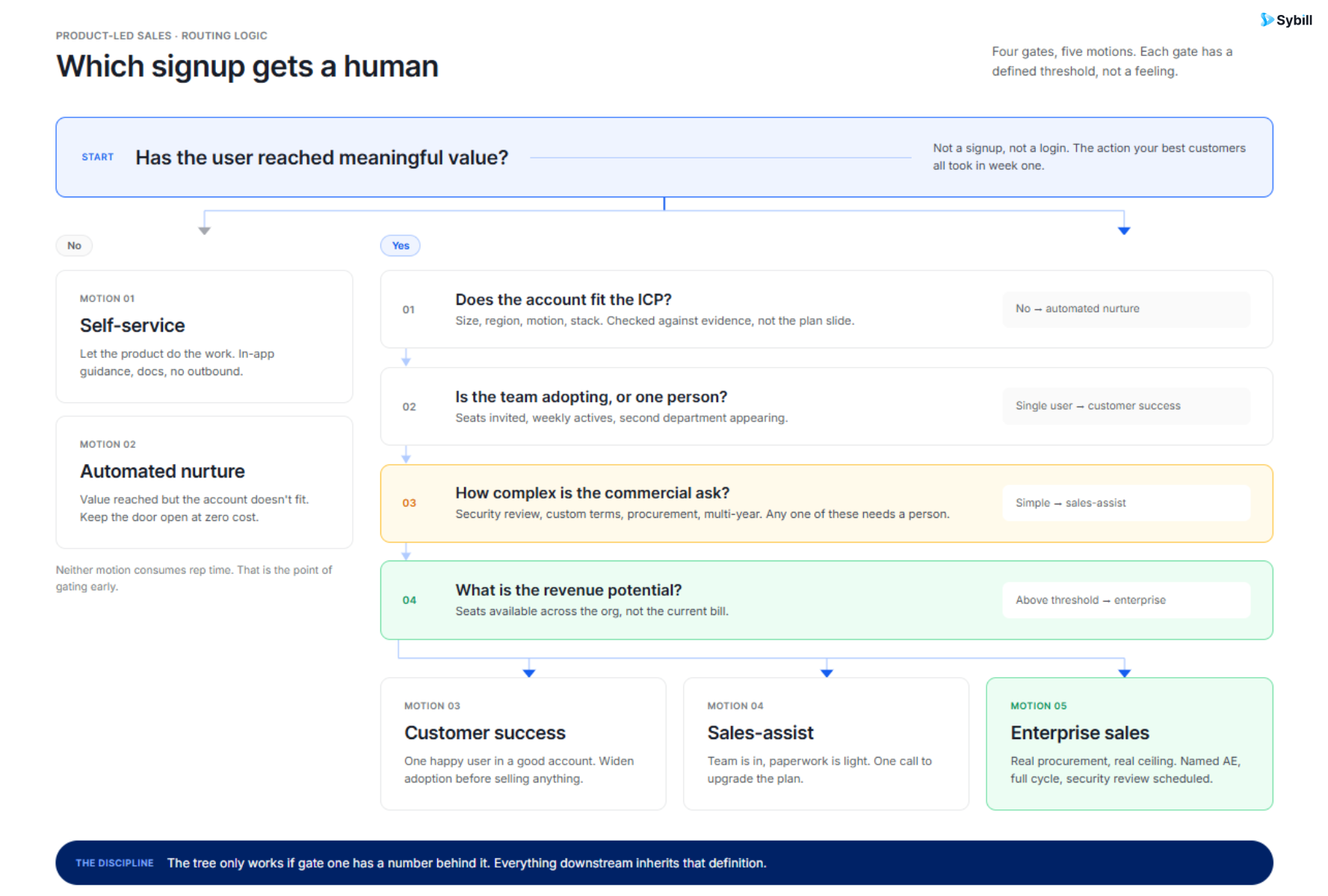
A startup rarely needs to replace PLG with sales-led growth overnight. The more useful question is whether particular users, accounts or customer segments need a sales-assisted path.
Sales should stay away when the user has not reached value, the account is outside the ICP, expected revenue cannot support human acquisition costs or outreach would interrupt a successful self-service journey.
A login is not an invitation to call. Neither is a feature click. Product-led sales should reduce unnecessary selling, not create a more sophisticated way to pester people.
Start by identifying the behaviour that shows a user has achieved a meaningful outcome.
It is rarely “logged in five times.” Better signals reflect actual value:
Analyse which actions correlate with conversion, retention and expansion. Your activation event should come from evidence, not whichever event is easiest to track.
A highly active user can still belong to a company that will never become a valuable customer.
Combine product behaviour with:
This prevents the sales team from treating enthusiasm and commercial potential as the same thing.
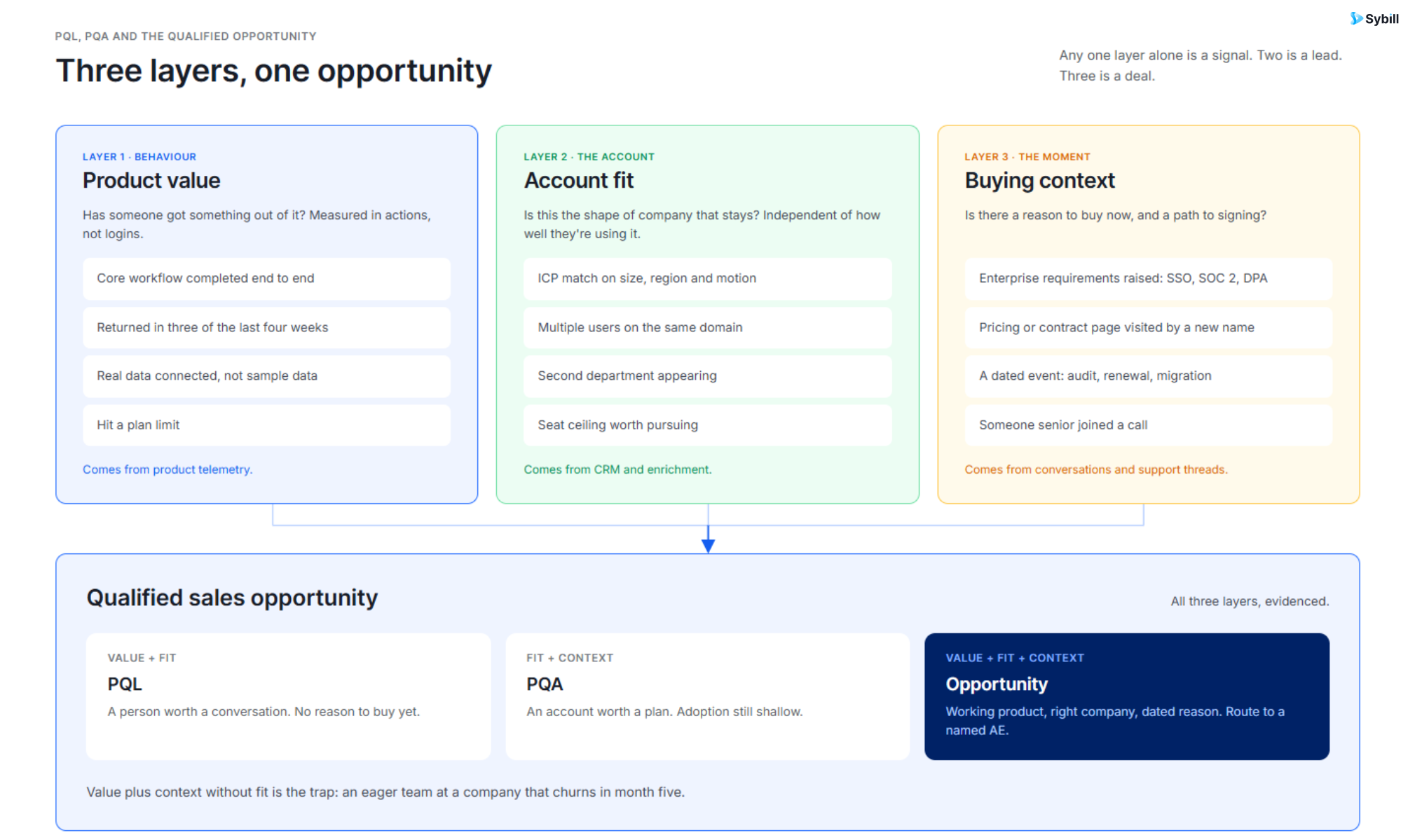
A product-qualified lead, or PQL, is an individual whose product behaviour indicates that sales assistance may be valuable.
A product-qualified account, or PQA, is an organisation whose collective usage, fit and buying context indicate a meaningful revenue opportunity.
Strong qualification uses three layers:
ProductLed reports that free-trial PQLs convert to paid customers at an average rate of 25%, while only 24% of surveyed product-led companies use PQLs. The same benchmark shows why teams should validate their own signals rather than rely on generic engagement scores.
Decide what happens when a user or account meets particular conditions.
Possible routes include:
Define suppression rules too. A rep should not contact every new user, duplicate an existing customer-success conversation or approach several people from the same account without coordination.
Product events are useful only if the revenue team can act on them.
The operating system must:
This may require product analytics, a warehouse or CDP, a PLS orchestration platform and a CRM.
Sybill’s role begins when a qualified user or account enters a human sales motion. It helps the seller prepare, understand what buyers say, follow up and keep the opportunity record current.
“Contact the PQL” is not a sales play.
A useful play identifies the signal, account context, objective and appropriate conversation.
For example:
Six people from a high-fit company have adopted the collaboration workflow, and the team is approaching the free-plan limit. The rep should not open with a generic demo request. They should offer help evaluating team-wide administration, security and rollout requirements.
Build separate plays for initial conversion, team expansion, cross-sell, stalled adoption and enterprise evaluation.
Measure whether product value becomes revenue:
The goal is not to create as many PQLs as possible. It is to identify the signals that reliably predict valuable customer outcomes.
Use the formulas in 10 Product-Led Sales Metrics That Actually Matter.
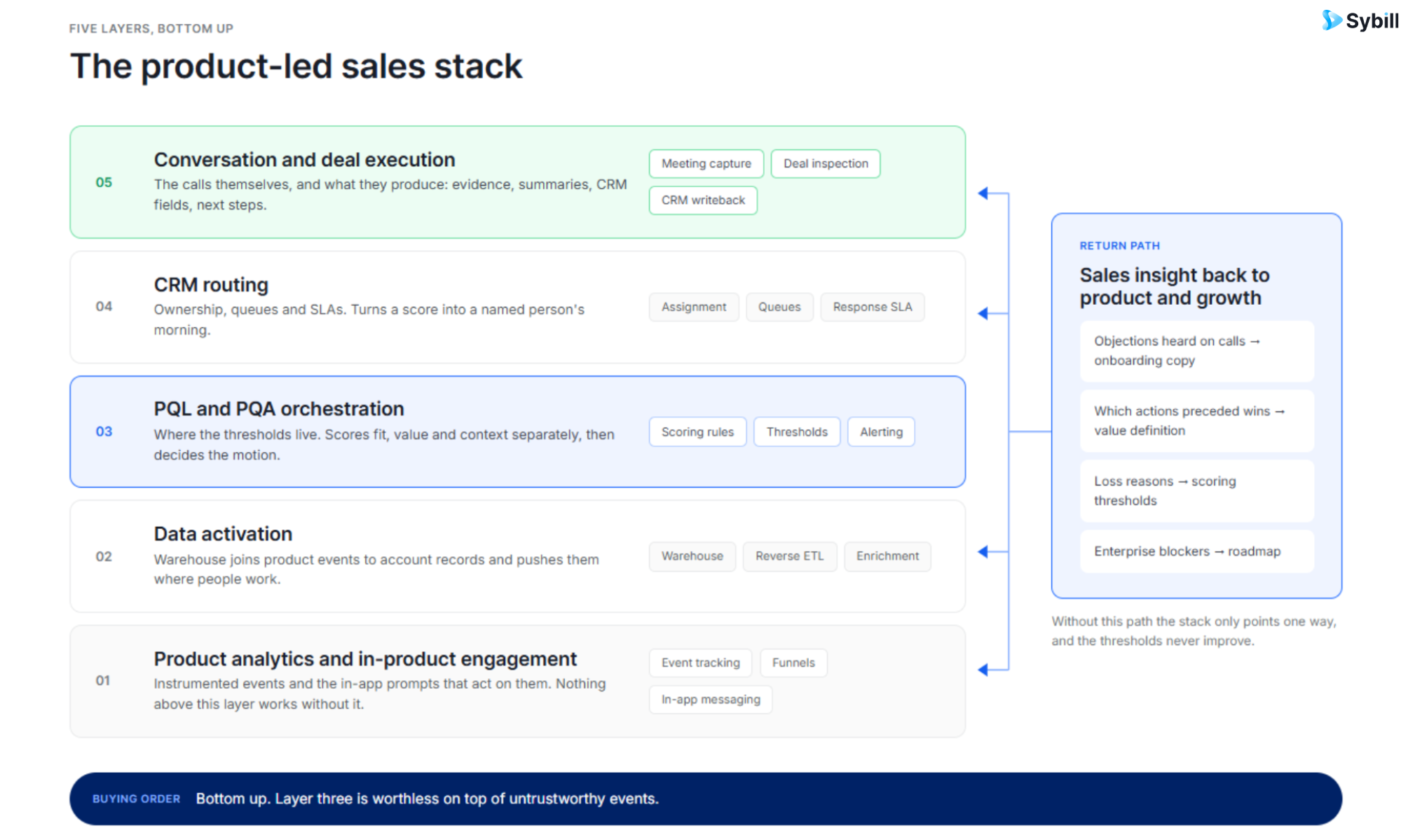
Product-led sales software is not one tidy category. Different tools capture signals, activate data, qualify accounts or help sellers act.
When evaluating tools, ask:
Start with the system you cannot operate without, then add tooling where manual work, slow experimentation or missing context is constraining revenue.
For a deeper comparison of qualification platforms, see The 9 Best Lead-Scoring Tools.
Product signals can tell your team who used a feature, how often they returned and whether adoption is spreading.
But they cannot explain:
That evidence appears in human conversations.
Once an account reaches sales, Ask Sybill can retrieve needs, stakeholders, objections, commitments and deal history across calls, emails, CRM records and other sales context.
Deal Inspection helps teams assess qualification, momentum and risk. CRM Autofill captures new conversation evidence without asking reps to perform another round of administration. Follow-ups, AI tasks and the Deal Workspace help turn that context into action.
The division of labour is clean:
Product analytics tells the team who did what. Sybill helps the rep understand what buyers said, what the deal needs and what should happen next.
Your product earned the conversation. See how Sybill helps sellers make it count.
Imagine a RevOps manager at a 700-person software company starts using a free workflow-automation product.
They complete the core setup, connect their CRM and invite five colleagues. Usage spreads across two sales teams. The company matches the vendor’s enterprise ICP, and the group is approaching a plan limit.
That is stronger than one active PQL. It is a possible PQA.
Sales reaches out with a specific hypothesis: the team may need central administration, broader CRM governance and enterprise security. During the conversation, the RevOps manager confirms the value but reveals that IT, finance and the CRO will influence the purchase.
The product signal found the account. The conversation uncovered the buying process.
PLS works when those two forms of evidence remain connected throughout the deal.
Product-led sales is not a free trial with an AE waiting nearby.
It is a coordinated system that decides:
The product should lead users to value. Sales should enter only when a human can help turn that value into a larger, more complex or more durable customer outcome.
Get started with Sybill to bring better buyer and deal context into every product-led sales conversation.
Product-led growth often creates inbound demand by allowing users to discover and experience the product independently. Product-led sales qualifies that demand using actual product behaviour, account fit and buying context. Unlike a conventional inbound lead, a PQL has experienced measurable product value. Read the broader inbound versus outbound sales comparison.
A product-led business uses the product as a major driver of acquisition, activation, retention and expansion. Users can usually experience meaningful value before making a substantial purchase or speaking to sales. Product-led does not mean sales, marketing and customer success disappear. Their work is organised around the product experience.
No. Product-led sales can work with freemium plans, free trials, product sandboxes or guided product experiences. The essential requirement is that prospective customers can experience enough genuine product value to produce useful qualification signals before or alongside sales engagement.
A product-qualified lead is an individual whose product behaviour suggests that sales assistance may be useful. A product-qualified account is an organisation whose combined user activity, customer fit and buying context indicate a larger commercial opportunity. B2B PLS teams often need both because an active user may not control the organisational purchase.
Product-led growth often creates inbound demand by allowing users to discover and experience the product independently. Product-led sales qualifies that demand using actual product behaviour, account fit and buying context. Unlike a conventional inbound lead, a PQL has experienced measurable product value. Read the broader inbound versus outbound sales comparison.
A product-led business uses the product as a major driver of acquisition, activation, retention and expansion. Users can usually experience meaningful value before making a substantial purchase or speaking to sales. Product-led does not mean sales, marketing and customer success disappear. Their work is organised around the product experience.
No. Product-led sales can work with freemium plans, free trials, product sandboxes or guided product experiences. The essential requirement is that prospective customers can experience enough genuine product value to produce useful qualification signals before or alongside sales engagement.