Find us at booth #83, join us for a harbor side happy hour, or catch Gorish’s talk.

Sept, 16-18 > Learn more


Tamanna Mishra

May 15, 2026
.png)
AI auto follow up emails help sales teams turn meeting context into timely, personalized follow-ups without starting from a blank page. But speed alone is not the win. The real win is relevance. The best AI follow-up tools capture what buyers said, what they care about, what was promised, who owns the next step, and how the rep actually writes. Sybill does exactly that, helping reps send contextual follow-ups right after every meeting.
Sales teams spend weeks preparing for the big call.
They research the account. They map stakeholders. They build the deck. They run discovery. They handle objections. They say all the right things.
Then the call ends.
And suddenly, the most important next step is sitting inside a rep’s overloaded brain, a messy transcript, and maybe three half-written notes in the CRM.
That is where deals lose momentum.
Not because the rep is lazy. Not because the buyer is uninterested. But because follow-up is where good conversations turn into actual movement. If the email is late, vague, incomplete, or painfully generic, the energy from the call evaporates.
You know the email.
“Just checking in.”
“Let me know if you have any questions.”
“Looking forward to next steps.”
Nobody has ever forwarded that to their CFO with the message, “This vendor gets us.”
That is why AI auto follow up emails are becoming such a big deal for sales teams. Done right, they help reps send faster, sharper, more contextual emails after every meeting. Not robotic templates. Not generic AI word salad. Real follow-ups that recap the conversation, capture action items, and move the deal forward.
Sybill helps reps do exactly that. It turns meeting context into personalized follow-up emails in the rep’s own writing style, right after the call, so every buyer gets a message that feels specific, timely, and useful.
AI auto follow up emails are follow-up emails generated automatically by AI after a sales call, demo, discovery meeting, customer check-in, renewal discussion, or any other buyer interaction.
At the simplest level, they save reps from staring at a blank email draft.
But the better version goes much deeper.
A strong AI follow-up email tool does not just write a polished message. It uses the actual meeting context to understand what happened, what matters, and what should happen next.
That includes details like:
That difference matters.
Because sales follow-up is not creative writing. It is deal management in email form.
A good follow-up confirms alignment. A bad one creates ambiguity. A great one helps the buyer sell your solution internally.
Here is the simplest way to understand the category.
.png)
The bottom line: AI auto follow up emails are useful only when they reduce effort without flattening the message.
Because nobody needs more AI-generated beige.
Most sales follow-ups do not fail because reps cannot write.
They fail because reps are busy, context is scattered, and post-call admin is where enthusiasm goes to die.
A rep might have six calls in a day. Each call has different pain points, stakeholders, objections, next steps, and timelines. By 5 pm, the discovery call from 10:30 am is already competing with Slack pings, CRM updates, pipeline reviews, and the existential dread of Monday forecasting.
So follow-ups become rushed.
Sometimes they are late. Sometimes they miss the real buyer concern. Sometimes they summarize the call but forget the next step. Sometimes they are so generic they could have been sent after literally any meeting in the known universe.
The most common problems look like this:
.png)
A follow-up email is not a courtesy note. It is a control point. It tells the buyer, “Here is what I heard. Here is what matters. Here is what happens next.”
If your follow-up cannot do that, it is just inbox confetti.
The best AI auto follow up email tools do not begin with a prompt. They begin with context.
That is what separates a useful sales follow-up from a generic AI-generated email that sounds like it was written by a polite intern trapped inside a SaaS brochure.
.png)
After a sales call, the AI analyzes the conversation. It identifies what was discussed, what the buyer cared about, what objections came up, and what commitments were made.
This is where transcript-only tools can struggle. A transcript tells you what was said. A sales-aware AI tool understands why it mattered.
For example, “We need to loop in finance” is not just a line in a transcript. It might mean budget validation, stakeholder expansion, procurement risk, or a chance to bring in the economic buyer.
Good AI follow-up tools catch those signals.
A follow-up email should not just say, “Great speaking with you.”
It should clarify what happens next.
Who is sending the security documentation? Who is introducing the RevOps lead? Who is confirming the timeline? Who owns the pricing review? When is the next call?
This is where AI can remove a lot of manual cleanup. Instead of asking reps to reconstruct every open item from memory, it can identify action items and assign them to the right participants.
That is not just admin reduction. That is pipeline hygiene.
Once the AI understands the meeting, it creates a follow-up email that includes:
The goal is not to write the longest email. The goal is to write the email the buyer can act on.
AI should remove the blank page. It should not remove human judgment.
The rep still reviews the message, adjusts nuance, adds anything sensitive, and sends it. That review step matters because sales is still human. AI can capture context. The rep still owns the relationship.
A strong AI-generated sales follow-up email should not read like a recycled template wearing a fake mustache. It should feel like a continuation of the actual conversation.
That means five things.
First, it should open with context. Not “Hope you’re doing well.” Not “Thanks for your time.” Those are fine, but they are not enough. The email should acknowledge something specific from the meeting.
Second, it should summarize only what matters. Buyers do not need a court transcript. They need the business problem, the relevant discussion points, and the path forward.
Third, it should capture action items. A follow-up without ownership is just vibes.
Fourth, it should connect the conversation back to value. If the buyer talked about slow CRM updates, messy handoffs, or poor deal visibility, the email should reinforce how the solution helps with those specific pains.
Fifth, it should make the next step painfully obvious.
Here is the difference between a good follow up email and a subpar one.
.png)
The second email works because it is specific. It reflects the conversation. It confirms the pain. It documents next steps. It gives the buyer something useful to forward internally.
That is the standard AI auto follow up emails should meet.
Generic AI email generators are impressive until you ask them to understand a deal.
They can write clean copy. They can make your email shorter, warmer, punchier, or more professional. They can even create five subject line options that sound like they went to a productivity bootcamp.
But sales follow-up is not just a writing task.
It is a context task.
A generic AI tool does not automatically know:
That means the rep still has to feed the AI all the important context.
At that point, the workflow becomes hilariously inefficient.
You summarize the meeting so the AI can summarize the meeting.
That is not automation. That is cosplay.
For sales teams, the real value comes from AI that already understands the conversation and can connect it to the deal. That is where Sybill’s approach is stronger.
Sybill does not just draft emails.
It remembers the room.
That is the product story this blog should own, because it separates Sybill from generic AI writing tools and basic email automation platforms.
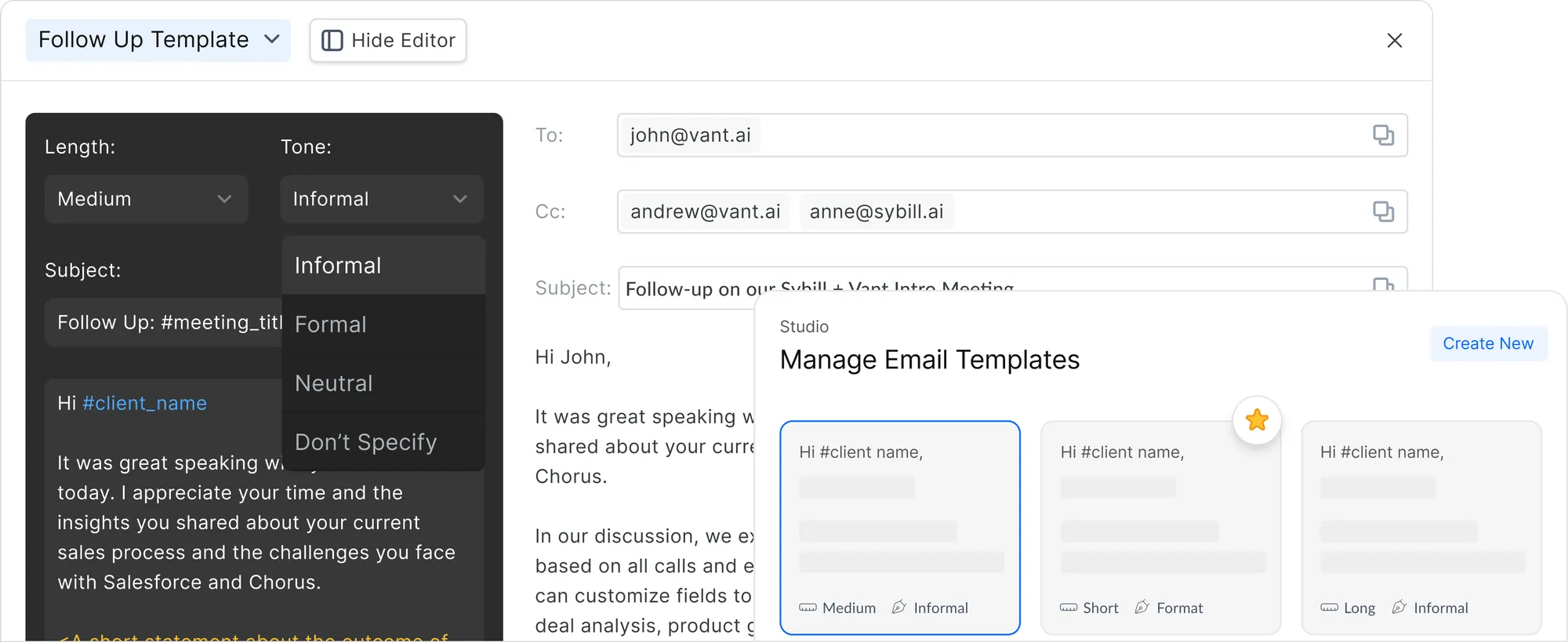
Sybill writes follow-up emails based on actual call context and the rep’s writing style. It helps reps send personalized emails right after the meeting, without missing key discussion points or open action items.
.png)
With Sybill, reps do not have to manually explain what happened on the call before getting a usable email.
Sybill captures the conversation and turns it into a follow-up that reflects the meeting. It can include a thoughtful acknowledgment, a concise summary of what was discussed, and the specific next steps that matter.
This is especially useful after calls where multiple things happen at once.
A buyer mentions an integration concern. Another stakeholder asks for a security review. Someone brings up budget timing. A champion says they need a deck for their VP. The rep leaves with four follow-up threads in one conversation.
Sybill helps organize that chaos into a clear email.
Deals do not usually stall because everyone explicitly says “no.”
They stall because one person forgot to send the security document. Or the buyer never confirmed who should join the next call. Or the rep did not recap the procurement question clearly enough. Or the next step was “circle back,” which is just a slower way of saying “good luck.”
Sybill captures action items and assigns them to the correct call participants, so follow-ups are not just polite recaps. They become accountability documents.
That matters for reps. It matters even more for managers who need consistent execution across the team.
One of the biggest fears with AI-generated sales emails is that everyone starts sounding like the same overenthusiastic robot.
Sybill avoids that by letting reps personalize emails based on their own style. Reps can customize length, tone, subject, and body. They can also create and save templates for different deal stages.
Even better, Sybill can learn from a rep’s past emails and generate follow-ups with the same essence.
That means a rep who writes crisp, direct emails does not suddenly sound like a corporate newsletter. A rep who uses a warmer consultative tone can keep that style. The AI supports the relationship instead of sanding off the personality.
Sybill is not a generic AI layer pretending every workflow is the same.
Its sales-aware AI uses company and deal context to produce more relevant outputs. It also looks across calls and emails to understand the fuller picture of a deal, instead of treating every call like an isolated event.
That is important because follow-ups do not happen in a vacuum.
The email after a first discovery call is different from the email after a technical validation call. A follow-up to a champion is different from a follow-up to an economic buyer. A renewal check-in is different from a pricing negotiation.
Sybill helps reps match the follow-up to the moment.

AI auto follow up emails are useful across the sales cycle, but they are especially powerful after high-context conversations.
Discovery calls are packed with valuable context. Pain points. Goals. Current processes. Buying triggers. Internal blockers. Success criteria.
A strong AI follow-up after discovery should recap the buyer’s world, not just your product.
For example, instead of saying, “Here is more information about Sybill,” the email can say:
“Based on what you shared, your team is losing time across post-call admin, inconsistent CRM updates, and missed follow-up tasks. I’ve included a quick overview of how Sybill helps reps move from call to summary, email, and CRM update without manual rework.”
That is much stronger because it connects the product to the pain.
Demo follow-ups are where many reps accidentally become feature librarians.
They send a long list of everything shown on the call. The buyer then has to figure out what mattered.
AI can help tighten the recap around the buyer’s priorities. If the buyer cared most about CRM Autofill, Personalized Emails, and AI Tasks, the follow-up should not spend equal space on everything else.
It should reinforce the specific workflows that caught their attention.
Pricing conversations are delicate. The follow-up needs to be clear, accurate, and calm.
AI auto follow up emails can help recap package details, timelines, procurement steps, decision owners, and any open commercial questions. That reduces confusion and keeps the deal from becoming a “Wait, what did we agree on?” situation.
Very glamorous. Very necessary.
Customer conversations are full of expansion signals, risks, and success proof.
An AI-generated follow-up can recap outcomes discussed, new goals, unresolved concerns, and next steps for expansion. This is useful for customer success teams as much as account executives.
When deals slow down, reps often send lazy nudges.
“Just checking in” is not a strategy. It is a shrug in email form.
A better AI-assisted follow-up can reference the last real business priority, restate the value, and suggest a specific next step.
That is how you reopen a conversation without sounding desperate.
AI auto follow up emails and sales email sequences are not the same thing. They can work together, but they solve different problems.
Sales sequences are planned in advance. They are great for outbound prospecting, nurture motions, event follow-ups, and structured cadences.
AI auto follow up emails are triggered by real buyer interactions. They are strongest after meetings, demos, calls, and deal events where the context has changed.
Here is the difference.
.png)
The simplest way to think about it: Sequences help you start and maintain outreach. AI auto follow up emails help you respond intelligently after something meaningful happens.
For modern sales teams, both matter. But if your reps are having high-value conversations and then sending low-value follow-ups, the leak is obvious.
Not every AI follow-up email tool deserves a spot in your sales workflow.
Some are glorified prompt boxes. Some are template libraries with an AI sticker. Some can write decent emails but cannot understand the deal. Some are useful for individual reps but weak for teams that need consistency, security, and process visibility.
Here is what to check before choosing one.
.png)
Sybill is built around these exact needs. It helps reps draft contextual follow-ups, capture meeting summaries, update CRM, manage AI Tasks, and keep deal workflows moving from one place.
That is the bigger point.
The best AI follow-up email tool should not only write emails. It should reduce the operational drag around follow-up.
AI can make sales follow-ups faster. It can also make bad habits scale beautifully.
That is the danger.
Here are the mistakes to avoid.
AI-generated does not mean send-ready every time. Reps should still review for nuance, accuracy, and relationship context.
Especially after sensitive conversations around budget, legal, procurement, or competitive displacement.
Some AI tools love paragraphs the way toddlers love glitter.
More words do not mean more value. A good follow-up should be complete, but not exhausting. Buyers should understand the point in seconds.
Personalization is not “I noticed you mentioned your dog.”
Useful personalization connects to business context. Pain points, priorities, constraints, desired outcomes, and agreed next steps matter more than random trivia.
Every sales follow-up needs a next step. Even if the next step is small.
Confirm the next call. Ask for the right stakeholder. Share a document. Request approval. Validate timing. Move something forward.
No CTA, no momentum.
AI can help write the email. It cannot own the relationship.
The rep still needs judgment. The rep knows when to be direct, when to slow down, when to push, when to soften, and when the buyer needs something outside the script.
AI should make good reps sharper, not make every rep sound identical.
The best sales teams do not treat follow-up as admin.
They treat it as part of the sales strategy.
Because every follow-up email answers a few silent questions for the buyer:
Did this rep understand our problem?
Did they listen carefully?
Do they know what matters?
Are they organized?
Can I trust them with the next step?
Can I forward this internally without rewriting it myself?
That last one is huge.
A strong follow-up does not just help the buyer remember the meeting. It helps them advocate for the next step when you are not in the room.
That is where AI auto follow up emails can have a serious impact. They help reps consistently turn conversations into clear, buyer-ready communication.
Not eventually. Not after three reminders. Right after the meeting, while the context is still fresh and the deal still has heat.
Sybill helps sales teams do this by connecting follow-up emails to the full sales workflow. The same conversation can power the meeting summary, the CRM update, the action items, and the follow-up email.
That is the difference between a tool that writes emails and a system that keeps deals moving.
Speed matters in sales follow-up.
But speed without context is just faster noise.
AI auto follow up emails are valuable because they help reps turn real conversations into clear, timely, personalized communication. They reduce manual drafting, prevent missed action items, and help buyers understand exactly what happens next.
But the quality of the output depends on the quality of the context.
Generic AI can write a decent email. Sybill helps write the right one.
With Sybill, sales teams can generate follow-up emails from actual call context, personalize them in the rep’s writing style, capture open items, and keep deal momentum alive without drowning in post-call admin.
If your reps are still writing follow-ups from memory, copy-pasting templates, or sending “just checking in” emails into the void, it may be time for a better system.
Try Sybill to create instant, contextual, personalized follow-up emails after every sales meeting, without sounding like a bot.
AI auto follow up emails are follow-up emails drafted automatically by AI after a sales call, meeting, or customer interaction. The best tools use conversation context, action items, buyer priorities, and deal stage to create relevant emails that help move the opportunity forward.
AI follow-up emails help sales teams save time, reduce missed action items, improve response speed, and create more consistent post-meeting communication. They are especially useful after discovery calls, demos, pricing discussions, renewal meetings, and expansion conversations.
They can be, but only if the AI has enough context. Basic tools may personalize with names and company details. Stronger tools like Sybill use call context, open items, deal history, and the rep’s writing style to create more specific and useful follow-ups.
A strong sales follow-up email should include a contextual opening, a short recap of the discussion, key buyer pain points, action items, owners, timelines, helpful resources, and a clear next step. It should be easy for the buyer to act on or forward internally.
No. AI auto follow up emails should reduce manual drafting and admin work, not replace sales judgment. Reps still need to review the message, refine nuance, and decide what the buyer needs next. The best AI tools help reps communicate faster without making the relationship feel automated.
AI auto follow up emails are follow-up emails drafted automatically by AI after a sales call, meeting, or customer interaction. The best tools use conversation context, action items, buyer priorities, and deal stage to create relevant emails that help move the opportunity forward.
AI follow-up emails help sales teams save time, reduce missed action items, improve response speed, and create more consistent post-meeting communication. They are especially useful after discovery calls, demos, pricing discussions, renewal meetings, and expansion conversations.
They can be, but only if the AI has enough context. Basic tools may personalize with names and company details. Stronger tools like Sybill use call context, open items, deal history, and the rep’s writing style to create more specific and useful follow-ups.