Find us at booth #83, join us for a harbor side happy hour, or catch Gorish’s talk.

Sept, 16-18 > Learn more


Tamanna Mishra

February 14, 2026
67 percent of B2B buyers say sales conversations do not reflect their actual business context. Nearly three out of four buyers walk into calls already informed, already opinionated, and already constrained by internal realities sales rarely uncover.
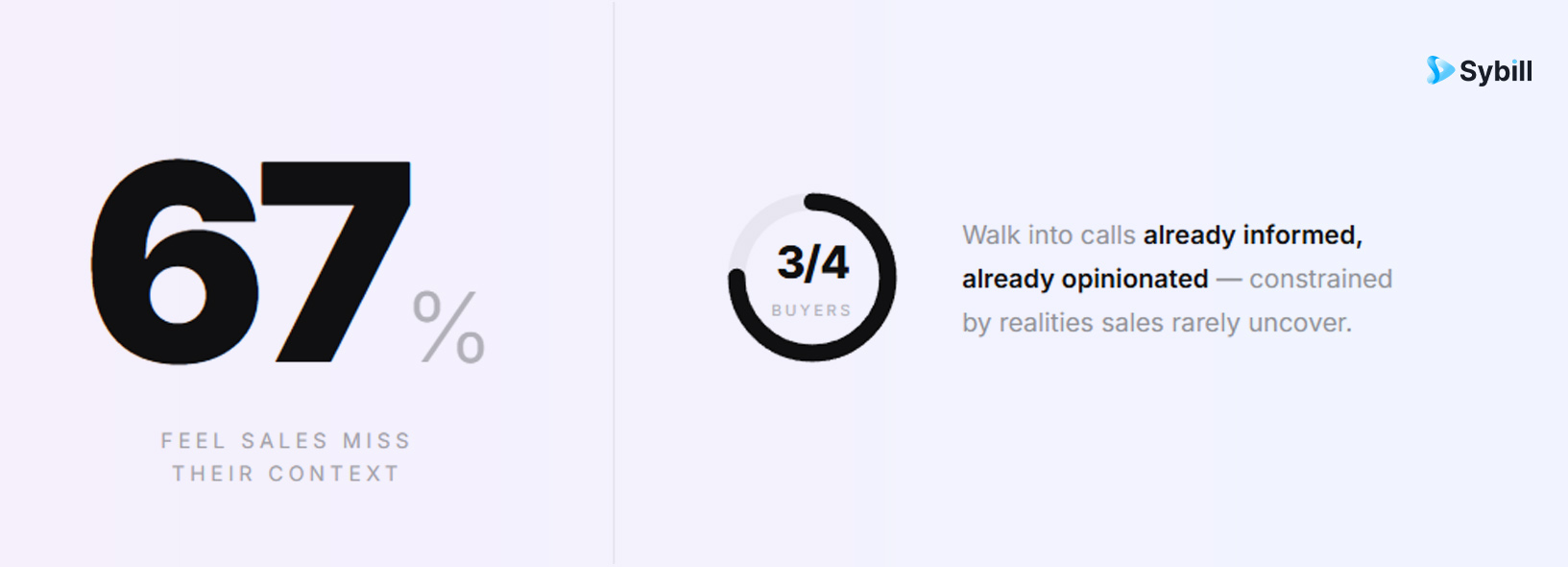
These numbers paint a stark picture. Especially when everyone claims they sell consultatively. Very few can prove it. The numbers surely don’t/
Sales teams talk about discovery, empathy, and buyer centricity while running calls that feel like feature speed dating. Buyers show up informed, politically constrained, and under pressure. Reps show up with a script and hope.
That mismatch is an execution problem.
Consultative selling has always been the right philosophy. The problem is that it has never been operational. It lives in enablement decks, not systems. In intentions, not behaviors.
AI does not replace consultative selling.
It finally makes it executable at scale.
This is not about sounding smarter on calls. It is about capturing buyer intent, decision risk, and context consistently, then using that intelligence to guide discovery, next steps, and coaching across every deal.
That is what it means to operationalize consultative selling with AI.
The consultative selling definition has changed, even if most sales teams have not updated how they execute it.
Today, consultative selling is structured diagnosis, not casual questioning. It is a disciplined approach to uncovering how a buyer understands their problem, what risks they are managing, and what constraints shape their decisions. This is not about sounding curious. It is about running a deliberate diagnostic conversation.
At its core, the goal of consultative selling is to help buyers make better decisions under uncertainty. Buyers are rarely choosing between a good option and a bad one. They are choosing between trade-offs, timing risks, and internal pressures. Effective consultative selling clarifies those trade-offs and makes decision paths visible.
Modern consultative selling adapts in real time based on buyer signals. Changes in tone, hesitation, urgency, or pushback all signal how a buyer is thinking. This is where AI for consultative selling becomes critical. AI helps capture, interpret, and retain these signals across conversations, something human memory alone cannot do consistently at scale.
Click here for a deep dive into what it means to sell consultatively in 2026.
It is equally important to be clear about what consultative selling is not.
Click here for a deep dive into relationship selling vs insight selling.
Consultative selling today is a decision-support role, not a persuasion role. The job is not to convince buyers to say yes. It is to help them understand their situation clearly enough to make a confident decision.
If consultative selling feels effective in isolated deals but unreliable across the team, you are seeing a scale problem, not a skill problem.
Most organizations struggle to operationalize consultative selling because execution breaks the moment volume increases. What works for a few top performers quietly collapses when applied across dozens of reps and hundreds of deals.
Here is where it breaks down.
Here is the hard truth.
You cannot operationalize consultative selling with playbooks alone. Playbooks describe what should happen. They do not ensure it actually happens. To scale consultative selling, teams need systems that capture how buyers think, not just what they buy.
This is why consultative selling breaks at scale and why execution, not philosophy, is the real bottleneck.
To operationalize consultative selling is not to document best practices. It is to make good judgment repeatable, inspectable, and scalable across every deal and every rep.
Operationalization means the difference between a few great conversations and a system that consistently produces them.
To get there, four requirements must be in place.
This is the point where AI stops being optional.
Without AI, consultative selling remains aspirational. With it, consultative selling becomes executable at scale.
AI does not sell. AI observes, remembers, and connects patterns humans cannot at scale.
That distinction matters. AI-assisted consultative selling is not about automating human judgment. It is about augmenting it with visibility that no individual rep or manager can achieve alone.
This is why AI changes execution. Consultative selling still requires human skill. AI simply makes that skill consistent, measurable, and scalable across the entire sales organization.
Not all AI tools for consultative selling are created equal. The ones that actually work share four core capabilities. Miss even one, and consultative selling stays theoretical.
This is the foundation.
AI must go beyond transcription and identify what buyers mean, not just what they say.
How Sybill helps:
Sybill captures buyer needs and intent directly from conversations, tagging objections, interests, and risk signals automatically so nothing critical gets lost after the call.
Consultative selling fails when discovery quality is inconsistent. AI should make that visible.
How Sybill helps:
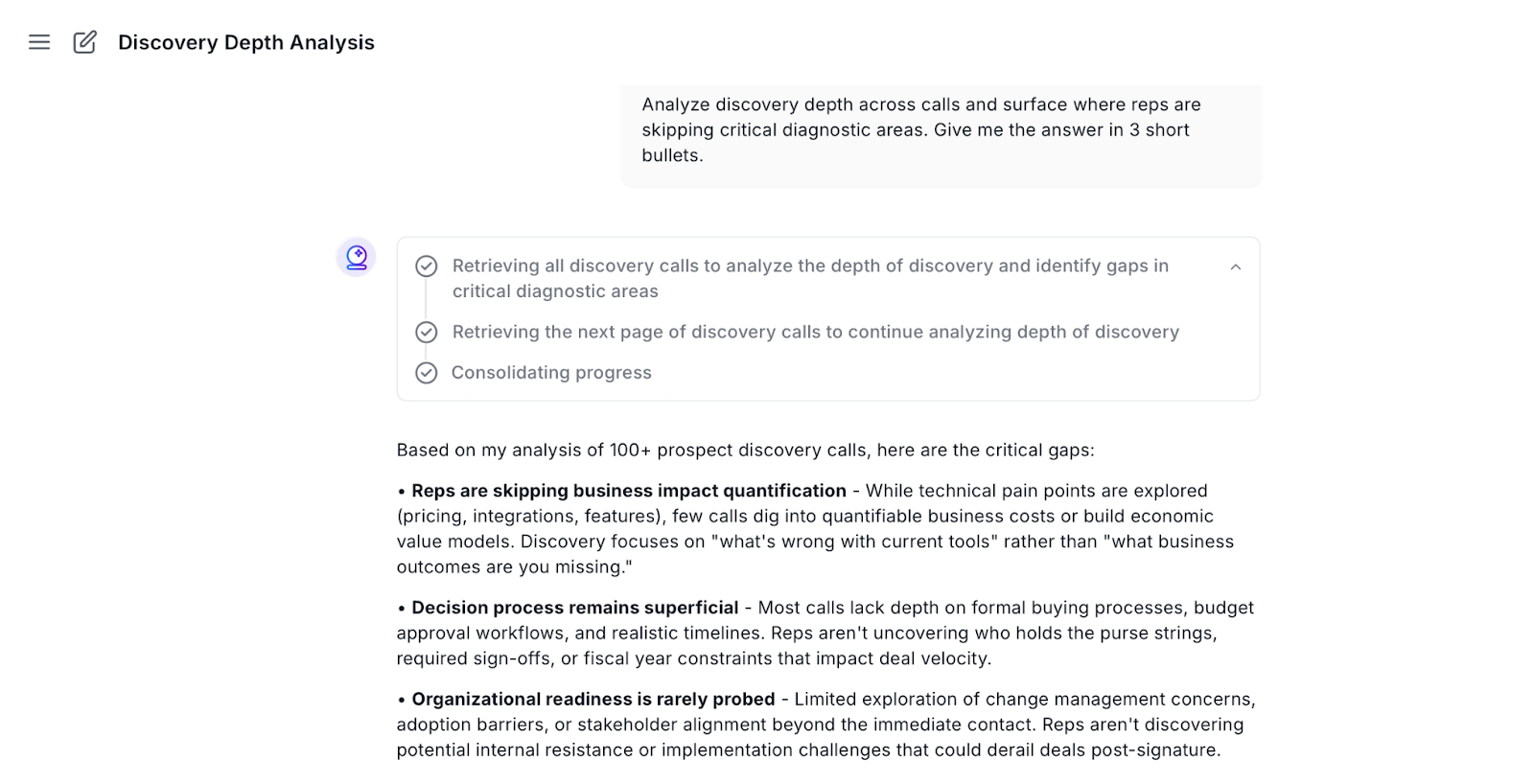
Supersellers use Ask Sybill to analyze discovery depth across calls and surface where reps are skipping critical diagnostic areas, using real winning deals as the benchmark.
Great consultative selling looks at the entire decision journey, not isolated calls.
How Sybill helps:
Sybill’s Deal Workspace builds a unified deal view that shows how buyer intent, objections, and momentum evolve, giving teams early warning before deals stall or slip.
Coaching breaks when it relies on summaries and opinions.
AI must anchor coaching in real buyer conversations.
How Sybill helps:
Sybill can surface moments where discovery weakened or buyer signals were missed, allowing managers to coach with precision and not generic, one-size-fits-all advice.
Using AI for consultative selling is not about adding more tools to the stack. It is about improving how discovery, understanding, and follow-through happen across every conversation.
Here is what that looks like in practice.
Strong consultative selling starts before the meeting, not during it.
How Sybill helps:
Sybill’s Pre-Meeting Brief automatically summarizes deal context, buyer signals, and likely discussion areas before the call begins.
This is where consultative selling either deepens or derails.
How Sybill helps:
Sybill’s Behavior AI captures buyer engagement signals, objections, and interest areas directly from live conversations, helping reps adjust discovery and next steps.
Execution quality is defined by what happens next.
How Sybill helps:
Sybill’s Magic Summaries capture buyer intent and key decision signals automatically.
How Sybill helps:
Sybill’s AI Tasks convert buyer commitments into concrete, trackable next steps.
How Sybill helps:
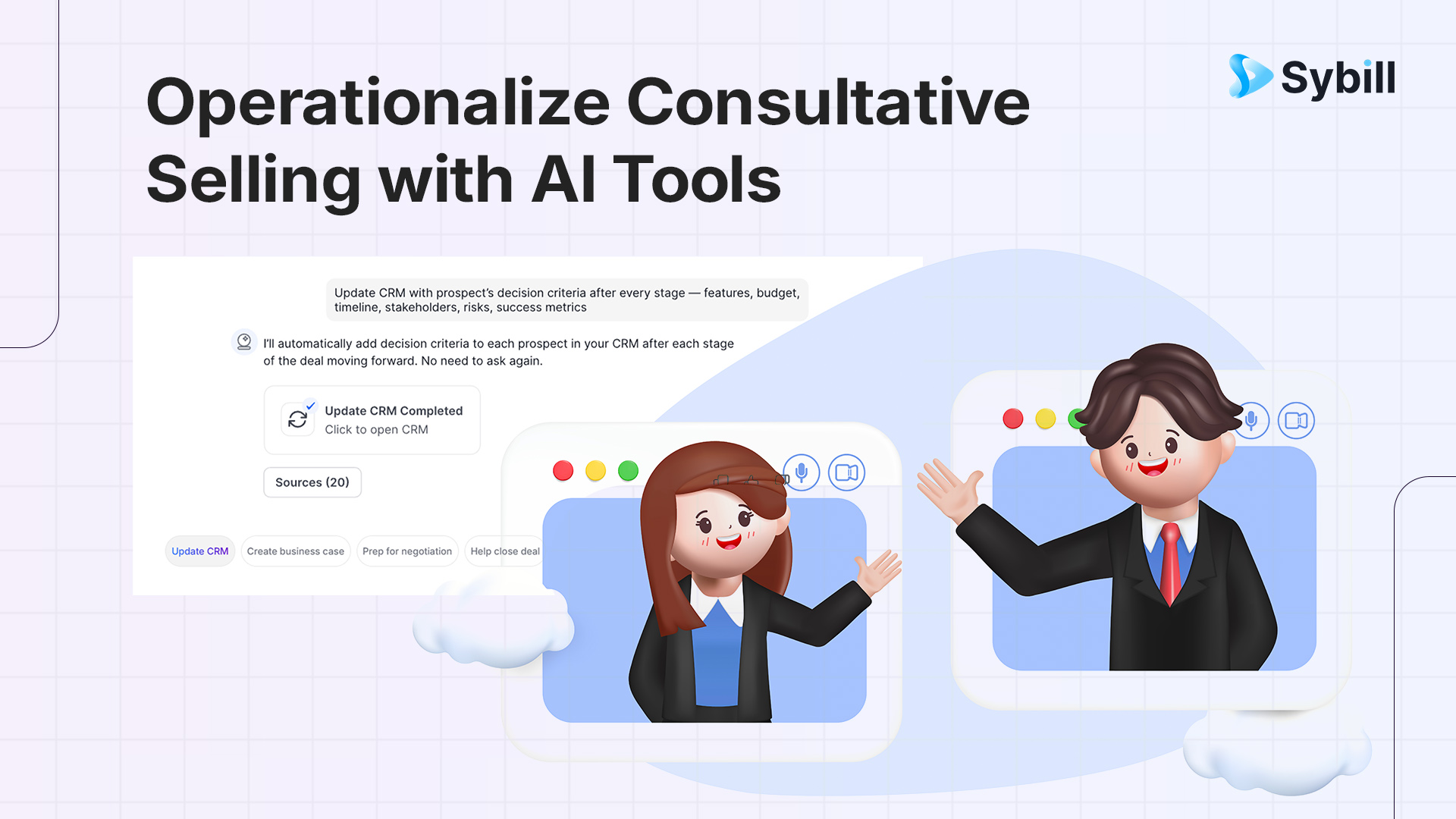
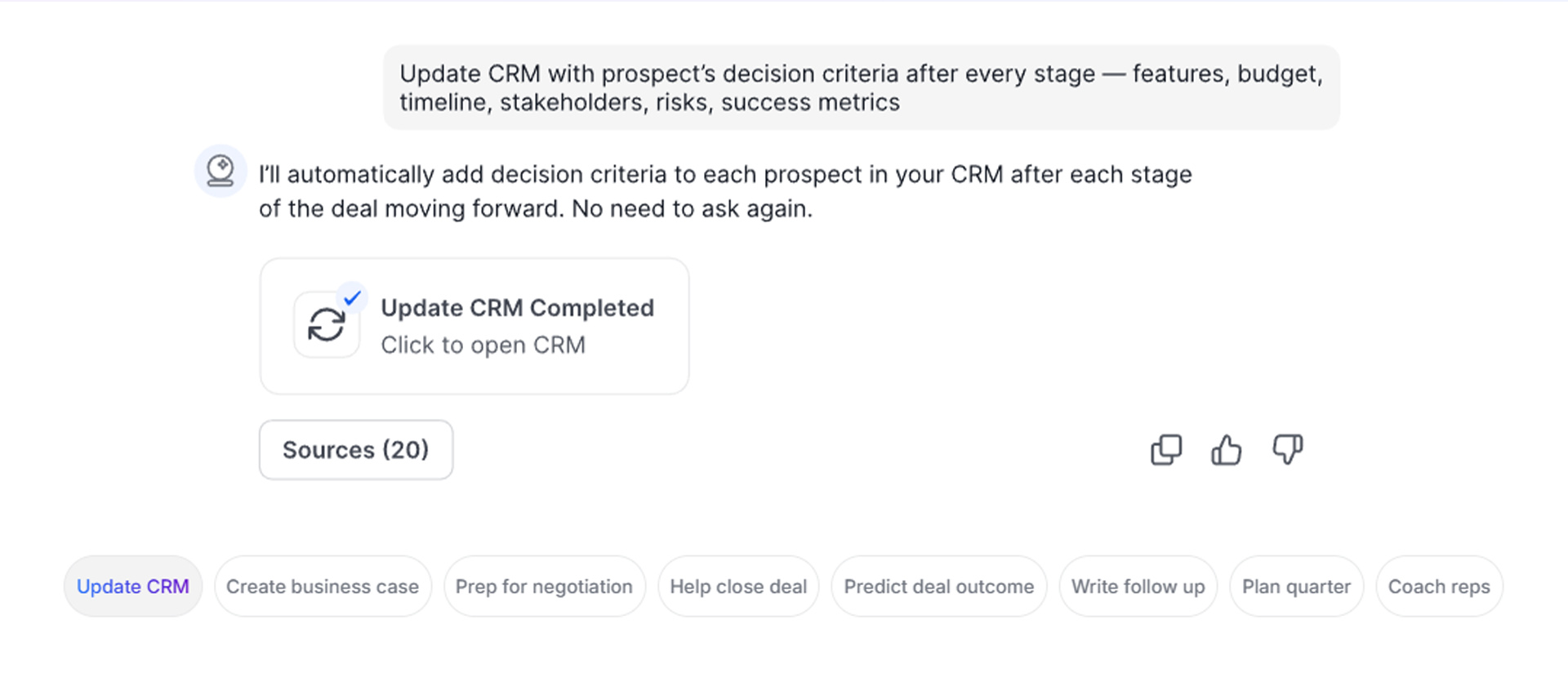
Sybill’s CRM Autofill updates the CRM with decision context without manual input.
Execution rule:
Every call should change your understanding of the buyer’s decision process.
Research has always been part of consultative selling. The problem is that most teams still rely on manual prep that is slow, inconsistent, and outdated by the time the call starts.
AI-powered research tools for AI-assisted consultative selling replace:
Modern research tools do something fundamentally different.
What AI-assisted research enables:
Sybill continuously learns from real sales conversations to power buyer-specific research. Instead of relying on static prep, teams see discovery angles, risks, and context based on how similar buyers actually made decisions in past deals and their current real world needs and intent.
This list answers one question only:
Does the tool help reps understand buyers better and act smarter at scale?
Most AI tools claim to support consultative selling. Very few actually operationalize it.
Best for: Operationalizing consultative selling end to end
Sybill is purpose-built for consultative selling execution, not surface-level automation.
Why Sybill leads:
What makes it different:
Sybill is not a call recorder, transcription layer, or reporting dashboard. It is a consultative selling system designed around buyer behavior, decision risk, and execution consistency across the entire sales cycle.
This is the difference between knowing what happened on a call and understanding how a buyer is deciding.
Click here to try Sybill free.
.jpg)
Best for: Conversation analysis and deal inspection
Strengths:
Limitations:
Gong tells you what happened. It does not consistently guide what to do next.
Click here for a deep dive on Sybill vs Gong.
.jpg)
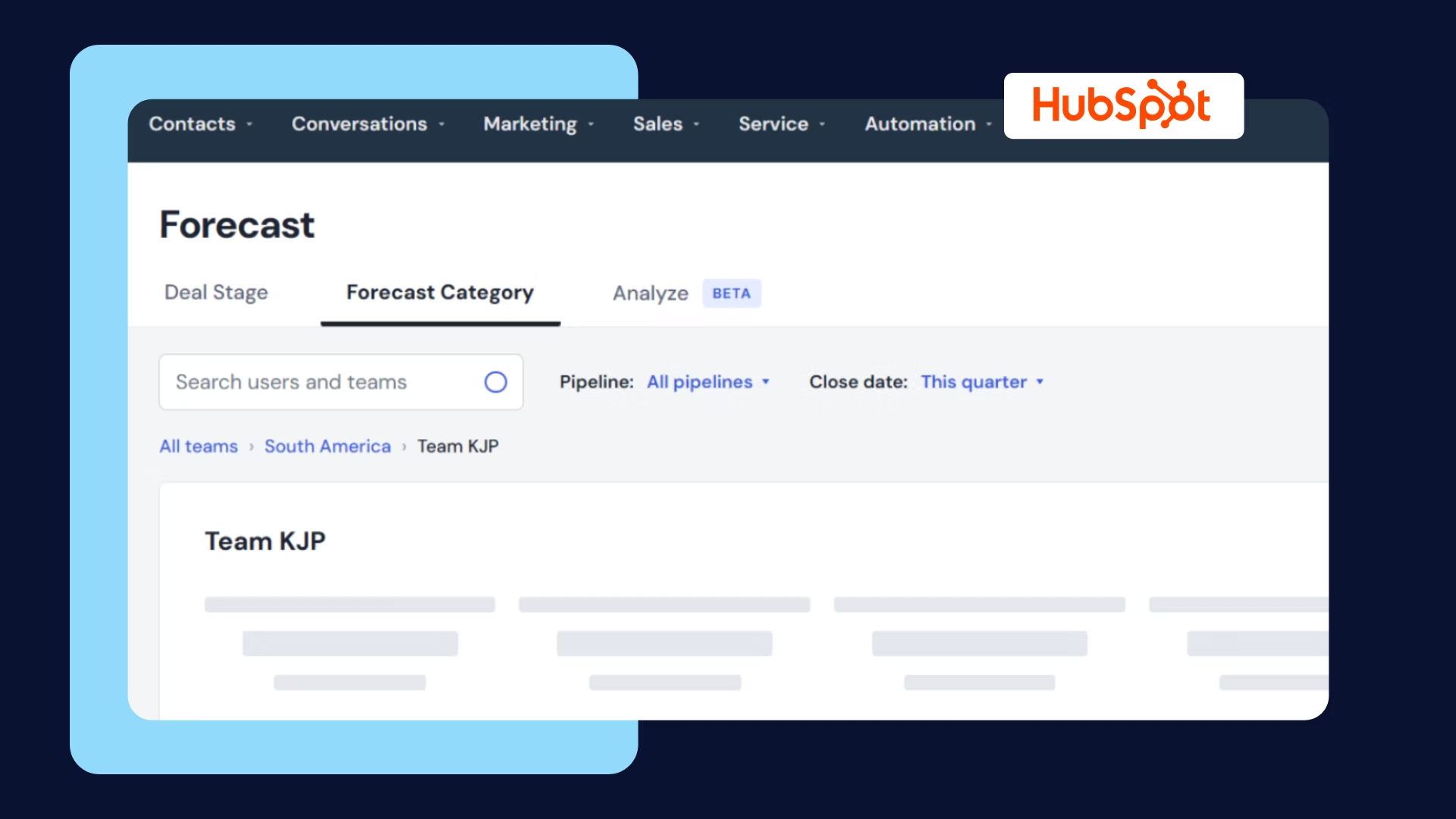
Best for: CRM-native AI assistance for SMB and mid-market teams
Strengths:
Limitations:
HubSpot AI improves productivity. It does not deeply operationalize consultative selling.
.jpg)
Best for: Lightweight call transcription and summaries
Strengths:
Limitations:
Fireflies records conversations. It does not understand them or act in the context of sales processes, strategies, and methodologies like consultative selling.
Click here for a Sybill vs Fireflies comparison deep dive.
.jpg)
Best for: Forecasting and pipeline visibility
Strengths:
Limitations:
Clari helps leaders predict revenue. It does not help reps run better consultative conversations.
Bottom line:
Most AI tools support sales workflows. Only a few support consultative selling execution. Sybill stands out because it focuses on how buyers think, decide, and commit, not just how reps perform.
Choosing the best AI tool for consultative sales is not about feature checklists or vendor promises. It is about whether the tool actually strengthens consultative selling in day-to-day execution.
Most tools look impressive in demos. Far fewer hold up when you ask a harder question: does this help reps understand buyers better and act smarter across real deals?
Use the evaluation questions below to cut through the noise. They are designed to separate AI tools that operationalize consultative selling from those that simply add another layer of reporting.
Evaluation checklist:
If an AI tool creates more dashboards than insight, it is not helping consultative selling. The right tool should quietly improve discovery, decision clarity, and coaching outcomes without increasing cognitive or operational load.
If you want to operationalize consultative selling, success cannot be measured by activity volume or tool usage. It must be measured by execution quality and buyer outcomes.
These are the metrics that actually matter.
When these metrics improve, consultative selling becomes a system that works at scale.
Great reps - or supersellers, like we like to call them - will always matter.
But systems decide whether consultative selling survives growth.
As deal volume increases and buying journeys become more complex, consultative selling cannot depend on individual intuition or heroic effort. It needs structure, visibility, and consistency. That is exactly where AI tools for consultative selling change the game.
AI is not rewriting the philosophy of consultative selling. It is doing something far more important. It is making buyer understanding repeatable, coachable, and scalable across every deal.
When consultative selling is built into systems, teams stop guessing. Discovery improves. Coaching becomes evidence-based. Execution becomes predictable.
Consultative selling is a buyer-centric sales approach where reps diagnose business problems, decision risks, and success criteria before proposing solutions. The consultative selling definition today goes beyond asking good questions. It focuses on insight, context, and decision support, helping buyers navigate complexity and make confident choices rather than pushing them toward a preset outcome.
The best AI tool for sales, like Sybill, improves buyer understanding, discovery quality, and execution consistency while reducing manual work. The most effective tools combine conversation intelligence, deal-level context, and coaching insights so sales teams can act on buyer signals, not just track activity or outcomes.
AI supports consultative selling by analyzing sales conversations, identifying discovery gaps, tracking buyer intent over time, and surfacing decision risk early. When used correctly, AI for consultative selling helps teams replicate high-performing consultative behaviors consistently across reps and deals, instead of relying on individual intuition.
Consultative selling is a buyer-centric sales approach where reps diagnose business problems, decision risks, and success criteria before proposing solutions. The consultative selling definition today goes beyond asking good questions. It focuses on insight, context, and decision support, helping buyers navigate complexity and make confident choices rather than pushing them toward a preset outcome.
The best AI tool for sales, like Sybill, improves buyer understanding, discovery quality, and execution consistency while reducing manual work. The most effective tools combine conversation intelligence, deal-level context, and coaching insights so sales teams can act on buyer signals, not just track activity or outcomes.
AI supports consultative selling by analyzing sales conversations, identifying discovery gaps, tracking buyer intent over time, and surfacing decision risk early. When used correctly, AI for consultative selling helps teams replicate high-performing consultative behaviors consistently across reps and deals, instead of relying on individual intuition.