Find us at booth #83, join us for a harbor side happy hour, or catch Gorish’s talk.

Sept, 16-18 > Learn more


Tamanna Mishra

August 8, 2026
%20(66).png)
TL;DR
The best B2B lead generation strategies create demand, identify suitable buyers, start relevant conversations, and convert interest into pipeline. The right mix depends on your ICP, sales motion, budget, buying stage, and time to impact. AI improves research, personalization, qualification, and follow-up, but cannot manufacture a reason to buy.
A spreadsheet containing 4,000 webinar registrants can look magnificent in a dashboard. If sales cannot tell who fits, why they might buy, or what to say next, it is not pipeline. It is a larger haystack.
That distinction matters because buyers increasingly control the journey. In a 2026 survey of 646 B2B buyers, Gartner found that 67% preferred a rep-free experience and 45% had used AI during a recent purchase. Buyers want to research on their terms. They do not want to surrender an email address just to discover what a product does.
Effective B2B lead generation helps self-directed buyers progress and gives sales enough context to add value. The job is not to force everyone into a demo. It is to make the right conversation easier to start.
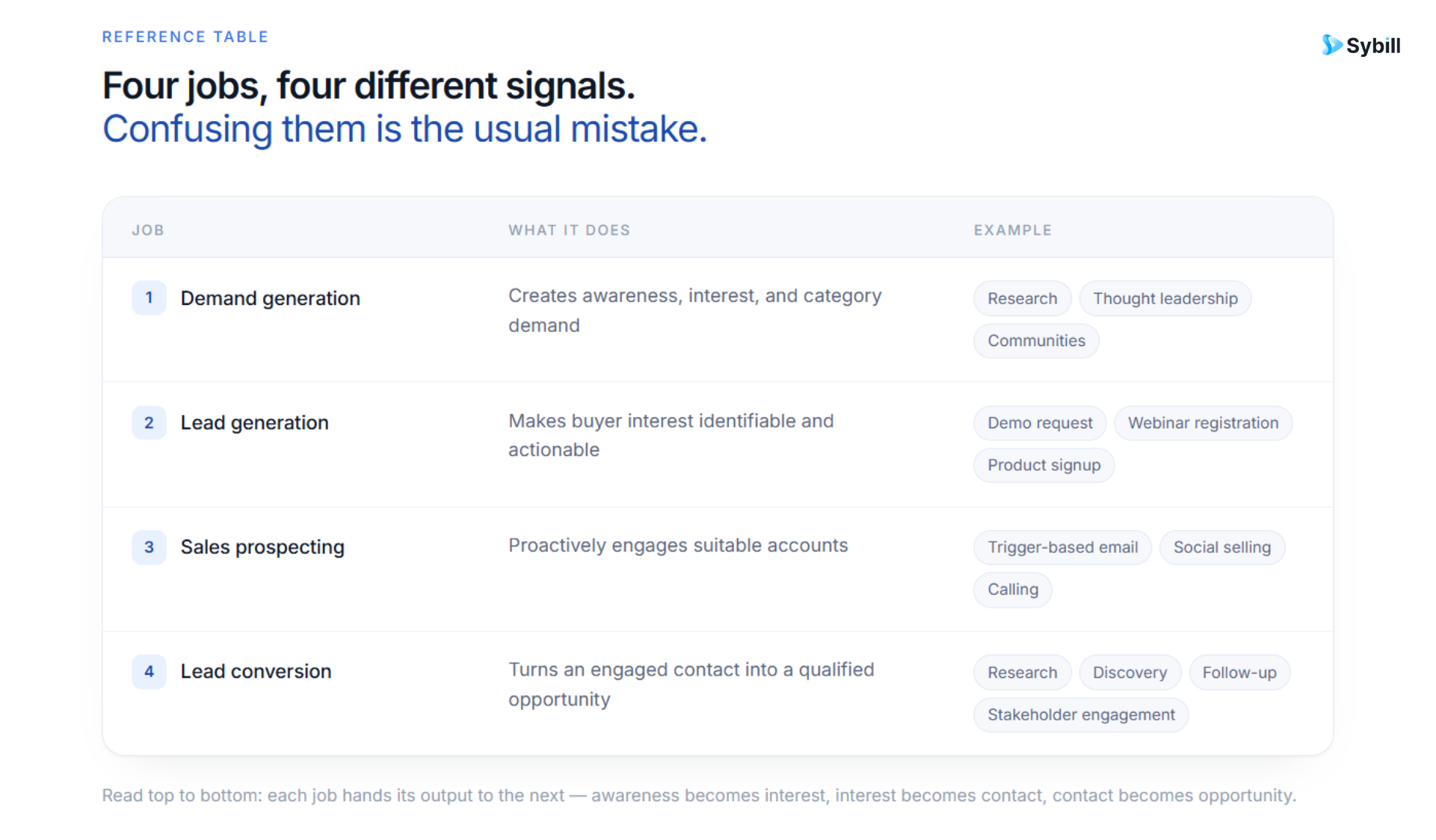
B2B lead generation is the process of identifying potential business buyers, creating a legitimate reason for them to engage, and capturing enough information to qualify and progress that interest. It connects demand creation to sales opportunity creation.
That sounds simple until four different jobs are stuffed into one funnel and labelled “lead gen.”
Sybill does not build lead lists or enrich anonymous visitors. Its value begins when an account or contact is known, then grows with buyer context.
A rep can use pre-meeting briefs to see company, attendee, CRM, email, and interaction context. Magic Summaries capture needs, objections, and next steps. Personalized follow-ups use call context and the rep’s style, while CRM Autofillpreserves qualification data.
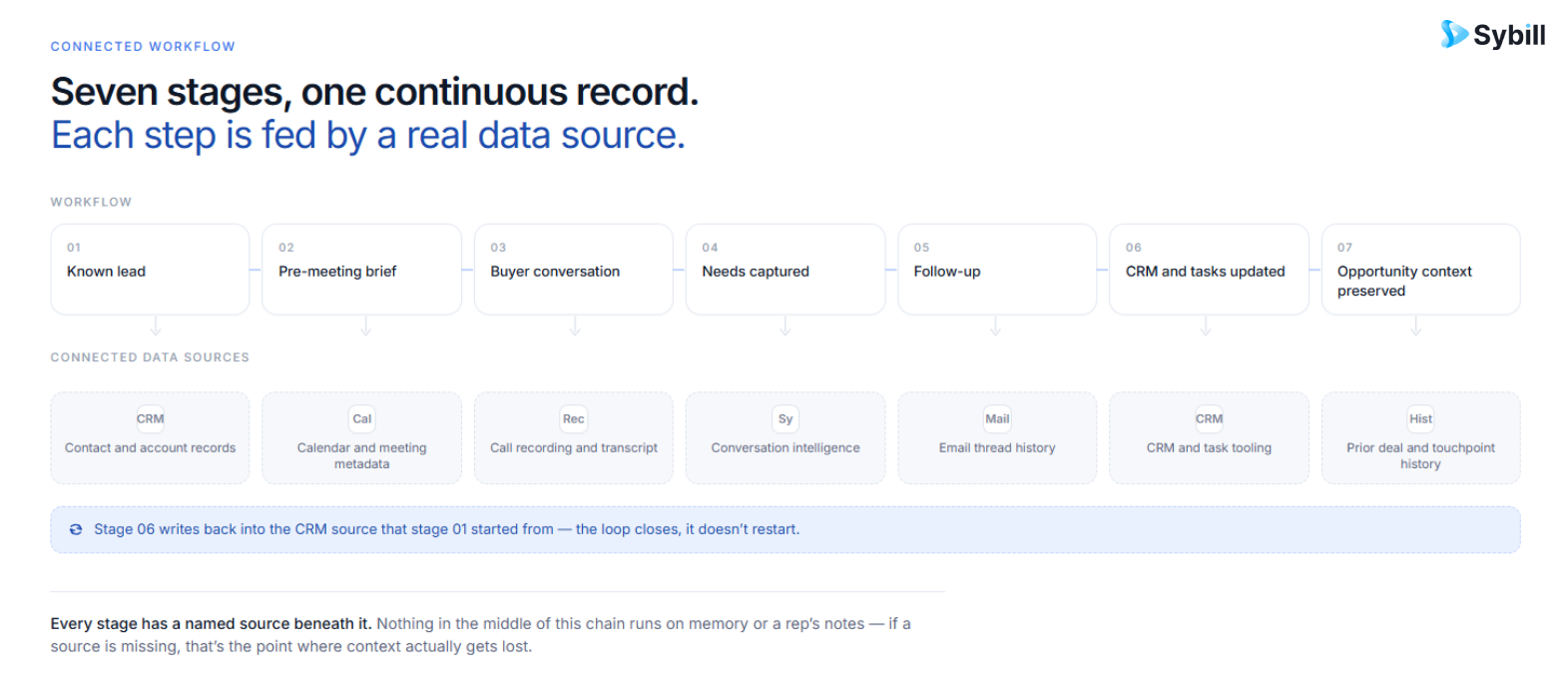
The result is a connected workflow:
Known lead or target account → Pre-meeting context → Buyer conversation → Needs and intent captured → Contextual follow-up → CRM and tasks updated → Opportunity context preserved
Sybill’s integrations keep meeting, CRM, email, dialer, and collaboration context together. Ask Sybill can query interactions or find opportunities worth revisiting.
Do not let qualified leads disappear into disconnected sales workflows.
Book a demo.
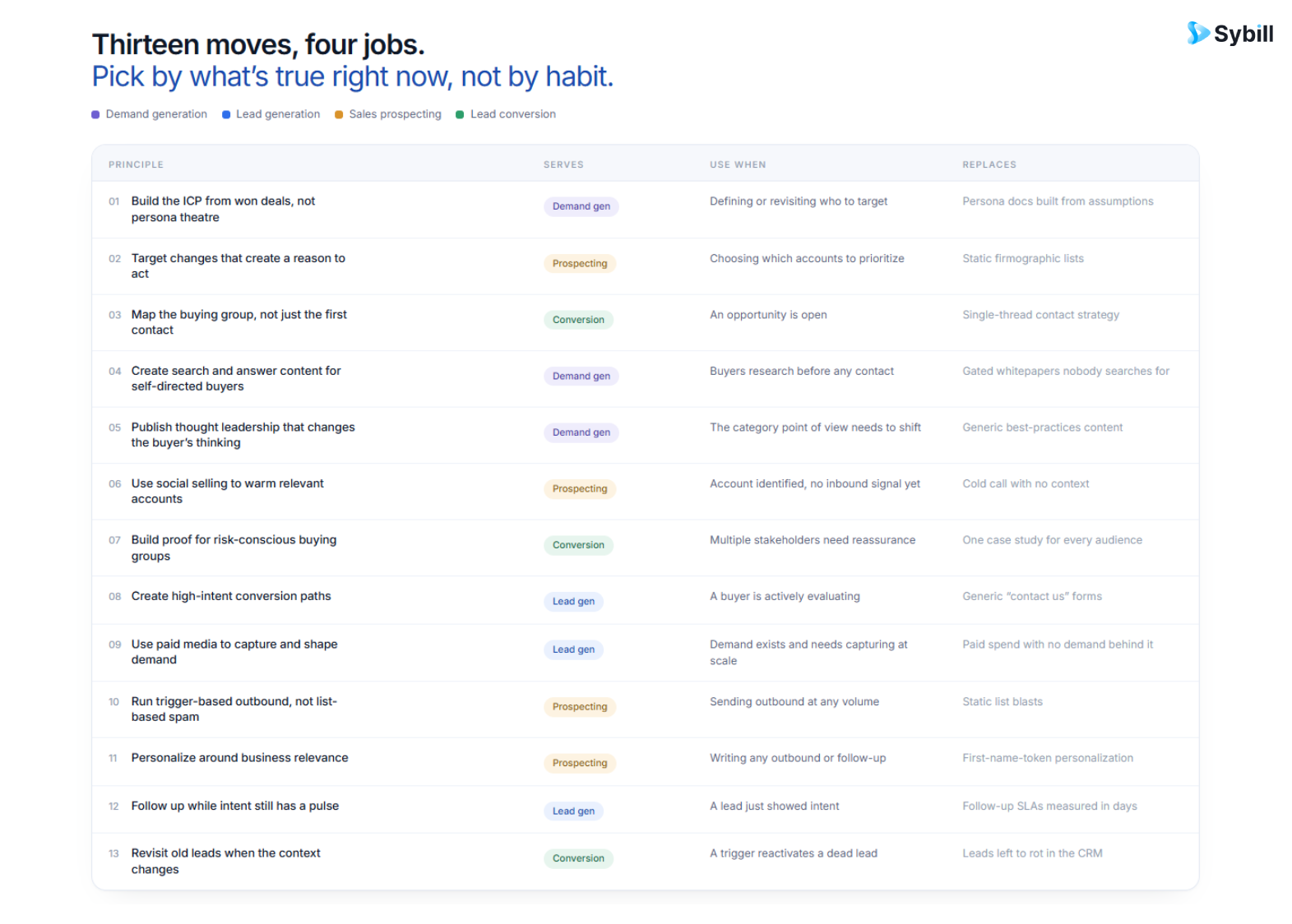
Start with customers who buy, succeed, expand, and stay. Look for shared firmographics, technology, problems, triggers, retention, and economics. Ask why those patterns matter. An ICP that describes almost every company describes nothing. “Growing B2B SaaS businesses” is not targeting. It is a mood.
Strong outreach answers “Why you?” and “Why now?” Funding, leadership changes, deadlines, expansion, and technology migrations can create urgency. Form a business hypothesis, not fake familiarity. “Congratulations on the funding” is not insight. Explain the problem the change may create.
Find out who will use the product, approve budget, evaluate risk, manage procurement, and live with implementation. Forrester reports that a typical 2026 business purchase involves 13 internal stakeholders and nine external influencers. One “lead” is often the visible edge of a much larger decision.
Answer questions buyers ask while defining a problem, comparing vendors, and planning implementation. Use guides, comparisons, calculators, templates, documentation, and role-specific use cases. Cover price, limitations, integrations, migration, security, and who should not buy. Buyers will ask somewhere. Better that they ask you.
Offer a defensible point of view, original evidence, or a framework. Repackaging five tips is not thought leadership. The 2025 Edelman and LinkedIn report found that hidden buyers assess this content and can advocate for lesser-known vendors. Good ideas can put a smaller brand on the shortlist.
Follow target accounts, learn from people inside them, share expertise, and join conversations where you have something real to add. Then outreach has context. Social selling is not an automated connection request followed 17 seconds later by a pitch. That is a sequence wearing a human profile picture.
Use case studies, reviews, benchmarks, security documentation, implementation detail, and demonstrations to help buyers defend the decision. Explain the starting problem, constraints, deployment, and time to value. Buyers are not only asking, “Did it work?” They are asking, “Could it work here without detonating my quarter?”
Match the CTA to buyer readiness. A researcher may want a comparison, a technical evaluator may need a sandbox, and a buyer with a project may want a demo. Test form friction against quality. Fewer fields may increase submissions, but an unqualified form fill is not a win.
Paid search captures active demand. Account-targeted ads create familiarity. Retargeting helps interested visitors continue evaluating. Measure each campaign according to its job, and do not label every click a sales lead. Paid search may reveal useful messages and demand patterns, but it does not improve organic rankings.
Build smaller account lists around clear fit and a credible reason to act. Research the company, role, trigger, likely problem, and proof. See these B2B sales prospecting tactics, or compare purpose-built AI SDR tools if you need contact discovery and autonomous outreach.
First-name tokens are mail merge, not personalization. Connect the account’s situation, buyer role, current trigger, and plausible business consequence. AI can accelerate research and drafting, but someone must judge whether the premise deserves attention. See how generative AI supports sales personalization without automating irrelevance at scale.
Respond promptly to high-intent actions, but do not confuse speed with quality. After a meeting, include the buyer’s priority, agreed outcome, unresolved issue, owners, and dated action. Sybill can capture those details and draft the message. For timing and templates, see this guide to sales follow-up emails.
Closed-lost does not always mean dead forever. A missing feature may ship, budget may reset, or a deadline may turn “later” into “now.” Re-engage when something material changes and explain why it matters. Ask Sybill can help find accounts lost for a now-resolved reason. Sending the same breakup email every quarter is CRM necromancy.
Choose a portfolio based on where demand exists, how buyers purchase, what your team can execute, and how quickly results are needed.
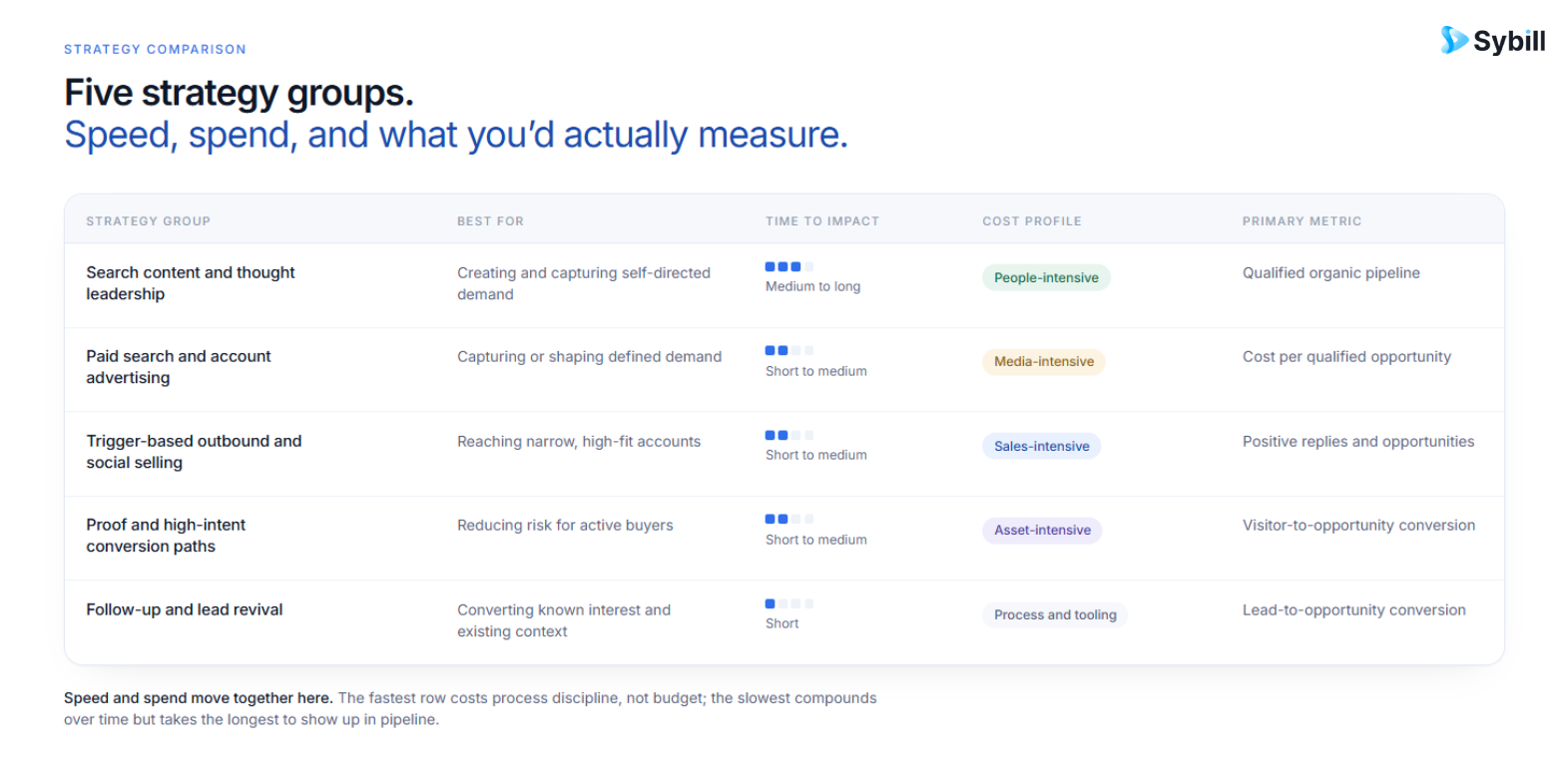
Start with two or three channels, measure opportunity quality, and expand from evidence. Thirteen half-run programs create more dashboards, not more growth.
Clicks, impressions, form fills, open rates, and cost per lead diagnose individual steps. They do not prove efficient customer acquisition.
Measure the commercial chain:
Also inspect why leads are rejected, where buying groups stall, and which messages recur in won and lost conversations. Gartner’s 2026 research found that 69% of B2B buyers prefer to validate AI-generated insights with sales reps. The rep’s role is increasingly to add context, confidence, and decision support. Measure whether your lead generation system helps them do that.
The best B2B lead generation strategies do not end at the form fill, reply, or booked meeting. They give the right buyer a reason to engage, then help sales understand the context well enough to move the conversation forward.
Sybill helps sales teams act on qualified interest with better research, better preparation, contextual follow-up, and cleaner CRM data. Less lead leakage. Less tab archaeology. More time spent on conversations that may actually become revenue.
Turn qualified interest into pipeline with the context intact. Book a Sybill demo.
The most effective B2B lead generation strategies combine ICP targeting, search content, proof, high-intent conversion, trigger-based outbound, and timely follow-up. The mix depends on the market and sales motion. Measure qualified opportunities, pipeline, velocity, and revenue, not only contact volume or cost per lead.
Define the ICP from successful customers, identify changes that create urgency, and address problems those buyers need to solve. Capture enough information to assess fit and intent, then follow up with context. High-quality B2B leads come from alignment between audience, timing, value, proof, and qualification.
Demand generation creates awareness and interest in a problem or category. Lead generation makes some interest identifiable through demo requests, registrations, signups, or responses. Demand can exist without a captured lead, and a captured lead can exist without meaningful demand. Strong programs connect both.
AI supports research, trigger detection, prioritization, personalization, conversation analysis, qualification, follow-up, CRM updates, and revival. Different tools cover different jobs. Sybill is most useful once an account is known, helping sales teams prepare, capture context, follow up, and preserve what they learn.
The most effective B2B lead generation strategies combine ICP targeting, search content, proof, high-intent conversion, trigger-based outbound, and timely follow-up. The mix depends on the market and sales motion. Measure qualified opportunities, pipeline, velocity, and revenue, not only contact volume or cost per lead.
Define the ICP from successful customers, identify changes that create urgency, and address problems those buyers need to solve. Capture enough information to assess fit and intent, then follow up with context. High-quality B2B leads come from alignment between audience, timing, value, proof, and qualification.
Demand generation creates awareness and interest in a problem or category. Lead generation makes some interest identifiable through demo requests, registrations, signups, or responses. Demand can exist without a captured lead, and a captured lead can exist without meaningful demand. Strong programs connect both.