Find us at booth #83, join us for a harbor side happy hour, or catch Gorish’s talk.

Sept, 16-18 > Learn more


Tamanna Mishra

May 28, 2026
.png)
AI SDR tools are having their main character moment. Every platform now claims it can prospect, personalize, follow up, book meetings, update your CRM, and probably make a decent espresso if you ask nicely.
Sales teams, however, know better.
More meetings do not automatically mean more pipeline. Sometimes it just means your AEs inherit a calendar full of “Wait, who are you again?” calls.
The real question is not which AI SDR tool can send the most emails. The real question is:
Which AI SDR tool helps your team create qualified conversations, preserve buyer context, and move deals forward after the meeting is booked?
That is why this list includes traditional AI SDR tools, plus Sybill, which is not a classic AI SDR platform. Sybill is the intelligence layer that helps sales teams turn AI-sourced meetings into clean CRM data, better follow-ups, sharper coaching, and real deal momentum.
Because booking the meeting is cute. Winning the deal is the job.
An AI SDR tool is software that automates sales development tasks like prospect research, lead enrichment, personalized outreach, follow-ups, reply handling, lead qualification, meeting booking, and CRM updates.
In plain English, it does the repetitive work SDRs usually drown in.
The best AI SDR tools help teams:
But here is where the category gets messy.
Some “AI SDR tools” are truly autonomous agents. Some are sales engagement tools with AI writing features. Some are data enrichment platforms wearing an AI SDR trench coat. Some are excellent at finding leads but weak at conversations. Others can book meetings but leave your CRM looking like a haunted spreadsheet.
So before we get into the best AI SDR tools, let’s define the real buying criteria.
The best AI SDR tool is not the one with the flashiest demo. It is the one that fits your sales motion without creating more chaos for reps, managers, and RevOps.
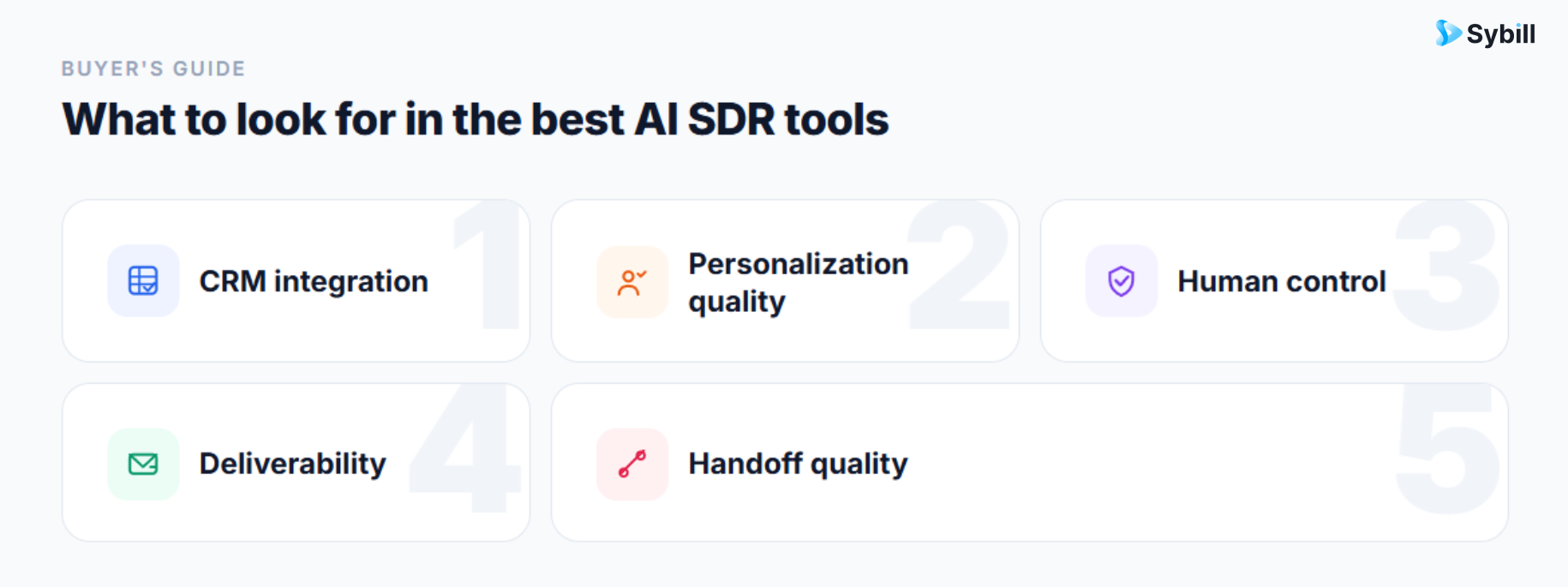
If your AI SDR does not sync properly with Salesforce or HubSpot, congratulations, you have bought another tab.
CRM integration should include:
This matters because AI SDR tools are only useful if the rest of your sales team can actually trust the data they create.
“Hi {first_name}, I saw your company exists” is not personalization.
Strong AI SDR tools personalize using:
The more contextual the outreach, the less it feels like it escaped from a template farm.
Full autonomy sounds amazing until your AI sends a weird message to your dream account.
Look for controls like:
For high-volume outbound, human-in-the-loop controls are not a weakness. They are how you avoid accidentally turning your brand into a cold email meme.
If your emails land in spam, your AI SDR is just journaling.
Deliverability features matter. Look for:
Outbound scale without deliverability discipline is how good domains go to die.
This is the most underrated criterion.
Most AI SDR tools are obsessed with booking meetings. But sales leaders should ask:
What happens after the meeting is booked?
Does the rep know why the prospect agreed to talk? Does the meeting context show up in CRM? Does the follow-up reflect the actual conversation? Does the manager know which deals are heating up or going sideways?
This is exactly where Sybill fits. AI SDRs help you get into more conversations. Sybill helps you turn those conversations into action.
Let’s be honest upfront: Sybill is not a traditional AI SDR tool. It does not exist to scrape a giant lead list, blast outbound emails, or pretend to be a digital SDR named Ava, Alice, Frank, or any other suspiciously productive coworker.
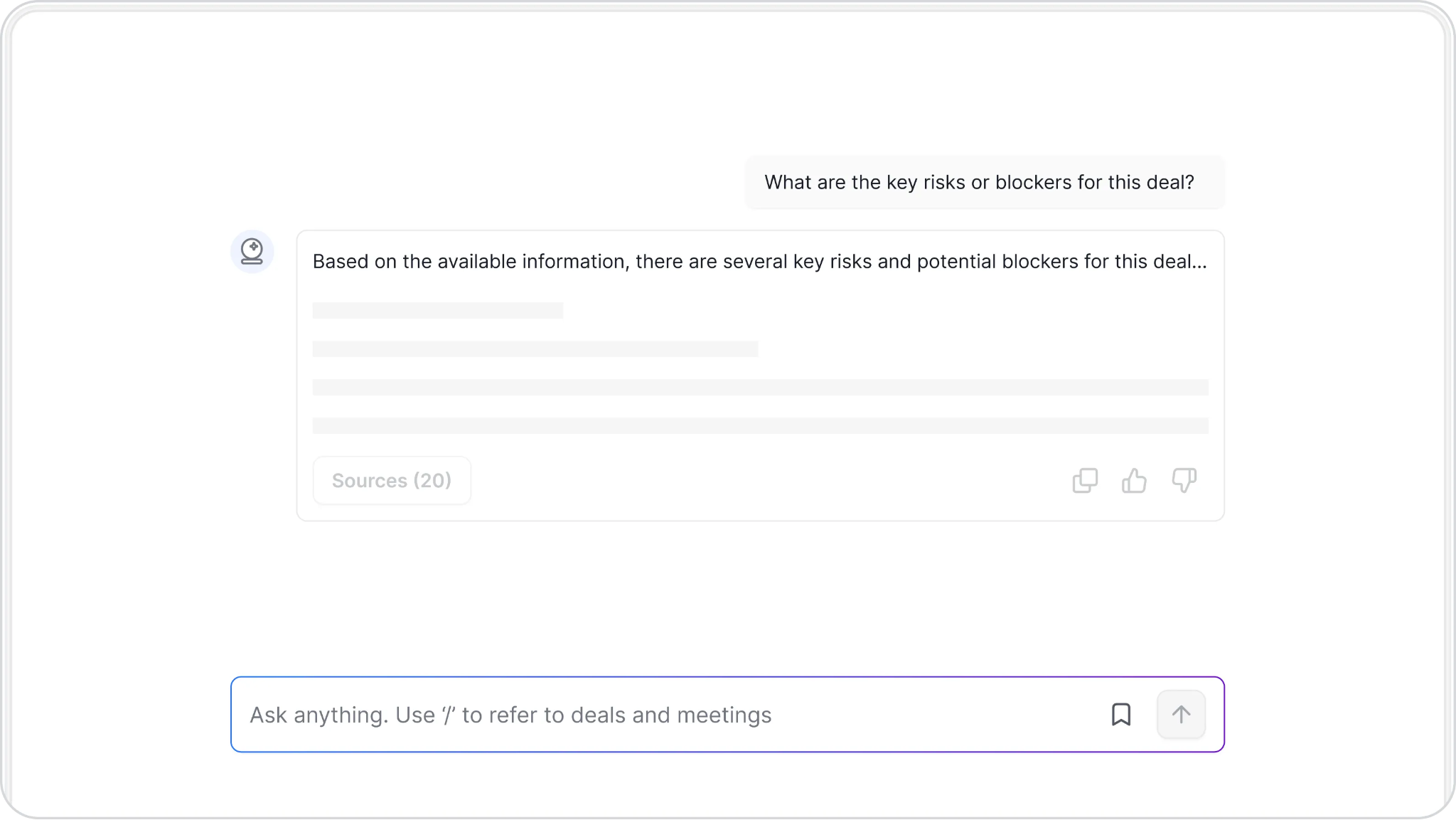
Sybill is better described as the AI intelligence layer for sales teams that want AI-sourced meetings to turn into actual pipeline.
Because here is the dirty little secret of AI SDR tools: booking the meeting is only the opening scene.
The real sales work begins when the prospect shows up, explains the business problem, asks tricky questions, mentions a competitor, reveals budget uncertainty, brings in another stakeholder, or says, “Send me something after this.”
If that context disappears after the call, your AI SDR did its job but your revenue process still leaked.
Sybill helps close that gap.
Sybill supports the sales workflow after a prospect enters the conversation.
With Pre-Meeting Brief, reps can walk into meetings with context instead of scrambling through CRM notes, LinkedIn tabs, and Slack threads.
With Magic Summary, reps get clean, structured summaries of what happened on the call.
With CRM Autofill, Sybill updates Salesforce or HubSpot with buyer needs, pain points, objections, next steps, and deal context.
With Personalized Emails, reps can send follow-ups based on the actual conversation, not a generic “Great chatting today” email that says everything and nothing.
With AI Tasks, commitments become action items instead of disappearing into the black hole between meetings.
With Ask Sybill, reps and managers can ask questions across calls, deals, and buyer interactions.
And with Deal Workspace and Deal Pipeline, teams can inspect deal health, risks, opportunities, and momentum without waiting for everyone to manually update CRM.
If your AI SDR books 40 meetings but your reps still miss follow-ups, forget objections, skip CRM updates, and lose buyer context, you have not improved your sales process. You have just created faster chaos.
Sybill helps sales teams make the AI SDR investment actually useful by connecting meetings to execution.

Sales teams that already have outbound, inbound, or AI SDR-sourced meetings and want better context, CRM hygiene, follow-up execution, and deal visibility.
AiSDR is one of the clearest examples of a true autonomous AI SDR platform.
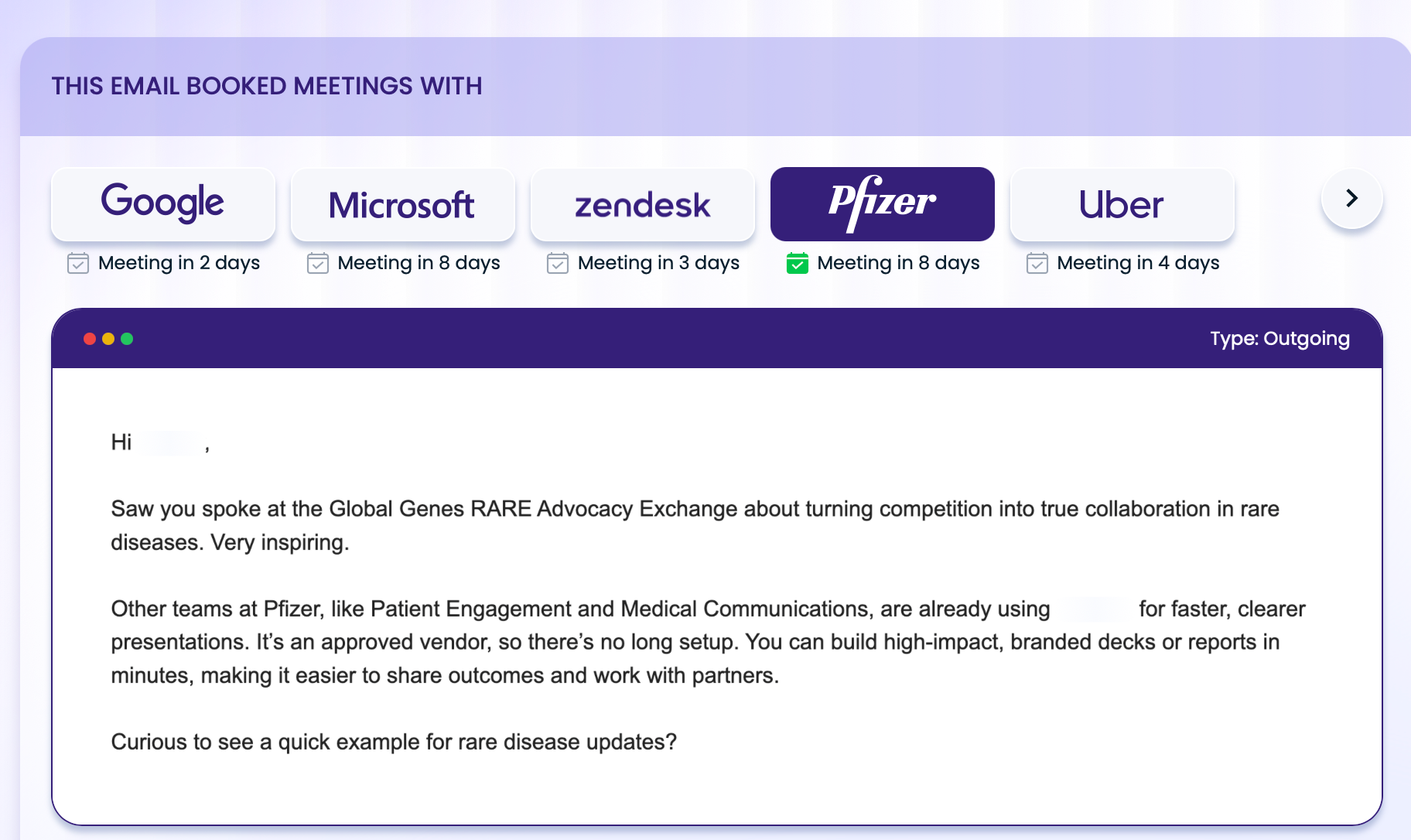
It is built to handle outbound tasks like finding prospects, writing personalized messages, sending follow-ups, managing replies, and booking meetings. It is especially interesting for HubSpot-first teams because its HubSpot integration is one of the most frequently highlighted parts of its positioning.
AiSDR uses CRM data, lead scores, custom fields, LinkedIn activity, and company signals to personalize outreach. For teams that already have strong CRM hygiene and a defined ICP, that can be useful. The tool can run email, LinkedIn, and SMS workflows, which makes it a fit for teams that want more than email automation.
AiSDR is a good fit when your team wants a relatively hands-off outbound engine.
You define your ICP, give the tool messaging direction, connect the relevant systems, and let the AI manage a large chunk of the SDR workflow. This can work well for companies with a clear target market and repeatable outbound motion.
It is less ideal if your messaging is still experimental, your CRM data is messy, or your team sells a complex product that needs careful nuance from the first interaction.
Growth teams that want an autonomous AI SDR with strong HubSpot connectivity and predictable pricing.
Artisan’s Ava is positioned as an AI BDR or AI employee that can run large parts of the outbound workflow.
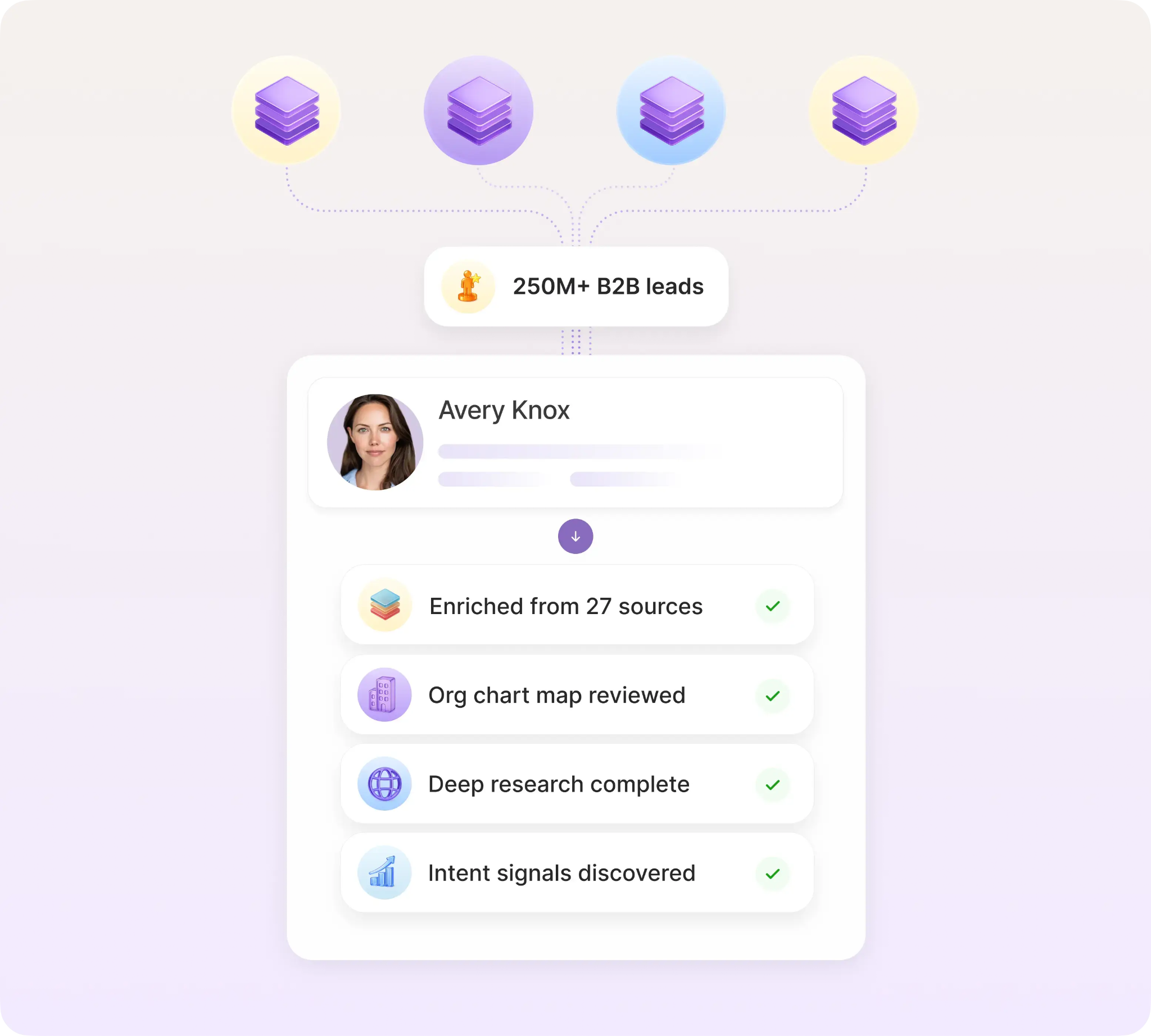
Ava can help with prospecting, enrichment, personalized email outreach, LinkedIn outreach, follow-ups, and reply handling. The big appeal is that teams do not need to stitch together too many separate tools. Artisan combines data, personalization, and outbound workflow automation inside one platform.
For outbound-heavy teams, that is attractive. Instead of buying a database, a sequencing tool, a personalization tool, and an AI writer separately, Artisan tries to bundle the experience into one AI agent.
Artisan is best suited for teams that want scale and structure.
If your team is running outbound across large prospect pools and wants AI to handle research and first-touch messaging, Ava can help reduce manual work. Its built-in contact database also makes it useful for teams that do not already have a strong data provider.
The caution is quality control. Fully autonomous outreach can drift into generic messaging if teams do not tune it carefully. And LinkedIn automation should always be evaluated carefully because platform limits and compliance rules matter.
Outbound teams that want an AI BDR-style platform for prospecting, personalization, and multichannel outreach.
11x.ai is one of the more well-known names in the autonomous AI SDR category.
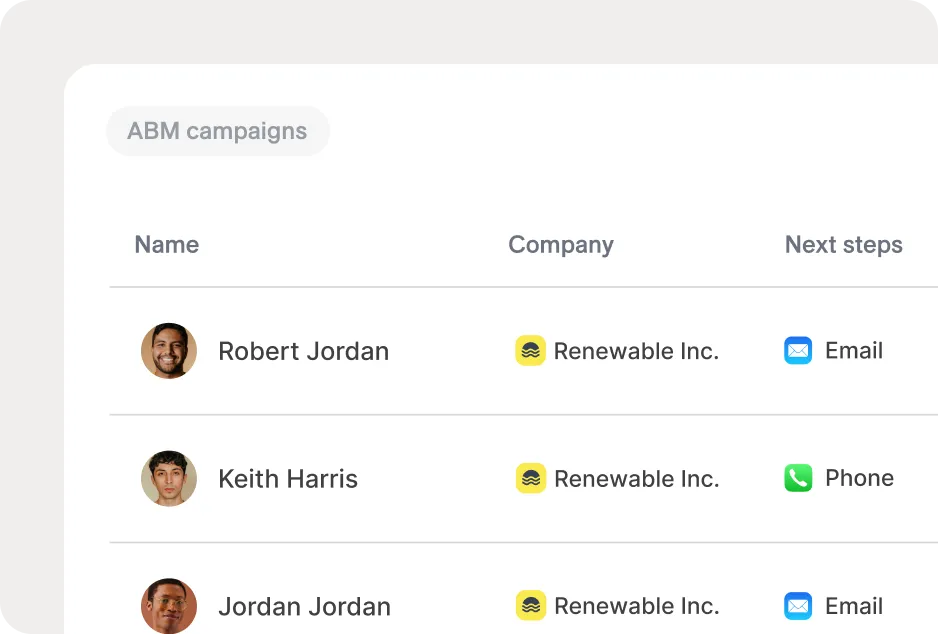
Its AI SDR, Alice, is designed to handle outbound tasks like prospect research, email writing, sequencing, reply handling, and meeting booking. The pitch is clear: add a digital SDR that can run outreach at scale without the cost and ramp time of hiring more human SDRs.
For enterprise and funded mid-market teams, that can be compelling.
11x.ai is best for teams with a large addressable market, clear ICP, strong RevOps support, and enough budget to support an enterprise AI SDR program.
This is not the tool you buy casually because someone saw a LinkedIn post about AI agents. It needs clean data, sharp messaging, proper routing, and a team ready to handle the meetings it generates.
The promise is scale. The tradeoff is complexity.
Enterprise and mid-market sales teams with large outbound targets, strong RevOps infrastructure, and budget for high-autonomy automation.
Reply.io is not a pure AI SDR in the same way as 11x.ai or AiSDR. It is a mature sales engagement platform with an AI SDR layer through Jason AI.
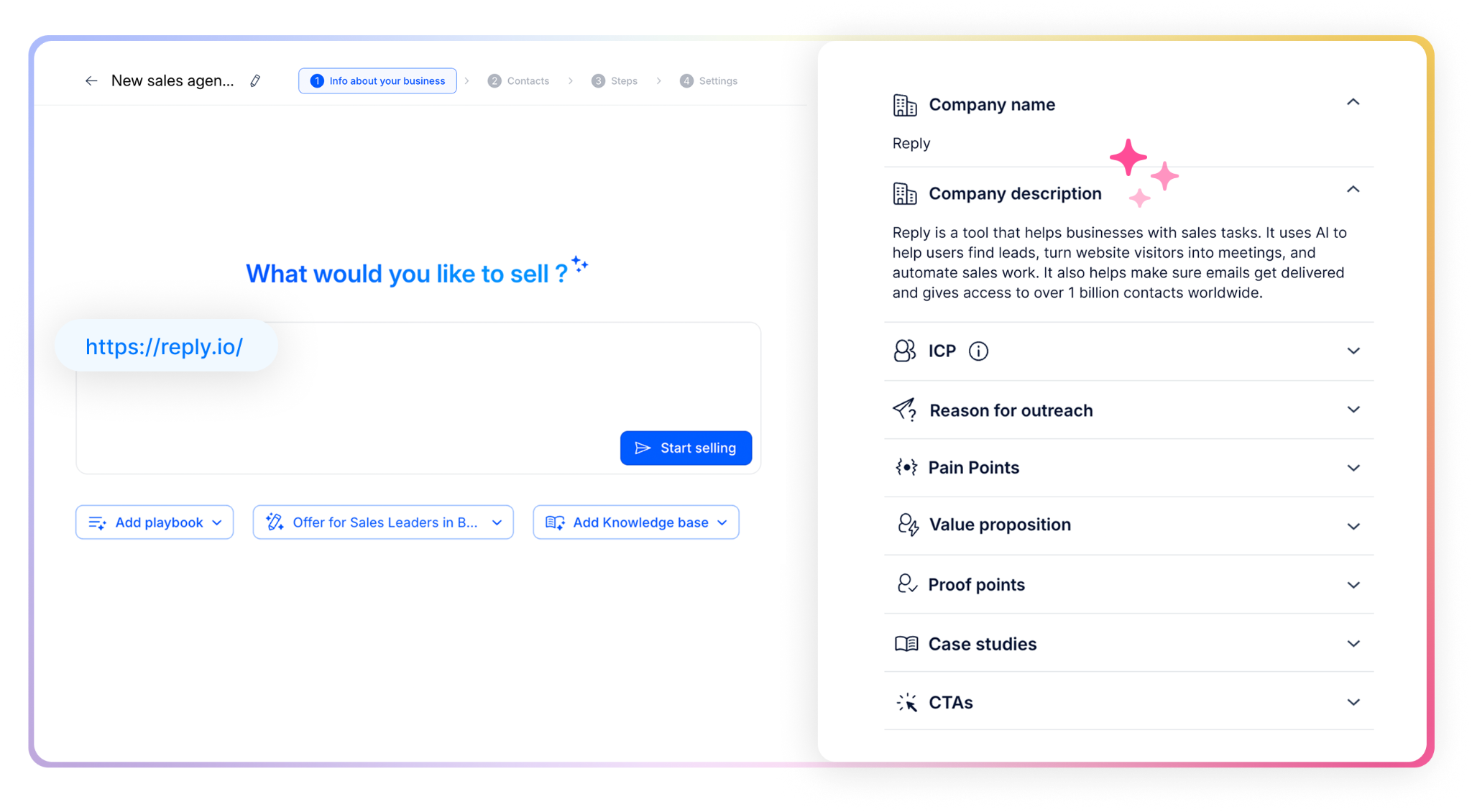
Jason AI helps teams generate outreach, create sequences, manage follow-ups, and support multichannel engagement across email, LinkedIn, phone calls, SMS, and WhatsApp. It is a strong fit for teams that want AI assistance but do not want to hand the entire outbound process to a fully autonomous agent.
Reply.io Jason AI works well when your team already has a sales motion and wants AI to speed up execution.
You still control the strategy, targeting, and workflow. The AI helps with message creation, sequence building, reply handling, and productivity. This makes it less risky for teams that want automation but still care about control.
For many sales teams, this middle ground is more practical than full autonomy.
Sales teams that want AI-enhanced sales engagement across multiple channels without giving up control.

AI SDR tools are obsessed with getting you the meeting. Sybill is obsessed with making the meeting count.
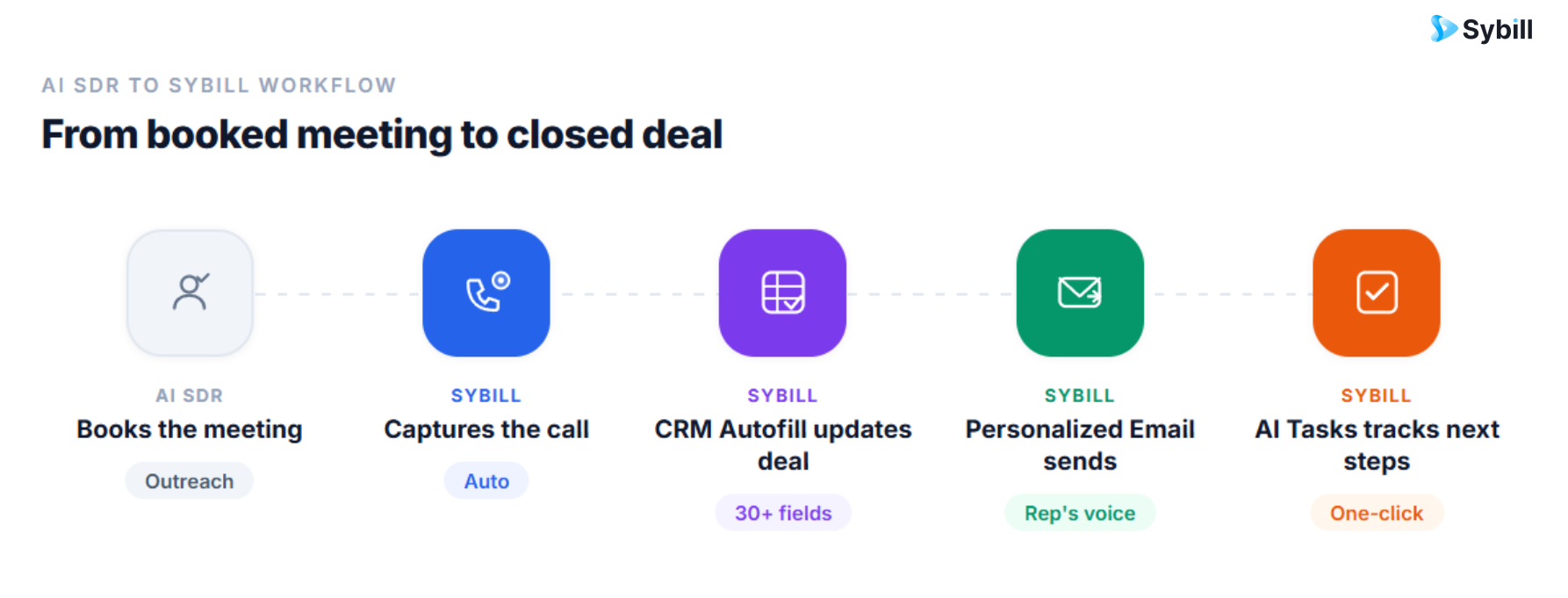
Because sales teams do not win by generating activity. They win by converting conversations into next steps, stakeholder alignment, urgency, and closed revenue.
Here is how the stack should work:
This is how sales teams move from “we booked more meetings” to “we are actually running a better revenue process.”
Because the real risk with AI SDR tools is not that they fail. The scarier risk is that they work, flood your team with meetings, and expose every weakness in your follow-up, CRM hygiene, discovery process, and deal execution.
Sybill gives sales teams the intelligence layer they need once the conversation starts.
Choose Sybill if your team already has meetings coming in and wants to improve what happens before, during, and after those conversations.
Sybill is the right fit if you want to:
Sybill is especially useful if your team is already using an AI SDR, sales engagement platform, or outbound automation tool and needs better sales intelligence after the meeting is booked.
Choose AiSDR if you want an autonomous AI SDR, especially in a HubSpot-first environment.
It is a good fit if you have a clear ICP, clean CRM data, and want the AI to handle prospecting, outreach, follow-ups, and meeting booking with minimal daily involvement.
Choose Artisan if you want an all-in-one AI BDR platform with built-in contact data and multichannel outbound.
It works well for outbound-heavy teams that want to reduce manual prospecting and run personalized email plus LinkedIn campaigns from one system.
Choose 11x.ai if you have enterprise budget, large outbound targets, and strong RevOps support.
It is best suited for teams that want high-autonomy outbound automation and have the internal maturity to manage setup, governance, and follow-through.
Choose Reply.io Jason AI if you want AI assistance inside a multichannel sales engagement workflow.
It is a good fit for teams that want better sequencing, message generation, and follow-up support while keeping humans in control.
The best AI SDR tools can help your team scale outreach, personalize messages, qualify leads, and book meetings faster. That is valuable.
But the teams that win in 2026 will not be the ones with the noisiest outbound machine. They will be the ones that connect every AI-sourced conversation to CRM context, follow-up quality, coaching, and deal execution.
So yes, evaluate AiSDR, Artisan, 11x.ai, and Reply.io Jason AI if you want outbound automation.
But if your real problem is what happens after the meeting lands on the calendar, Sybill deserves a serious look.
Because your AI SDR can open the door.
Sybill helps your team walk in prepared, capture what matters, follow up intelligently, and move the deal forward.
That is where the pipeline stops being theater and starts becoming revenue.

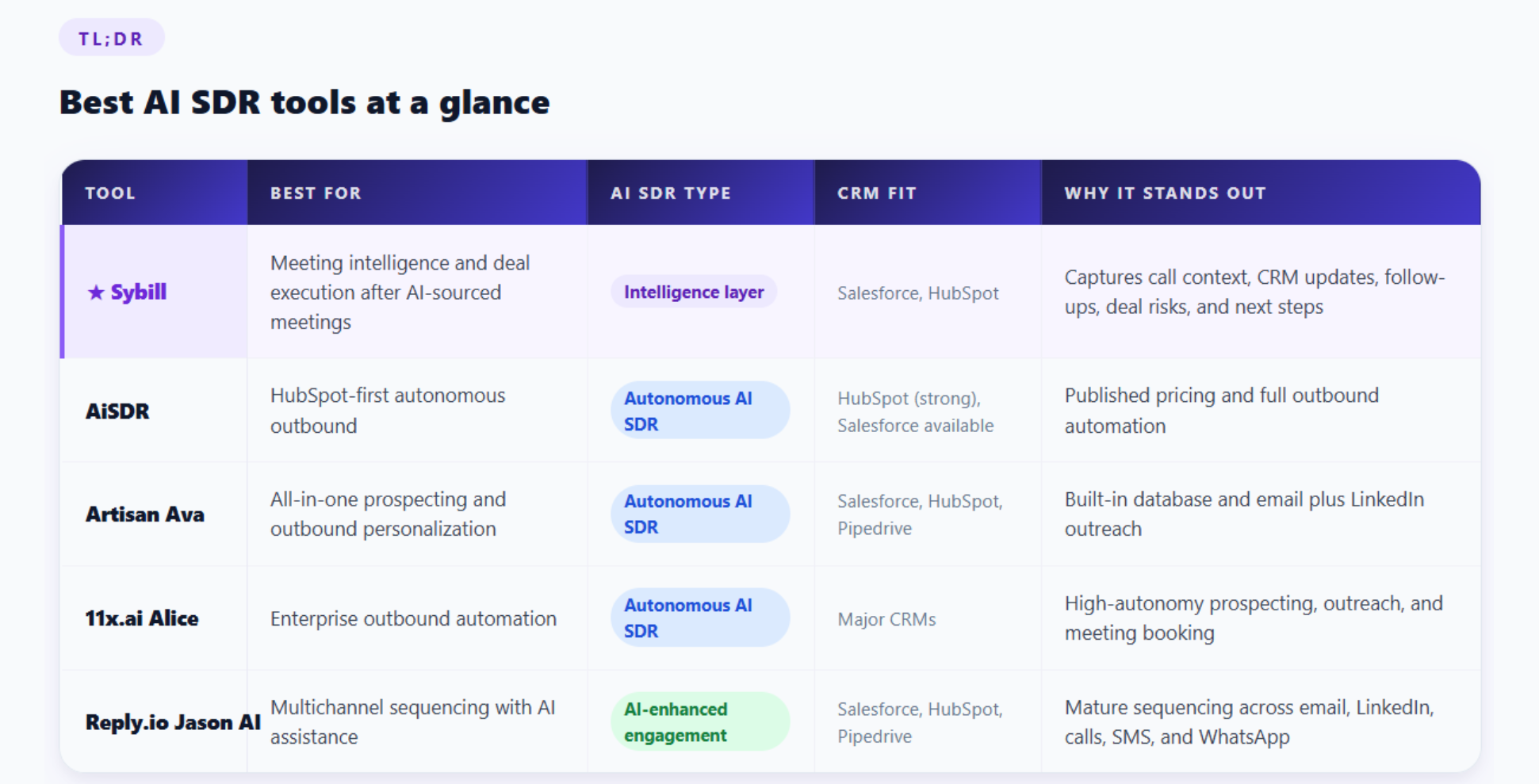
The best AI SDR tool depends on your sales motion. AiSDR is strong for autonomous outbound, Artisan is strong for all-in-one prospecting and outreach, 11x.ai fits enterprise outbound automation, and Reply.io Jason AI works well for AI-assisted multichannel sequencing. Sybill is best for teams that want meeting intelligence, CRM Autofill, and follow-up execution after AI SDR-sourced meetings.
An AI SDR automates early sales development work like finding prospects, researching accounts, writing personalized outreach, sending follow-ups, qualifying replies, booking meetings, and updating CRM records. Some AI SDR tools are fully autonomous, while others assist human SDRs inside existing workflows.
AI SDR tools are worth it if your team has a clear ICP, clean CRM data, strong messaging, deliverability controls, and a defined handoff process. They are not worth it if your sales process is unclear and you expect AI to magically fix bad targeting, weak positioning, or messy CRM data.
AI will replace some repetitive SDR tasks, not the entire SDR role. AI is strong at research, enrichment, first-touch outreach, follow-ups, and scheduling. Human SDRs are still better at judgment, relationship building, complex objections, discovery, and account strategy.
AiSDR is especially strong for HubSpot-first teams and also supports Salesforce. Reply.io Jason AI integrates with Salesforce, HubSpot, and Pipedrive. Artisan Ava connects with HubSpot, Salesforce, and Pipedrive. 11x.ai integrates with HubSpot, Salesforce, and other major CRMs. Sybill integrates with Salesforce and HubSpot as the intelligence layer for meeting summaries, CRM Autofill, personalized follow-ups, AI Tasks, and deal context.
An AI SDR tool usually focuses on top-of-funnel automation, including prospecting, outreach, qualification, and meeting booking. Sybill focuses on the sales conversation and deal execution layer. It helps with Pre-Call Briefs, Magic Summary, CRM Autofill, Personalized Emails, AI Tasks, Ask Sybill, Deal Workspace, and Deal Pipeline.
AI SDR tools can replace repetitive SDR tasks, but they should not replace human judgment in complex sales. AI can research, write, follow up, qualify, and schedule. Human reps are still needed for nuanced discovery, trust-building, stakeholder mapping, negotiation, and deal strategy.
AI SDR pricing varies widely. Some AI-assisted tools start below $100 per month, while autonomous AI SDR tools often start around $850 to $900 per month and can go into several thousand dollars per month for enterprise use. Pricing usually depends on outreach volume, channels, number of agents, CRM setup, and contract terms.
For Salesforce users, Reply.io Jason AI, Artisan Ava, AiSDR, and 11x.ai are worth evaluating depending on the level of autonomy needed. Sybill is a strong fit for Salesforce teams that want to capture meeting context, update CRM fields automatically, generate follow-ups, and inspect deal intelligence after meetings.
AiSDR is a strong option for HubSpot-first outbound automation. Artisan Ava and Reply.io Jason AI also support HubSpot workflows. Sybill is a strong fit for HubSpot teams that want better meeting intelligence, CRM hygiene, and follow-up execution after AI SDR-sourced calls.
The best AI SDR tool depends on your sales motion. AiSDR is strong for autonomous outbound, Artisan is strong for all-in-one prospecting and outreach, 11x.ai fits enterprise outbound automation, and Reply.io Jason AI works well for AI-assisted multichannel sequencing. Sybill is best for teams that want meeting intelligence, CRM Autofill, and follow-up execution after AI SDR-sourced meetings.
An AI SDR automates early sales development work like finding prospects, researching accounts, writing personalized outreach, sending follow-ups, qualifying replies, booking meetings, and updating CRM records. Some AI SDR tools are fully autonomous, while others assist human SDRs inside existing workflows.
AI SDR tools are worth it if your team has a clear ICP, clean CRM data, strong messaging, deliverability controls, and a defined handoff process. They are not worth it if your sales process is unclear and you expect AI to magically fix bad targeting, weak positioning, or messy CRM data.