Find us at booth #83, join us for a harbor side happy hour, or catch Gorish’s talk.

Sept, 16-18 > Learn more

%20(1).avif)
Mamta Tainwala

July 8, 2026
%20(28).png)
Every B2B sales team has felt this: the SDRs are working hard, the leads keep coming, and somehow the pipeline still feels like a lottery. Some reps chase prospects who were never going to buy. Meanwhile, a genuinely ready buyer sits untouched in the queue for three days and books a demo with your competitor instead.
Lead scoring exists to end the lottery. Done well, it tells your team exactly who to call first and why. Done badly, it becomes a number everyone learns to ignore.
This guide covers the full discipline: what B2B lead scoring is, how AI-driven scoring actually works, how to weight criteria and set thresholds, how to automate the whole thing, and why so many scoring models quietly stop working. If you already know the concepts and want tool recommendations, jump to our roundup of the best lead scoring tools in 2026.
Lead scoring in B2B sales is the practice of assigning numerical values to prospects based on how closely they fit your ideal customer profile and how strongly their behavior signals buying intent. The score ranks every lead so sales knows who to prioritize, who to nurture, and who to disqualify.
A B2B lead score typically combines two dimensions:
Fit (explicit data): Who they are. Job title, seniority, company size, industry, revenue, tech stack, geography. Fit answers: could this person buy from us?
Engagement (implicit data): What they do. Pricing page visits, content downloads, email opens, webinar attendance, demo requests, product usage. Engagement answers: do they want to?
A VP of Sales at a 500-person SaaS company who visited your pricing page twice this week scores high on both. A student who downloaded one ebook scores low on both. The interesting cases, and the reason scoring is a discipline rather than a spreadsheet, are everything in between.
AI-driven lead scoring uses machine learning models trained on your historical conversion data to identify which combinations of attributes and behaviors actually predict closed-won deals, then scores every new lead against those patterns automatically.
The difference from traditional scoring is who decides what matters:
Rules-based scoring: A human assigns points. Pricing page visit = +10. Company under 50 employees = -20. Simple, transparent, and limited by human assumptions.
AI-driven scoring: The model examines thousands of historical leads, both won and lost, and discovers the patterns itself. Maybe leads who attend a webinar AND visit the integrations page within a week convert at 4x your baseline. No human would have guessed that combination. The model finds it.
Under the hood, the process runs in four steps:
The better platforms add explainability: showing reps which signals drove each score. That transparency matters more than accuracy for adoption, because reps act on scores they understand and ignore scores that feel like a black box.
One important caveat: predictive models typically need at least six months of conversion outcomes to learn meaningful patterns. If your dataset is thin, start with rules-based scoring, or with conversation signals, which we cover below.
Weight lead scoring criteria by back-testing against your closed-won deals: identify the attributes and behaviors your actual customers shared before buying, assign the heaviest weights to the signals with the strongest historical correlation to revenue, and cap any single category so no one signal can qualify a lead alone.
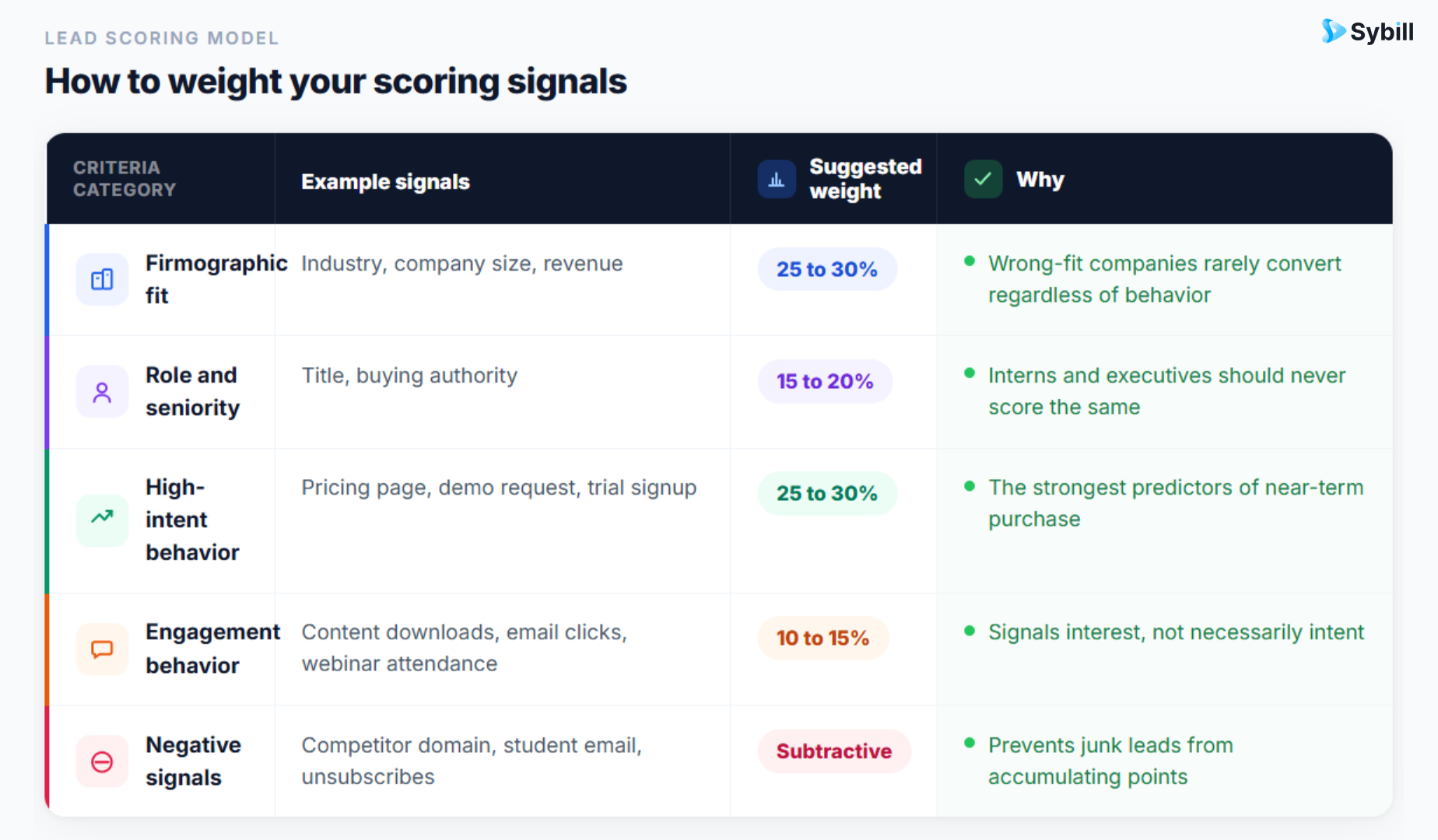
A practical weighting framework for B2B:
Three weighting mistakes show up constantly:
Overweighting volume over quality. Ten email opens should never outscore one pricing page visit. Weight by intent strength, not activity count.
Ignoring negative scoring. Without point deductions, a persistent tire-kicker eventually crosses your threshold on sheer activity. Subtract points for disqualifying attributes and decay points for inactivity over 30 to 60 days.
Treating weights as permanent. Your ICP shifts, your product changes, your market moves. Revisit weights quarterly against fresh closed-won data, or use an AI model that reweights continuously.
Set thresholds by back-testing: find the score at which historical leads converted at two to three times your baseline rate, make that your sales-ready line, and add a second, higher threshold for fast-track routing. For enterprise deals, score the account, not just the individual lead.
Enterprise B2B breaks simple thresholds for one reason: nobody buys alone. A typical enterprise purchase involves six to ten stakeholders, and your "lead" is one member of a buying committee. Three practical adjustments:
Aggregate to the account level. Five mid-scoring contacts from the same company signal more than one high-scoring contact. Roll individual scores up to an account score, and set your enterprise threshold there.
Create tiered thresholds with matching plays. A common structure: below 40, automated nurture. 40 to 70, SDR outreach within a day. Above 70, direct AE routing within the hour. Enterprise accounts above threshold with multiple engaged stakeholders skip the queue entirely.
Route on threshold-crossing events, not scores alone. A score of 75 matters less than the event that pushed it there. "Crossed 70 because the CFO just visited pricing" is an action trigger; the number by itself is trivia.
Then hold the threshold accountable. If leads above the line are not converting at a multiple of the leads below it, the threshold, or the model beneath it, needs revision.
Automate lead scoring by connecting three layers: data collection (CRM, website, email, and call activity flowing in automatically), scoring (a rules engine or ML model that updates scores in real time), and action (routing, alerts, and nurture triggers that fire when thresholds are crossed).
Here is the automation stack, layer by layer:
Layer 1: Automate the data in. A scoring model is only as good as its inputs, and inputs maintained by hand decay fast. Website and email activity usually flow in automatically through your marketing platform. The chronic gap is conversation data: what actually happened on the calls. This is where CRM Autofill closes the loop, pushing structured updates, budget mentions, stakeholders, objections, next steps, into Salesforce, HubSpot, Zoho, or Dynamics 365 after every call and email, with no rep effort.
Layer 2: Automate the scoring. Use your CRM's native engine (HubSpot, Einstein, Zia) or a standalone predictive platform. Our lead scoring tools comparison breaks down which fits which stack. Whatever you pick, scores must update in real time. A score refreshed nightly is a score that misses the buying window.
Layer 3: Automate the action. Threshold crossed → lead routed, rep alerted, pre-meeting brief generated. Score decays → lead re-enters nurture. Disqualifying signal appears → lead exits the queue before an SDR wastes a morning on it.
Teams that automate all three layers, especially the conversation data layer, run measurably cleaner pipelines than teams that automate scoring but still feed it manually updated CRM data. The model was never the bottleneck. The inputs were.
AI is collapsing the wall between scoring and qualification. Scoring used to end where the conversation began: a lead crossed the threshold, sales took over, and the score froze. AI now extends scoring through the entire deal, using conversation intelligence to qualify on what buyers actually say.
Four shifts define where this is going in 2026:
From static scores to living scores. Traditional scores stop updating after handoff. Conversation intelligence keeps scoring through every call and email: budget confirmed, score up; economic buyer went silent, score down. Deal inspection checks each opportunity against your qualification framework, MEDDIC, BANT, or your own, and flags the gaps automatically.
From behavioral proxies to stated intent. A pricing page visit is a proxy for intent. A prospect saying "we have budget approved for Q3" is intent. AI extracts buyer needs, blockers, and priorities directly from conversations, including engagement signals from video that no form fill ever captures, and factors in when competitors show up in your deals.
From dashboards to answers. Instead of building a report to find at-risk deals, teams ask. Ask Sybill answers questions like "which qualified deals have no confirmed timeline?" across the entire pipeline in seconds, which turns scoring from a routing mechanism into a forecasting input leaders can actually trust.
From scoring leads to learning from wins. AI now closes the loop: patterns from closed-won deals feed back into sales plays, so the definition of a "good lead" is continuously rewritten by what actually wins.
Get started for free with Sybill and see what scoring looks like when it listens to your calls instead of stopping at the form fill.
Lead scoring fails for five predictable reasons: stale CRM data feeding the model, scores that reward activity instead of intent, no negative scoring, no feedback loop from sales, and scores that freeze the moment a conversation starts.
If your SDRs have stopped trusting the score, run this diagnostic:
1. The data underneath is stale. Wrong titles, dead emails, three-week-old deal records. No algorithm survives bad inputs. Fix CRM hygiene first; it is the highest-leverage repair on this list.
2. Activity is masquerading as intent. If a lead can cross your threshold by opening twelve newsletters, your weights are broken. Rebalance toward high-intent signals and add score decay.
3. Nothing subtracts. No negative scoring means every lead trends upward forever. Students, competitors, and job seekers all eventually look "hot."
4. Sales feedback never reaches the model. When SDRs mark scored leads as junk, does anything change? If disqualification reasons never flow back into weighting, the model repeats its mistakes indefinitely. Create a monthly loop between SDR feedback and scoring criteria, and make rejected-lead reasons a required field.
5. The score dies at handoff. The most common failure in B2B: the score said 85, the first call revealed no budget and no authority, and the CRM still says 85. Without conversation-based updating, your pipeline fills with high-scoring deals that were disqualified weeks ago in plain speech on recorded calls. This is exactly the gap conversation-based scoring closes.
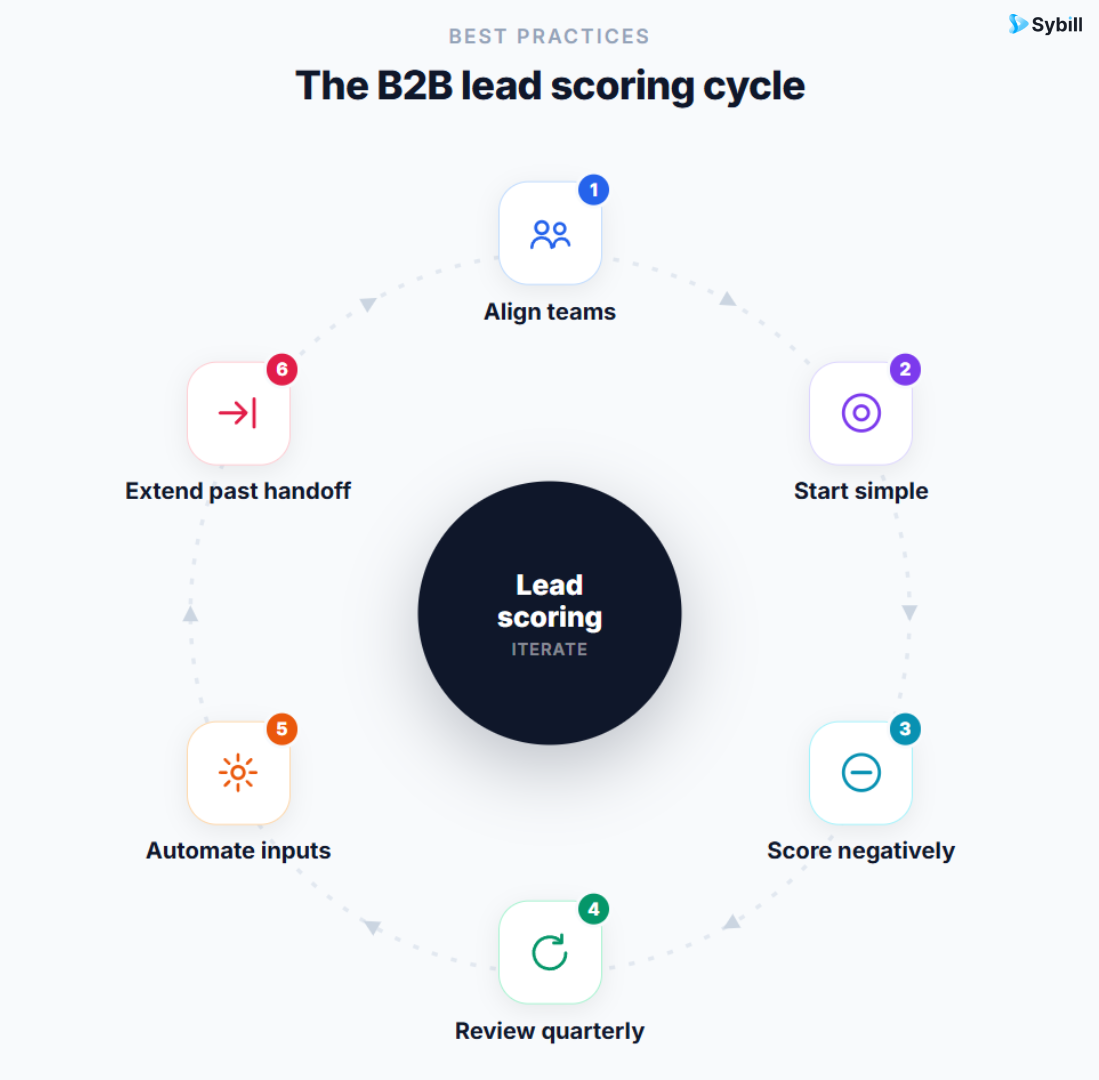
1. Define "qualified" with sales and marketing in the same room. Most scoring disputes are definition disputes in disguise. Agree on the ICP, the disqualifiers, and the threshold consequences before touching a points table.
2. Start simple, then earn complexity. A five-criteria rules-based model your team trusts beats a fifty-signal model nobody understands. Add sophistication as data volume grows.
3. Score negatively from day one. Deduct for poor fit, decay for inactivity. A score that only rises is a score that lies.
4. Review against revenue quarterly. Pull last quarter's closed-won deals and check what they scored at handoff. If your best customers scored mediocre, your model is optimized for something other than revenue.
5. Automate the inputs before the algorithm. A basic model fed by complete, current data outperforms a sophisticated model fed by guesswork. Automated CRM updates are the unglamorous foundation everything else stands on.
6. Extend scoring past the handoff. Keep qualifying on conversation evidence through the whole deal cycle. The teams that win treat scoring as a living system from first touch to closed-won, not a marketing formality that ends at the demo booking.
Choose lead scoring software by matching three things: your CRM (native scoring beats bolted-on scoring for adoption), your data maturity (rules-based for thin datasets, predictive for six-plus months of outcomes), and your funnel gap (top-of-funnel prioritization versus in-funnel qualification).
The short version: if you run HubSpot, Salesforce, or Zoho, start with their native scoring. If your motion is account-based or product-led, look at the specialist platforms. And whatever handles the top of your funnel, add conversation-based scoring for everything that reaches a call. We compare all nine leading options, with pricing and honest limitations, in our guide to the best lead scoring tools in 2026, and our framework for evaluating AI sales tools covers the buying process itself, from pilot design to security review.
Get started for free with Sybill and add the scoring layer that starts where every other tool stops: the conversation.
What is AI lead scoring in B2B sales? AI lead scoring in B2B sales uses machine learning models trained on historical conversion data to automatically rank leads by their likelihood to become customers. Instead of manually assigned points, the model learns which combinations of firmographic fit and buying behavior actually predict closed-won deals, and scores every new lead against those patterns.
How does AI-driven lead scoring work in B2B sales? The model trains on your historical leads and outcomes, detects which signal combinations correlate with conversion, scores new leads on a 0-100 scale, and retrains continuously as new outcomes arrive. The best platforms also explain which signals drove each score so reps can act on the insight.
Does HubSpot CRM have lead scoring for B2B? Yes. HubSpot offers manual, rules-based lead scoring on Professional plans and AI predictive scoring on Enterprise plans, with multi-model support and score explainability. Teams pair it with conversation intelligence tools like Sybill to keep the underlying CRM records accurate after every call, since predictive scores are only as good as the data feeding them.
How do you automate lead scoring for B2B sales? Automate three layers: data collection (website, email, and conversation activity flowing into the CRM automatically), scoring (a rules engine or machine learning model updating scores in real time), and action (routing, alerts, and nurture triggers firing at threshold crossings). Most failed automations skip the first layer and feed the model manually maintained data.
How do you properly weight lead scoring criteria in B2B? Back-test against closed-won deals: weight firmographic fit at roughly 25 to 30%, high-intent behaviors like pricing visits and demo requests at 25 to 30%, role and seniority at 15 to 20%, general engagement at 10 to 15%, and apply negative scoring for disqualifiers. Revisit weights quarterly against fresh revenue data.
How do you set lead scoring thresholds for enterprise B2B deals? Find the score at which historical leads converted at two to three times your baseline, set that as your sales-ready threshold, and add a higher fast-track tier. For enterprise deals, aggregate individual scores to the account level, since purchases involve six to ten stakeholders, and route on threshold-crossing events rather than raw scores.
Why is my lead scoring not working properly? The five most common causes: stale CRM data feeding the model, weights that reward activity volume over buying intent, no negative scoring or decay, no feedback loop from SDR disqualifications back into the criteria, and scores that stop updating once sales conversations begin. Fix data quality first; it is the most common root cause.
What is the difference between lead scoring and lead qualification in B2B? Lead scoring numerically ranks prospects on fit and engagement, typically before or during early contact, to decide who sales talks to first. Lead qualification verifies whether a specific opportunity meets criteria like budget, authority, need, and timeline, usually through conversations. Modern AI tools connect the two by updating scores based on qualification evidence from calls.
AI lead scoring in B2B sales uses machine learning models trained on historical conversion data to automatically rank leads by their likelihood to become customers. Instead of manually assigned points, the model learns which combinations of firmographic fit and buying behavior actually predict closed-won deals, and scores every new lead against those patterns.
The model trains on your historical leads and outcomes, detects which signal combinations correlate with conversion, scores new leads on a 0-100 scale, and retrains continuously as new outcomes arrive. The best platforms also explain which signals drove each score so reps can act on the insight.
Yes. HubSpot offers manual, rules-based lead scoring on Professional plans and AI predictive scoring on Enterprise plans, with multi-model support and score explainability. Teams pair it with conversation intelligence tools like Sybill to keep the underlying CRM records accurate after every call, since predictive scores are only as good as the data feeding them.