Find us at booth #83, join us for a harbor side happy hour, or catch Gorish’s talk.

Sept, 16-18 > Learn more

%20(1).avif)
Mamta Tainwala

July 4, 2026
%20(24).png)
The best conversational intelligence platforms for enterprise sales coaching are Sybill for execution-driven coaching, Gong for large-scale analytics, Chorus for enterprise reporting, Salesloft for engagement-integrated coaching, Avoma for documentation-led review, and Attention for call scoring. The strongest pick analyzes every call, surfaces coachable moments automatically, and turns coaching insights into rep action.
The best conversational intelligence platforms for enterprise sales coaching are the ones that analyze every call, automatically surface coachable moments, and connect that feedback to rep action. Recording and scorecards are no longer enough at scale; the platforms that win in 2026 close the loop from insight to improved behavior.
Let me set the scene, because enterprise coaching has a math problem that smaller teams never fully feel.
Say you run coaching for 200 reps making 10 calls a day. That is 2,000 conversations a day, 10,000 a week. Your frontline managers, generously, might review five or six calls per rep per month. Do the arithmetic and you are coaching on well under one% of what your team actually says to customers. Every winning move, every fumbled objection, every deal that quietly died on a discovery call, 99% of it is invisible to the people responsible for improving performance.
That is not a coaching program. That is coaching by anecdote. Conversational intelligence exists to fix exactly this, and the platforms below differ mainly in how well they turn that fixed coverage into reps who actually get better. For the category basics first, see what conversation intelligence is.
Coaching needs conversational intelligence at enterprise scale because human review cannot keep up with the volume of conversations a large team produces. Without it, coaching relies on the handful of calls a manager happens to hear, which is neither representative nor fair. With it, every rep is coached from patterns across all their calls.
The scale problem breaks coaching in three specific ways, and it helps to name them:
Conversational intelligence addresses all three at once. It analyzes 100% of calls, flags coachable moments in near real time, and benchmarks every rep against the same objective signals, talk-to-listen ratio, discovery-question depth, objection handling, next-step clarity. The result is coaching that is comprehensive, timely, and consistent, which is exactly what enterprise scale demands and manual review can never deliver.
Evaluate a coaching platform on how well it closes the loop from call to improved rep behavior, not on how many metrics it can display. A dashboard full of scores that nobody acts on is expensive decoration. The rubric below separates coaching tools that inform from coaching tools that actually change behavior.
Score each platform 1 to 5 on these seven criteria:
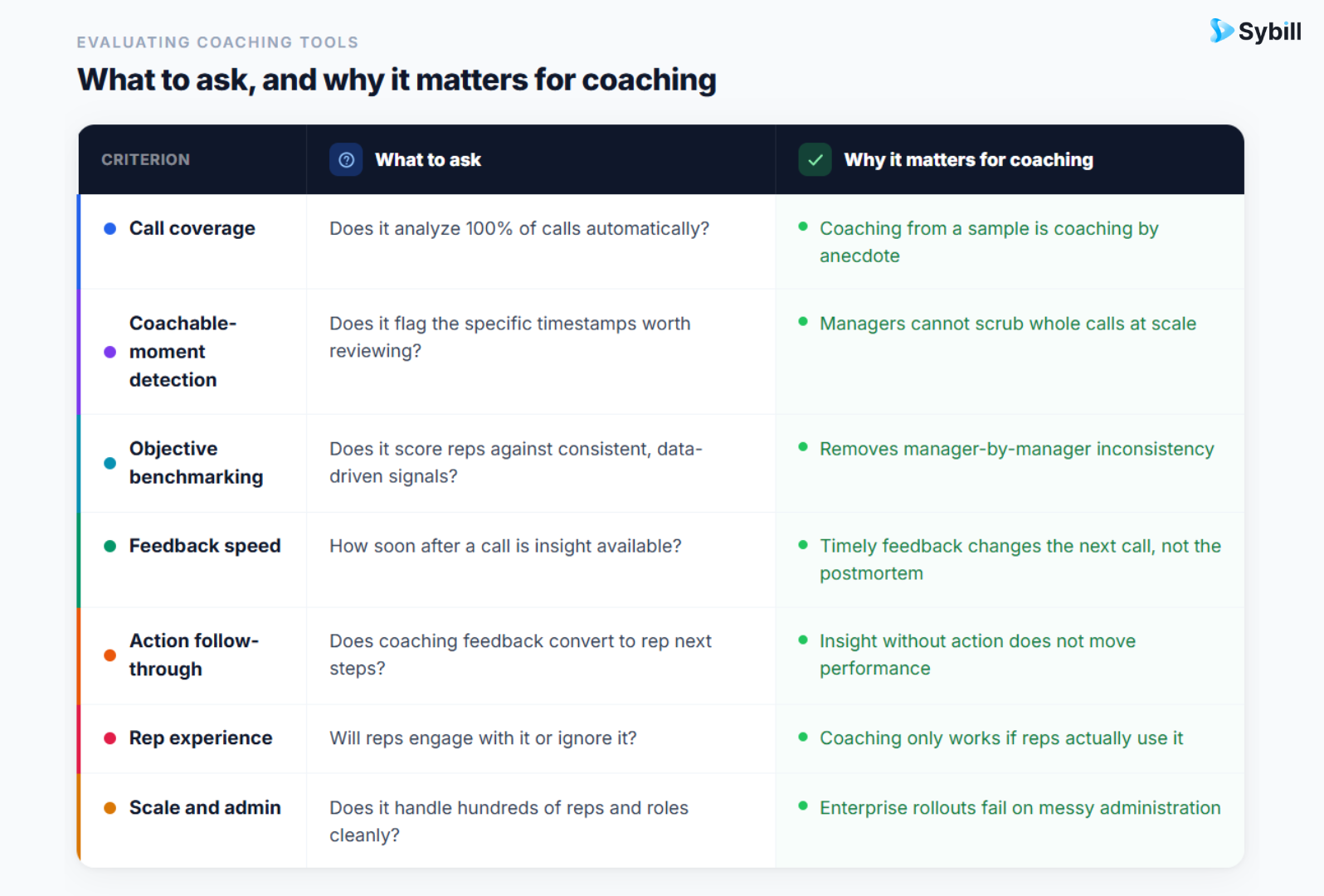
The single most overlooked criterion is action follow-through. Most platforms stop at the scorecard. The ones worth enterprise budget make sure the feedback becomes something the rep actually does differently on the next call.
The table below ranks the seven platforms by coaching depth and, critically, by whether coaching converts to action. Use it to build a shortlist, then read the reviews for fit.
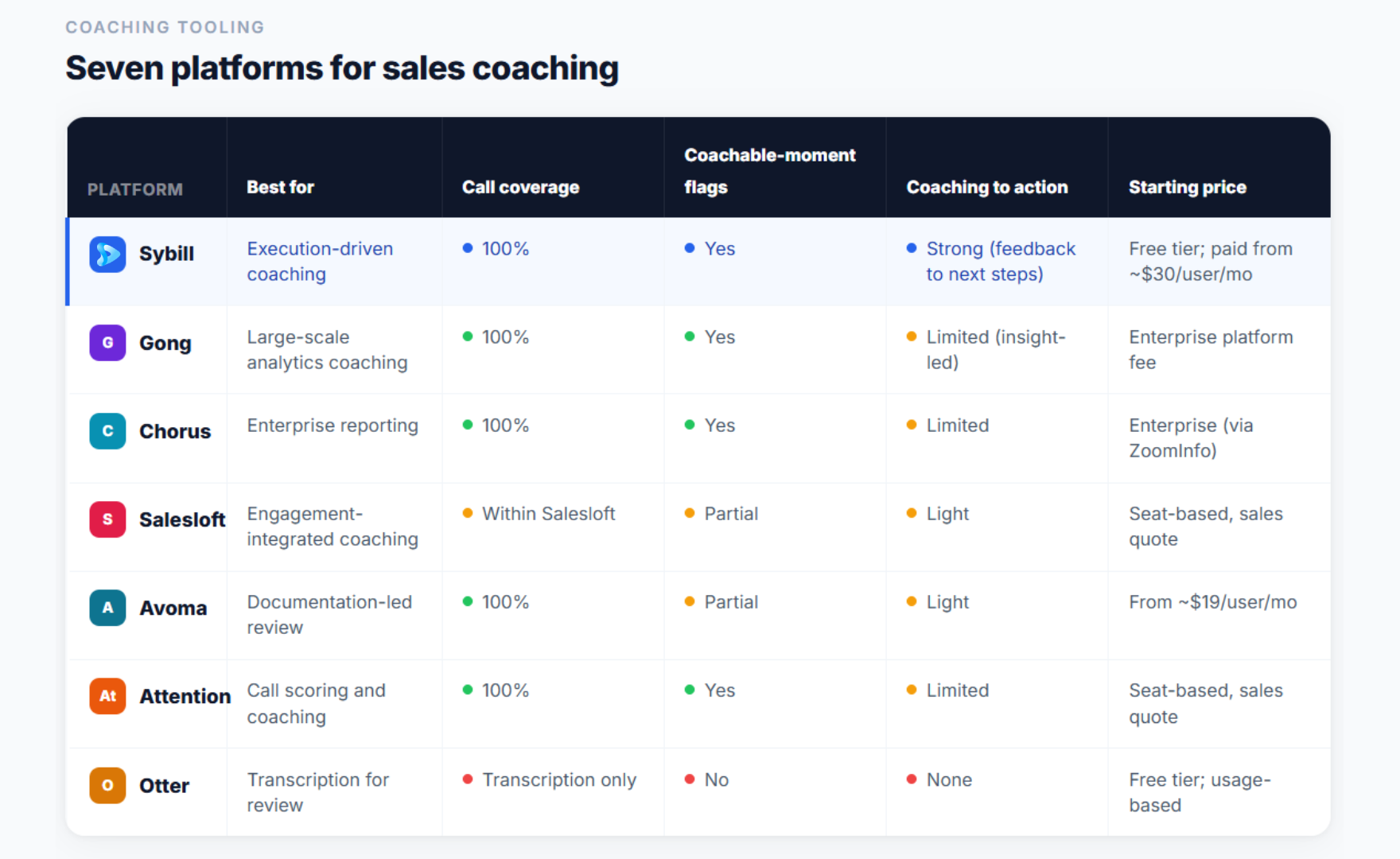
Here is the detail behind the ranking, viewed specifically through the coaching lens. Each review opens with what the platform is, then where it helps managers coach and where it leaves the loop open.
Sybill is a conversational intelligence platform that treats coaching as a loop to close, not a scorecard to file. It analyzes every call, surfaces the moments worth coaching, benchmarks reps against consistent signals, and, crucially, converts what happens on the call into rep action.
For coaching specifically, that last part is the differentiator. Sybill's coaching and performance analysis flags where a rep talked too much, missed a discovery question, or handled an objection well, then ties it to the deal's actual next steps through AI Tasks and CRM autofill. Because it also drafts follow-ups and updates the CRM automatically, it frees the hours managers and reps would otherwise lose to admin, hours that can go into actual coaching instead. Across Sybill usage, reps save 5 to 14 hours a week and new-rep ramp compresses toward 2 to 3 months.
Gong is a revenue intelligence platform with deep call analytics that many large enterprises use as a coaching backbone. Its strength is the breadth and depth of what it surfaces across hundreds of reps, and leadership leans on it heavily for trend spotting.
For coaching, Gong gives managers rich insight into what is happening. Where the loop tends to stay open is turning that insight into rep action; the follow-through often lands back on the manager and rep manually. That is why some teams pair Gong's analytics with an execution-first layer. See our Sybill versus Gong comparison and Sybill plus Gong.
Chorus, part of ZoomInfo, is a conversational intelligence platform strong on enterprise reporting and integration with the ZoomInfo ecosystem. For coaching, it captures and analyzes calls well and fits organizations already invested in that stack.
Its emphasis is reporting and analysis rather than converting coaching feedback into rep behavior change, so the action side of the loop is lighter.
Salesloft is a sales engagement platform with conversation intelligence built in, so coaching insights sit next to the cadences and workflows reps already use. For teams living in Salesloft, that adjacency makes coaching feel native.
Its coaching capability is solid within the Salesloft world, though it is one feature of a broader engagement suite rather than a dedicated coaching engine. For the wider engagement category, see our Salesloft and Outreach alternatives guide.
Avoma is a meeting assistant that produces clean, organized call records, which makes manager review straightforward. For coaching built around reviewing well-documented calls, it is a reliable choice.
Its coachable-moment detection and action follow-through are lighter than a dedicated coaching platform, so more of the coaching work stays manual.
Attention focuses squarely on scoring conversations and surfacing coaching metrics, which makes it a direct fit for managers who want structured, quantified feedback. If your immediate goal is call scoring and coaching dashboards, it does that job well.
Its scope centers on scoring rather than converting feedback into downstream rep action, so the loop closes less tightly.
Otter is a transcription-first tool that gives managers searchable written records of calls. For lightweight review, where a manager wants to read rather than re-listen, it is fast and inexpensive.
It is not built for structured coaching. There is no coachable-moment detection, benchmarking, or action follow-through, so it functions as a review aid rather than a coaching platform.
Image cue: A "coaching loop" spectrum placing the seven platforms from "review only" (Otter) to "closes the loop: insight to action" (Sybill). Alt text: "Spectrum placing seven conversational intelligence platforms by how fully they close the sales coaching loop."
You roll out coaching across a large team by standardizing what "good" sounds like, letting the platform surface coachable moments at scale, and making feedback fast and action-oriented. Enterprise rollouts fail when coaching stays subjective, slow, or disconnected from what reps do next.
A practical sequence:
Done well, this turns coaching from a manager bottleneck into a scalable system. And because execution-first platforms also automate the post-call admin, managers get back the very hours a serious coaching program requires. For the broader field beyond coaching, see our guide to the best conversation intelligence tools.
There is no single best platform for every team, because it depends on your coaching priority. If you want coaching that converts feedback into rep action, Sybill leads on execution-driven coaching. If your priority is deep analytics and reporting across hundreds of reps, Gong and Chorus are strong. The key is choosing a platform that analyzes 100% of calls and closes the loop from insight to behavior change, rather than one that only produces scorecards.
It improves coaching by removing the coverage, speed, and consistency limits of manual review. Instead of managers hearing a few calls per rep per month, the platform analyzes every call, flags the specific moments worth coaching, and benchmarks reps against consistent signals. That means comprehensive, timely, and fair feedback, and the best platforms then tie that feedback to concrete next steps so it actually changes rep behavior.
Yes, and large distributed teams benefit most. Because the platform analyzes calls automatically regardless of location or time zone, coaching no longer depends on a manager being present or available to review. Every rep gets coached from the same objective standard, which solves the consistency problem that plagues big, spread-out teams relying on individual managers.
Pricing ranges widely. Entry and documentation-focused tools can start around $19 to $30 per user per month, while enterprise analytics platforms carry larger platform-level fees. For coaching specifically, weigh cost against the manager and rep hours the platform returns and the ramp-time it saves, since a platform that reclaims coaching time and speeds ramp can pay for itself well beyond its seat price.
No. It amplifies managers rather than replacing them. The platform handles what humans cannot do at scale, analyzing every call and surfacing coachable moments, so managers spend their time on the high-value human work of actually coaching, mentoring, and motivating reps. It turns managers from bottlenecks into coaches who can reach the whole team, not just the calls they happened to hear.
Impact often shows up first in ramp time. When new reps learn from analyzed calls and top-performer benchmarks instead of trial and error, ramp can compress from four-to-six months toward two-to-three. For tenured reps, improvement tracks with how tightly feedback ties to action; when coaching points become concrete next steps, coached behaviors tend to show up in subsequent calls rather than fading after the review.
There is no single best platform for every team, because it depends on your coaching priority. If you want coaching that converts feedback into rep action, Sybill leads on execution-driven coaching. If your priority is deep analytics and reporting across hundreds of reps, Gong and Chorus are strong. The key is choosing a platform that analyzes 100% of calls and closes the loop from insight to behavior change, rather than one that only produces scorecards.
It improves coaching by removing the coverage, speed, and consistency limits of manual review. Instead of managers hearing a few calls per rep per month, the platform analyzes every call, flags the specific moments worth coaching, and benchmarks reps against consistent signals. That means comprehensive, timely, and fair feedback, and the best platforms then tie that feedback to concrete next steps so it actually changes rep behavior.
Yes, and large distributed teams benefit most. Because the platform analyzes calls automatically regardless of location or time zone, coaching no longer depends on a manager being present or available to review. Every rep gets coached from the same objective standard, which solves the consistency problem that plagues big, spread-out teams relying on individual managers.