Sales Process & Methodologies

CHAMP Sales Methodology: Questions, Examples, and a Practical Qualification Framework

CHAMP sales methodology connecting buyer evidence about challenges, authority, money, and prioritization to four qualification decisions

TL;DR

The CHAMP sales methodology is a qualification framework built around Challenges, Authority, Money, and Prioritization. It begins with the buyer’s business problem instead of asking about budget first. Used well, CHAMP helps sellers decide whether an opportunity should advance, needs further validation, belongs in nurture, or should be disqualified. The framework only works when CRM fields contain buyer-confirmed evidence rather than rep assumptions. This guide explains every CHAMP element, provides qualification questions, and introduces a practical evidence matrix for evaluating deals.

CHAMP Is an Evidence Test, Not a Four-Question Checklist

You can complete four CHAMP fields in 30 seconds and still have no idea whether the deal is real.

A rep can write:

  • Challenge: Forecasting is difficult
  • Authority: VP of Sales
  • Money: Budget available
  • Prioritization: High

The CRM looks healthy. But none of those entries tells the manager what the buyer actually said, how recently it was confirmed, or what the organization has committed to doing.

“Forecasting is difficult” could mean the board has demanded a solution before the next operating review. It could also mean the prospect casually mentioned that spreadsheets are annoying.

“Budget available” could mean the CFO approved a project. It could mean the rep assumes a large company can afford the product.

CHAMP becomes useful when each element contains enough evidence to support a qualification decision.

A meaningful qualification process must answer:

  1. What has the buyer confirmed?
  2. What has the seller inferred?
  3. What information remains missing?
  4. What must happen next?
  5. Does the opportunity deserve more time?

The point is not to make every deal look qualified. The point is to reach the most accurate decision possible.

What Is the CHAMP Sales Methodology?

CHAMP is a sales qualification framework that helps sellers evaluate an opportunity through four areas:

  • Challenges: Does the buyer have a meaningful problem that the seller can help solve?
  • Authority: How will the organization evaluate, approve, and purchase a solution?
  • Money: Is there a credible way to fund the purchase?
  • Prioritization: Is the organization prepared to act on the problem?

CHAMP is widely associated with sales leader Zorian Rotenberg. His current description presents CHAMP as a broader selling system that includes customer experience, methodology, process, qualification, and performance measurement.

“Make Your Customer a Champion.”
Zorian Rotenberg, creator of the CHAMP Selling System

The phrase captures an important part of CHAMP. Qualification should not be something done to the prospect. A strong process helps the buyer clarify the problem, understand the internal path to change, and build support for action.

Most contemporary sales teams use CHAMP primarily as a qualification framework. They commonly interpret the final “P” as Prioritization. Rotenberg’s current overview expands it to Priority, Process, and Plan as part of the broader CHAMP system.

This guide uses Prioritization because that is the established qualification shorthand. It still treats the buyer’s process and plan as essential evidence, especially under Authority and Prioritization.

What Does CHAMP Stand For?

Each CHAMP element answers a different qualification question.

CHAMP Element What the Seller Must Establish Weak Evidence Stronger Evidence
Challenges The buyer has a significant problem the seller can credibly help solve "They want more efficiency." The buyer explains where the problem occurs, who it affects, its impact, and the consequence of leaving it unresolved.
Authority The seller understands how the organization will decide "My contact is a director." The buying roles, approval path, stakeholder concerns, and access plan are identified.
Money The organization has a credible funding path "They are a large company." The buyer identifies an approved budget, possible funding source, approval threshold, or business-case requirement.
Prioritization The organization is likely to dedicate attention and resources to the problem "They want to move soon." The buyer confirms competing initiatives, a reason to act, internal resources, and a meaningful target date.

These elements are connected. A costly problem may create a funding case. A powerful sponsor may elevate its priority. A high-priority initiative may create access to additional stakeholders.

CHAMP is presented as an acronym, but real qualification rarely happens in a neat sequence.

How to Use the CHAMP Sales Methodology

  1. Challenges: establish a problem the buyer will act on

CHAMP starts with Challenges because a buyer’s ability to purchase matters only when there is a worthwhile reason to change.

That does not mean every frustration is a qualified business challenge.

Suppose a prospect says, “Our CRM data is always out of date.” A seller still needs to determine:

  • Which information becomes outdated?
  • Why does that happen?
  • Who is affected?
  • What decisions suffer?
  • What has the organization already tried?
  • What does the problem cost in time, money, risk, or missed opportunity?
  • What happens if the current process continues?
A strong Challenge entry might read:
The VP of Sales said managers spend Friday afternoons chasing CRM updates from 40 account executives. The stale data affects Monday forecast reviews and contributed to two opportunities remaining in Commit after buyers had stopped responding.

That entry contains a source, operational impact, and connection to a business decision.

It is considerably more useful than “poor CRM hygiene.”

  1. Authority: map the decision system

Authority is frequently reduced to one question: “Are you the decision-maker?”

Modern B2B purchases rarely work that way.

One person may own the business outcome. Another controls the budget. Security may assess data handling. Procurement may negotiate terms. A finance leader may require an ROI case. A senior executive may have veto power without joining most sales conversations.

CHAMP should help the seller understand:

  • Who owns the problem?
  • Who can release the funds?
  • Who will evaluate the solution?
  • Who will use it?
  • Who can block the purchase?
  • Which stakeholders have been contacted?
  • What sequence of approvals is required?
  • Who will advocate internally when the seller is absent?

A senior title is not proof of authority. The seller needs evidence of how the person participates in this particular decision.

  1. Money: identify a credible funding path

Money is broader than an existing budget line.

A company may fund a solution through:

  • An approved project budget
  • A discretionary departmental budget
  • Money currently spent on another tool
  • A new business-case request
  • A paid pilot
  • A phased implementation
  • Funds released by delaying another initiative

CHAMP puts Money after Challenges because the financial conversation becomes more productive once both parties understand the value of solving the problem. However, sellers should not translate that principle into, “If the pain is big enough, they will find the money.”

A credible funding path still requires evidence.

The buyer should be able to explain how comparable purchases are funded, who approves them, which financial constraints apply, and what proof the organization needs before committing.

  1. Prioritization: determine whether the business will act

A problem can be painful, affordable, and supported by a senior stakeholder without becoming an active purchase.

Organizations constantly choose between legitimate needs. Hiring, expansion, compliance, product launches, cost reduction, and infrastructure projects may all compete for the same attention and resources.

Prioritization should establish:

  • Where the initiative ranks against other work
  • What changed to make it important now
  • What happens if it is delayed
  • Whether there is a meaningful business event
  • Which internal resources are available
  • When the organization needs to begin, decide, or realize value
  • Whether the buyer is willing to take a concrete next step
A date alone is not proof of priority. “We would like to implement in October” is weaker than:
The CRO wants the new process operating before annual planning begins on October 15. RevOps has assigned an implementation owner, and Security has reserved a review slot in September.

The second statement connects time to organizational action.

The Best CHAMP Qualification Questions to Ask

The goal is not to ask every question in one meeting. That would turn discovery into an audit.

Select questions based on what you already know, then follow the buyer’s answers. If the buyer gives a vague response, deepen it. If the answer contradicts something previously said, resolve the contradiction.

Neil Rackham, creator of SPIN Selling, offers a useful standard for sales frameworks:

“A good model is at the intersection of validity and simplicity.”
Neil Rackham, Huthwaite International

CHAMP provides the simplicity. The seller must supply the judgment.

Questions about Challenges

Qualification Question What It Tests Evidence to Listen For
"What changed that made this worth addressing now?" Trigger and context A new target, leadership change, operational breakdown, renewal, risk, or strategic initiative
"Walk me through where the problem appears in the current workflow." Problem specificity A concrete process, affected team, system, handoff, or repeated failure point
"Who feels the impact most directly?" Scope and ownership Named roles, teams, customers, or leaders accountable for the outcome
"How are you measuring the effect today?" Business impact Time, revenue, cost, risk, conversion, productivity, retention, or another relevant measure
"What have you already tried?" Persistence and prior learning Previous tools, process changes, internal workarounds, and reasons they did not solve the problem
"What happens if the organization leaves this unchanged for another six months?" Consequence of inaction A credible operational, financial, customer, or strategic consequence

Avoid forcing every challenge into an exaggerated financial calculation. Some consequences involve risk, employee capacity, customer experience, or strategic delay. Quantify where the buyer has a defensible basis.

Questions about Authority

Qualification Question What It Tests Evidence to Listen For
"How does your organization normally evaluate a purchase like this?" Buying process Specific stages, teams, reviews, and approval steps
"Who owns the business outcome we have been discussing?" Business authority A named executive or functional owner accountable for the result
"Who else will evaluate whether a solution is suitable?" Evaluation roles Technical, security, operational, financial, and user stakeholders
"Whose approval releases the budget?" Financial authority A budget owner, approval threshold, or executive signatory
"Who could stop this project, even if the core team supports it?" Veto power and risk Procurement, legal, security, IT, finance, or a competing executive
"What would help us involve those people at the right point?" Access A credible introduction, scheduled review, or agreed stakeholder plan

Authority is not fully confirmed because a contact names the CRO. Access matters. A stakeholder map without a plan to engage relevant people is still incomplete.

Questions about Money

Qualification Question What It Tests Evidence to Listen For
"How have similar projects been funded?" Funding precedent A department, project budget, executive fund, or existing spend
"Has money already been allocated, or would the team need to build a case?" Budget status Approved, requested, unallocated, or dependent on justification
"What is the current process costing the organization?" Economic context Staff time, tool costs, lost revenue, delays, rework, or risk
"Who would need to approve an investment in this range?" Financial approval path Named approver and relevant spending threshold
"What evidence would Finance need to support the request?" Business-case requirement ROI, payback period, risk reduction, customer impact, or benchmark
"Which other initiatives would compete for the same funds?" Budget competition Named projects and a realistic trade-off

A buyer who says “there is no budget” may still be qualified if a genuine problem and credible funding process exist.

A buyer who repeatedly avoids all financial and approval questions is not automatically disqualified, but the opportunity remains financially unverified.

Questions about Prioritization

Qualification Question What It Tests Evidence to Listen For
"Where does this sit among the team's other priorities?" Relative importance A comparison with named initiatives
"What makes this important now rather than next quarter?" Reason to act A business event, leadership request, renewal, deadline, or escalating consequence
"What becomes harder if the decision is delayed?" Cost of delay A specific operational, financial, customer, or strategic impact
"Which internal resources would need to support implementation?" Organizational commitment An owner, technical resources, training capacity, or project time
"Is there a date by which the solution must be operating, not merely purchased?" Outcome timing An implementation deadline connected to a business objective
"What is the next action your team is prepared to take?" Active intent A scheduled stakeholder meeting, data review, technical evaluation, or business-case session

Priority is demonstrated through action. Enthusiasm without a next step is an encouraging sentiment, not proof of purchase readiness.

Use This CHAMP Evidence Ladder to Test Every Answer

A buyer answer can exist at different levels of reliability. The following evidence ladder is a Sybill editorial model.
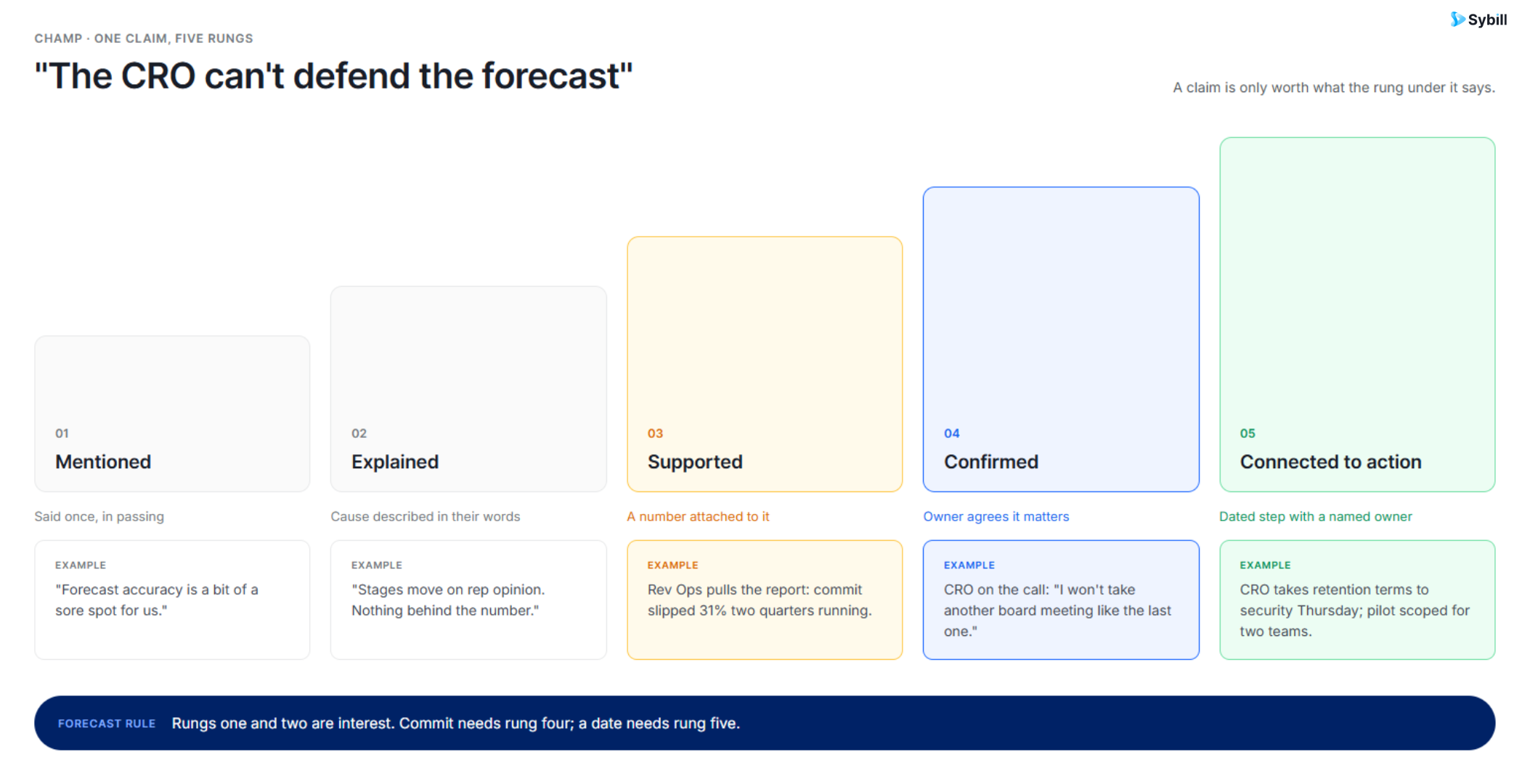
CHAMP evidence ladder progressing from a buyer mention to stakeholder confirmation and an agreed sales action
  1. Mentioned: The buyer refers to a problem, person, budget, or date.
  2. Explained: The buyer provides enough context to understand what it means.
  3. Supported: The answer includes a concrete example, measure, process, or consequence.
  4. Confirmed: A relevant stakeholder verifies the information.
  5. Connected to action: The organization commits to a next step because of it.

Consider the difference:

  • Mentioned: “Our CRO cares about forecast accuracy.”
  • Explained: “The CRO reviews the forecast with the board every month.”
  • Supported: “The last forecast missed actual revenue by 14 percent.”
  • Confirmed: The CRO joins a call and describes the required improvement.
  • Connected to action: The CRO agrees to review a business case with Finance by Friday.

Not every CHAMP element must reach the highest level during the first conversation. The evidence level tells the seller what to validate next.

Use a CHAMP Evidence Matrix Instead of Four Empty CRM Fields

The CHAMP Evidence Matrix helps sellers distinguish facts from assumptions and turn missing information into a next action. This is a practical operating model developed for this guide.

CHAMP Element Buyer Claim Supporting Evidence Status Missing Information Next Validation Action
Challenges Forecast data is unreliable VP Sales described weekly manual cleanup and stale Commit opportunities Confirmed Full cost and board impact Ask how forecast errors affect planning and executive reporting
Authority CRO approves the purchase VP Sales named the CRO as executive owner Inferred Direct access and approval criteria Schedule a business-case review with the CRO
Money Funding may come from the sales technology budget Buyer identified a possible budget source Partially confirmed Available amount and approval threshold Confirm range and Finance requirements
Prioritization Improvement is needed before annual planning Buyer provided the annual planning date Confirmed Implementation ownership Identify the internal project owner and Security review window

Use four straightforward statuses:

  • Confirmed: Supported by a relevant buyer or documented action
  • Inferred: Plausible, but not directly established
  • Missing: No useful evidence yet
  • Contradictory: Different stakeholders or interactions provide incompatible information

Contradictory evidence deserves special attention. If one stakeholder calls the project urgent while another says it is not funded this year, the solution is not to select the more convenient answer. The contradiction becomes the next qualification task.

What Does CHAMP Look Like in a Real Sales Opportunity?

Consider a fictional software company evaluating an AI sales assistant for a 40-person account executive team.

The first discovery call is with the Director of Revenue Operations.

Element What the Buyer Says Initial Assessment
Challenges Managers spend Friday afternoons chasing CRM updates, and reps prepare manually for follow-up calls. The operational problem is specific, but the financial and forecast impact remains unquantified.
Authority The RevOps director is leading the evaluation. The VP of Sales and IT will also be involved. Buying roles are identified, but the seller has not met the executive sponsor or technical evaluator.
Money There is no dedicated budget yet. The buyer believes funds could come from a sales technology consolidation project. A possible funding path exists, but it has not been approved or sized.
Prioritization The team wants to improve CRM completeness before annual planning in ten weeks. There is a relevant event, but implementation capacity has not been confirmed.

The qualification decision after call one

The correct outcome is Validate, not Advance and not Disqualify.

The opportunity has:

  • A specific problem
  • An internal evaluation owner
  • A possible funding path
  • A meaningful target event

It does not yet have:

  • Confirmed executive sponsorship
  • A defined business impact
  • An approved budget path
  • Confirmation that IT can review and implement the solution in time

The seller’s next move is not another generic demo.

The next meeting should include the VP of Sales and focus on:

  1. The effect of incomplete CRM information on pipeline reviews and rep productivity
  2. The outcomes required before annual planning
  3. The project’s funding and approval path
  4. IT’s evaluation requirements
  5. The internal owner responsible for implementation

If the VP confirms the business importance, agrees on an evaluation plan, and involves IT, the opportunity may be ready to advance.

If the VP treats the project as exploratory and will not commit resources before annual planning, the appropriate decision may be Nurture.

Good qualification protects the seller from false confidence. It also protects the buyer from being dragged through a sales process they are not ready to complete.

How to Make a Qualification Decision With CHAMP

CHAMP should end with a decision about where the opportunity belongs.

Qualification Decision When to Use It Appropriate Seller Action
Advance The challenge, buying path, funding path, and priority are supported by credible evidence Progress to the next agreed stage with a buyer-owned action
Validate The opportunity is plausible, but one or more material assumptions remain unconfirmed Design the next interaction around the missing evidence
Nurture The challenge is real, but the organization is not currently prioritizing action Agree on a relevant trigger or date for re-engagement
Disqualify There is no meaningful problem, solution fit, buying path, or intention to act Close the opportunity respectfully and record the reason

A seller does not need perfect information to advance every deal. They need enough evidence to justify the time, resources, and forecast confidence assigned to it.

The standard should also rise with the stage. Early discovery may require a credible challenge and a possible buying path. A late-stage commit should require significantly stronger evidence about authority, funding, internal process, priority, and buyer action.

CHAMP vs. BANT, MEDDIC, and SPICED

CHAMP is not automatically better than every other qualification framework. It solves a particular problem: how to qualify around a meaningful business challenge when budget and purchase readiness may still be developing.

Framework Primary Job Best-Fit Selling Context What It Covers Less Deeply
CHAMP Qualify around the buyer's challenge and readiness to act Consultative B2B discovery where budget may not be allocated yet Decision criteria, champions, procurement, and competition
BANT Establish budget, authority, need, and timeline Simpler or higher-velocity opportunities Business impact and complex buying dynamics
MEDDIC Qualify complex opportunities using metrics, buying roles, decision mechanics, pain, and champions Enterprise deals involving multiple stakeholders and formal evaluation Can be heavier than necessary for simpler opportunities
SPICED Connect situation, pain, impact, critical events, and decisions SaaS and recurring-revenue motions May capture more customer context than a simple initial qualification requires

CHAMP vs. BANT

BANT evaluates Budget, Authority, Need, and Timeline. CHAMP changes the order and framing:

  • Challenges come before Money.
  • Money includes financial capacity and the ability to create a funding path.
  • Prioritization examines relative organizational importance, not just a desired purchase date.
  • Authority should map the buying system rather than identify one decision-maker.

BANT can still be useful when budget and timing are genuine early gates. The problem is not the acronym. The problem is using it as an interrogation or rejecting a well-matched buyer before the organization has had reason to allocate funds.

CHAMP vs. MEDDIC

CHAMP works well as an initial opportunity-qualification framework. MEDDIC goes further into enterprise deal mechanics, including:

  • Metrics
  • Economic buyer
  • Decision criteria
  • Decision process
  • Identified pain
  • Champion

A sales team can qualify an opportunity with CHAMP and then use MEDDIC or MEDDPICC to manage the complexity of a larger deal. The frameworks do not have to compete for exclusive ownership of the sales process.

CHAMP vs. SPICED

Both CHAMP and SPICED begin with buyer context rather than product fit.

SPICED provides more explicit treatment of business impact, a critical event, and how the organization will decide. CHAMP offers a more compact initial test of whether there is a meaningful challenge, buying authority, a financial path, and organizational priority.

Read Sybill’s broader guide to choosing a scalable sales framework if you are deciding which framework belongs in your sales process.

When Should a Sales Team Use CHAMP?

CHAMP is especially useful when:

  • The buyer has a real problem but has not defined a project yet.
  • Budget may need to be created after the business case is understood.
  • The sale requires consultative discovery.
  • The seller needs an early opportunity-qualification standard.
  • Teams currently advance deals based on interest rather than evidence.
  • CRM fields contain conclusions without supporting context.
  • Sellers need a framework simple enough to remember during live conversations.

CHAMP may not be sufficient on its own when:

  • The deal involves a large buying committee.
  • Procurement and legal can materially affect the timeline.
  • Formal decision criteria determine the vendor selection.
  • Competitive positioning is central to the opportunity.
  • The seller needs an internal champion to navigate the account.
  • Implementation risk requires a mutual action plan.
  • Success metrics must be established before purchase.

In those cases, use CHAMP as the first qualification layer and add the relevant elements of MEDDIC, MEDDPICC, SPICED, or your organization’s deal process.

Avoid selecting a framework through arbitrary thresholds such as a particular contract value or number of days. Deal complexity depends on buying roles, risk, procurement, required change, and decision structure, not only revenue.

How to Operationalize CHAMP in Your CRM

A useful CRM implementation should preserve the evidence behind each conclusion.

Consider capturing these fields:

CRM Field What It Should Contain Example
CHAMP status Confirmed, inferred, missing, or contradictory Authority: Inferred
Buyer evidence What the buyer actually said or committed to "The CRO approves sales technology purchases above $50,000."
Evidence source Call, email, meeting, document, or stakeholder Discovery call with VP of Sales
Last confirmed Date the information was most recently verified August 14, 2026
Missing information The material qualification gap CRO's evaluation criteria
Next validation action The next step designed to resolve the gap Invite CRO to the business-case review
Qualification decision Advance, validate, nurture, or disqualify Validate

Do not require every CHAMP field to be fully complete immediately after the first call. That encourages reps to guess. Instead:

  • Define the minimum evidence required at each opportunity stage.
  • Allow “unknown” or “unconfirmed” as valid entries.
  • Record when and where the evidence was captured.
  • Review material gaps during pipeline and deal inspections.
  • Reconfirm information after stakeholder, priority, or timeline changes.
  • Separate AI-extracted information from the seller’s final qualification judgment.

A blank field is visible. A confidently written assumption is harder to detect and often more damaging.

How AI Can Support CHAMP Qualification

CHAMP is simple enough to remember, but keeping it current across calls, emails, stakeholders, and CRM fields is harder. This is where AI can help. Its strongest role is not making the qualification decision for the seller. It is retrieving, structuring, and maintaining the evidence the seller needs.

Prepare around missing evidence

Before a meeting, Sybill’s Pre-Meeting Briefs can bring together previous interactions, deal context, participant information, and recent activity.

Instead of entering the call with “I need to ask about CHAMP,” the seller can enter with a specific objective:

We understand the business challenge and target date. We have not confirmed the budget owner or technical approval process.

That produces a much better conversation.

Ask questions across the deal history

Ask Sybill lets sellers query information across calls, emails, CRM context, and other deal interactions.

Ask Sybill separating confirmed, inferred, and missing CHAMP qualification evidence for a sales opportunity

Useful CHAMP prompts include:

  • What business challenges has the buyer described across this deal?
  • Which impacts have been quantified, and which remain general?
  • Who has been named in the buying and approval process?
  • Have we spoken directly with the person who controls the budget?
  • What has the buyer said about funding or procurement?
  • Which events or consequences make this initiative a priority?
  • Separate confirmed CHAMP evidence from assumptions and missing information.
  • What should I validate in the next meeting?

The output should support the rep’s judgment, not replace it. A person being mentioned does not prove authority. A date in an email does not automatically prove priority.

Capture CHAMP context after each interaction

Meeting summaries can retain challenges, stakeholders, funding context, priorities, objections, and next steps while the conversation is still fresh.

CRM Autofill can then update selected standard and custom fields after calls and emails. RevOps teams can configure CHAMP fields, review the prompts used to populate them, and test the outputs before wider deployment.

The important design choice is the field prompt.

Instead of:

Does the buyer have authority?

Use:

Identify the people the buyer explicitly named as evaluators, influencers, budget owners, approvers, or blockers. Do not infer decision authority from job title alone.

Instead of:

Is there budget?

Use:

Record any buyer-confirmed budget amount, funding source, approval threshold, comparable spend, or process for requesting funds. State “not confirmed” when no evidence exists.

This makes CRM automation more useful and less likely to turn uncertainty into false confidence.

Turn qualification gaps into actions

AI Tasks can capture pending actions and organize them by deal.

For CHAMP, those tasks might include:

  • Schedule a financial review with the budget owner.
  • Confirm implementation capacity with RevOps.
  • Send the business-case template requested by the CRO.
  • Ask the champion to validate the buying committee.
  • Reconfirm the critical event after the project delay.

A qualification gap is useful only when it changes what the seller does next.

Inspect deals against the qualification standard

Sybill’s Deal Inspection supports questions about missing qualification criteria, budget, procurement, buying committees, buyer intent, and deal risk.

A manager could ask:

  • Which late-stage deals have no confirmed funding path?
  • Which opportunities identify authority without direct stakeholder access?
  • Which opportunities have a target date but no business event supporting it?
  • Which deals contain contradictory priority signals?
  • Which deals moved stages without a buyer-owned next action?

This shifts the pipeline review away from rep storytelling and toward evidence, gaps, and strategy.

AI can retrieve and maintain the record. The seller and manager remain responsible for deciding whether the evidence is credible enough to advance the deal.

Read Sybill’s AI-powered sales qualification guide for a wider look at using conversation and CRM signals across different frameworks.

How to Roll Out CHAMP Across a Sales Team

A methodology workshop is not an implementation. The team needs shared evidence standards, CRM support, coaching, and inspection.

Phase Team Action Deliverable
Week 1: Define Agree on what counts as confirmed, inferred, missing, and contradictory evidence for each CHAMP element CHAMP evidence standard
Week 2: Configure Add the required fields, sources, confidence labels, and validation actions to the CRM CRM configuration and prompts
Week 3: Practice Run discovery and deal-review exercises using real or anonymized opportunities Question bank and coaching notes
Week 4: Inspect Review live opportunities for evidence quality and missing information Baseline qualification audit
Ongoing Compare qualification decisions with actual deal outcomes and refine the standard Quarterly framework review

During coaching, inspect behavior as well as field completion:

  • Did the rep ask a useful follow-up?
  • Did they test an assumption?
  • Did they summarize the problem accurately?
  • Did they earn access to another stakeholder?
  • Did the next step resolve a material qualification gap?
  • Did the CRM preserve uncertainty where evidence was unavailable?

The framework is simple. Consistent execution is the difficult part.

Turn CHAMP Sales Methodology Into a Qualification Decision, Not More Admin

CHAMP earns its place in a sales process by forcing four practical questions:

  • Is there a business challenge worth solving?
  • Can the organization make a decision?
  • Is there a credible financial path?
  • Will the buyer act?

But the acronym alone cannot tell you whether the answers are true.

That requires buyer evidence, thoughtful discovery, visible uncertainty, and next steps designed to validate what matters. It also requires qualification information to remain current as the deal evolves.

Sybill helps sales teams retrieve that evidence from calls, emails, and CRM context, keep qualification fields updated, turn missing information into tasks, and inspect deals for risk. The seller still makes the call. They simply make it with a better record of what the buyer has actually said and done. Explore how Sybill helps you inspect and qualify deals.

Frequently Asked Questions

What does CHAMP stand for in sales?

CHAMP stands for Challenges, Authority, Money, and Prioritization. The framework helps sellers understand the buyer’s business problem, decision structure, funding path, and readiness to act.

What is the CHAMP sales methodology?

The CHAMP sales methodology is a B2B qualification framework that begins with the buyer’s challenges before examining authority, money, and priority. Its purpose is to determine whether an opportunity deserves continued investment and what the seller still needs to validate.

Who created the CHAMP framework?

CHAMP is widely attributed to sales leader Zorian Rotenberg. His current materials describe CHAMP as a broader customer-centric selling system that includes qualification, sales process, methodology, and performance management.

What is the difference between CHAMP and BANT?

CHAMP starts with Challenges, while BANT starts with Budget. CHAMP also evaluates Money as a potential funding path and Prioritization as the initiative’s importance relative to other work. BANT focuses on Budget, Authority, Need, and Timeline.

Is CHAMP a sales methodology or a qualification framework?

CHAMP is most commonly used as a sales qualification framework, although its creator describes the broader CHAMP Selling System as a complete sales methodology and operating system. The four-letter qualification model does not replace every stage of a complete sales process.

What are the best CHAMP qualification questions?

The best questions uncover the impact of the challenge, map how the organization decides, identify a credible funding path, and test whether the buyer will commit resources and actions. They should generate buyer evidence rather than simple yes-or-no answers.

When should a sales team use CHAMP?

Use CHAMP when sellers need an early, buyer-centered way to qualify consultative B2B opportunities, especially when a meaningful problem may exist before the buyer has formally allocated budget.

Can CHAMP be used with MEDDIC or SPICED?

Yes. A team can use CHAMP for initial qualification and then apply MEDDIC, MEDDPICC, or SPICED when the opportunity requires deeper analysis of business impact, decision criteria, procurement, champions, competition, or critical events.

How do you score a deal using CHAMP?

CHAMP does not require an official numerical score. Teams can classify evidence as confirmed, inferred, missing, or contradictory, then decide whether to advance, validate, nurture, or disqualify the opportunity.

Can AI automate CHAMP qualification?

AI can retrieve CHAMP evidence from calls and emails, summarize it, update CRM fields, and identify missing information. A seller or manager should still validate the evidence and make the final qualification decision.

Get started with Sybill

Accelerate your sales with your personal assistant

Get Started Free

Frequently Asked Questions

What does CHAMP stand for in sales?

CHAMP stands for Challenges, Authority, Money, and Prioritization. The framework helps sellers understand the buyer’s business problem, decision structure, funding path, and readiness to act.

What is the CHAMP sales methodology?

The CHAMP sales methodology is a B2B qualification framework that begins with the buyer’s challenges before examining authority, money, and priority. Its purpose is to determine whether an opportunity deserves continued investment and what the seller still needs to validate.

Who created the CHAMP framework?

CHAMP is widely attributed to sales leader Zorian Rotenberg. His current materials describe CHAMP as a broader customer-centric selling system that includes qualification, sales process, methodology, and performance management.

Get started with Sybill

Once you try it, you’ll never go back.