Find us at booth #83, join us for a harbor side happy hour, or catch Gorish’s talk.

Sept, 16-18 > Learn more


Mamta Tainwala

February 12, 2026
TL;DR:
Not all sales frameworks solve the same problem.
BANT is your fast filter for high-volume inbound (qualify or disqualify in minutes).
MEDDIC/MEDDICC is the enterprise deal map that keeps complex, multi-stakeholder cycles from going sideways.
SPICED is purpose-built for SaaS, treating every conversation as discovery for long-term revenue, not just an initial close.
CHAMP leads with the buyer's pain, which makes budget conversations easier downstream.
GPCT reframes qualification around goals, ideal for consultative selling.
N.E.A.T. forces you to quantify the economic cost of inaction, which is what actually gets deals approved internally.
The real unlock in 2026? Whichever framework you pick, AI now handles the tedious part (logging qualification data, updating CRM fields, tracking changes across calls) so your team can focus on the conversations instead of the admin.
“I can’t remember at what part of the call but I suddenly felt very sure the deal will be signed. Because I remember them smiling and nodding.” Sometimes, rather most times in sales, everyone relies on their gut. That tension between gut instinct and structured methodology? It plays out on every sales floor, every single day.
Some reps swear by intuition. Others live and die by their qualification checklists. And most sales managers are somewhere in the middle, trying to get a dozen different sellers to follow the same playbook without turning every discovery call into a robotic interrogation.
That's where sales frameworks come in. Not as rigid scripts, but as shared languages that help teams qualify better, forecast more accurately, and stop wasting time on deals that were never going to close.
There are a lot of frameworks out there. And choosing the wrong one (or choosing the right one and implementing it poorly) can actually slow your team down. So let's cut through the noise.
Before we get into the specific methodologies, let's get the definitions straight, because sales framework, sales methodology, and sales process get thrown around interchangeably and they really shouldn't be.
A sales process is the sequence of steps your deal moves through. Think: prospecting, discovery, demo, proposal, negotiation, close. It's the "what happens when."
A sales methodology is the approach your reps take within those steps. It's the "how" of selling, the philosophy that shapes conversations.
A sales framework sits above both. It's the overarching strategic structure that combines your process and methodology into a repeatable system. Think of it as the architecture that holds everything together, especially when deals get complex and multiple stakeholders enter the picture. If you want a deeper dive into these distinctions, Sybill's breakdown of sales process vs. methodology vs. framework is worth a read.
The best frameworks don't just tell reps what to ask. They create a shared understanding across the team about what "qualified" actually means, what information matters at each stage, and when a deal is real versus when it's wishful thinking.
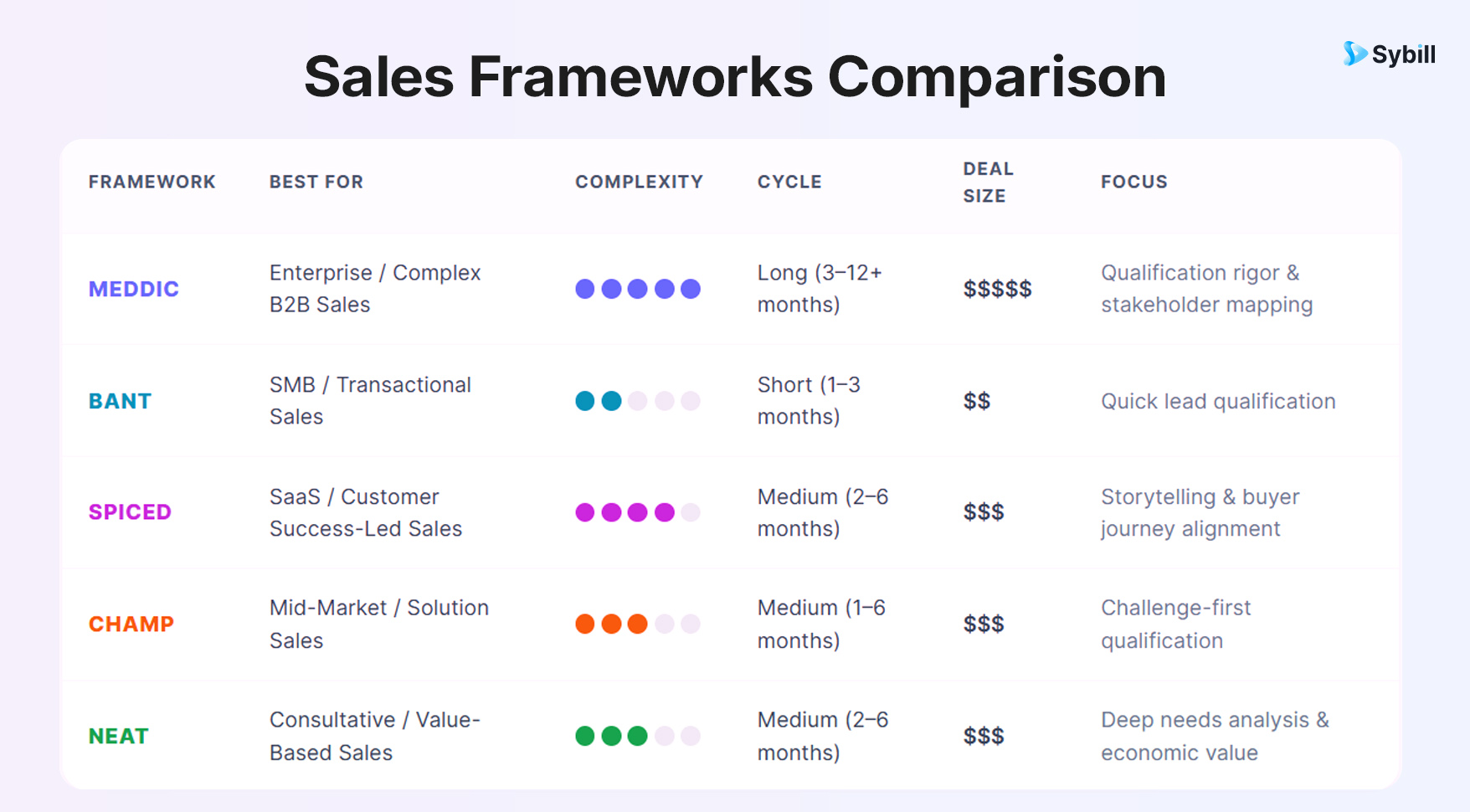
Not every framework works for every team. The best sales methodology for big deals is fundamentally different from what works in a high-velocity SMB motion. Here's a breakdown of the most widely used frameworks and the contexts where they shine.
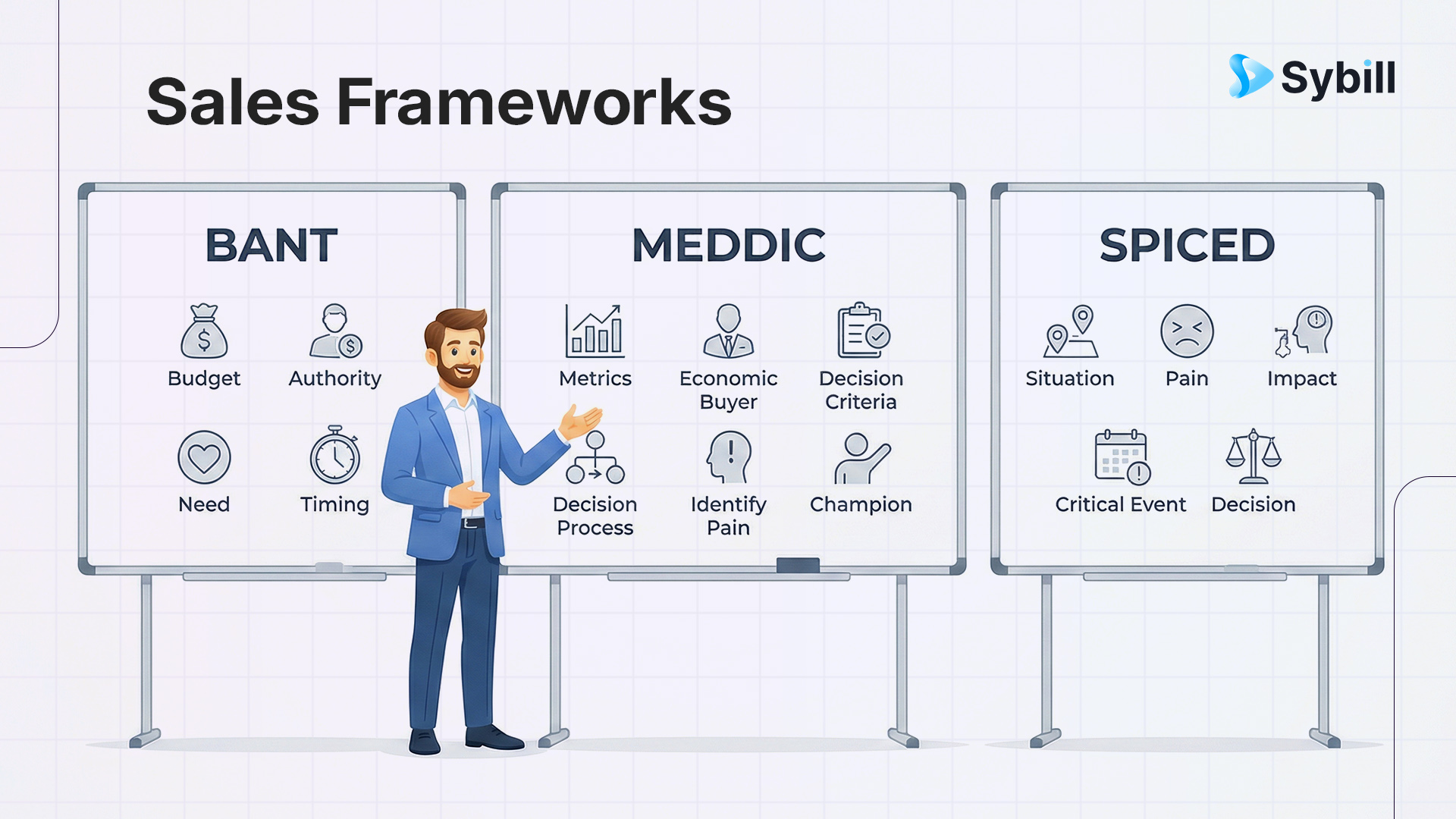
What it stands for: Budget, Authority, Need, Timeline
BANT was born at IBM in the 1960s, back when a single mainframe sale could make a rep's entire year. It's beautifully simple: does the prospect have the budget, the authority to buy, a genuine need, and a timeline that makes sense?
Best for: High-velocity sales, inbound qualification, and situations where you need to sort leads quickly. If your team handles a high volume of inbound and needs to separate the tire-kickers from the ready-to-buy crowd fast, BANT still earns its keep.
Where it falls short: Modern B2B buying is messier than four neat boxes. Budgets are fluid. "Authority" is rarely one person. And leading with "What's your budget?" in the first two minutes of a call is a great way to get ghosted.
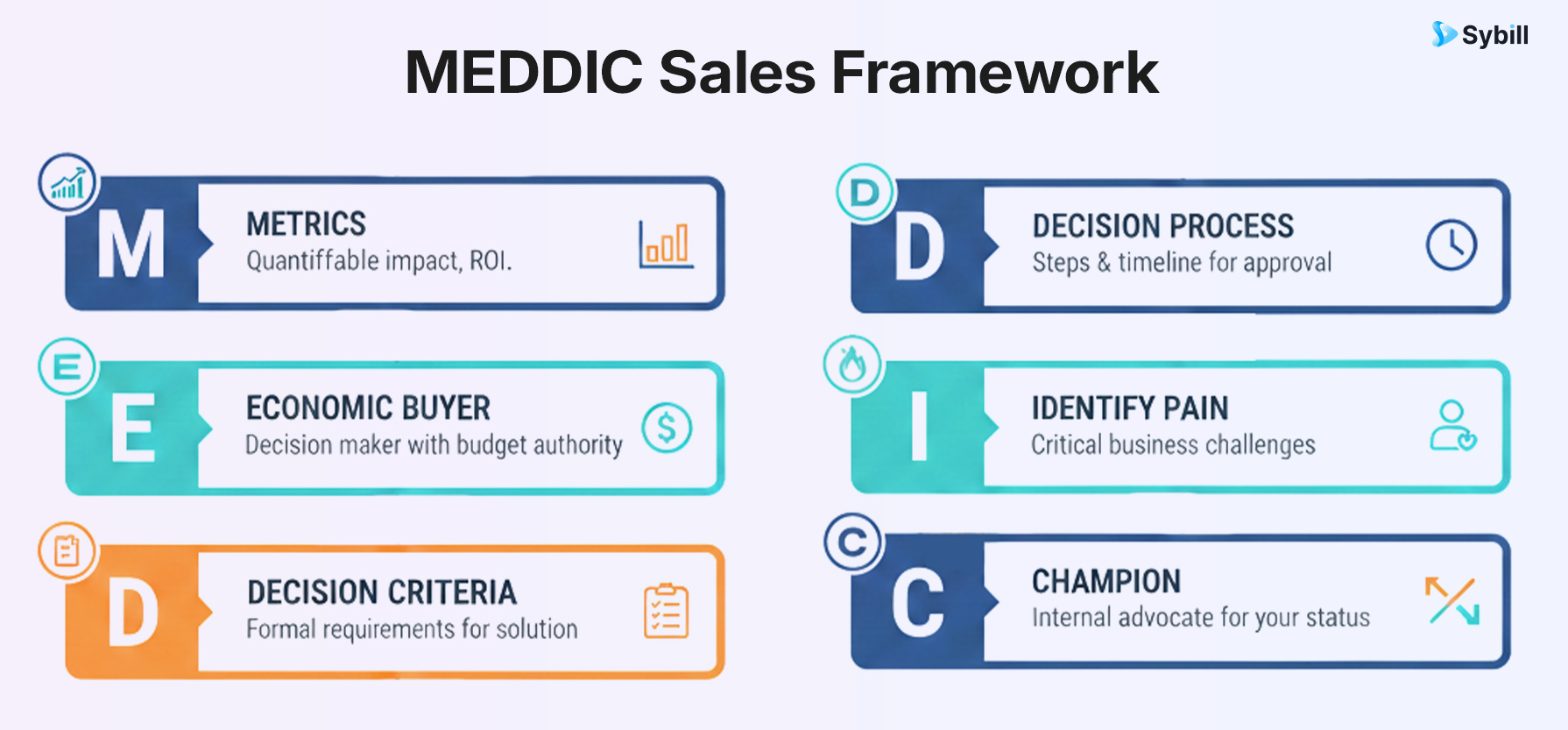
What it stands for: Metrics, Economic Buyer, Decision Criteria, Decision Process, Identify Pain, Champion (MEDDICC adds Competition)
The MEDDIC sales qualification framework was developed in the 1990s at PTC, and it's become the go-to for enterprise sales teams running complex, multi-stakeholder deals. The MEDDICC sales qualification framework definition is essentially an expanded version that adds a Competition element, forcing reps to understand the competitive landscape alongside every other qualification dimension.
Best for: Enterprise and mid-market deals with long sales cycles, multiple decision-makers, and significant deal values. If you're selling six-figure contracts to organizations with procurement teams and legal reviews, MEDDIC gives your reps the structure to navigate all of that.
Where it falls short: It's thorough, which is its strength and its weakness. For teams running shorter sales cycles or dealing with smaller deal sizes, MEDDIC can feel like bringing a forensic investigation kit to a first date. Reps can also fall into the trap of treating it like a checkbox exercise rather than a genuine discovery tool.
What it stands for: Situation, Pain, Impact, Critical Event, Decision
SPICED was designed by Winning by Design specifically for the SaaS and recurring revenue world, and that matters. Unlike older frameworks that were built for one-and-done transactions, SPICED treats discovery as an ongoing dialogue. It's less about checking qualification boxes and more about deeply understanding the buyer's world so you can build the kind of trust that leads to expansion, not just a first deal.
Best for: SaaS sales teams, particularly those focused on land-and-expand motions where the initial deal is just the beginning of the revenue relationship.
Where it falls short: Because it's relationship-heavy, it can be harder to standardize across a team. Reps need strong discovery skills to use it well, which makes onboarding and coaching critical.
What it stands for: Challenges, Authority, Money, Prioritization
CHAMP flips BANT on its head by leading with the prospect's challenges rather than their budget. The philosophy is simple: if the pain is real and urgent enough, budget will follow.
Best for: Teams that sell solutions to complex problems and want to lead with empathy rather than interrogation. CHAMP works well when your product addresses challenges that prospects may not have fully articulated yet.
What it stands for: Goals, Plans, Challenges, Timeline
HubSpot popularized GPCT as a more buyer-centric alternative to BANT. Instead of starting with "do you have budget?" it starts with "what are you trying to achieve?" This reframing turns qualification into a strategic conversation about the prospect's aspirations rather than a financial interrogation.
Best for: Inbound-heavy teams and consultative selling motions where understanding the buyer's goals creates natural alignment with your solution.
What it stands for: Need, Economic Impact, Access to Authority, Timeline
N.E.A.T. pushes reps to dig deeper than surface-level needs. It's not enough that a prospect says they "need" something. N.E.A.T. asks: what's the economic impact of not solving this? That shifts the conversation from feature comparisons to business outcomes, which is where the real urgency lives.
Best for: Mid-market to enterprise teams where justifying ROI is central to getting deals approved.
This is the question every VP of Sales asks, and the honest answer is: it depends on what you're scaling.
If you're scaling an enterprise motion, MEDDIC/MEDDICC is hard to beat. Its structure gives managers a common language for deal reviews, makes forecast calls more grounded in reality, and helps new reps ramp faster because they know exactly what information they need to uncover.
If you're scaling a SaaS or recurring revenue business, SPICED was literally designed for you. Its emphasis on impact and ongoing discovery aligns with how SaaS buyers actually make decisions.
If you're scaling a high-velocity team that needs to qualify fast and move on, BANT (modernized with conversational best practices) still works.
But here's the real talk: the best scalable sales framework is the one your team actually uses. And that's where most organizations fall apart. A study found that CRM adoption hovers around 40% at many companies. If reps aren't logging their qualification data, your framework is just a poster on the wall.
Let's be honest about something. The gap between "we use MEDDIC" and "our team consistently applies MEDDIC on every deal" is enormous. Most framework failures aren't about choosing the wrong methodology. They're about:
Reps don't have time for manual data entry. They'd rather spend their energy on the next call than logging MEDDIC fields in Salesforce after every conversation. So the CRM goes stale, managers lose visibility, and the framework becomes a thing that only gets updated before QBRs.
Discovery quality varies wildly across the team. Your top reps instinctively ask great qualification questions. Your newer reps miss critical signals. Without a way to capture and coach on actual conversations, the framework stays theoretical for half the team.
Frameworks are static, but deals aren't. A deal you qualified in January looks completely different by March. Champions leave. Budgets shift. Timelines slip. If nobody is systematically re-qualifying deals as they progress, your pipeline is built on outdated assumptions.
This is exactly why sales enablement frameworks are evolving beyond training decks and PDFs. The modern sales enablement framework isn't just about teaching reps the methodology. It's about embedding the methodology into the tools reps already use, so it becomes automatic rather than aspirational.
This is where things get interesting. AI isn't replacing sales frameworks. It's making them actually work at scale.
Think about what used to happen: a rep would have a great discovery call, uncover key MEDDIC criteria, and then... maybe log 30% of it in the CRM if they had time. The rest lived in their head or in scattered notes. Managers would ask "is this deal qualified?" and get a confident "yes" backed by vibes rather than data.
AI flips this. Tools like Sybill listen to sales calls, identify when qualification criteria are mentioned, and write that information directly into your CRM. The rep doesn't have to do anything except have a great conversation. The framework gets populated automatically.
Here's what that looks like in practice. A rep runs a discovery call and naturally uncovers the economic buyer, a key pain point, and the decision timeline. Instead of spending 20 minutes after the call logging that into MEDDIC fields, Sybill's Deal Summaries capture and categorize that information in real time. Whether your team follows MEDDIC, BANT, SPICED, or a custom methodology, the CRM reflects what was actually discussed, not what a rep remembered to type three hours later.
Get started for free with Sybill and see how your framework adoption transforms when AI handles the busywork.
This changes three things fundamentally:
Coaching becomes data-driven. Managers can see which reps consistently uncover champion information and which ones skip it. Instead of generic training, you can coach to specific gaps using actual call data.
Forecasting gets honest. When every deal's qualification status is based on what buyers actually said (not what reps optimistically interpreted), your forecast stops being fiction. You can see which deals are genuinely MEDDIC-complete and which ones have gaps.
Re-qualification happens automatically. Because AI is capturing signals from every call and email throughout the deal lifecycle, your qualification data stays current. If a champion mentions that budgets got frozen in a follow-up call, that shows up in your deal workspace without anyone having to manually update a field.
If you're evaluating different sales methodologies and trying to figure out which one fits, here are the questions that actually matter:
What does your average deal look like? If you're running 90-day enterprise cycles with 6+ stakeholders, you need MEDDIC or MEDDICC. If you're closing in 14 days with a single decision-maker, that level of rigor will slow you down. Match the framework's complexity to your deal's complexity.
How mature is your sales team? Newer teams benefit from simpler frameworks (BANT, CHAMP) that give them clear guardrails. Experienced teams can handle more nuanced approaches like SPICED or MEDDIC that require stronger discovery skills.
What does your sales motion look like? Different sales techniques work for different motions. Inbound-heavy teams might lean toward GPCT. Outbound enterprise teams gravitate toward MEDDIC. PLG-assisted teams might need a lighter-touch framework for initial qualification that deepens as deals grow.
Can you actually enforce it? Be realistic. If your CRM is already a wasteland and reps resist any new process, starting with a lightweight framework and using AI-powered qualification tools to reduce the adoption burden is smarter than rolling out MEDDICC and hoping for the best.
Are you willing to blend? Most mature sales organizations don't use a single framework in isolation. They use BANT for initial qualification and MEDDIC for deep qualification on deals that make the cut. Think of BANT as the bouncer checking IDs at the door and MEDDIC as the detailed background check.
A sales enablement framework is bigger than any single methodology. It's the system you build to ensure your team can learn, apply, and consistently execute whatever sales framework you choose. Here's what the best ones include:
Onboarding that goes beyond theory. New reps should hear real call recordings where the framework was applied well (and poorly). Role-plays should simulate realistic discovery conversations, not scripted Q&A sessions.
Ongoing coaching tied to real conversations. Weekly deal reviews should use actual call data to evaluate qualification quality. Did the rep identify the economic buyer? Did they uncover metrics? Conversation intelligence turns these from subjective debates into objective discussions.
Automation that removes friction. Every manual step you add to your framework is a step that won't get done consistently. Automate CRM updates, follow-up emails, and deal scoring so your framework runs in the background while reps focus on selling.
Templates and playbooks. Give reps pre-built templates for discovery prep, post-call follow-ups, and deal reviews that align with your chosen framework. This standardizes quality without standardizing personality.
Feedback loops. Track which qualification criteria correlate with won deals versus lost deals. Over time, you can refine your framework based on what actually predicts success in your specific market.
The SaaS landscape has shifted the conversation around different sales methodologies in meaningful ways. Buyers are more informed, buying committees are larger, and the expectation of personalization is higher than ever. Here's what's working for modern SaaS teams:
Hybrid frameworks are becoming the norm. Instead of being purists about one methodology, top teams are mixing and matching. They might use BANT for SDR-level qualification, SPICED for AE-led discovery, and MEDDIC for enterprise deal management. The key is having clear handoff criteria between each stage.
Discovery is continuous, not one-time. The old model of "do one discovery call, check the boxes, move on" is dying. Modern sales methodologies treat every touchpoint as an opportunity to deepen qualification. A demo isn't just about showing features. It's about confirming pain, testing commitment, and identifying new stakeholders.
AI is the enablement layer. The best sales methodology for big deals in 2026 isn't defined by the acronym you choose. It's defined by how well your team captures, shares, and acts on buyer intelligence. AI tools that automatically extract qualification signals from conversations and feed them into your deal workspace are what separate high-performing teams from the rest.
Sales frameworks aren't magic. They won't turn mediocre reps into superstars overnight. But the right framework, applied consistently and supported by the right tools, gives your team a shared language, a qualification standard, and a coaching foundation that compounds over time.
The biggest shift happening right now isn't which acronym teams choose. It's the realization that framework execution matters more than framework selection. And with AI handling the capture and enforcement layer, the gap between "we use MEDDIC" and "we actually use MEDDIC" is closing fast.
Get started for free with Sybill and turn your sales framework from a theoretical exercise into a competitive advantage.
What is a sales framework?
A sales framework is a strategic structure that combines your sales process (the steps a deal moves through) with your sales methodology (the approach reps use at each step) into a repeatable, coachable system. It provides the shared language and qualification criteria that help teams sell consistently.
Who has the best scalable sales framework?
There's no single "best" framework. MEDDIC/MEDDICC scales well for enterprise teams. SPICED is built for SaaS and recurring revenue. BANT works for high-velocity motions. The most scalable framework is the one your team will actually use, and AI-powered tools like Sybill dramatically improve adoption by automating the data capture.
What is the MEDDIC sales qualification framework?
MEDDIC stands for Metrics, Economic Buyer, Decision Criteria, Decision Process, Identify Pain, and Champion. It's a structured approach to qualifying complex deals by ensuring reps understand every dimension of the buyer's decision-making process.
What is the MEDDICC sales qualification framework definition?
MEDDICC is an expanded version of MEDDIC that adds Competition as a seventh qualification criterion. It forces reps to assess the competitive landscape alongside the standard MEDDIC elements, which is critical in enterprise deals where competitors are always present.
What is a sales enablement framework?
A sales enablement framework is the system you build around your chosen methodology to ensure team-wide adoption. It includes onboarding, coaching, templates, automation, and feedback loops that help reps learn and consistently apply the framework in real selling situations.
What are the best sales methodologies for SaaS?
SaaS teams tend to favor SPICED (built specifically for recurring revenue), MEDDIC/MEDDICC (for enterprise SaaS), and hybrid approaches that combine lighter frameworks for initial qualification with deeper methodologies as deals progress. The key differentiator in 2026 is how well AI supports the methodology in practice.
Can you use multiple sales frameworks at once?
Absolutely. Many successful organizations use BANT for initial lead qualification and MEDDIC for deep deal qualification. The key is defining clear criteria for when each framework applies and ensuring your CRM and tools can support both.
A sales framework is a strategic structure that combines your sales process (the steps a deal moves through) with your sales methodology (the approach reps use at each step) into a repeatable, coachable system. It provides the shared language and qualification criteria that help teams sell consistently.
There's no single "best" framework. MEDDIC/MEDDICC scales well for enterprise teams. SPICED is built for SaaS and recurring revenue. BANT works for high-velocity motions. The most scalable framework is the one your team will actually use, and AI-powered tools like Sybill dramatically improve adoption by automating the data capture.
MEDDIC stands for Metrics, Economic Buyer, Decision Criteria, Decision Process, Identify Pain, and Champion. It's a structured approach to qualifying complex deals by ensuring reps understand every dimension of the buyer's decision-making process.