
Find us at booth #83, join us for a harbor side happy hour, or catch Gorish’s talk.

Sept, 16-18 > Learn more


Tamanna Mishra

January 19, 2026
A renewal gets pushed to “next quarter.”
Your champion goes quiet.
Usage looks stable, but urgency disappears.
Nothing looks broken. And yet, the account churns.
This is the reality most churn mitigation and prediction tools are trying to solve. Not the sudden cancellations, but the slow, quiet breakdowns across teams and workflows.
Churn is rarely caused by one bad interaction. It builds through small failures in systems: weak onboarding, unclear ownership, missed follow-ups, and context that lives in calls or emails but never makes it into shared tools. By the time churn risk appears in a dashboard, the opportunity for effective intervention has often passed.
This is why churn management cannot rely on prediction alone. Understanding churn mitigation meaning is critical here. Mitigation is not about reacting to a risk score. It is about designing systems that surface early signals and trigger the right actions while there is still time to influence the outcome.
The best churn mitigation and prediction tools do more than flag risk. They connect insight to execution across Sales, Customer Success, and RevOps. When churn is treated as a systems problem, prediction becomes earlier, mitigation becomes practical, and retention stops feeling reactive.
Most churn programs fail for a simple reason. Teams use the same words to mean very different things. Churn mitigation, churn prediction, and churn management are often used interchangeably, but they solve different problems. When those definitions blur, retention strategies break.
Let’s get precise.
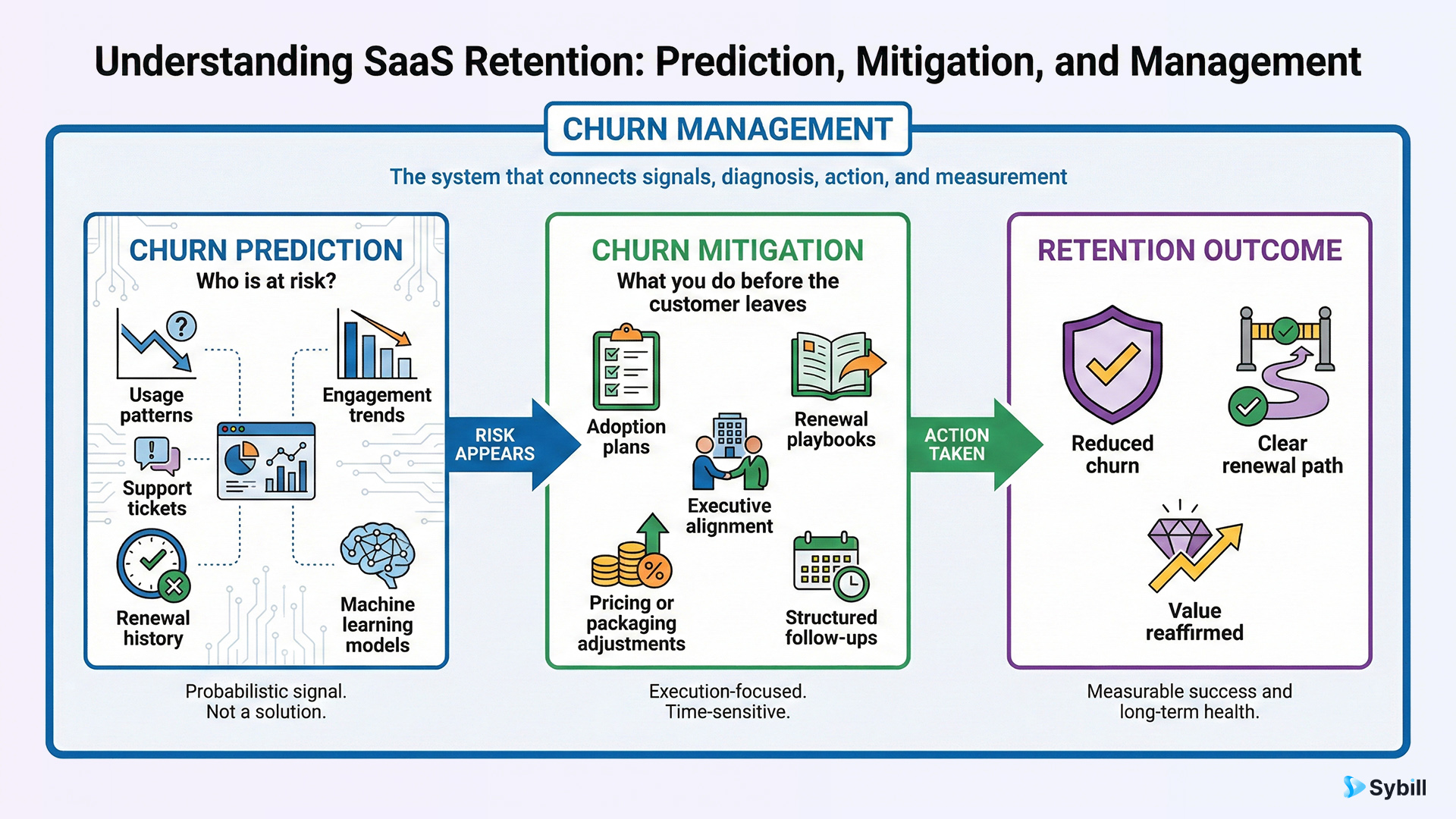
Churn mitigation is what you do after risk appears but before the customer leaves.
This is where most churn mitigation strategies live. Not in dashboards, but in execution. Mitigation includes concrete actions such as targeted adoption plans, renewal playbooks, pricing or packaging adjustments, executive alignment calls, and structured renewal sequencing. It is about changing the trajectory of an at-risk account, not just labeling it as high risk.
The mistake many teams make is assuming mitigation starts after a formal churn alert. In reality, mitigation should begin the moment friction or hesitation shows up, often long before a renewal conversation even starts. Strong churn mitigation strategies are proactive, coordinated, and time-bound. Weak ones are reactive and scattered.
Churn prediction is about estimating the likelihood that a customer will leave. It is inherently probabilistic.
Modern churn mitigation and prediction tools use customer churn prediction using machine learning to analyze patterns across usage, engagement, tickets, renewals, and historical outcomes. The output is a risk score or ranking. What it is not is an explanation or a solution.
Churn prediction breaks down when the data is incomplete. Models built only on product usage miss sentiment and stakeholder changes. Models built only on CS notes miss behavioral decline. Prediction can tell you who is at risk, but without context, it cannot tell you why or what to do next.
Churn management is the system that connects everything.
It brings together signals from across the business, diagnoses the underlying cause of risk, activates the right mitigation actions, and measures whether those actions actually work. Churn management is not about building better dashboards. It is about creating a repeatable operating model that reduces avoidable losses over time.
The strongest churn mitigation and prediction tools are the ones that support this full loop. Prediction without mitigation is noise. Mitigation without management is chaos. Retention improves when all three work together.
Churn rarely comes out of nowhere. It shows up as signals, scattered across systems and teams. Strong churn management starts by knowing where to look and how early those signals appear.
Most churn mitigation strategies fail because these signals stay siloed. They do not offer a usable signal taxonomy teams can operationalize. Effective churn management depends on spotting patterns across these signals early, then acting before risk hardens into churn.
Churn signals do not live in one place. They surface across products, tickets, contracts, conversations, and CRM notes. The role of churn mitigation and prediction tools is not just to collect these signals, but to turn them into coordinated action before churn becomes irreversible.
Here is how the churn management landscape actually breaks down, based on where signals originate and how teams act on them.
These tools focus on health scores, lifecycle tracking, and playbooks that guide retention efforts once risk is identified. Platforms like Gainsight, Totango, and ChurnZero aggregate usage, engagement, and CS inputs to highlight at-risk accounts. They are effective at organizing churn mitigation strategies, but often rely on other systems for deep context.
Product analytics platforms such as Amplitude and Pendo surface behavioral churn signals like usage drops, feature abandonment, and stalled onboarding. They are essential for understanding what customers are doing inside the product. However, they rarely explain why behavior changed or how teams should respond outside the product.
CRM-native tools like Salesforce Einstein and HubSpot place churn risk in pipeline and renewal context. They connect commercial signals such as renewal timing, deal slippage, and payment issues to revenue outcomes. This is critical for forecasting churn, but CRM data alone often misses early warning signs from conversations and sentiment. This is especially true when CRM updates remain manual even in 2026.
Click here to understand how CRM autofill can help.
Support platforms including Zendesk, Intercom, and Qualtrics capture friction, sentiment, and experience data. They are strong indicators of dissatisfaction and service-driven churn risk. The gap is execution. These insights often stay trapped in support workflows instead of informing broader churn management actions.
Predictive tools like Pecan specialize in customer churn prediction using machine learning. They analyze historical data to rank accounts by risk with high statistical accuracy. What they do not solve is follow-through. Prediction without orchestration still leaves teams asking what to do next.
This is where AI tools like Sybill stand apart.
Sybill connects CS platforms and predictive models to tools that revenue teams use more frequently. By capturing churn signals from real customer conversations - across what’s said and what’s not - structuring them automatically, and turning them into CRM updates, follow-ups, and next steps, Sybill closes the gap between insight and action.
In modern churn management, that gap is where most churn actually happens.
Most lists of churn mitigation and prediction tools compare features in isolation. That’s not how churn management works.
We evaluated tools based on whether they help teams detect risk early and act on it consistently, not just whether they surface another dashboard.
Our lens favors churn mitigation and prediction tools that reduce churn in practice.
Not all churn mitigation and prediction tools solve the same problem. Some detect risk. Some organize response.
But very few help teams actually prevent avoidable churn. Below is a grounded breakdown of the most relevant tools in 2026, starting with the one that closes the execution gap most teams struggle with.

Best for: Turning customer conversations into churn management actions
Most churn platforms help you see risk. Sybill helps you do something about it.
Sybill is strongest when churn risk is tied to misalignment, weak value articulation, missing next steps, or deals that feel stable until renewal pressure hits. In these cases, churn does not come from usage data or ticket volume. It comes from what was said, what was implied, and what never got followed up on.
For churn prediction, Sybill does not try to replace statistical models. Instead, it upgrades them. Calls and meetings often surface churn signals weeks before dashboards do. Budget cuts, vendor consolidation, wavering ROI confidence, and stakeholder shifts appear first in conversations. Sybill captures those signals automatically, structures them, and makes them searchable, improving the quality of data feeding churn prediction systems.
Where Sybill truly stands out is churn mitigation.
Best for: CS-led health scoring and retention playbooks
ChurnZero is designed for Customer Success teams that want visibility into account health and a structured way to respond. It aggregates usage, engagement, and CRM data into real-time health scores, making churn risk easier to spot across the portfolio.
For churn mitigation, ChurnZero shines in its playbook-driven approach. CS teams can standardize how they respond once an account crosses a risk threshold, which helps reduce inconsistency. Where it falls short is depth. It does not offer strong product analytics or conversation intelligence, so teams often know that an account is at risk without fully understanding why. As part of a broader churn management stack, it works best when paired with tools that provide richer context.
Best for: Enterprise customer success operations
Gainsight remains one of the most comprehensive platforms for enterprise churn mitigation and prediction. Its predictive models, lifecycle automation, and journey orchestration capabilities are built for scale and complexity.
In churn prediction, Gainsight excels at combining multiple signal types across large account bases. In churn mitigation, it enables standardized journeys and escalation paths that reduce manual effort across large CS teams. The tradeoff is time-to-value. Implementation complexity and operational overhead mean Gainsight delivers the most value to high-touch, well-resourced organizations with mature churn management processes.
Best for: Segmentation and automated retention workflows
Totango focuses heavily on segmentation and rule-based automation. Its health scoring and workflow engine allow teams to run targeted churn mitigation strategies across different customer cohorts.
For churn prediction, Totango relies on structured inputs and defined scoring models. For mitigation, its strength lies in consistency. However, outcomes depend heavily on data quality and a clearly defined CS motion. Without those, automation can amplify noise instead of reducing churn. Totango fits teams that value structure and already have disciplined churn management foundations.
Best for: Salesforce-native churn prediction
Salesforce Einstein brings churn prediction directly into the CRM. It analyzes deal velocity, renewal timing, and historical outcomes to surface risk within Salesforce workflows.
This makes it useful for understanding churn prediction meaning in a revenue context. However, Einstein’s view of churn is only as good as the data in Salesforce. It lacks deep visibility into product usage, support friction, and customer conversations, which limits its effectiveness for proactive churn mitigation.
Best for: SMB churn management in a CRM-first stack
HubSpot’s AI-driven health scoring offers smaller teams a simple entry point into churn management. Engagement-based signals help flag declining interest or activity.
For churn mitigation, HubSpot provides basic workflows and alerts, but deeper diagnosis often requires additional tools. Without product or support integrations, teams risk false positives. HubSpot works best for SMBs that want lightweight churn management without operational complexity.
Best for: Support-driven churn mitigation
Zendesk AI contributes to churn mitigation by reducing friction. Faster resolution times, better ticket triage, and sentiment tracking directly lower churn driven by poor support experiences.
Zendesk is less about churn prediction and more about removing churn accelerants. It does not own renewal strategy or account planning, which is why it works best as part of a larger churn management system rather than as a standalone solution.
Best for: Proactive in-app engagement and reactivation
Intercom helps teams intervene before disengagement turns into churn. Its AI-driven messaging enables timely nudges, onboarding support, and re-engagement flows.
These churn mitigation strategies work well for product-led motions. Intercom is less effective in complex B2B environments where churn is driven by stakeholder dynamics and commercial negotiations rather than in-product behavior alone.
Best for: Customer churn prediction using machine learning on product behavior
Amplitude is powerful for identifying behavioral churn signals. Feature adoption trends, usage drop-offs, and path analysis help teams understand what users are doing before they churn.
Amplitude contributes strongly to customer churn prediction using machine learning, but it stops at insight. Teams need separate systems to act on those insights, making Amplitude a diagnostic layer rather than a churn mitigation engine.
Best for: Onboarding and adoption-led churn mitigation strategies
Pendo focuses on improving adoption, which directly impacts churn. By identifying onboarding drop-offs and feature underuse, it enables targeted in-product interventions.
Its limitation is scope. Pendo has little visibility into commercial risk, stakeholder changes, or renewal dynamics. It works best when adoption is the primary churn driver.
Best for: Experience-driven churn prediction
Qualtrics combines feedback, sentiment, and operational data to surface churn risk from an experience lens. This adds valuable context, especially in large organizations.
The tradeoff is complexity. Qualtrics is insight-rich but execution-light, and it requires significant effort to translate insights into churn mitigation strategies. It is best suited for mature enterprise CX programs.
Best for: Predictive ML churn models across data sources
Pecan specializes in customer churn prediction using machine learning across multiple datasets. Its models can be highly accurate when data infrastructure is strong.
However, prediction alone does not reduce churn. Pecan relies on external systems for mitigation and execution, making it a strong analytical component but not a complete churn management solution.
There is no single best tool for churn. The right churn management stack depends on what actually drives churn in your business and how early you can intervene. Use this decision framework to align tools with real churn causes, not generic best practices.
Prioritize product analytics and in-app engagement. Tools like Amplitude or Pendo help identify usage drop-offs, failed onboarding, and feature abandonment. These insights support churn mitigation strategies focused on improving adoption before disengagement hardens into churn.
Prioritize friction removal and workflow automation. Zendesk AI helps reduce churn by improving resolution speed, surfacing sentiment trends, and preventing issues from escalating. In this case, faster action matters more than predictive accuracy.
Prioritize conversation intelligence and follow-through. Churn signals such as budget hesitation, weak ROI language, or shifting priorities appear in calls long before dashboards flag risk. Pair execution-focused tools with a CS platform so churn mitigation happens while there is still leverage.
Enterprise platforms like Gainsight or Totango provide standardized workflows, health scoring, and lifecycle management. They work best for high-touch teams with mature churn management processes.
Most teams need a layered approach, not a monolith:
When these layers work together, churn mitigation and prediction tools stop operating in silos and start driving measurable retention outcomes.
Most churn stacks break at the same point. They get really good at spotting risk and surprisingly bad at doing something about it.
That happens because AI is often treated as the churn score. In practice, AI is far more useful as a translation layer between messy customer reality and clean internal execution. That difference matters for churn management.
Modern churn mitigation and prediction tools use customer churn prediction using machine learning to identify patterns across product usage, engagement, support activity, and historical outcomes. This is what most vendors describe as predictive analytics or risk scoring.
The models work. Accuracy keeps improving.
The hidden trap is operational. Teams get a reliable risk score and still lose the account because nothing changes fast enough. Prediction surfaces risk, but it does not resolve misalignment, clarify value, or move a renewal forward. Without action, even the best churn prediction becomes a lagging indicator.
This is why prediction alone rarely improves retention outcomes.
AI-driven churn mitigation focuses on execution.
Instead of surfacing another alert, AI helps teams act consistently by generating context-rich next steps, structuring follow-ups, and coordinating actions across Sales, Customer Success, and RevOps. This is where churn mitigation strategies stop being reactive and start becoming repeatable.
Over time, this creates retention muscle memory. Playbooks run even when teams are busy. Follow-ups do not rely on individual discipline. Critical signals do not disappear into call notes or inboxes. Churn mitigation becomes a system, not a scramble.
At a higher level, AI strengthens churn management by closing the loop between insight and action.
Prediction reduces surprises by surfacing risk earlier.
Mitigation reduces avoidable losses by acting while influence is still possible.
Management reduces chaos by making retention a shared, visible motion.
This is also where conversation data becomes a differentiator.
Calls and meetings routinely surface churn signals weeks before dashboards reflect risk. Budget pressure, vendor consolidation, shifting priorities, and vague ROI language show up in conversations long before usage drops or tickets spike. While many tools talk about signals and sentiment, most still rely heavily on product and support data.
AI tools like Sybill make conversation signals usable. They summarize what was said, make it searchable, and convert it into next steps and CRM updates. That is how AI moves beyond scoring and starts driving real churn mitigation and prediction outcomes.
This is the difference between knowing churn is coming and actually stopping it.
Most churn mitigation strategies fail because they focus on activity, not outcomes. Teams run QBRs, send follow-ups, and escalate internally, yet churn still happens.
The difference between busy work and effective mitigation comes down to when teams act and how consistently they follow through.
Here are churn mitigation strategies that actually change outcomes, and how AI makes them scalable.
Usage dips and delayed renewals are symptoms, not causes. Effective churn mitigation starts by identifying the real driver: unclear value, internal misalignment, budget pressure, or shifting priorities. AI helps by capturing patterns across conversations, tickets, and engagement so teams do not chase the wrong problem.
Vague success goals kill retention. Strong churn mitigation strategies anchor outcomes to specific milestones that ladder up to renewal. AI supports this by structuring next steps, tracking commitments, and ensuring progress is visible instead of assumed.
Champion churn is one of the most common and underestimated churn drivers. When a key stakeholder leaves or disengages, risk spikes fast. AI helps surface stakeholder changes from conversations and prompts teams to expand relationships before renewal pressure mounts.
Unclosed loops are silent churn accelerants. Missed follow-ups, unanswered questions, and vague “we’ll circle back” moments compound over time. AI ensures that action items, risks, and commitments captured in calls are translated into concrete follow-ups instead of disappearing into notes.
Manual updates, note-taking, and task tracking drain time from strategic work. AI removes this friction so teams can focus on executive alignment, value articulation, and negotiation. This is the real meaning of churn mitigation at scale.
Where Sybill fits naturally is in execution. It enables mutual plans and follow-ups that reflect the customer’s actual language and behaviors, not generic templates. It also ensures consistent CRM updates so churn risk and progress are visible to leadership. When these strategies are supported by AI, churn mitigation stops being reactive and starts becoming repeatable.
Churn mitigation and prediction tools are powerful, but only when they move beyond insight and into execution. Prediction helps you see risk earlier. It tells you which accounts might leave and where to pay attention. But prediction alone does not change outcomes.
What actually reduces churn is what happens next.
The most effective churn management stacks connect insight to action in the same day, not the next quarter. They ensure signals do not get lost in dashboards, calls, or inboxes. They turn risk into decisions, decisions into next steps, and next steps into measurable progress toward renewal.
This is where many teams struggle. Retention work lives in post-call chaos. Notes are scattered. Follow-ups are inconsistent. CRM data is incomplete. Churn mitigation strategies exist, but execution depends on individual effort.
Sybill brings structure to that chaos. By turning customer conversations into clear summaries, consistent CRM truth, actionable next steps, and reliable follow-through, Sybill helps teams make churn management operational.
When execution improves, churn mitigation and prediction tools finally deliver on their promise.
Click here to try Sybill free.
Churn mitigation in SaaS refers to the actions taken after churn risk appears but before the customer leaves. It focuses on execution, not analysis. Churn mitigation strategies include adoption interventions, renewal playbooks, executive alignment, pricing or packaging adjustments, and structured follow-ups. The goal is to change the trajectory of an at-risk account while there is still time to influence the outcome. Effective churn mitigation is proactive, coordinated, and time-bound, not reactive firefighting after a cancellation decision.
Churn prediction is the process of estimating the likelihood that a customer will cancel or not renew. It is probabilistic, not deterministic. Most churn mitigation and prediction tools calculate churn risk using patterns across product usage, engagement, support tickets, renewal history, and account behavior. Advanced systems use machine learning models to rank accounts by risk. Churn prediction identifies who is at risk, but it does not explain why or automatically tell teams what to do next.
The best churn mitigation and prediction tools depend on what drives churn in your business. Product analytics tools help identify behavioral risk, CS platforms organize retention workflows, and support systems reduce friction. Execution-focused tools like Sybill stand out when churn is driven by misalignment, weak value articulation, or missed follow-through after customer conversations. In practice, B2B SaaS teams see the strongest churn management results from a stack that combines prediction, mitigation, and execution rather than relying on a single platform.








