Find us at booth #83, join us for a harbor side happy hour, or catch Gorish’s talk.

Sept, 16-18 > Learn more


Tamanna Mishra

May 15, 2026

Most sales negotiations do not fall apart because of pricing, features, or competition. They fail because the real constraint never surfaces.
That constraint is what black swan negotiation is really about.
Popularized by Chris Voss, the black swan negotiation method focuses on uncovering the hidden factors that quietly control deals. Internal politics. Career risk. Procurement pressure. Unspoken timelines. The things buyers rarely say out loud until leverage is already lost.
Sales teams understand this idea in theory. Many have read the book. Some have invested in Chris Voss sales training. Very few know how to apply black swan negotiation strategy in real sales conversations, across multiple calls, under pressure.
Black Swan negotiation, developed by former FBI hostage negotiator Chris Voss, is a negotiation method built on uncovering hidden "Black Swans" — unknown pieces of information that, once discovered, completely change the leverage and dynamics of a deal. The method centers on tactical empathy, calibrated questions ("How am I supposed to do that?"), labeling emotions ("It seems like you're concerned about..."), mirroring, and strategic use of the late-night FM DJ voice to make counterparts feel heard and reveal their true constraints. In B2B sales, Black Swan techniques are especially powerful during procurement negotiations and competitive evaluations where buyers have hidden motivations, and AI tools like Sybill help sellers identify potential Black Swans by analyzing conversation patterns across multiple calls to surface recurring concerns, unstated objections, and emotional triggers that the buyer never explicitly articulated.
This blog is a practical guide to execution. You will learn how black swans actually show up in sales calls, how to ask questions that surface them early, and how to review conversations to spot missed leverage. You will also see real black swan negotiation examples and repeatable frameworks you can use before, during, and after every deal-critical conversation.
But first, the basics.
Black swan negotiation is the practice of uncovering hidden deal constraints that radically change leverage once they surface. The term comes from Chris Voss, an erstwhile FBI kidnapping negotiator, who defines black swans as unknown factors that, when revealed, reshape the entire negotiation.
In sales, black swan negotiation strategy rarely looks dramatic. They show up as quiet forces that buyers do not disclose upfront.
A CFO worried about career risk.
A procurement team enforcing rules the buyer cannot bypass.
An internal champion who likes your product but lacks authority.
A timeline driven by board pressure.
They are the control points.
The black swan method challenges textbook negotiation advice that focuses on persuasion, concessions, and clever framing. Real sales conversations do not move forward because a rep argues better. They move forward when a rep discovers what is actually stopping the buyer from saying yes.
Black swan negotiation is not about pushing harder. It is about listening longer and empathetically, asking better questions, and recognizing leverage before it disappears.
According to The Black Swan Group, most negotiators fall into one dominant style. Each type brings strengths and predictable blind spots when hunting for black swans.
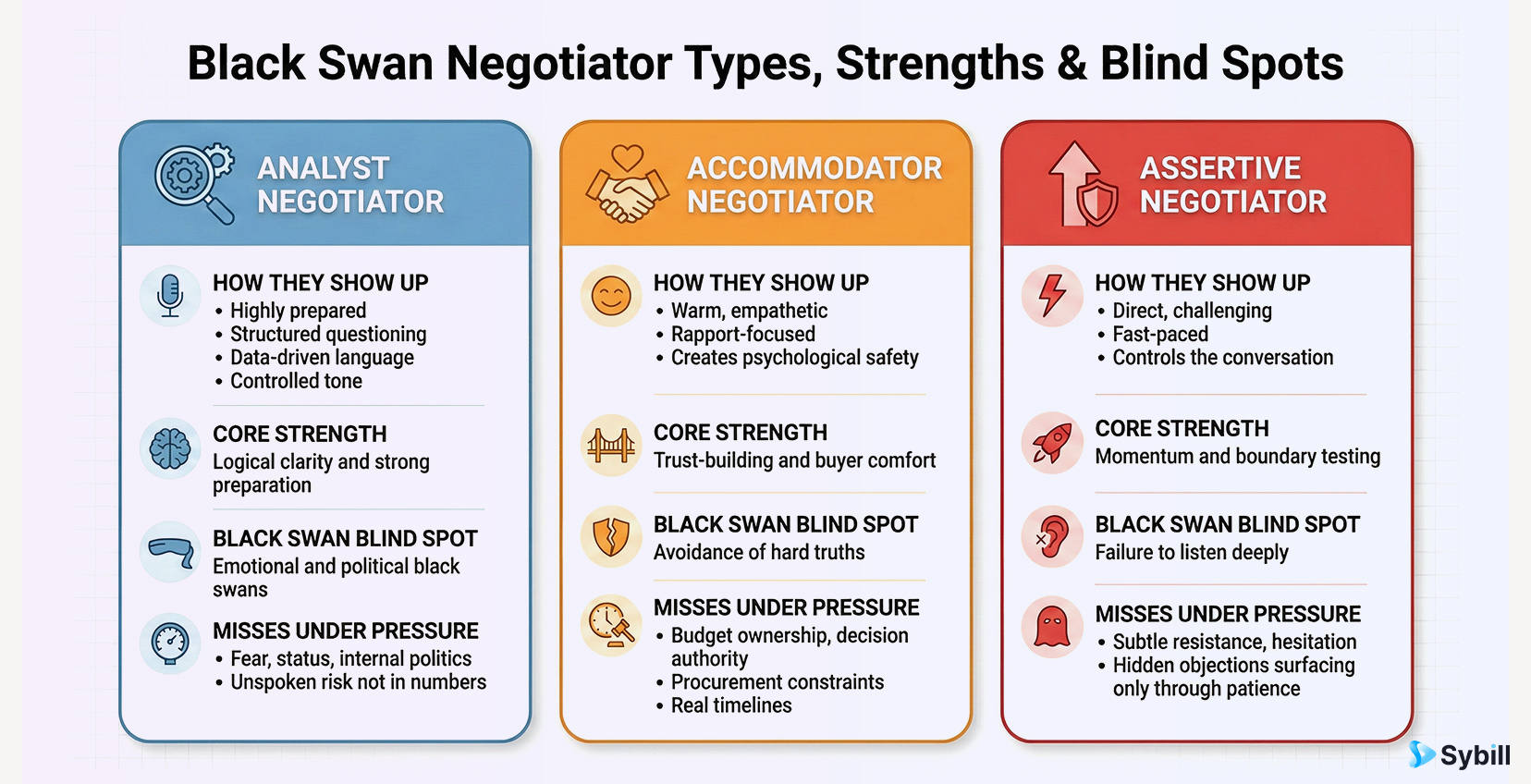
Analysts prepare obsessively and speak carefully. On sales calls, they ask structured questions and avoid emotional language. Their blind spot is overthinking. Analysts often miss emotional black swans like fear, status, or internal politics because they listen for logic, not tension. Under pressure, they retreat into data instead of probing discomfort.
Accommodators build rapport fast and create psychological safety. Buyers feel heard and relaxed. Their blind spot is avoidance. Accommodators hesitate to ask uncomfortable questions that surface real constraints, especially around money, authority, or risk. In high-stakes moments, they prioritize harmony over leverage.
Assertives push hard and control the conversation. They test boundaries and challenge buyers directly. Their blind spot is listening. Assertives often talk past subtle signals and trigger resistance before black swans emerge. When pressure rises, they double down on persuasion instead of curiosity.
Most reps default to one style under stress. Black swan negotiation starts by recognizing that default and learning how to counterbalance it before the deal demands it.
Most sales reps lose leverage the moment they start trying to convince.
In high-stakes deals, persuasion shuts information down.
Buyers become guarded.
Answers get polished. The real story disappears.
That is why the black swan method prioritizes listening over pitching. You cannot uncover hidden constraints while you are talking.
Real black swan negotiation examples almost always start with a question, not a statement.
Calibrated questions slow the conversation and force the buyer to think out loud. Questions like “How does your team decide when priorities conflict?” or “What happens internally if this slips?” surface power dynamics, risk, and decision friction that never appear in a standard demo.
Most reps do ask discovery questions. But discovery is not negotiation.
Discovery focuses on needs and use cases. Negotiation questions focus on authority, consequences, trade-offs, and risk. They test assumptions instead of confirming interest. They invite uncomfortable truths instead of surface agreement.
Black swans show up when the buyer feels safe enough to reveal what actually controls the deal. Listening creates that safety. Persuasion destroys it.
Save this section. Copy it. Bring it into your next deal.
Effective black swan negotiation relies on asking questions that surface constraints buyers rarely volunteer. The examples below are drawn from real black swan negotiation examples that shift leverage when asked early enough.
If you’re wondering, “what are some good black swan negotiation questions,” you’re at the right place. Use these to slow the conversation and force the buyer to think beyond features.
No-oriented questions lower defensiveness and invite honesty.
Labels acknowledge emotion without judgment. This is a core part of the black swan method taught by Chris Voss.
Use this question bank as a living asset. Black swans do not announce themselves. They surface when your questions give buyers permission to tell the truth.
Most negotiations are lost after the call, not during it. Reps move on, memory fades, and leverage lessons disappear. That is why the best black swan negotiation examples come from disciplined call reviews, not instinct.
This debrief template turns every deal conversation into training. It reflects how negotiation is taught in Chris Voss sales training, where progress comes from reviewing behavior, not replaying opinions.
Use this immediately after any high-stakes call.
Negotiation skill does not improve through experience alone. It improves through reflection. Without systematic review, the same mistakes repeat across deals.
When calls are debriefed consistently, patterns emerge. Where leverage is lost. Where black swans surface. Where pressure changes behavior. That visibility is what turns negotiation from intuition into a repeatable advantage.
Great negotiators do not “wing it.” They walk into calls already hunting for black swans.
Preparation in black swan negotiation is not about knowing the company background or memorizing talking points. It is about recognizing patterns before the conversation starts. The goal is simple: predict where leverage will appear or disappear.
Use this checklist before every deal-critical call.
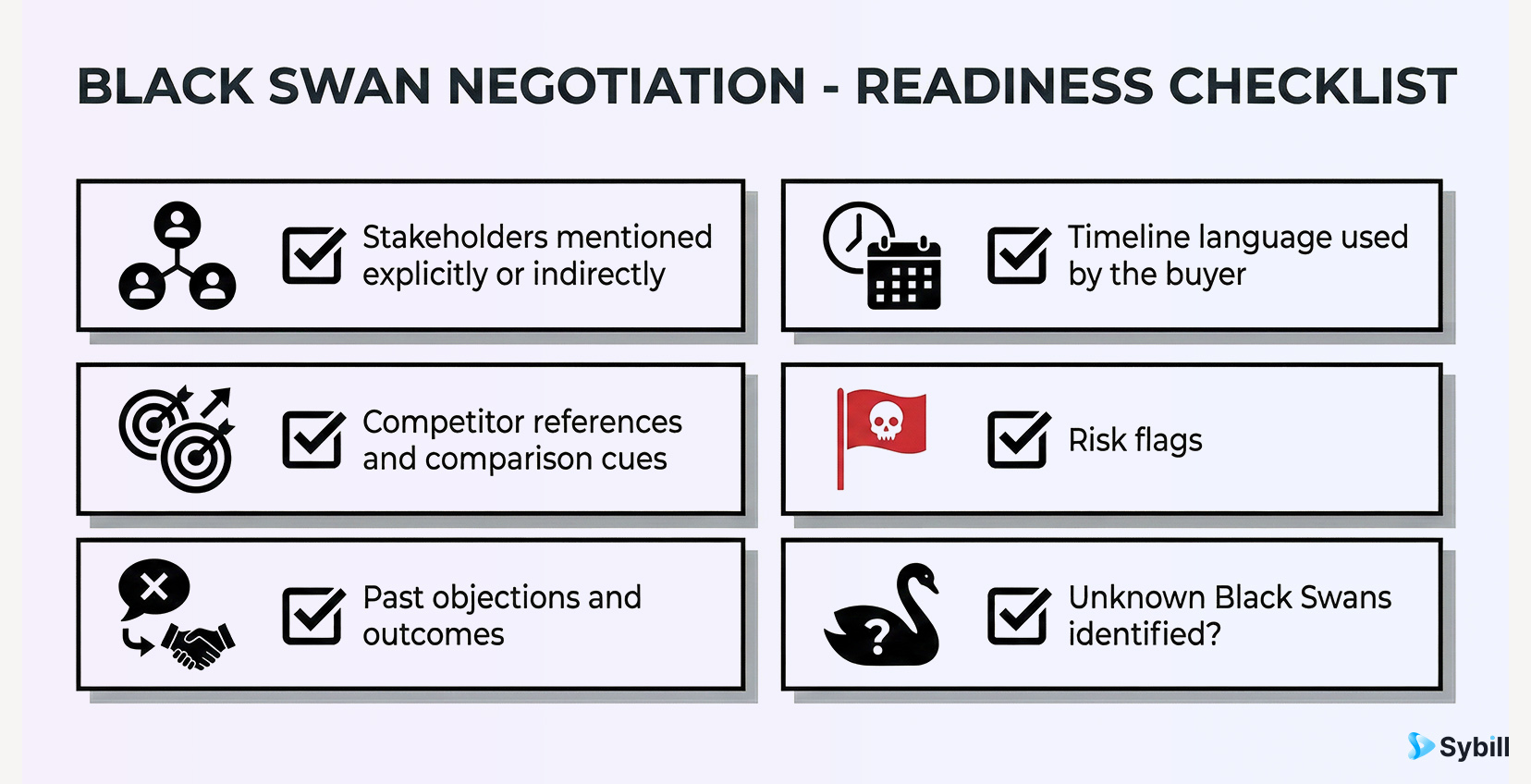
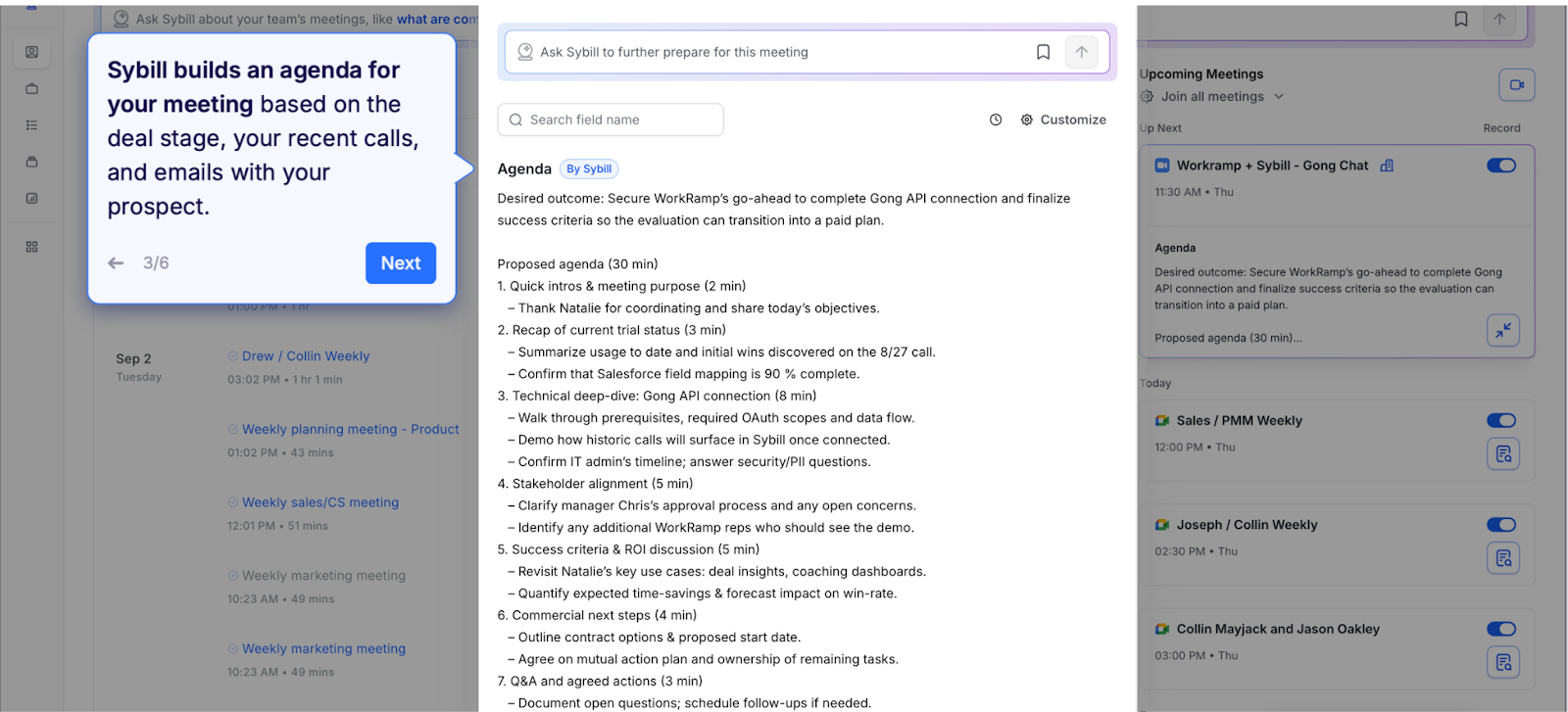
Most leverage is lost because reps discover constraints too late. A pre-meeting brief compresses learning across past calls so you do not rely on memory or gut feel when stakes are high.
Sybill’s Pre-meeting Brief pulls together buyer signals, objections, risks, and context from previous conversations so you walk in prepared to ask the right questions.
The best black swan negotiation examples do not reveal themselves in one call. They show up in patterns.
Top sellers review negotiation behavior across multiple conversations because leverage loss is rarely accidental. It is habitual.
How Sybill helps:
Sybill reviews multiple calls together instead of treating each one as a standalone event. Patterns in hesitation, objections, and missed signals become visible without relying on memory.
These behaviors only become visible when calls are reviewed together.
How Sybill helps:
Ask Sybill highlights repeated moments where reps talk over buyers, concede early, or skip leverage-testing questions, using real call evidence rather than subjective feedback.
As Chris Voss teaches, negotiation mastery comes from awareness under pressure. Auditing behavior across multiple calls turns negotiation from intuition into a system. When patterns become visible, black swans stop being surprises and start becoming signals.
How Sybill helps:
Sybill anchors coaching in transcripts, buyer quotes, and behavior trends. Coaching conversations shift from opinion to proof, making negotiation improvement measurable and repeatable.
Elite sellers do not rely on memory or gut feel to improve negotiation. They turn real conversations into training data.
This is where black swan negotiation stops being theory and becomes execution. Instead of guessing what went wrong, top sellers use targeted prompts to surface missed leverage, emotional cues, and behavioral patterns drawn directly from their calls. The approach mirrors how Chris Voss teaches negotiation skills to be practiced, reviewed, and refined against reality.
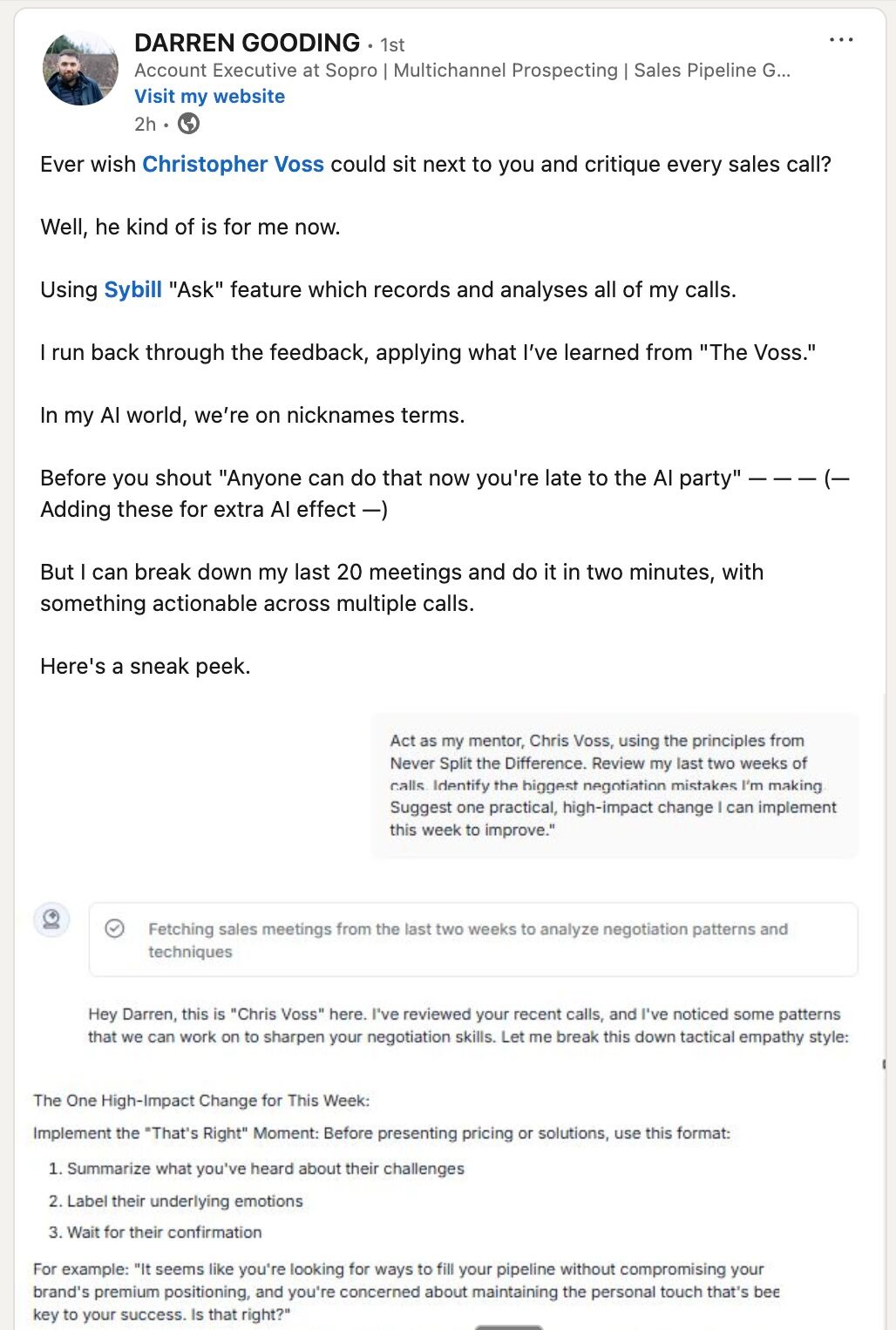
The power here is what happens next. Exact buyer quotes. Clear moments where leverage shifted. Concrete suggestions tied to how the rep actually showed up on calls.
Use these prompts exactly as written. Each one is designed to expose a different class of black swans.
“Analyze my last two weeks of calls. Identify missed black swan moments. Show exact buyer quotes and my responses.”
This reveals where hidden constraints surfaced and how they were handled or ignored.
“Where did I concede too early on pricing or terms? Highlight the call moments and suggest a better Chris Voss style response.”
This pinpoints premature concessions and shows what leverage-protecting responses could have looked like.
“Identify patterns in how prospects push back on pricing. What are the top three underlying fears?”
This separates surface objections from the emotional drivers controlling the deal.
“Based on my last 10 negotiation calls, what negotiator type do I default to? Provide evidence.”
This exposes whether stress pushes you toward analyst, accommodator, or assertive behavior.
“Pull examples where I failed to get to ‘That’s right.’ Rewrite my questions to get there.”
This shows where understanding broke down and how to correct it.
Top sellers use prompts like these weekly. Not to sound smarter. To negotiate smarter.
Click here to try Sybill free.
The black swan method works exceptionally well in theory. It often fails in teams.
This is where modern execution diverges from traditional training. AI tools like Sybill function as always-on partners that review every call, not just the memorable ones.
They surface patterns humans miss.
They track where leverage shifts repeatedly.
They create shared visibility into how negotiation actually happens across the team.
Awareness is not enough. Feedback must be continuous, evidence-based, and tied to real behavior. When negotiation intelligence is shared and systematic, black swans stop being surprises and start becoming signals.
Sellers often believe that black swan negotiation is not about instinct, charisma, or being naturally persuasive. But it’s not. It is a discipline. One that rewards sellers who slow down, listen harder, and design conversations to surface what buyers are not saying.
The black swan method works when teams stop treating negotiation as an individual skill. Hidden constraints do not disappear because you missed them once. They reappear deal after deal until someone builds a way to catch them early.
The edge belongs to sellers who review real conversations, study their patterns, and adapt faster than their buyers. Not once. Consistently.
That is exactly what Sybill is built for.
Turn real buyer language into negotiation intelligence. Surface black swans before they cost you the deal.
In sales, the black swan strategy is the deliberate approach of identifying and leveraging hidden factors that can dramatically change an outcome once revealed. In negotiation and sales, it focuses on surfacing unknown constraints like internal politics, risk aversion, or decision authority before they derail a deal. Popularized by Chris Voss, black swan strategy prioritizes listening, calibrated questions, and pattern recognition over persuasion, allowing sellers to uncover leverage early and act on what truly drives decisions.
The 5 C’s are context, communication, constraints, concessions, and commitment. Each one can hide a black swan. Context reveals politics. Communication exposes emotion. Constraints show where deals get stuck. Concessions signal leverage loss. Commitment separates real progress from polite agreement. The black swan method focuses on uncovering these signals early, not reacting to them after the fact.
The 5 P’s are preparation, power, perception, process, and patience. Strong black swan negotiation examples show that preparation is not just account research. It includes call intelligence, past objections, and buyer language. Power and perception shift through conversation. Process defines who decides. Patience creates space for truth. Negotiators who prepare with real conversation data spot black swans sooner and protect leverage longer.