Find us at booth #83, join us for a harbor side happy hour, or catch Gorish’s talk.

Sept, 16-18 > Learn more


Tamanna Mishra

August 6, 2026
%20(64).png)
AI can now draft a competent cold email faster than a Succession alliance can collapse. That has made average outreach cheaper, faster, and much harder to notice.
Belkins’ analysis of 7.5 million cold emails sent during 2025 found an average reply rate of just 0.45%. That number is unusually low because the study counted replies against all sends to net-new contacts and did not use opens to flatter the result. It should not be casually compared with studies that use different denominators. But the direction is clear: mass-produced adequacy is not winning many conversations. Read the Belkins cold email response rate study.
Cold email is not dead. Generic cold email is simply buried under millions of nearly identical messages announcing that someone “came across your profile” and would “love to connect.”
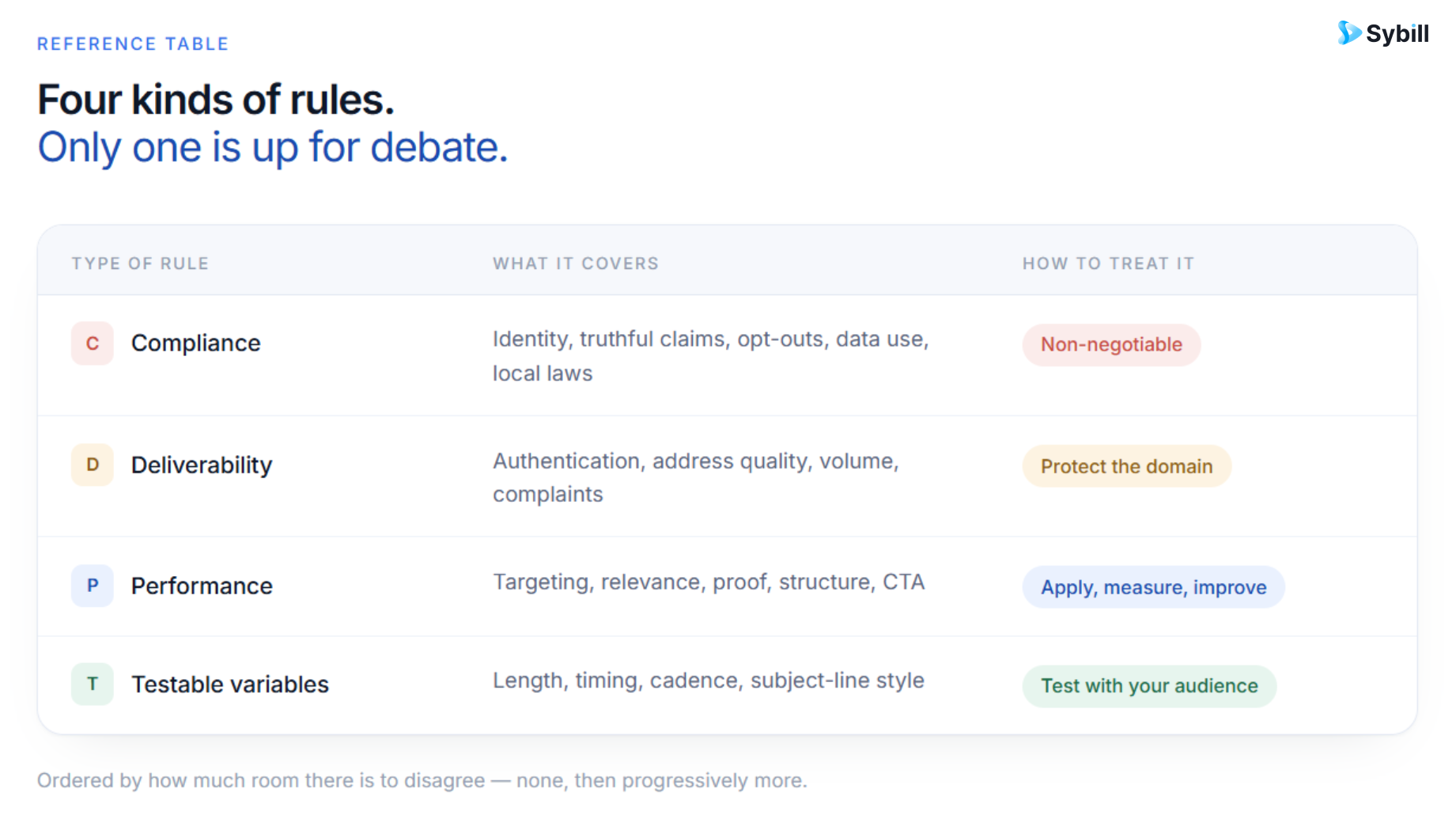
The cold email rules that matter in 2026 help you contact the right person, make a credible business connection, protect your sender reputation, and respect the law. Some are non-negotiable. Others should be tested.
Contact relevant people, give them a credible reason to care now, connect their situation to one useful outcome, identify yourself honestly, and provide an easy opt-out. Keep the email concise, ask one low-friction question, protect your sender reputation, and measure positive replies instead of opens.
Cold email rules are the legal requirements, deliverability practices, and writing principles governing unsolicited business email. Legal and platform requirements must be followed. Advice about length, timing, and follow-up cadence should be tested.
Targeting comes before copy. A beautifully written irrelevant email is still spam with good grammar.
Define the account, role, company stage, problem, and trigger that make someone a plausible buyer. If the person cannot influence the problem, no personalization will rescue the message.
A relevant account is not automatically a timely account. Look for a real signal: hiring, expansion, a leadership change, a product launch, a strategic initiative, a regulatory shift, a technology change, or previous engagement.
Connect the signal to a plausible need. “Congratulations on the funding” followed by an unrelated pitch is automation wearing a party hat.
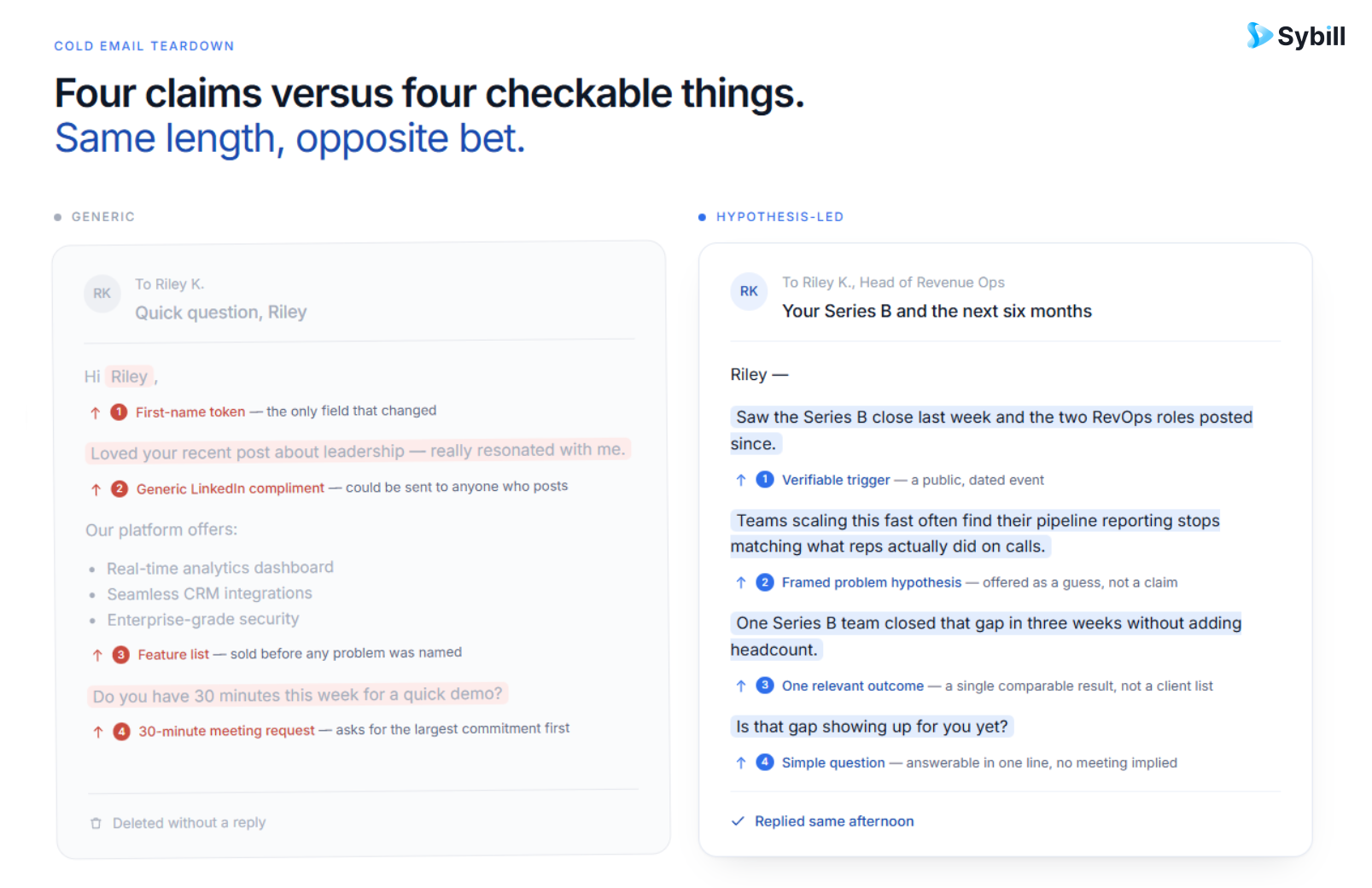
A first name is data entry. Mentioning someone’s university, city, or latest post adds nothing if it has no connection to the offer.
Useful personalization makes a business connection:
Use “teams at this stage often find” or “I may be wrong, but” to distinguish an informed hypothesis from amateur corporate clairvoyance.
Where Sybill fits: Sybill is not a cold email sequencing or deliverability platform. Sybill Buyer Intelligence surfaces recurring pain points, buying triggers, objections, stakeholder priorities, and buyer language across calls, emails, and CRM data. Reps can use those patterns to form sharper hypotheses for similar cold accounts. Once a meeting is booked, Sybill’s pre-meeting briefs combine attendee research, email interactions, CRM information, previous calls, and deal context.
The subject line should identify the conversation, not disguise the email or manufacture urgency. Avoid fake “Re:” lines, false familiarity, and unsupported claims. Front-load the relevant idea. “Scaling manager coaching at Acme” says more than “Quick question.”
For deeper guidance, see these cold email subject line principles and examples.
Delete “My name is,” “I wanted to introduce myself,” and the paragraph about your market-leading company. Your name is in the sender field. Start with the trigger or observation that explains why you chose this person.
Choose the problem most logically connected to the signal, then describe one outcome.
Weak: “We improve productivity, collaboration, revenue, forecasting, onboarding, and customer experience.”
Stronger: “We help sales managers keep deal context current while the team scales.”
Use one comparable customer, situation, result, or insight. The best proof matches the recipient’s industry, company stage, role, or problem. Keep it to one line. A wall of logos does not prove that you understand this buyer.
Never invent a metric or imply that a customer achieved a result you cannot verify.
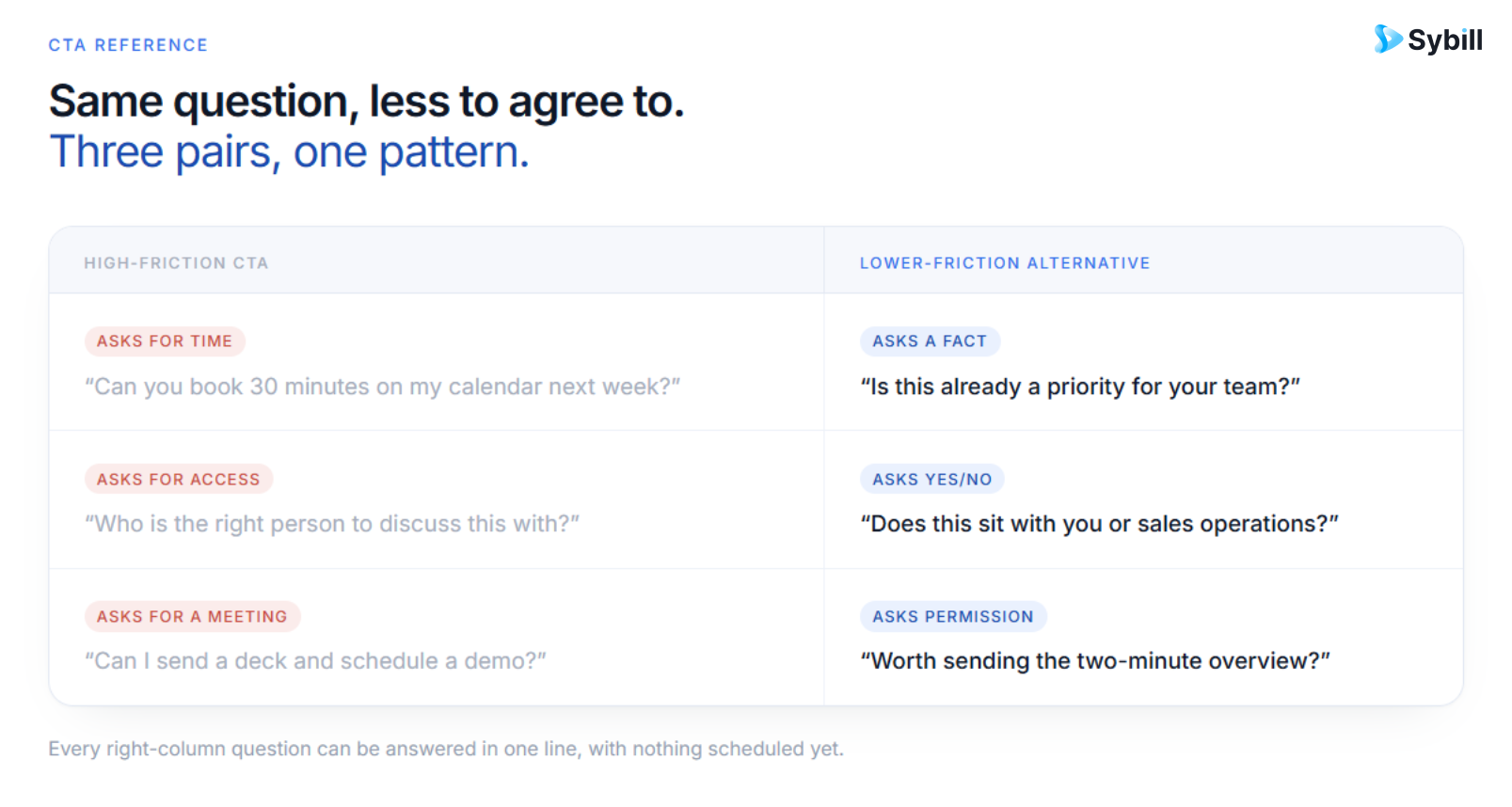
A cold email should start a conversation, not attempt to close a deal by calendar ambush. Asking a stranger for 30 minutes, a referral, and feedback on your deck in the same message is not a CTA. It is a task list.
Seventy-five to 150 words is a useful working range, not a universal law. Complex offers may need more context.
Use short paragraphs and one idea. Edit the email down to:
Great copy cannot reply to itself from the spam folder. Authenticate the domain, verify addresses, monitor bounces, increase volume responsibly, and watch complaints.
Google’s email sender guidelines require SPF or DKIM authentication for all senders to Gmail and impose additional requirements on bulk senders. Google recommends keeping spam rates reported in Postmaster Tools below 0.1% and avoiding 0.3% or higher.
There is no universally safe daily volume. Domain history, list quality, infrastructure, and recipient behavior all matter.
Cold email law depends on the sender, recipient, location, business type, message, and use of personal data. Get legal advice for the markets you target.
In the US, the FTC’s CAN-SPAM compliance guide covers commercial email, including B2B messages. It requires accurate sender information, honest subject lines, a physical postal address, a clear opt-out, and timely suppression.
The ICO’s B2B marketing guidance says PECR’s consent rule does not apply to corporate subscribers, but senders must identify themselves and provide an opt-out address. Sole traders and some partnerships are treated differently, and UK GDPR can apply.
Respect objections and suppression lists. Compliance is not merely a footer problem.
A follow-up should add a useful detail, proof point, new angle, or reason the issue matters now. “Bumping this” only proves the first email exists.
Track delivery, bounces, total replies, positive replies, qualified conversations, meetings, and opportunities. Treat opens cautiously. Google says it does not track open rates and cannot verify the accuracy of third-party open data. An open is not pipeline.
For follow-up timing, examples, and templates, read Sybill’s sales follow-up email guide.
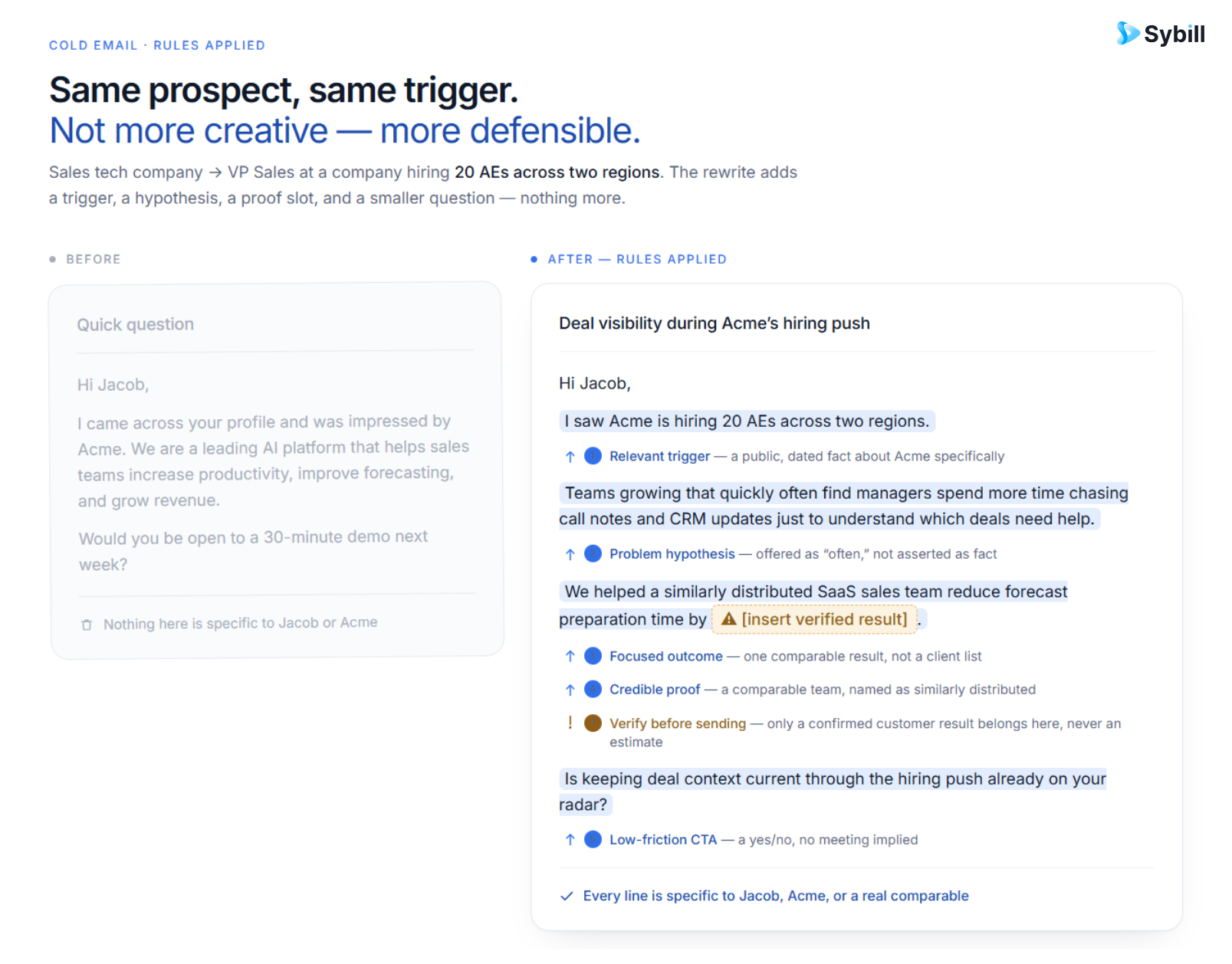
Imagine a sales technology company contacting a VP of Sales whose company is hiring 20 AEs across two regions.
Before
Subject: Quick question
Hi Jacob,
I came across your profile and was impressed by Acme. We are a leading AI platform that helps sales teams increase productivity, improve forecasting, and grow revenue.
Would you be open to a 30-minute demo next week?
After
Subject: Deal visibility during Acme’s hiring push
Hi Jacob,
I saw Acme is hiring 20 AEs across two regions. Teams growing that quickly often find managers spend more time chasing call notes and CRM updates just to understand which deals need help.
We helped a similarly distributed SaaS sales team reduce forecast preparation time by [insert verified result].
Is keeping deal context current through the hiring push already on your radar?
The rewrite is not more creative. It is more defensible. It uses a relevant trigger, frames a hypothesis, reserves space for verified proof, and asks an easy question. For more scenarios, see these sales email examples and templates.
Some popular cold emailing rules are folklore dressed as certainty:
Use a framework, not a copy-paste script. Test timing and length with comparable audiences. Stop when someone opts out, objects, or continued contact is inappropriate. Modern filters consider far more than whether you typed “free.”
Before sending, ask:
If the answer to the first two questions is no, do not rewrite the opener. Rethink the target.
The best cold email is the one the right buyer can recognize as relevant without performing interpretive dance. Follow the non-negotiable rules, test the variables, and give AI better context before asking it to write more email.
Contact relevant people, use a timely reason for reaching out, identify yourself honestly, make one focused value connection, add credible proof, and ask one easy question. Protect sender reputation, provide an opt-out, and comply with applicable laws.
Cold emailing can be legal, but rules vary by jurisdiction and recipient type. US commercial email must comply with CAN-SPAM, including B2B email. UK requirements differ by business type, while UK GDPR may apply when personal data is used. Seek legal advice for your markets.
B2B cold email rules cover truthful identification, honest subject lines, relevant targeting, lawful data use, opt-outs, domain authentication, sender reputation, and respectful follow-up. “B2B” is not a universal exemption from email or privacy law.
There is no universal number. Start with a small, verified, relevant list and increase volume only while delivery, bounce, complaint, and reply quality remain healthy. Capacity depends on domain history, authentication, infrastructure, and list quality.
There is no fixed number for every market. Every follow-up should add value, and the sequence should stop after an opt-out, objection, or clear lack of fit. Judge cadence by positive replies and qualified conversations, not a template’s prescribed number of touches.
Contact relevant people, use a timely reason for reaching out, identify yourself honestly, make one focused value connection, add credible proof, and ask one easy question. Protect sender reputation, provide an opt-out, and comply with applicable laws.
Cold emailing can be legal, but rules vary by jurisdiction and recipient type. US commercial email must comply with CAN-SPAM, including B2B email. UK requirements differ by business type, while UK GDPR may apply when personal data is used. Seek legal advice for your markets.
B2B cold email rules cover truthful identification, honest subject lines, relevant targeting, lawful data use, opt-outs, domain authentication, sender reputation, and respectful follow-up. “B2B” is not a universal exemption from email or privacy law.