Find us at booth #83, join us for a harbor side happy hour, or catch Gorish’s talk.

Sept, 16-18 > Learn more

%20(1).avif)
Mamta Tainwala

June 30, 2026
%20(16).png)
Call recording captures and stores audio for later playback. Conversation intelligence uses AI to transcribe, analyze, and act on those recordings, extracting sentiment, objections, and next steps, then automatically updating the CRM and drafting follow-ups. Recording gives you a file. Conversation intelligence gives you insights, actions, and outcomes.
The difference is what happens after the call ends. Call recording captures audio and waits for a human to do something with it. Conversation intelligence transcribes the call, analyzes what was said, and acts on it, updating the CRM, drafting the follow-up, and flagging risk without anyone pressing a button.
Let me show you what that gap feels like in real life, because the definition alone never lands until you have lived it.
Picture this. Your team records every customer call. You have thousands of hours sitting in a folder somewhere. A deal goes sideways, and you think, "I should probably listen to that discovery call and figure out what went wrong."
You open the recording. It is 47 minutes long. You do not have 47 minutes. You scrub through, hunting for the part that matters. Five minutes in, you give up and just ask the rep what happened. They do not remember the details either. And the chance to learn from that conversation? Gone.
That scene plays out in revenue teams everywhere, every single day. Companies buy call recording believing it will lift performance, then discover that recordings alone change nothing. They are just files gathering digital dust.
Now run the same call through conversation intelligence. That 47-minute discovery automatically produces a summary flagging that the prospect raised budget three times, compared your pricing unfavorably to a competitor twice, and never once confirmed they could actually sign off on the purchase. Your CRM updates itself with those signals. Your manager gets an alert that the deal is wobbling. A follow-up draft is already sitting in your inbox, written around what was actually said.
One gives you a file. The other gives you insights, actions, and outcomes. That is the whole story in a sentence, and the rest of this guide unpacks it. If you want the category-level definition first, start with what conversation intelligence is.
Call recording is software that captures audio or video from business conversations and stores those files for later playback. Think of it as a tape recorder for the digital age, with better storage and a search bar bolted on.
You need to understand the foundation before you can appreciate what gets built on top of it, so let's give recording its due.
Here is what call recording does well:
And here is where it quietly stops:
Is recording ever enough on its own? Honestly, sometimes. If your only goal is legal compliance, or you are a three-person team with a handful of calls a week, basic recording does the job. But the moment you want recordings to actually improve performance, the manual effort buries you. Ten reps making ten calls a day is 100 calls. Even at 2x speed, that is 25-plus hours of listening a day. The math simply does not work. For the broader category context, see our guide to the best AI meeting recorders.
Conversation intelligence is AI software that starts with the recording and then transforms it into a strategic asset. It transcribes every call, analyzes what mattered, and pushes the results into your workflow, all automatically and at scale.
Think of it as hiring an expert analyst to sit in on every single conversation, take flawless notes, spot patterns across thousands of calls, and update your systems the moment the call ends. Except it never gets tired, never misses a detail, and never asks for a raise.
Here is what that actually looks like:
A transcript tells you what was said. Conversation intelligence tells you what it meant, and what to do next. That is the leap.
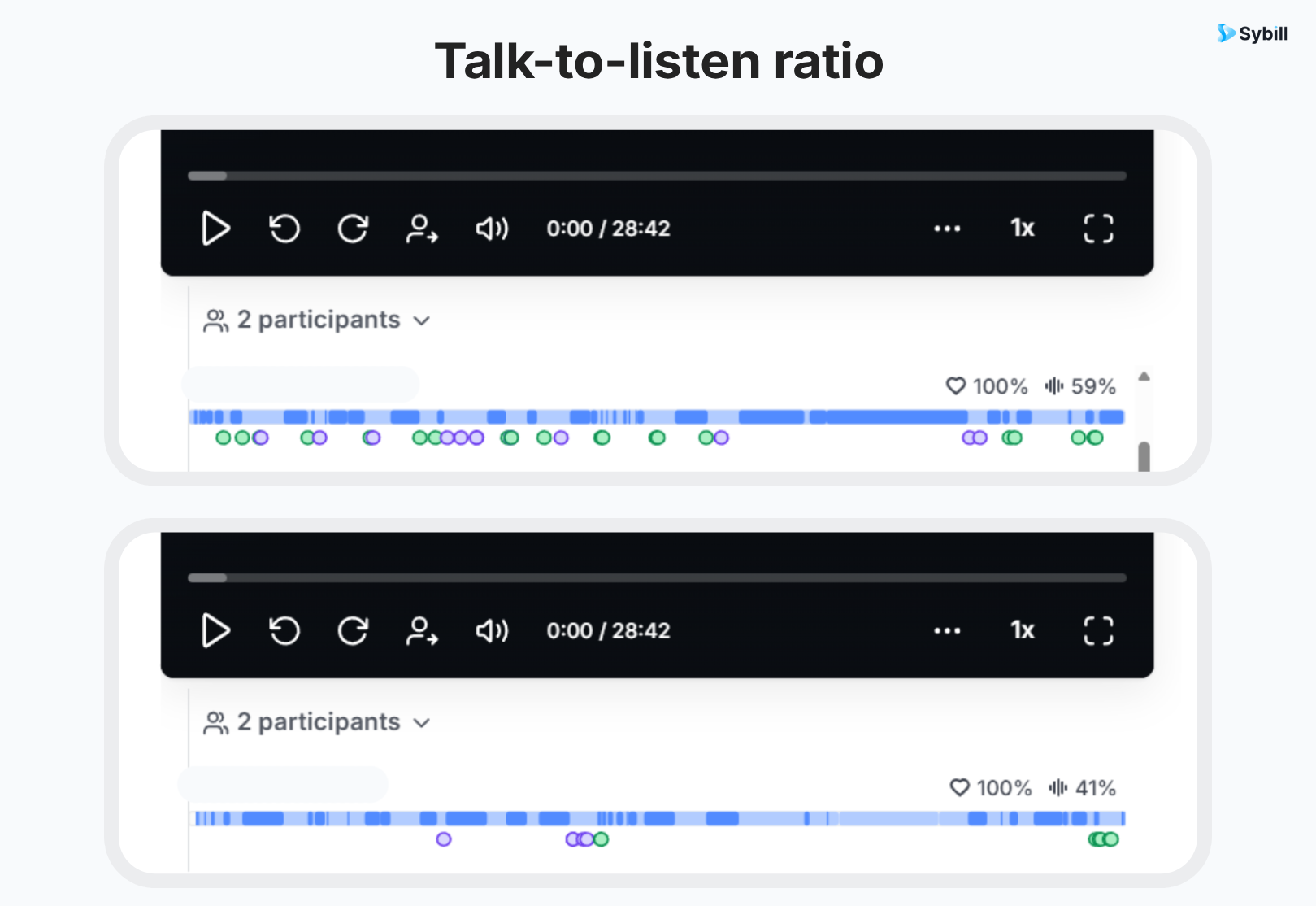
The five differences that matter are reactive versus proactive, manual versus automated, storage versus strategic asset, individual versus team intelligence, and passive versus active. Each one maps directly to a business outcome, not a feature checkbox.
Let me put real stakes on each of these, because the table is the extractable version and the story is where it sinks in.
Recording lets you look back after the deal is already lost. Intelligence catches the problem while you can still fix it. A prospect says they are "also looking at a competitor." In a recording, that line sits buried in a 40-minute file nobody opens. With intelligence, it triggers an alert, logs the competitor mention, and prompts the rep to send a battlecard the same day. One is an autopsy. The other is treatment.
Two hundred calls this week. With recording, your manager listens to maybe ten. That is five percent coverage. With intelligence, all 200 get analyzed, scored, and turned into coaching. The coverage gap alone changes what is possible.
Your top rep mentions a new feature in 80 percent of calls, and it lands every time. Recording stores those 100 files. Intelligence spots the pattern, quantifies the positive response, and hands the entire team a winning talk track. One archives data. The other turns it into advantage.
Win rates are slipping and you do not know why. Recording means manually combing through lost deals. Intelligence runs one query and shows you that 78 percent of lost deals raised implementation-time concerns that nobody addressed. Now you know exactly what to coach.
A prospect says, "We need to decide by end of quarter." Recording files that deadline away. Intelligence creates a CRM task with a due date, updates the close date, adds the deal to a time-sensitive alert list, and drops the quote into the follow-up draft. Active beats passive every time.
Get started for free with Sybill and feel the difference between a tool that stores your calls and one that actually moves your deals.
Conversation intelligence solves the problems recording can only document: slow ramp time, stalled deals, coaching that does not scale, stale CRMs, shaky forecasts, and winning strategies that never spread. Recording shows you the symptom. Intelligence treats the cause.
Here is the practical translation, problem by problem:
For most modern revenue teams, you need conversation intelligence, which already includes recording as its foundation. You are not choosing between them. You are deciding whether to stop at the recording or use the intelligence layer sitting right on top of it.
You probably only need standalone call recording if you are a two- or three-person team that can review every call by hand, your only goal is legal compliance, or your call volume is genuinely tiny.
You need conversation intelligence if any of this sounds like you: four or more people making customer calls, coaching that has outgrown what managers can deliver manually, win rates or forecast accuracy that need work, reps drowning in post-call admin, a CRM that is perpetually stale, or deals you are losing without clear visibility into why.
If that second list describes your team, and for most B2B revenue teams it does, the real question is not "should I get conversation intelligence?" It is "which platform actually fits how my reps work?" For that, here is our ranked breakdown of the best conversation intelligence tools for sales teams, and if you are weighing the category leader specifically, our Sybill versus Gong comparison.
Get started for free with Sybill and experience the difference between passive call recording and active conversation intelligence that drives revenue through automated insights, coaching, and CRM updates. Get started for free with Sybill
It works with it. Conversation intelligence includes recording as its foundation, so this is not a replacement question but an evolution. You cannot have conversation intelligence without first recording the call, but it then layers transcription, AI analysis, insight extraction, CRM automation, and coaching on top. Implementing a platform like Sybill gives you both the recording and the intelligence that makes recordings useful at scale.
Basic call recording ranges from free to roughly $20 to $50 per user per month. Conversation intelligence platforms generally run higher per seat because they do far more, though some, including Sybill, offer a free tier with unlimited recording and transcription. The ROI math shifts once you factor in saved rep time. Saving each rep five hours a week on admin is 20 hours a month redirected to selling. Free trials let you measure that impact before committing budget.
Adoption comes down to three things. First, does it make their lives easier or harder? Reps love Sybill because it joins meetings, records, transcribes, and updates the CRM without them doing anything different. Second, is the value immediate? A follow-up draft in the inbox five minutes after a call earns engagement fast. Third, does it live where they already work? When insights show up in Salesforce and Slack instead of a separate dashboard, it becomes part of the workflow rather than another tab to forget.
No. The extra steps are the entire point. Recording captures audio and stops. Conversation intelligence transcribes, analyzes sentiment and objections, extracts next steps, updates the CRM, and drafts follow-ups automatically. Recording is the raw material; intelligence is the finished work. Calling intelligence "recording with extra steps" is like calling a kitchen "a fridge with extra steps."
Yes, in many cases. Platforms like Sybill can ingest historical recordings and transcripts, so the conversation data you have already captured is not wasted. You can layer intelligence onto an existing archive and start surfacing patterns from calls that happened before you adopted the tool.
For pure compliance and documentation, basic call recording with consent notifications and retention policies meets the requirement. Conversation intelligence includes those same recording and storage capabilities, so it covers compliance too, while adding analysis and automation on top. If compliance is your only goal, recording is sufficient. If you want compliance and performance, intelligence covers both.
It works with it. Conversation intelligence includes recording as its foundation, so this is not a replacement question but an evolution. You cannot have conversation intelligence without first recording the call, but it then layers transcription, AI analysis, insight extraction, CRM automation, and coaching on top. Implementing a platform like Sybill gives you both the recording and the intelligence that makes recordings useful at scale.
Basic call recording platforms typically range from free (limited features) to $20-50 per user per month. Conversation intelligence platforms generally range from $50-150+ per user per month depending on features and scale. While conversation intelligence costs more upfront, the ROI calculation changes dramatically when you factor in the value it delivers. Consider that if conversation intelligence saves each rep just 5 hours per week on admin work (conservative based on automated CRM updates and follow-up emails), that's 20 hours per month per rep redirected to revenue-generating activities. Additionally, CI tools improve win rates by 10-20% through better coaching and execution, shorten ramp time by 30-50% for new reps, and improve forecast accuracy by 15-25%. Free tools like Sybill offer free trials so you can measure actual impact before committing budget.
Adoption comes down to three things. First, does it make their lives easier or harder? Reps love Sybill because it joins meetings, records, transcribes, and updates the CRM without them doing anything different. Second, is the value immediate? A follow-up draft in the inbox five minutes after a call earns engagement fast. Third, does it live where they already work? When insights show up in Salesforce and Slack instead of a separate dashboard, it becomes part of the workflow rather than another tab to forget.