Find us at booth #83, join us for a harbor side happy hour, or catch Gorish’s talk.

Sept, 16-18 > Learn more


Tamanna Mishra

January 29, 2026
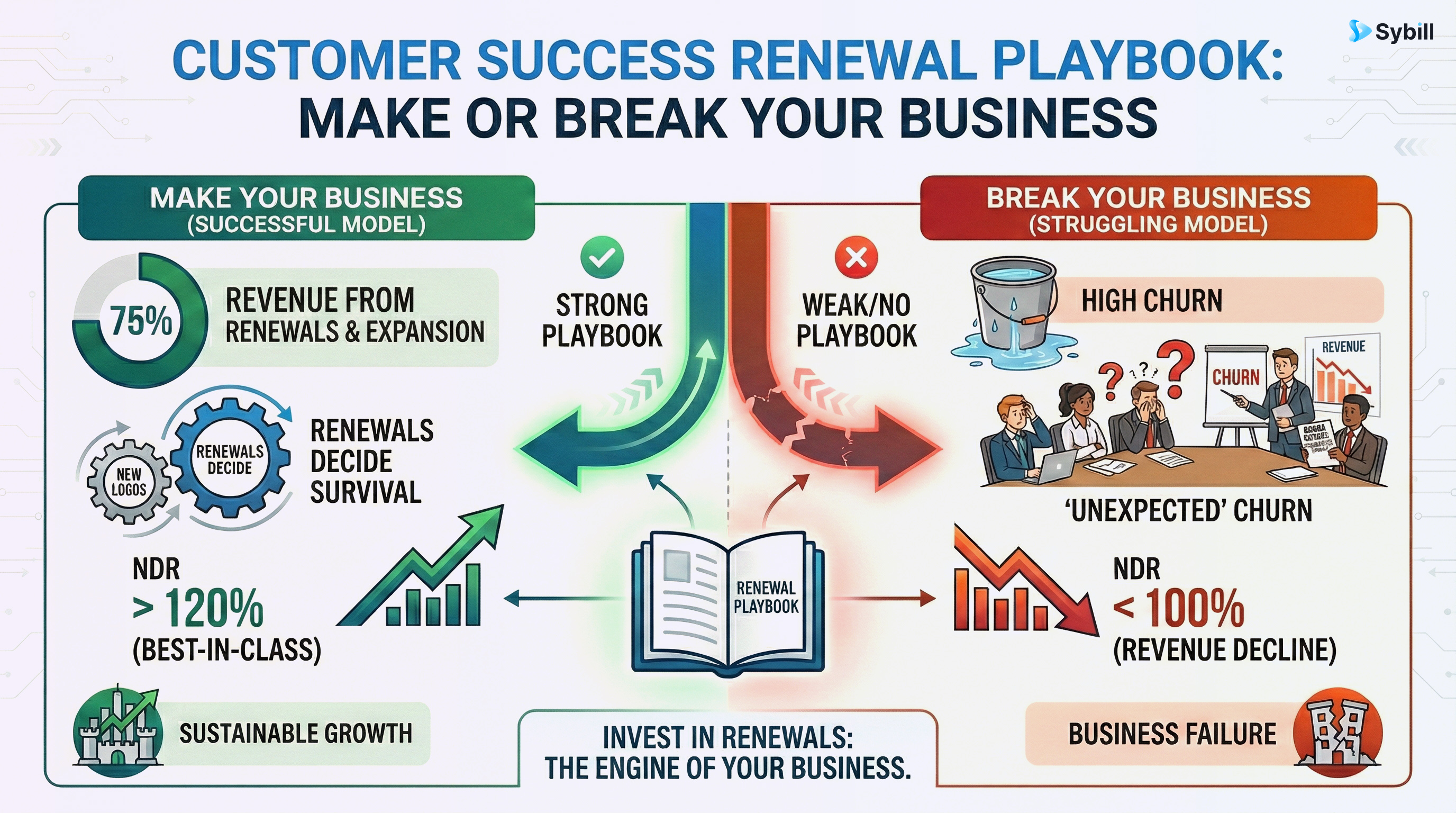
That’s the share of SaaS revenue that comes from renewals and expansion, not new logos. New sales create momentum. Renewals decide survival.
The best SaaS companies understand this. They consistently report Net Dollar Retention above 120 percent. Everyone else spends each quarter explaining churn to the board and calling it “unexpected.”
And yet, for something this critical, most renewal motions still begin the same way.
A Slack message.
“This account is up for renewal next month.”
Renewals get treated like Netflix subscriptions until Finance joins the call and asks why a six-figure account suddenly feels shaky. CSMs are then expected to save the deal with half-written notes, outdated CRM fields, and whatever context they can reconstruct from memory.
That is not a renewal strategy. That is panic management.
This customer success renewal playbook is built for teams that want renewals to be predictable. Ones that want less drama at renewal time. It shows how modern customer success teams replace gut feel with real signals. Signals hidden in customer calls. Signals buried in emails. Signals that never make it into the CRM because no one updates it properly.
Most renewals are lost long before the contract end date because teams miss what customers are already telling them.
Subtle hesitation.
Repeated objections.
Shifts in tone.
Silence from champions.
These signals show up first in conversations, not dashboards.
And this is where Sybill partners with you. It turns calls and emails into renewal intelligence that customer success teams can actually act on.
Renewals are not a date on a contract. They are a verdict on whether your customer still believes the value story.
If SaaS growth were a movie, new sales would get the trailer. Renewals pay for the sequel.
Here is the math most teams already know but still underplay. Acquiring a new customer costs 5 to 7 times more than retaining an existing one. A 5 percent increase in retention can lift profits anywhere between 25 and 95 percent.
So, when renewals slip, the damage compounds fast. Renewal forecasting errors hurt more than pipeline misses because they hit revenue you already counted on.
This is exactly why a SaaS renewal playbook matters more than another outbound experiment.
Yet many teams still treat renewals as a downstream task. And that’s why…
Most renewals do not fail because of price. They fail because customer success teams lose narrative control.
When the story of value lives only in a CSM’s head, a Slack thread, or scattered CRM notes, it collapses under pressure. Finance wants justification. Procurement wants proof. New stakeholders want context. The CSM has fragments.
An ideal playbook to manage renewal as a CSM in SaaS does one thing exceptionally well.
It preserves the value narrative over time. It turns conversations, outcomes, and risks into shared context that survives handoffs, escalations, and negotiations.
Without that, even happy customers become risky renewals.
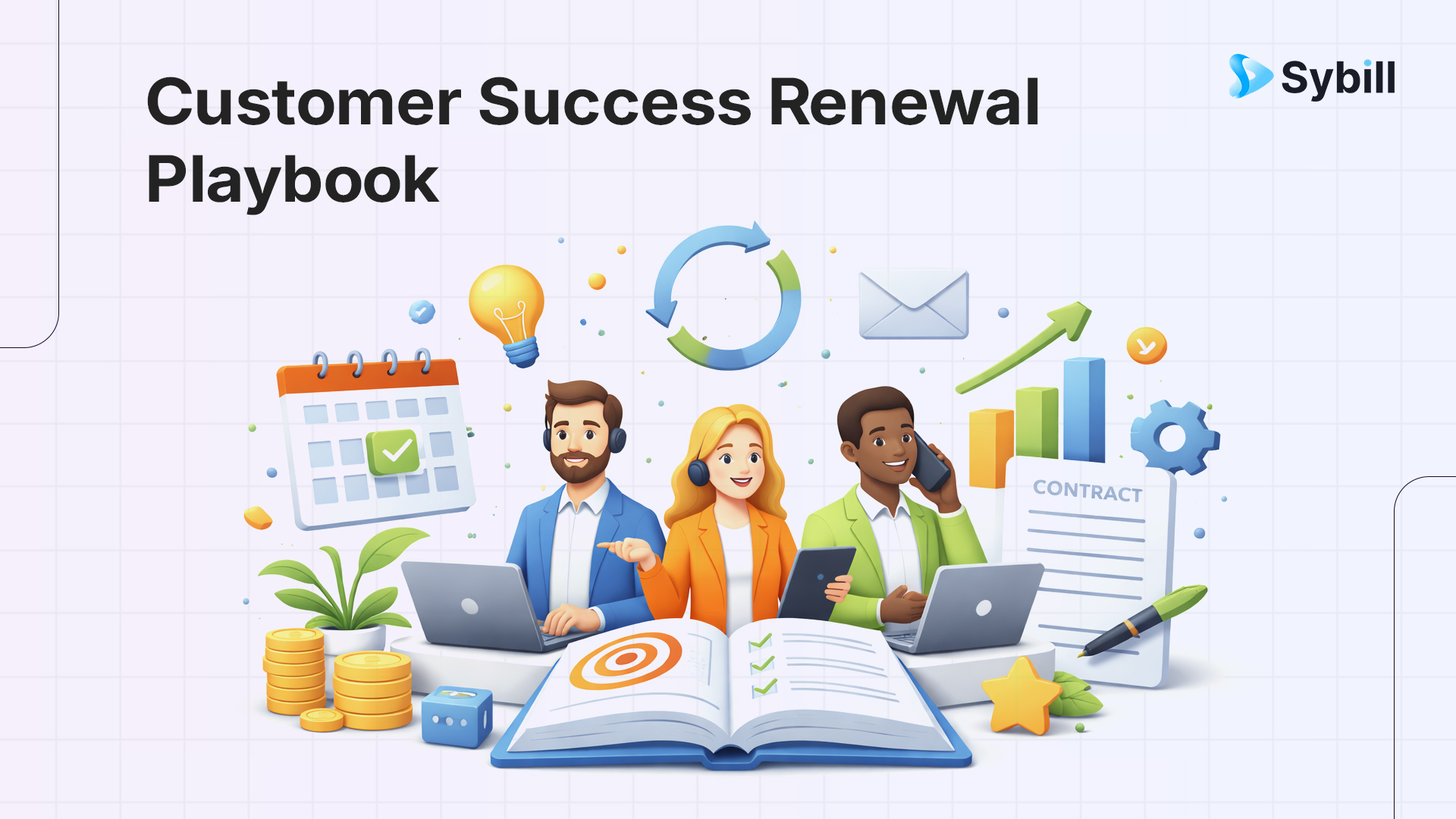
A customer success renewal playbook is a repeatable, signal-driven system that tells CSMs what to do, when to do it, and how to influence renewal outcomes across the entire customer lifecycle.
Not just at renewal time. Across onboarding, adoption, value delivery, risk detection, and internal alignment.
The best renewal playbooks are designed to remove ambiguity. They make renewal execution boring in the best possible way. Clear actions. Clear triggers. Clear ownership.
A modern playbook goes far beyond timelines and email templates. It includes:
This is where many playbooks quietly break.
Usage can be healthy and sentiment can still be deteriorating. Dashboards rarely catch that in time.
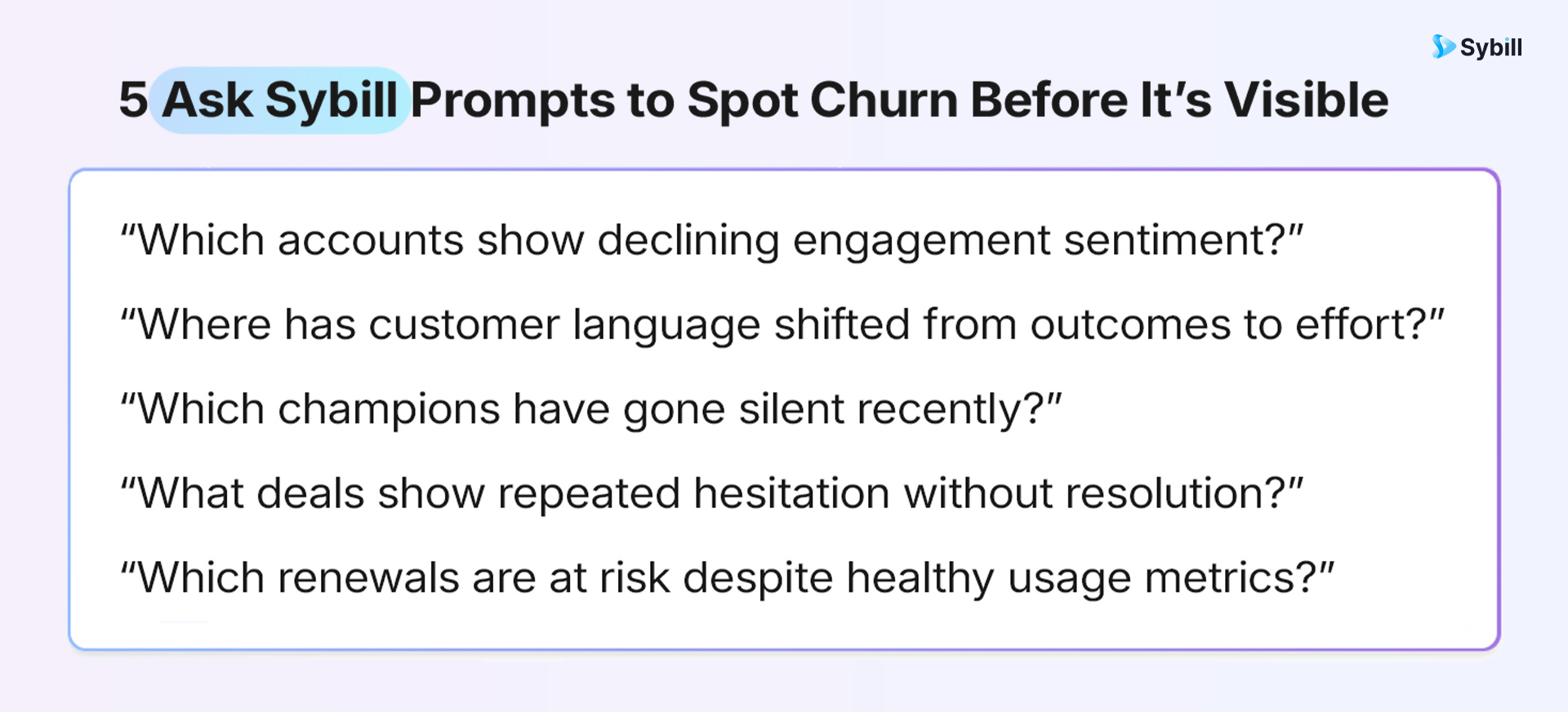
This is where Sybill adds a critical layer. Sybill brings conversational and emotional context into renewal decisions. Not just activity metrics, but intent, hesitation, confidence, and risk based on real customer language.
Related read: 12 best churn prediction and mitigation tools for SaaS
One of the fastest ways to break a renewal motion is to argue about ownership.
In many SaaS teams, renewals sit in an uncomfortable gray zone. Sales assumes customer success will handle it. Customer success assumes Sales will step in when money is involved. By the time roles are clarified, the renewal clock is already ticking.
An ideal playbook to manage renewal as a CSM in SaaS starts by answering this question clearly.
The difference is not who shows up to the renewal call. It is whether everyone shows up with the same understanding of the account.
Alignment breaks when context lives in too many places. One person knows the objections. Another remembers the risk. Someone else updated the CRM three months ago.
This is where AI and CRM automation tools like Sybill help without overhauling how teams work. Or… We hear you… Without adding more meetings!
No more tribal knowledge trapped with one CSM. Just cleaner alignment, earlier visibility, and fewer last-minute surprises.
Most renewal problems are not caused by bad negotiation. They are caused by bad timing.
In a strong SaaS renewal playbook, renewal is not a last-minute event. It is a structured motion that runs quietly in the background of the customer lifecycle.
Here is the renewal timeline used in the most effective customer success renewal playbook examples.
Modern conversation intelligence tools like Sybill help by flagging early churn signals such as tone shifts, repeated objections, and engagement drops in calls and emails. These signals surface risk long before a renewal meeting ever hits the calendar.
NPS tells you how a customer feels in hindsight. Renewals are decided by what customers signal in real time.
In many customer success renewal playbook examples, the most reliable churn indicators show up in conversations long before a score drops.
Here are five signals that consistently predict renewal risk better than NPS:
If NPS is your main renewal signal, what are you missing in customer conversations right now?
A strong customer success renewal playbook is not built around stages alone. It is built around signals. What you do next should always depend on what the customer is actually telling you.
This framework keeps renewal execution simple, repeatable, and grounded in reality.
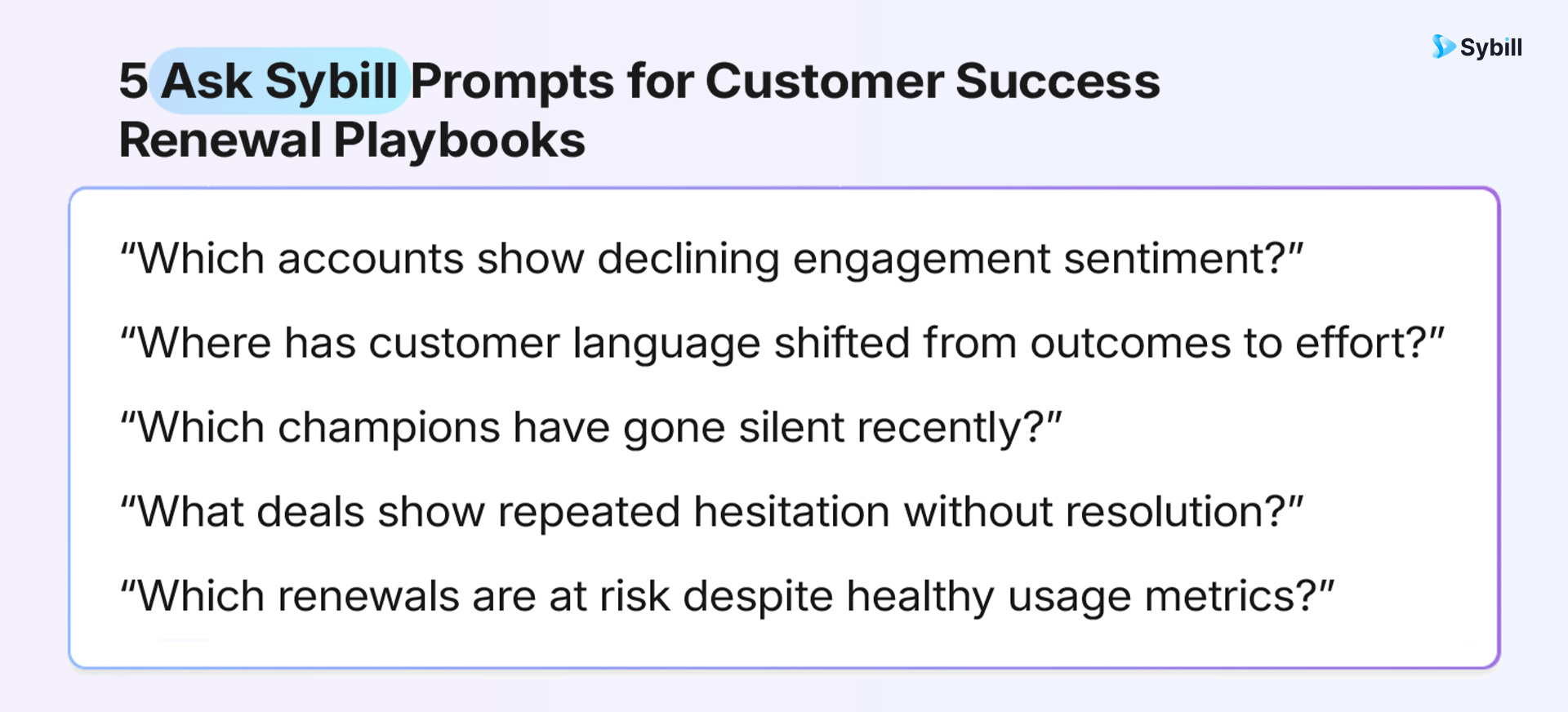
Modern teams use conversation-driven insight to guide each step. Tools like Ask Sybill allow customer success leaders to design and adapt renewal playbooks at the account level, not just by segment. The result is fewer assumptions, earlier course correction, and renewals that feel earned rather than forced.
Most customer success renewal playbook templates fail for one simple reason. They look good in a document and fall apart in real conversations.
High-performing CS teams rely on templates that do three things well.
Below are 6 templates that consistently show up in renewal motions that close cleanly.
Purpose:
Decide early whether an account is truly renewal-ready or quietly at risk.
What to include:
Why this template works:
It forces an objective assessment 120 days before renewal instead of a subjective scramble at the end.
What changes with AI and CRM automation tools like Sybill:
Conversation-based risk indicators sit alongside usage and health data. CRM Autofill keeps the scorecard current without manual updates, so it reflects reality, not memory.
Purpose:
Normalize renewal early and shift it from surprise to process.
What to include:
Why this template works:
It reframes renewal as a shared planning conversation rather than a commercial ambush.
Sybill enhancement:
The agenda is grounded in exact customer quotes pulled from past calls and emails. Expectations and hesitations are surfaced in the customer’s own words, not assumptions.
Purpose:
Arm champions before Finance and procurement enter the conversation.
What to include:
Why this template works:
Renewals stall when value cannot be defended internally. This template makes value portable.
Sybill enhancement:
Call summaries and email threads are used to prove value in the customer’s language. This strengthens internal selling to Finance and leadership without forcing the CSM to reconstruct history.
Purpose:
Remove improvisation from high-stakes renewal conversations.
What to include:
Why this template works:
It prevents reactive discounting and keeps conversations anchored in outcomes.
Sybill enhancement:
Objections are mapped to actual phrases customers use. Ask Sybill surfaces recurring objection patterns across accounts, helping teams prepare before objections escalate.
Purpose:
Create a disciplined response to renewal risk without burning margin.
What to include:
Why this template works:
Not every account should be saved. This playbook protects teams from chasing sunk costs.
Sybill enhancement:
Conversation signals help distinguish temporary friction from emotional disengagement. This prevents discounting accounts that are already mentally checked out.
Purpose:
Turn proven value into growth without damaging trust.
What to include:
Why this template works:
Expansion lands best when it feels like a continuation of value, not a sales pivot.
Sybill enhancement:
Expansion intent is often hidden inside comments during calls. Conversation intelligence surfaces these moments so CS teams can time upsells naturally and credibly.
These templates work because they are built around how customers actually behave, not how teams hope they behave.
Even experienced customer success teams lose renewals for reasons that feel avoidable in hindsight.
Here are the mistakes that show up most often.
AI tools like Sybill help reduce these failures by keeping context alive automatically. Conversations, risks, and signals do not disappear between calls or get trapped in someone’s head.
If your dashboards look healthy but a renewal still surprises you, where did the real signal live?
Do your CSMs open your renewal playbook when pressure hits?
Playbooks go stale in static form. They win when they are embedded into daily workflows.
When renewal logic is enforced through systems, execution becomes consistent. When it is optional, it becomes situational.
This is where AI-driven workflow tools like Sybill quietly add leverage.
When renewal playbooks live inside workflows, renewals stop depending on who remembers what.
A strong customer success renewal playbook is a critical piece of running a SaaS business, something you run quietly, consistently, and deliberately throughout the customer lifecycle.
The best ones do one thing exceptionally well. They preserve the value narrative. They capture risk early. And they ensure renewal decisions are guided by real customer signals, not last-minute guesswork.
When renewals rely on memory, scattered notes, or outdated CRM fields, even healthy accounts become fragile. When renewals are driven by conversations, context, and clear execution paths, outcomes become predictable.
Sybill helps customer success teams turn calls and emails into renewal intelligence, keep CRM data clean without manual work, and use Ask Sybill to guide renewal reviews with clarity and confidence.
If renewals matter to your growth model, they deserve more than reminders and spreadsheets. They deserve a system.
See how Sybill helps customer success teams run renewals with clarity, context, and control.
A customer success renewal playbook in SaaS is a structured, repeatable system that guides how renewals are managed across the customer lifecycle. It defines when renewal-related actions should happen, what signals to monitor, who owns each step, and how to respond to risk. The goal is to make renewals predictable by anchoring decisions in customer outcomes, adoption patterns, and ongoing engagement rather than last-minute negotiation.
The ideal playbook to manage renewal as a CSM in SaaS focuses on three things. Early risk detection, clear value articulation, and internal alignment. It helps CSMs identify renewal risk months in advance, preserve the value narrative in customer language, and coordinate effectively with sales and leadership. Most importantly, it removes ambiguity so CSMs are not improvising when renewal pressure is high.
Yes. Templates are essential once a SaaS team grows beyond a handful of accounts. Without templates, renewal quality depends on individual CSM style and experience, which leads to inconsistency and surprise churn. Well-designed customer success renewal playbook templates standardize best practices, reduce ramp time for new hires, and ensure that renewal-critical information is captured and reused across the team.