
Find us at booth #83, join us for a harbor side happy hour, or catch Gorish’s talk.

Sept, 16-18 > Learn more

%20(1).avif)
Mamta Tainwala

June 19, 2026
%20(5).png)
AI adoption is not one organizational decision. It is two: leadership decides whether to bet on AI, and the team decides whether to use it. A simple matrix reveals the gap between them, while a five-stage maturity ladder shows what to implement next.
Here is a pattern that shapes whether an AI investment compounds across a company or quietly dies in a Slack channel:
AI adoption inside a go-to-market organization is rarely a single decision.
It is two separate decisions, made by two groups that often move at completely different speeds.
Leadership decides whether to bet on AI.
The team decides whether to use it.
The gap between those two answers explains much of what happens next: why a rollout accelerates, stalls, fragments into private workflows, or burns money without changing how the organization works.
Over the last few years, Soumyarka Mondal, Cofounder and CTO at Sybill, has been watching this gap play out across hundreds of revenue teams. His conclusion: most companies are not "behind on AI" in some abstract sense. They are internally misaligned, with one group sprinting and the other standing still. He mapped that misalignment onto a framework we now call the GTM AI Adoption Matrix.
To make that misalignment visible, he mapped it onto a simple two-by-two.
We call it the GTM AI Adoption Matrix.
The matrix diagnoses who is moving. A separate five-stage maturity ladder explains what the organization should implement next.
That distinction matters. Leadership enthusiasm is not the same as organizational readiness, and broad experimentation is not the same as a scalable AI operating model.
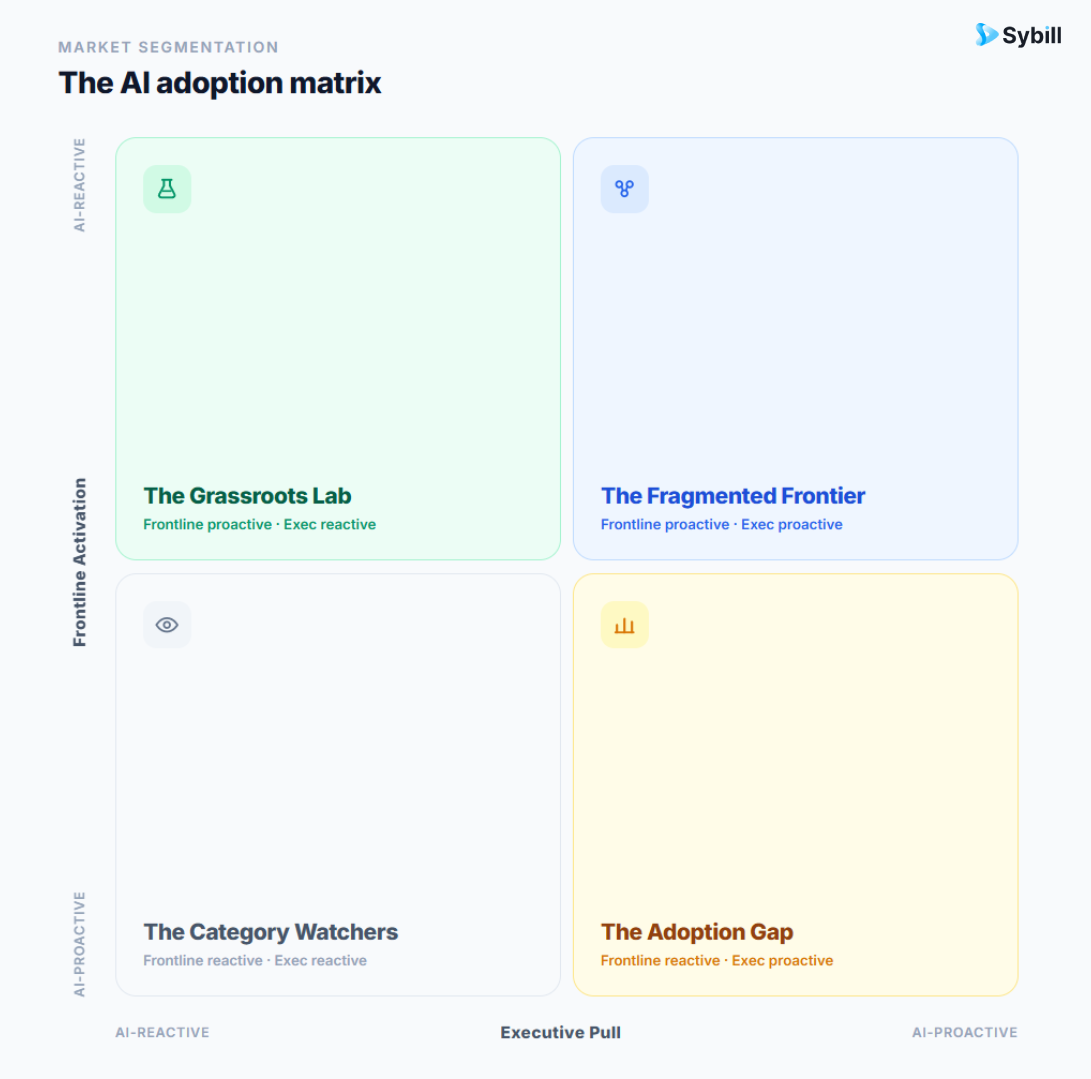
The matrix maps organizations across two dimensions.
The horizontal axis measures Executive Pull: how actively leadership is sponsoring, funding, and redesigning work around AI. Not whether they like the idea, but whether they are setting expectations, connecting AI to measurable outcomes, and changing how the company operates.
The vertical axis measures Frontline Activation: how consistently employees use AI in the work they do every day. "Proactive" here does not mean someone has a ChatGPT account. It means AI has become part of a repeatable workflow. People know when to use it, trust it enough to act on the output, and can connect that output to a business result.
Cross those two axes and four distinct organizational states appear. Most companies assume they are further along than they are, because leadership enthusiasm gets mistaken for organizational readiness. They are not the same thing, and conflating them is exactly how rollouts fail.
Proactive leadership, proactive team
This is the quadrant every company wants to claim.
Leadership is experimenting. The team is experimenting. Everyone has a preferred model, a private prompt library, and an automation they are excited to demonstrate.
Picture a fast-growing startup with a relatively small GTM organization. The CRO is building an agent to inspect pipeline. RevOps is connecting APIs. Reps are developing their own account-research and follow-up workflows. Managers are creating custom deal-review assistants.
The energy is real. The iteration is fast. People are getting value.
Then the hidden cost appears.
Every rep has built a different workflow. Everyone prompts differently. Important context about accounts, buyers, objections, and deals lives across private chat histories, personal documents, one-off automations, and individual memories.
The “AI system” is actually 30 incompatible systems wearing a trench coat.
When a successful workflow remains private, the organization does not benefit from it. When a rep leaves, part of the company’s AI capability may leave with them. When a new employee joins, they reconstruct the same context from zero.
The organization may be gaining individual productivity without becoming collectively smarter.
General-purpose models are widely available. The durable advantage comes from the company-specific context surrounding its customers, conversations, sales process, objections, relationships, and winning behaviors.
When every employee repeatedly rebuilds that context, the company keeps paying to teach AI who it is.
Ten smart reps with ten private AI systems do not create an AI-native organization.
They create ten islands.
The answer is not to shut down experimentation or force every employee into one rigid workflow.
It is to create a shared context layer underneath that experimentation.
Customer conversations, CRM records, email activity, deal history, stakeholder information, commitments, objections, and successful plays should contribute to a common organizational memory. People should still be free to experiment at the edges, but they should not have to reconstruct the foundation every time.
This is where a well-designed revenue intelligence platform can turn scattered workflows into a shared source of deal truth.
The mandate for this quadrant is:
Unify the context. Preserve the experimentation.
Reactive leadership, proactive team
This was labeled the “unlikely scenario” in the original version of the matrix. A more accurate description may be that it is often an invisible scenario.
Employees are already using AI, but leadership has not yet made it an organizational priority.
An SDR uses it for account research. A marketer drafts campaign variations. A sales engineer analyzes transcripts. A RevOps employee has quietly automated part of a weekly reporting process.
The company has AI activity, but it does not yet have an AI strategy.
Because leadership is not actively involved, the workflows remain informal. There may be no approved toolset, shared methodology, training, security guidance, or process for turning a successful personal experiment into an organizational capability.
The person who discovers a better workflow benefits.
The rest of the company may never know it exists.
Leadership may believe the organization is barely using AI while employees are already moving customer or company information through a collection of unapproved tools.
That creates obvious governance concerns. It also creates a quieter problem: useful experiments do not compound.
Grassroots adoption can generate valuable insights, but without executive sponsorship, budget, and shared infrastructure, it often loses momentum when priorities change.
Leadership should begin with discovery rather than restriction.
Find out how employees are already using AI. Identify which workflows are saving meaningful time or improving outcomes. Locate the internal champions who understand both the technology and the job being performed.
Then create sensible boundaries around tools, data, permissions, review, and risk.
The goal is not to centralize every experiment immediately. It is to make the best experiments visible, repeatable, and safe.
The mandate for this quadrant is:
Harness the energy. Add sponsorship and governance.
Proactive leadership, reactive team
This is the state I encounter most often.
Leadership understands that AI will reshape the revenue organization. The CRO is testing sophisticated workflows, running cross-deal analysis, and thinking about systems that can identify expansion opportunities, map relationships, monitor pipeline, and advance deals.
The team is several steps behind.
Reps may have become comfortable with meeting notes or an occasional AI-drafted follow-up. Managers may have access to new dashboards without changing how they run pipeline reviews. Employees attend an AI training session, try a few prompts, and then return to the workflows they already know.
The organization has executive ambition without corresponding behavioral change.
Leaders see what the newest models can do and assume the organization can jump directly to the most advanced use cases.
But a technically impressive workflow is not necessarily an adoptable workflow.
For a seller, AI adoption is not an abstract transformation program. It is a practical question:
Does this remove work from my day, or does it give me another system to manage?
The instinct of an AI-proactive leader is often to hand the team the same open-ended tools they personally enjoy.
That is usually the wrong entry point.
Most reps did not sign up to become prompt engineers. Asking an AI-reactive team to maintain complex instructions, switch between several tools, or repeatedly supply missing context produces inconsistent results and low adoption.
Start with discrete, painful, high-frequency jobs:
AI should enter through the workflow, not through a blank text box.
This is where purpose-built AI sales tools can provide the most value. The objective is not to eliminate all learning or change management. It is to minimize the new behavior required from the rep.
A useful implementation might automatically prepare a meeting brief, generate structured notes, complete relevant CRM updates, and draft a contextual follow-up email.
The first workflows should create an obvious benefit for the employee while improving visibility for the organization.
Once the team trusts AI with small, observable tasks, more sophisticated workflows become much easier to introduce.
The mandate for this quadrant is:
Embed AI into existing work and earn trust one workflow at a time.
Reactive leadership, reactive team
Neither leadership nor the broader team has meaningfully adopted AI.
The organization may be waiting for proven category winners, more reliable technology, clearer security assurances, or evidence from comparable companies. In some cases, leaders are still debating whether customer calls should be recorded at all.
There is nothing inherently irrational about moving carefully. The market is noisy, and many products marketed as AI are still features searching for a durable workflow.
But waiting has a hidden cost.
AI systems become more useful when they can work from reliable organizational context. If customer interactions are not captured, CRM data is incomplete, and knowledge remains scattered across inboxes and employees’ memories, the company is not only delaying software adoption.
It is delaying the creation of the foundation future AI will require.
An organization cannot move directly from undocumented customer conversations to dependable autonomous execution.
Agents operating without complete and current context do not automate good judgment.
They automate assumptions.
While the company waits for a perfect solution, more advanced organizations are accumulating structured customer history and learning how to incorporate AI into their workflows.
That advantage compounds.
Begin with the least glamorous layer: capture.
Record customer conversations appropriately. Connect relevant email, calendar, and CRM activity. Make meeting outcomes, commitments, objections, stakeholders, and next steps accessible.
Then automate the administrative work surrounding that information.
Do not begin by buying the most advanced system available and attempting to deploy everything at once. Establish the foundation, prove value, and move upward deliberately.
The mandate for this quadrant is:
Capture the work. Build the foundation.
The matrix answers one question:
Who inside the organization is pulling toward AI?
It does not tell you what technology to deploy first.
For that, revenue teams need a maturity ladder.
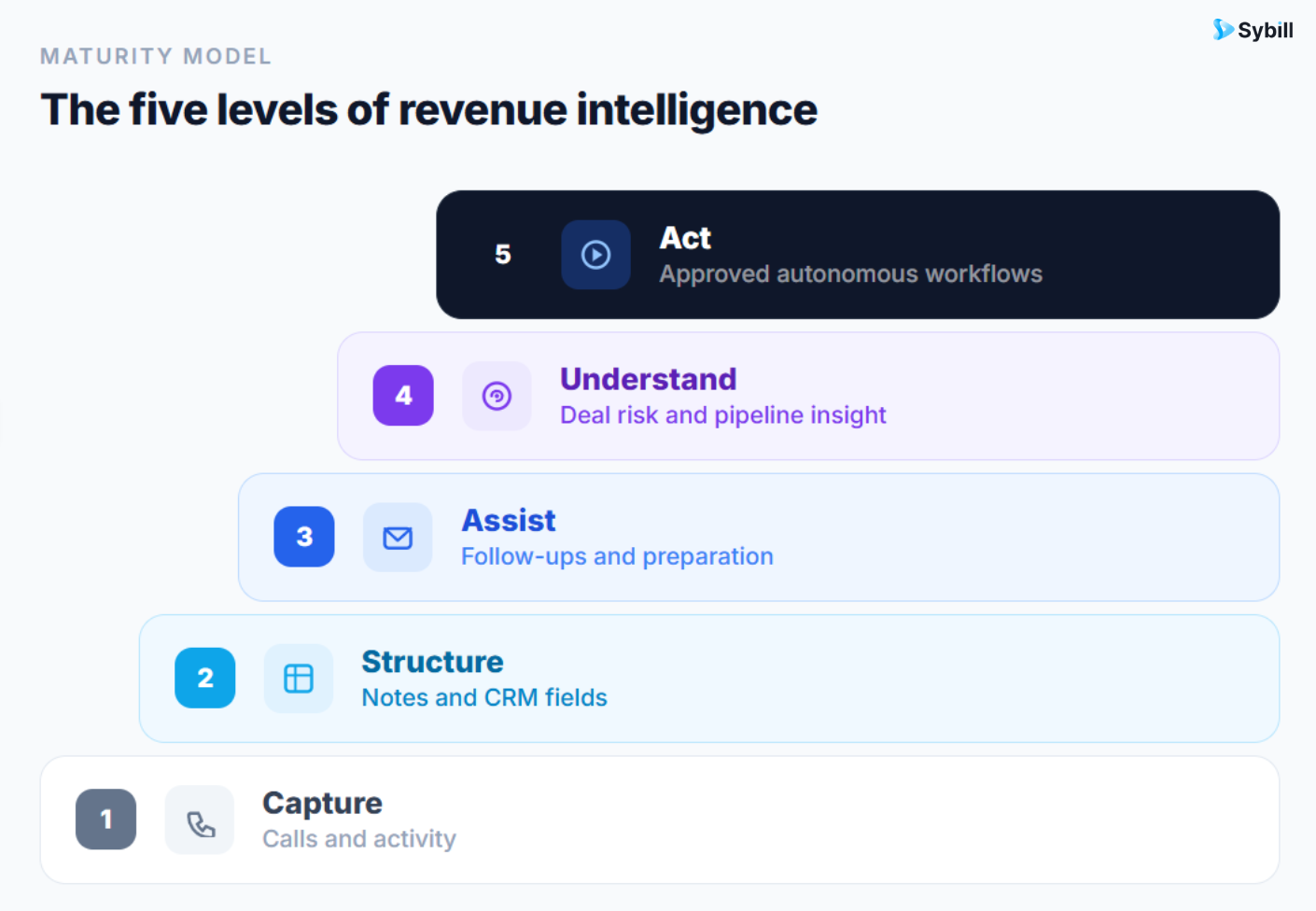
For conversation-led B2B revenue organizations, the visible progression often looks like this:
Call recording → Auto-notes → AI emails → Deal intelligence → Agentic workflows
A more durable way to describe the underlying stages is:
Capture → Structure → Assist → Understand → Act
The first step is creating reliable organizational memory.
For a conversation-led sales organization, that usually begins with call recording. It can also include email activity, calendar events, CRM changes, product signals, and other relevant buyer interactions.
You cannot analyze what you do not capture.
Without this layer, every workflow begins with partial information. Important details remain inside employees’ memories, private notes, and disconnected systems.
Raw information must be converted into usable context.
That includes meeting summaries, action items, objections, qualification data, CRM fields, stakeholder roles, commitments, and next steps.
Capture tells the organization what happened.
Structure makes what happened usable by people and systems.
This is also where many teams experience their first obvious AI benefit: fewer manual notes, less administrative work, and more consistent CRM data.
Once information is captured and structured, AI can begin helping employees perform recurring work.
That includes meeting preparation, contextual follow-ups, CRM administration, account research, task creation, and sales collateral.
This is where frontline trust is usually built.
Employees see AI removing work rather than creating another obligation. The value is visible, the output is reviewable, and mistakes are relatively easy to correct.
With enough reliable context, AI can reason across multiple interactions, accounts, and opportunities.
It can help teams inspect deals, identify risks, understand account relationships, detect patterns, support coaching, and surface the next best action.
At this stage, AI moves from individual productivity into revenue and deal intelligence.
The organization is no longer asking only, “Can AI write this email?”
It is asking, “What is happening across our pipeline, and what should we pay attention to?”
Only after the previous layers are sufficiently reliable should an organization delegate meaningful execution to agents.
Agents can then perform approved tasks, monitor changes, coordinate workflows, prepare assets, and take action across systems within defined permissions.
This does not mean every decision becomes autonomous. It means the system has enough context, structure, and governance to act safely within a clearly defined scope.
The precise entry point may vary by GTM motion. An outbound SDR team might begin with research and email assistance. A product-led company may start with usage signals. A customer-success organization may begin with account-health data.
But the dependency remains:
Capture before intelligence. Intelligence before autonomy.
Trying to deploy autonomous workflows before the underlying context exists is like building the fifth floor of a building without constructing the first four.
The demo may look impressive.
The operating system will be fragile.
An organization can have proactive leadership.
It can have proactive employees.
It can still fail to create compounding value from AI.
The missing dimension is context coherence: whether people, systems, and agents are operating from the same current understanding of the customer and deal.
Without it, the same buyer may be described differently in CRM, meeting notes, private prompts, and leadership reports. One workflow knows about a pricing objection. Another does not. One rep has mapped the buying committee. That knowledge is invisible to the rest of the organization.
A unified system of context does not require every employee to use the same interface.
It means the relevant workflows draw from a shared, current, and appropriately permissioned body of customer knowledge.
Context should be captured once and made useful throughout the revenue process. It should persist when employees change roles or leave the organization. It should become more valuable as more interactions take place.
That is what turns isolated AI activity into an organizational advantage.
It is also the core product thesis behind Sybill: AI should not begin with a blank prompt box. It should begin with the customer context already being created through calls, emails, CRM activity, and ongoing deal execution.
The model may change.
The context should compound.
Start by plotting where your organization actually sits, not where leadership wants it to be.
Ask:
Executive enthusiasm alone does not qualify as proactive leadership. There must be repeated behavior, ownership, and investment.
Ask:
Having access to an AI tool is not the same as adopting it.
Ask:
The first two assessments place you on the matrix.
The third determines whether your AI activity can compound.
Once you know your quadrant, identify the highest maturity stage your organization has adopted consistently - not the most advanced tool anyone has tested.
Your next move is usually one rung above that.
An AI-native revenue organization is not one in which every employee spends the day writing increasingly elaborate prompts.
The goal is not maximum AI activity.
The goal is better execution.
In a mature organization, customer context is captured once and made useful throughout the revenue process. Routine administrative work happens automatically. Employees receive assistance inside the workflows they already use. Leaders and reps operate from the same evidence. Successful patterns spread across the team.
AI becomes less visible even as it becomes more valuable.
Most organizations are still somewhere in the middle of this transition. Some have executive ambition but limited frontline adoption. Others have significant experimentation but no shared system through which the learning can compound.
The answer is not to boil the ocean.
Find your quadrant.
Identify the next rung of the ladder.
Build the context required to support it.
Then move one workflow at a time.
That is the difference between an AI strategy and an AI graveyard.
See how Sybill helps revenue teams capture customer context and turn it into notes, follow-ups, CRM updates, and deal intelligence - without requiring every rep to become a prompt engineer.
It is a two-by-two framework that maps an organization's Executive Pull (how actively leadership sponsors and funds AI) against its Frontline Activation (how consistently employees use AI in daily work). The four states are the Fragmented Frontier (both proactive), the Grassroots Lab (reactive leadership, proactive team), the Adoption Gap (proactive leadership, reactive team), and the Category Watchers (both reactive). It exists because companies do not adopt AI as a single unit; leadership and frontline teams usually move at very different speeds.
Because they face different incentives and risks. Leadership sees strategic leverage and is rewarded for betting early. Frontline employees see another change to an already busy workflow and ask whether it removes work or adds another system to manage. That gap is normal, but when it goes unmanaged it stalls rollouts, which is why diagnosing both axes separately matters.
Capture, then Structure, then Assist, then Understand, then Act. Capture creates organizational memory from calls and emails. Structure turns it into usable context like summaries and CRM fields. Assist helps reps with prep, follow-ups, and updates. Understand reasons across deals for risk and coaching. Act delegates execution to agents. Skipping rungs fails because autonomous agents need intelligence, and intelligence needs captured, structured context to reason over.
Leadership pulling harder than the organization can follow. An AI-proactive executive often wants agentic workflows immediately, but if the team is still getting comfortable with AI-drafted notes, jumping to autonomous agents produces low adoption and expensive failure. The fix is to meet the team where it is and move up the ladder deliberately.
Generic models are broadly available, so the model itself is not a durable advantage. The advantage is company-specific context: customers, objections, buying processes, and the plays that win. When every employee rebuilds that context privately, the value fragments and walks out the door with departing reps. A shared system of context lets that knowledge compound across the team, which is what turns individual AI productivity into organizational intelligence.
It is a two-by-two framework that maps an organization's Executive Pull (how actively leadership sponsors and funds AI) against its Frontline Activation (how consistently employees use AI in daily work). The four states are the Fragmented Frontier (both proactive), the Grassroots Lab (reactive leadership, proactive team), the Adoption Gap (proactive leadership, reactive team), and the Category Watchers (both reactive). It exists because companies do not adopt AI as a single unit; leadership and frontline teams usually move at very different speeds.
Because they face different incentives and risks. Leadership sees strategic leverage and is rewarded for betting early. Frontline employees see another change to an already busy workflow and ask whether it removes work or adds another system to manage. That gap is normal, but when it goes unmanaged it stalls rollouts, which is why diagnosing both axes separately matters.
Capture, then Structure, then Assist, then Understand, then Act. Capture creates organizational memory from calls and emails. Structure turns it into usable context like summaries and CRM fields. Assist helps reps with prep, follow-ups, and updates. Understand reasons across deals for risk and coaching. Act delegates execution to agents. Skipping rungs fails because autonomous agents need intelligence, and intelligence needs captured, structured context to reason over.





.avif)
