Find us at booth #83, join us for a harbor side happy hour, or catch Gorish’s talk.

Sept, 16-18 > Learn more

%20(1).avif)
Mamta Tainwala

May 26, 2026
.png)
Revenue intelligence is the practice of using AI to capture, analyze, and act on data from sales conversations, buyer interactions, and pipeline activity to improve deal execution, forecasting accuracy, and revenue predictability. Unlike traditional CRM reporting, which shows what reps entered into the system, revenue intelligence surfaces what actually happened in deals by analyzing call recordings, email threads, meeting patterns, and engagement signals automatically.
The leading revenue intelligence platforms in 2026 include Sybill, Clari (now merged with Salesloft), People.ai, Gong and several newer entrants. Gartner published its first Magic Quadrant for Revenue Action Orchestration in December 2025, formally recognizing the convergence of previously separate sales engagement, conversation intelligence, and revenue intelligence categories into a unified discipline. The category is estimated at $1.2 billion in 2024 and growing at approximately 13% annually.
The core promise of revenue intelligence is straightforward: replace gut-feel selling and self-reported CRM data with evidence-based deal management and AI-powered forecasting. Whether that promise delivers depends on what the platform actually does after capturing the data, which is where the tools diverge significantly.
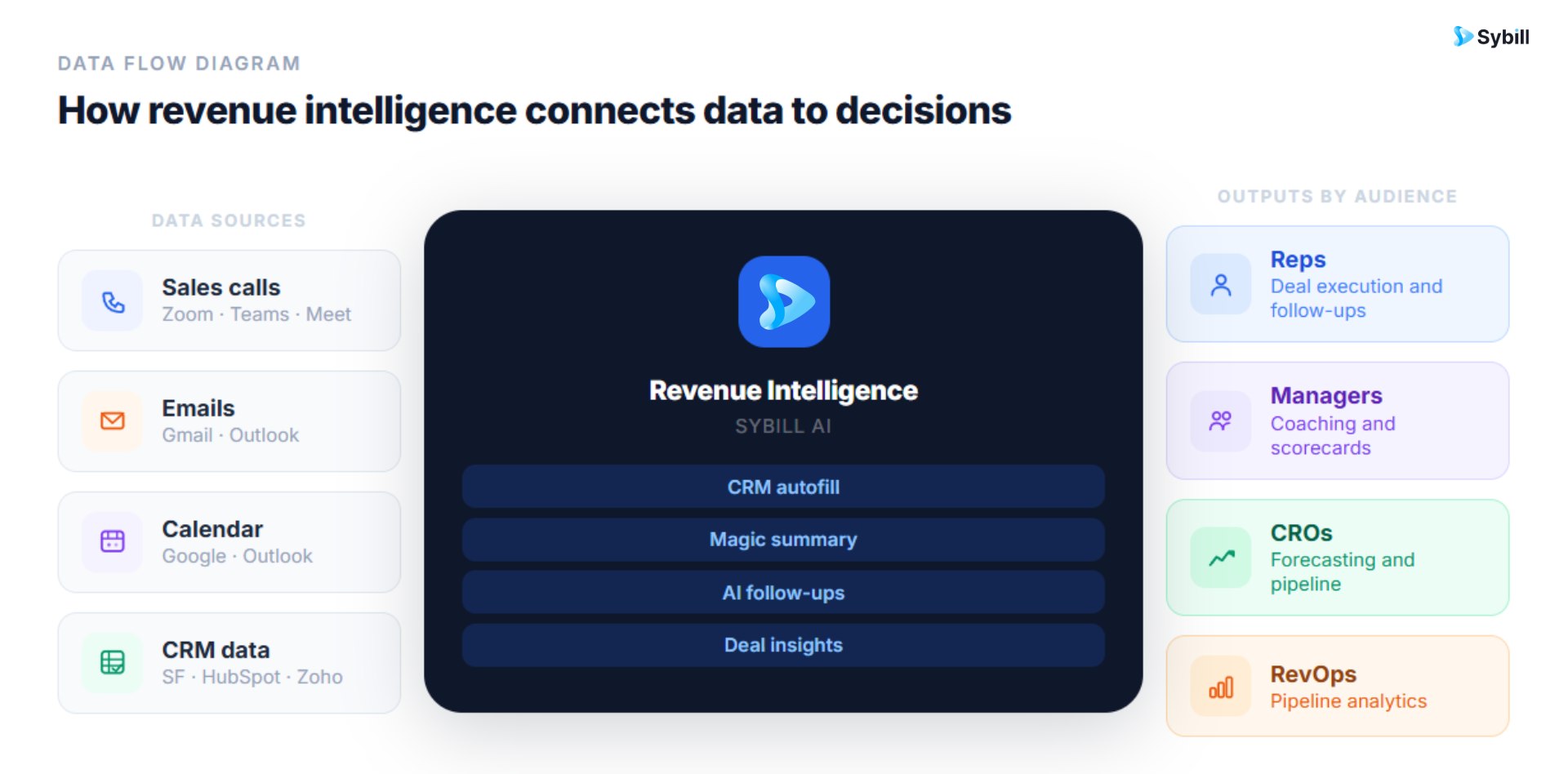
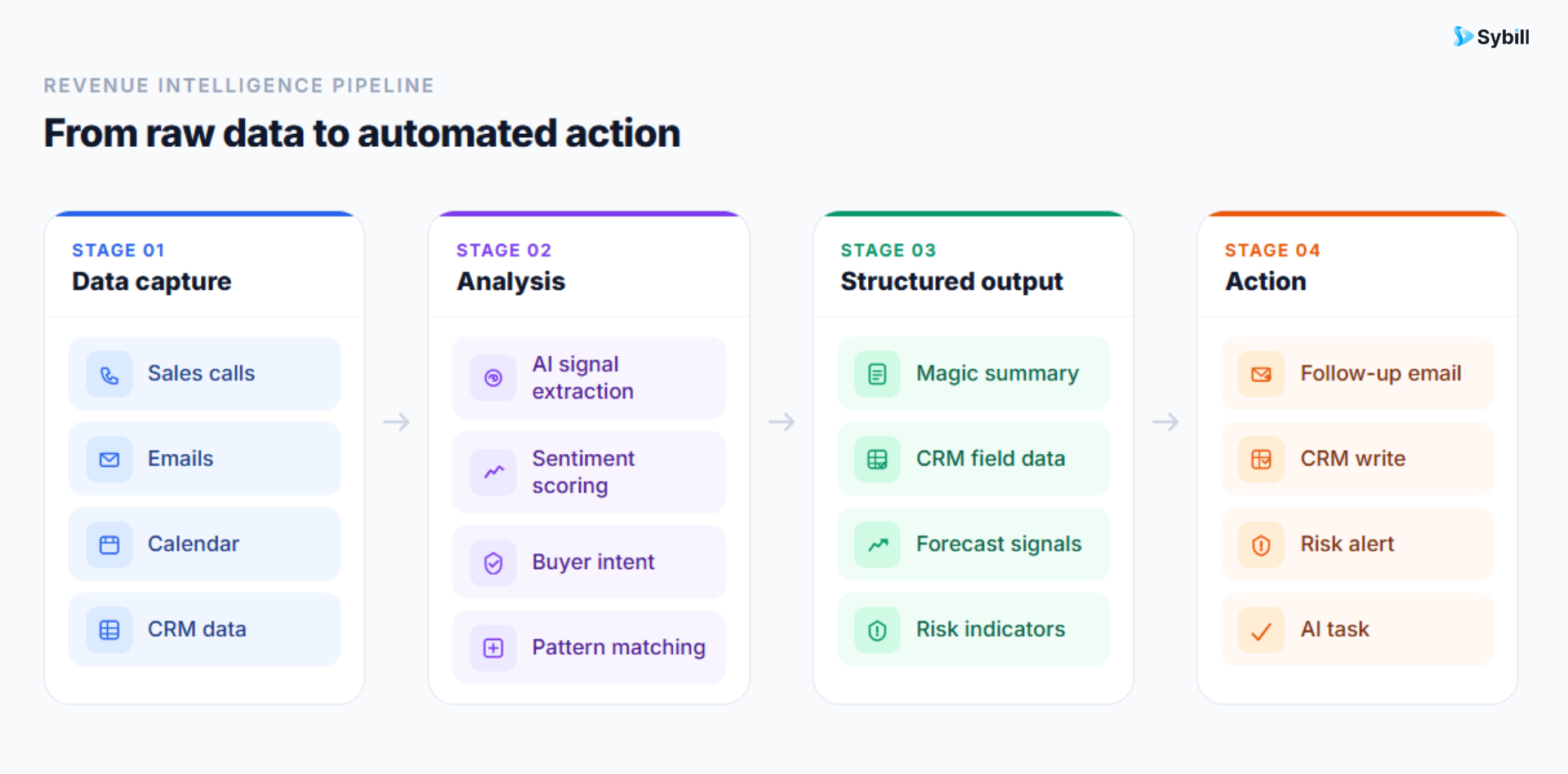
Revenue intelligence platforms operate on a four-stage process. Understanding each stage clarifies what separates genuine revenue intelligence from tools that rebrand basic call recording or CRM reporting as something more sophisticated.
The foundation of revenue intelligence is comprehensive data capture across every buyer touchpoint. This includes call recordings and transcriptions from video meetings (Zoom, Teams, Google Meet), phone calls, and increasingly in-person meetings. It also includes email metadata and content (response times, thread depth, stakeholder engagement, sentiment), calendar signals (meeting frequency, attendee changes, scheduling patterns), and CRM data (deal stages, amounts, field history, activity logs).
The critical difference between revenue intelligence and traditional sales reporting starts here. Traditional reporting relies on data reps manually enter into the CRM. Revenue intelligence captures data automatically from the interactions themselves, which means it works even when reps do not update Salesforce after every call. According to research cited by Validity, up to 79% of deal-related data collected by sales reps never makes it into the CRM. Revenue intelligence fills that gap by capturing directly from the source.
Raw data from calls, emails, and meetings is not intelligence. The analysis layer transforms recordings and activity logs into structured insights.
On the conversation intelligence side, this means extracting buyer signals (pain points mentioned, budget discussed, timeline confirmed, decision criteria stated), identifying objection patterns and competitive mentions, measuring engagement indicators (talk-to-listen ratios, question depth, multi-stakeholder involvement), and detecting risk signals (declining engagement, unresolved objections, missing decision-makers).
On the pipeline intelligence side, this means scoring deal health based on multi-channel engagement patterns, identifying deals where activity has stalled or stakeholders have disengaged, comparing deal progression against historical win and loss patterns, and flagging qualification gaps where key criteria (like confirmed economic buyer or quantified pain) have not been established.
Analysis without structured output is a dashboard nobody acts on. This stage translates insights into formats that integrate with existing workflows.
For reps, this means structured call summaries, automatic CRM field updates, follow-up email drafts, and pre-meeting context briefs. For managers, it means coaching recommendations tied to specific call moments, rep performance patterns across conversations, and deal-level risk alerts. For CROs and RevOps, it means pipeline health assessments, forecast models grounded in conversation evidence, and segment-level performance analytics.
The depth and quality of this output is where revenue intelligence platforms diverge most dramatically. Some platforms produce analytics dashboards that leadership consumes weekly. Others automate the post-call execution workflow that reps interact with after every single conversation.
The newest and most consequential layer of revenue intelligence is automated action. Rather than surfacing insights and expecting humans to act on them, leading platforms execute the follow-through automatically.
Sybill's CRM Autofill writes structured updates into 30 or more CRM fields after every call and email. AI follow-up emails draft in the rep's tone within minutes. Next steps are identified and tracked automatically. Pre-meeting briefs assemble context from CRM and past interactions before each call. Deal risk alerts surface before deals go cold.
This action layer is what separates revenue intelligence from revenue analytics. Analytics tells you what happened. Intelligence tells you what to do about it. Automation does it for you.
Revenue intelligence is frequently confused with adjacent categories. The distinctions matter because they determine what a tool actually does for your team.
A CRM is a system of record. It stores deal data, contact information, and activity history. Revenue intelligence is a system of action built on top of the CRM. It captures data the CRM misses (because reps did not enter it), analyzes patterns the CRM cannot detect (because it lacks AI), and automates workflows the CRM does not execute (because it was not designed to).
Revenue intelligence does not replace your CRM. It makes your CRM accurate and useful by filling it with data from actual buyer interactions rather than relying on rep memory and manual entry. Sybill, Gong, Clari, and every other platform in this category integrates with Salesforce, HubSpot, or both.
Conversation intelligence is a subset of revenue intelligence. CI platforms record, transcribe, and analyze sales calls to surface coaching insights and deal signals. Revenue intelligence is broader. It combines conversation data with email activity, calendar signals, CRM history, and sometimes external data to provide a complete picture of deal health and pipeline trajectory.
In practice, the boundary has blurred significantly. Gong started as conversation intelligence and repositioned as revenue intelligence. Clari started as pipeline analytics and added conversation intelligence through Copilot. Sybill covers both and adds the execution layer. The category labels matter less than the capabilities.
Sales engagement platforms (Outreach, Salesloft) automate outbound activity: email sequences, call cadences, and task management. They help reps do more outreach more efficiently. Revenue intelligence analyzes what happens during and after the interactions that engagement platforms generate. The Clari-Salesloft merger in December 2025 reflects the market's recognition that engagement and intelligence need to be unified.
Sales analytics platforms produce reports and dashboards from historical CRM data. They tell you what happened last quarter. Revenue intelligence is forward-looking. It predicts what will happen this quarter based on current buyer behavior, conversation signals, and engagement patterns. Analytics is descriptive. Revenue intelligence is predictive and prescriptive.
Revenue intelligence has existed as a concept since the late 2010s, when Gong and Chorus began recording and analyzing sales calls at scale. Three developments in 2025 and 2026 have made it essential rather than optional.
In December 2025, Gartner published its first Magic Quadrant for Revenue Action Orchestration, formally recognizing the convergence of sales engagement, conversation intelligence, and revenue intelligence into a unified category. Clari was named a Leader and Salesloft a Visionary. Gong was recognized as a Leader placed highest on both completeness of vision and ability to execute. This formalization signals to enterprise buyers that revenue intelligence is no longer an emerging category but established infrastructure for modern sales organizations.
The gap between what happens in deals and what appears in CRM records has not improved despite two decades of CRM adoption. Validity's 2025 report found that 76% of organizations say less than half their CRM data is accurate and complete. Gartner research shows only 7% of sales organizations achieve forecast accuracy of 90% or higher. Revenue intelligence platforms that automatically capture and structure deal data from conversations are the most practical solution to a problem that manual discipline has consistently failed to solve.
The first generation of revenue intelligence (2018 to 2023) focused on analysis: recording calls, surfacing insights, displaying dashboards. The current generation focuses on execution: writing CRM updates, drafting follow-ups, tracking next steps, and flagging risks automatically. This shift matters because insights without action produce no ROI. A coaching recommendation that sits unread in a dashboard does not improve close rates. A CRM field that auto-populates after every call with accurate deal data does.
The revenue intelligence landscape includes enterprise incumbents, mid-market challengers, and AI-native startups. Here is where each leading platform sits, what it does best, and where it falls short.
Positioning: AI-powered revenue intelligence platform built around post-call execution.
Core strengths: Sybill occupies a unique position in the landscape. Rather than leading with analytics dashboards for leadership (Gong's strength) or pipeline forecasting for CROs (Clari's strength), Sybill leads with the execution layer that makes both analytics and forecasting work: accurate, automated CRM data from every conversation.
CRM Autofill writes structured updates into 30 or more fields in Salesforce, HubSpot, Zoho, or Dynamics 365 after every call and email. Magic Summary generates structured call outputs within minutes. AI follow-up emails draft in the rep's voice. Pre-meeting briefs assemble deal context automatically. Ask Sybill enables cross-deal querying in natural language. The deal workspace provides pipeline visibility grounded in conversation evidence. In-person meeting capture through the native mobile app extends coverage beyond virtual calls.
Pricing: Essentials at $19 per user per month. Business at $79 per user per month. No minimum seats. No annual contract. Same-day deployment.
Best for: Sales teams from 5 to 200 reps that want every call to produce complete CRM data, automated follow-ups, and deal intelligence without requiring RevOps infrastructure or enterprise budgets. Teams running MEDDPICC, BANT, SPICED, or custom qualification frameworks.
Where it trades off: Sybill does not have the enterprise-scale benchmarking data that Gong has accumulated from billions of interactions, nor does it provide the board-level forecasting depth of Clari's dedicated pipeline management modules. For organizations with 500-plus reps and dedicated RevOps teams, these capabilities may justify the additional cost of enterprise platforms.
For a deeper comparison of all platforms in this category, see the full revenue intelligence platforms comparison.
Positioning: End-to-end revenue orchestration platform combining pipeline forecasting, sales engagement, and conversation intelligence.
Core strengths: The Clari-Salesloft merger, closed in December 2025, created what the companies describe as the largest Revenue AI company in the category. Clari brings best-in-class pipeline forecasting, deal inspection, and revenue management. Salesloft brings sales engagement (sequencing, cadences, task management) and workflow automation. Combined, they offer the broadest platform spanning from outbound engagement through pipeline analytics to board-level forecasting.
Gartner named Clari a Leader and Salesloft a Visionary in the inaugural Magic Quadrant for Revenue Action Orchestration. Enterprise customers include Adobe, IBM, 3M, and Zoom.
Pricing: Custom enterprise pricing for both Clari and Salesloft. Typically opaque and requires sales conversations. Industry estimates for Clari range from $68 to $175 per user per month depending on modules.
Best for: Enterprise revenue teams (200-plus reps) that need unified engagement and pipeline management under a single vendor. CROs and RevOps leaders who prioritize forecast accuracy and pipeline inspection as the primary revenue intelligence use case. Organizations committed to replacing fragmented point solutions with one end-to-end platform.
Where it falls short: The merger is recent, and full platform integration is still evolving. Clari's conversation intelligence (via Copilot) is not as deep as Gong's, and its CRM automation does not match Sybill's field-level autofill. Enterprise pricing and implementation complexity make it inaccessible for most mid-market and startup teams.
Positioning: Activity capture and revenue operations intelligence for enterprise teams.
Core strengths: People.ai specializes in automatically capturing seller activity from email, calendar, Zoom, Teams, and Slack, then using AI-powered activity-to-deal matching (backed by 49 patents) to map interactions to accounts and opportunities in the CRM. It excels at giving RevOps and leadership visibility into rep activity without requiring reps to log anything manually.
Pricing: Enterprise pricing. Not publicly listed.
Best for: Large enterprise organizations (500-plus reps) that need comprehensive activity capture and CRM enrichment as the foundation for pipeline analytics. Teams where the primary gap is knowing how much activity is happening on each deal, not what was said in each conversation.
Where it falls short: People.ai captures activity metadata (who called whom, how many emails were sent, which meetings occurred) but does not provide the conversation-level intelligence (what was said, what objections were raised, how the buyer responded) that conversation intelligence platforms deliver. It is a complementary layer, not a standalone revenue intelligence solution for teams that need coaching and deal execution insights.
Positioning: Revenue AI operating system for enterprise sales organizations.
Core strengths: Gong is the conversation intelligence market leader, with over $300 million in ARR and a Revenue Graph trained on 3.5 billion-plus sales interactions across 70-plus languages. It was named a Leader in Gartner's inaugural Magic Quadrant for Revenue Action Orchestration, placed highest on both completeness of vision and ability to execute. Gong's AI Briefer, call analytics, coaching libraries, and deal risk scoring set the standard for enterprise conversation intelligence.
In 2026, Gong expanded from conversation intelligence to a full engagement platform with Gong Engage, adding coaching capabilities and MCP (Model Context Protocol) support spanning Dynamics 365, Salesforce Agentforce, and HubSpot CRM. AI Data Extractor upgrades added date extraction, email and call support, and in-app refinement.
Pricing: Core Gong runs approximately $100 to $150 per user per month for mid-market. Engage adds additional per-seat cost. Platform fees of $5,000 to $50,000 annually. Annual contracts required. Full pricing analysis.
Best for: Enterprise sales organizations (100-plus reps) with dedicated RevOps teams that need the deepest conversation analytics, cross-organizational benchmarking, and leadership-level pipeline reporting. Organizations where the primary buyer is the CRO or VP of Sales who needs visibility across a large, complex sales org.
Where it falls short: Gong's pricing structure is prohibitive for startups and mid-market teams. The 2025 pricing restructure unbundled features like forecasting and engagement into separate paid modules. CRM automation depth (structured field autofill) lags behind purpose-built tools like Sybill. Implementation timelines of 8 to 24 weeks are misaligned with startup velocity.
Revenue.io provides real-time conversation guidance and AI coaching. Its strength is live call assistance and coaching for phone-based sales teams, particularly those using Salesforce as their primary CRM.
Avoma combines meeting intelligence, conversation analytics, and revenue intelligence features in a single mid-market-friendly platform. It includes meeting scheduling, which eliminates a separate tool. Its CRM automation is moderate, filling fewer structured fields than Sybill.
Chorus by ZoomInfo provides conversation intelligence bundled within the ZoomInfo ecosystem. It is strongest for teams already using ZoomInfo for prospecting data and wanting conversation analytics that connects directly to account and contact intelligence.
HubSpot Sales Hub offers CRM-native revenue intelligence for teams already in the HubSpot ecosystem. Forecasting, analytics, and conversation intelligence features are built directly into the CRM, eliminating integration complexity. Revenue intelligence capabilities are strongest in Professional and Enterprise tiers.
Salesforce Einstein and Agentforce provide native AI within Salesforce, including predictive scoring, deal summarization, and pipeline management. Agentforce adds autonomous agent capabilities for managing pipeline updates. The limitation is that Einstein operates on data already in Salesforce and cannot capture external meeting data.
Three trends are shaping how revenue intelligence will evolve through 2026 and beyond.
The current generation of revenue intelligence surfaces insights and automates some execution (CRM updates, follow-up emails). The next wave will move toward fully autonomous revenue agents that manage deal workflows end-to-end: identifying risk, recommending intervention strategies, executing outreach, and adjusting forecasts in real time. Gong's MCP integration, Clari's vision for Predictive Revenue Systems, and Sybill's agentic approach to post-call execution all point in this direction.
The Clari-Salesloft merger is the first major consolidation event, but it will not be the last. Gartner's new Revenue Action Orchestration category explicitly encompasses what were previously separate markets (sales engagement, conversation intelligence, revenue intelligence). Buyers increasingly want one platform rather than three, and vendors are responding through acquisitions, feature expansion, and repositioning. The standalone conversation intelligence tool that only records and transcribes calls is becoming a commodity.
Revenue intelligence is accelerating the shift away from the CRM as the primary interface reps use. Instead, the CRM becomes a data layer that revenue intelligence platforms write to and read from automatically, while reps interact with AI-powered workflows that sit on top. Sybill already operates this way: reps interact with Magic Summaries, follow-up emails, and pre-meeting briefs rather than logging into Salesforce to type notes. The CRM stays accurate because AI handles the data entry. Salesforce's own Agentforce strategy reflects this same trajectory.
Revenue intelligence is only as useful as what it does after your next call. Connect Sybill to your CRM, take a call, and see a structured summary, 30-plus CRM field updates, a follow-up email draft, and deal intelligence, all before your next meeting starts.
Start free with Sybill and experience revenue intelligence that executes, not just analyzes.
Revenue intelligence is the practice of using AI to capture, analyze, and act on data from sales conversations, buyer interactions, and pipeline activity. It provides sales teams with evidence-based insights into deal health, forecast accuracy, and pipeline trajectory by analyzing call recordings, email threads, meeting patterns, and CRM data automatically. The goal is to replace gut-feel decisions and incomplete CRM data with verified, actionable intelligence that improves revenue outcomes.
A CRM is a system of record that stores deal data, contact information, and activity history based on what reps enter manually. Revenue intelligence is a system of action that captures data automatically from buyer interactions (calls, emails, meetings), analyzes it using AI, and writes structured insights back into the CRM. Revenue intelligence does not replace the CRM. It makes the CRM accurate and useful by filling it with data from actual conversations rather than relying on rep memory.
The leading platforms serve different primary use cases. Sybill leads for post-call execution automation (CRM autofill, follow-up emails, deal intelligence) at accessible pricing. Gong leads for enterprise conversation analytics, coaching, and cross-organizational benchmarking. Clari plus Salesloft leads for pipeline forecasting and end-to-end revenue orchestration. People.ai leads for activity capture and CRM enrichment. Avoma serves mid-market teams wanting meeting intelligence and moderate CI features. The right choice depends on your team size, primary pain point, and budget. See the full platform comparison for details.
Revenue intelligence platform pricing ranges from free (basic meeting transcription) to over $500 per user per month (enterprise Salesforce with Agentforce). Sybill starts at $19 per user per month for Essentials and $79 for full Business capabilities with no minimum seats. Gong costs $100 to $150 or more per user per month plus platform fees. Clari uses custom enterprise pricing. The total cost of ownership should include licensing, platform fees, implementation costs, and ongoing admin overhead, which varies significantly across platforms.
If your CRM data is accurate, your reps consistently update fields after every interaction, your forecasts are within 10% accuracy, and your managers have clear visibility into deal health, you may not need a standalone revenue intelligence platform. In practice, most organizations struggle with all four. If your CRM is chronically incomplete, your forecast is regularly off, or your managers coach from gut feeling instead of conversation evidence, revenue intelligence addresses the root cause by automating data capture and analysis from the source.
Revenue intelligence improves forecasting by grounding predictions in conversation evidence rather than rep self-reporting. When deal qualification fields like MEDDPICC criteria are auto-populated from actual call data, managers can weight pipeline based on verified evidence. Deals with confirmed economic buyer, quantified pain, and mapped decision process close at predictable rates. Deals without that evidence do not. Teams using AI-populated qualification data report forecast accuracy improvements from the 60 to 70% range to above 85%.
In December 2025, Gartner published its first Magic Quadrant for Revenue Action Orchestration, formally recognizing the convergence of sales engagement, conversation intelligence, and revenue intelligence into a unified category. Clari was named a Leader and Salesloft a Visionary in the inaugural report. Gong was also recognized as a Leader. The creation of this category signals to enterprise buyers that revenue intelligence is now established infrastructure for modern sales organizations, not an emerging niche.
Yes, though the value drivers differ by team size. For small teams (under 25 reps), the primary ROI comes from time savings and CRM data quality rather than enterprise forecasting. Platforms like Sybill at $79 per user per month deliver 5 or more hours of weekly time savings per rep through automated CRM updates, follow-up emails, and meeting prep. That productivity recovery alone typically exceeds the platform cost multiple times over. Enterprise-grade analytics and forecasting become increasingly valuable as teams scale past 25 reps.
Revenue intelligence is the practice of using AI to capture, analyze, and act on data from sales conversations, buyer interactions, and pipeline activity. It provides sales teams with evidence-based insights into deal health, forecast accuracy, and pipeline trajectory by analyzing call recordings, email threads, meeting patterns, and CRM data automatically. The goal is to replace gut-feel decisions and incomplete CRM data with verified, actionable intelligence that improves revenue outcomes.
A CRM is a system of record that stores deal data, contact information, and activity history based on what reps enter manually. Revenue intelligence is a system of action that captures data automatically from buyer interactions (calls, emails, meetings), analyzes it using AI, and writes structured insights back into the CRM. Revenue intelligence does not replace the CRM. It makes the CRM accurate and useful by filling it with data from actual conversations rather than relying on rep memory.
The leading platforms serve different primary use cases. Sybill leads for post-call execution automation (CRM autofill, follow-up emails, deal intelligence) at accessible pricing. Gong leads for enterprise conversation analytics, coaching, and cross-organizational benchmarking. Clari plus Salesloft leads for pipeline forecasting and end-to-end revenue orchestration. People.ai leads for activity capture and CRM enrichment. Avoma serves mid-market teams wanting meeting intelligence and moderate CI features. The right choice depends on your team size, primary pain point, and budget. See the full platform comparison for details.